About
Egypt: The Complete Travel Guide for Independent Travelers
Why Visit Egypt
Egypt needs no introduction. Pyramids, pharaohs, the Nile — these words have echoed through classrooms and imaginations worldwide since childhood. But modern Egypt offers far more than textbook images. This is a land of contrasts where ancient temples stand alongside luxury resorts, where camel caravans pass air-conditioned tour buses, and where five millennia of history coexist with the chaos of a twenty-million-person megacity. The coral reefs of the Red Sea are world-class, the Saharan dunes stretch to infinity, and everywhere you turn, the past reaches into the present.
In a single trip, you can witness the only surviving Wonder of the Ancient World, dive among world-class coral reefs, sail the Nile on a traditional felucca, and lose yourself in the labyrinthine bazaars of Cairo. Egypt offers everything: from beach relaxation to intellectual deep-dives into humanity's oldest civilization. You could spend a week at a Red Sea resort and never see a pyramid — or you could visit a different temple, tomb, or museum every day and still barely scratch the surface of what this country contains.
For travelers from the United States, United Kingdom, Australia, and other English-speaking countries, Egypt presents an accessible adventure. Visa-on-arrival for most Western passports, direct flights from major hubs, widespread English in tourist areas, and a tourism industry well-accustomed to international visitors make independent travel straightforward. Yet beneath this accessibility lies a culture fascinatingly different from your own — and that's the real journey.
Egypt welcomes visitors year-round, but each season reveals different facets of the country. Winter (November through February) is ideal for exploring temples and tombs — temperatures hover around 68-77F / 20-25C, perfect for hours of walking through archaeological sites without heat exhaustion. Summer brings brutal heat to Upper Egypt but excellent diving conditions in the Red Sea — water temperatures reach 82-86F / 28-30C with visibility up to 100-130 feet / 30-40 meters. The shoulder seasons (March-April, October-November) offer the best of both worlds: warm but not deadly, fewer crowds than peak winter season. The key is choosing the right region for the right time.
Regions: What to Choose
Cairo and Surroundings
Cairo is chaos you can't love at first sight — but can't forget. A megacity of 20 million where traffic jams are a way of life, where the call to prayer from hundreds of minarets serves as your alarm clock, where a Ferrari sits gridlocked next to a donkey cart carrying vegetables. Skyscrapers neighbor slums, and a turn from a luxury hotel leads into a medieval labyrinth of alleyways. Cairo assaults all senses simultaneously: honking, merchant calls, the smell of spices, exhaust, and grilled meat, the visual chaos of Arabic signage. This is a city you must accept on its own terms — and then it opens up.
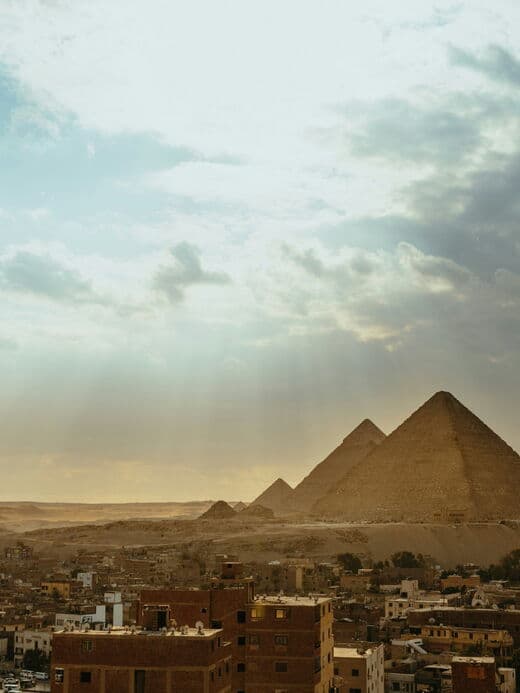
But this is precisely where you'll find what many come to Egypt for. The Pyramids of Giza and the Great Sphinx need no introduction — they're the calling card not just of Egypt but of human civilization itself. The only surviving Wonder of the Ancient World. Yes, there are crowds and persistent vendors offering camel rides, statuettes, photos. Yes, pictures don't capture the scale — the Great Pyramid at 455 feet / 138 meters looks smaller in photos than in reality. But standing at the base of the Great Pyramid and knowing it's 4,500 years old, that it was built without cranes or computers, that it remained the tallest structure on Earth for nearly 4,000 years — that changes something inside you.
Arrive at opening time (8 AM) — the first two hours are relatively calm before large tour groups arrive. Or come toward closing, an hour or two before sunset — crowds thin and the light turns golden, perfect for photography. You can enter the pyramids themselves for an additional fee: narrow corridors leading to burial chambers. Not recommended for claustrophobes, but the experience is unique — you're literally inside a wonder of the world. The Great Pyramid (Khufu) is the largest and most popular; tickets are limited (around 300 per day). Khafre's Pyramid is second-largest and less visited. Menkaure's Pyramid is smallest of the three greats but has virtually no queues.
The Great Sphinx lies at the pyramids' base — a mysterious creature with a lion's body and human head (probably Pharaoh Khafre). It's about 4,500 years old and has survived millennia, though it lost its nose — according to one version, to a cannonball from Napoleon's soldiers; another blames a religious zealot in the 14th century. The best Sphinx view is from the platform directly opposite, where classic 'kissing the Sphinx' photos are taken. Evenings bring the Sound and Light Show — a tourist attraction, but atmospheric: pyramids illuminated while a voice narrates ancient Egypt's history.
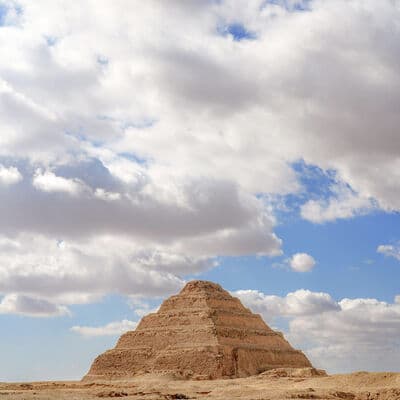
Less famous but equally impressive: Saqqara Necropolis and the Dahshur Pyramids. Saqqara contains the Step Pyramid of Djoser, the world's oldest pyramid (27th century BCE), prototype for all that followed. Also here: dozens of mastabas (nobleman tombs), the Pyramid of Unas with the oldest religious texts on its walls (Pyramid Texts), and the recently reopened Tomb of Mereruka with stunning reliefs. Saqqara has far fewer tourists than Giza, yet its history is even older. Recent discoveries here include hundreds of unopened sarcophagi — excavations continue.
Dahshur lies even further from tourist trails. Here stands the unique Bent Pyramid (Sneferu), whose angle changes mid-height — ancient builders either miscalculated or changed plans during construction. Nearby, the Red Pyramid — Egypt's third-largest — can be entered free (included in admission). A narrow corridor descends 200 feet / 60 meters, three chambers, the smell of ammonia from bats — and almost no one around. This is a pyramid as it should be: without crowds, without vendors, just you and 4,600 years of history.
Hire a taxi for half a day (negotiate price beforehand, around 800-1200 EGP / $16-25 USD) and visit all three sites: Giza, Saqqara, Dahshur. That's a full day of Egyptology, from the world's oldest pyramid to its most famous. Leave early morning to start at Giza before large groups arrive.
The Grand Egyptian Museum (GEM) finally opened fully in 2024 — the world's largest archaeological museum, located at the pyramids' foot. The futuristic building spans approximately 5.4 million square feet / 500,000 square meters, housing over 100,000 artifacts. Tutankhamun's treasures moved here: the golden mask, sarcophagi, throne, chariots, thousands of tomb items — everything formerly scattered through the old Egyptian Museum at Tahrir Square. Now it's all in one place with modern lighting and explanations. Also here: a colossal Ramesses II statue in the atrium, pharaonic mummies in a dedicated hall, artifacts spanning from predynastic through Greco-Roman periods.
Plan at least 4-5 hours for a visit, ideally a full day. Audio guides are essential — without context, half the exhibits remain mysterious. Book tickets online in advance, especially if you want the Tutankhamun gallery (additional charge). Cafes and restaurants inside; no need to leave. The museum neighbors the pyramids — logically combine them: pyramids at sunrise, museum until evening.
The old Egyptian Museum at Tahrir Square hasn't disappeared — part of the collection remains. A colonial-era building, chaotic exhibits, dusty display cases — but it has its own charm. Worth visiting if you have energy after GEM or if the museum's history interests you (it's over 120 years old). Plans call for converting it into a Cairo history museum within a few years.
Islamic Cairo is a universe unto itself, a city within the city. This is medieval Cairo, founded by the Fatimids in the 10th century, containing thousands of Islamic architectural monuments. The Citadel of Saladin is a 12th-century fortress on Mokattam Hill, from where Saladin ruled Egypt and repelled Crusaders. Inside: several mosques, museums, palaces. The main landmark is the Muhammad Ali Mosque (Alabaster Mosque), built in the 19th century in Ottoman style. Huge domes, two minarets, alabaster cladding that gave it its name. Inside: magnificent chandeliers, carpets, a sense of space and light. From the citadel's terrace, views span all Cairo — on clear days, pyramids appear on the horizon.
Khan el-Khalili is a 600-year-old bazaar. A labyrinth of narrow streets, covered passages, thousands of shops. They sell everything: gold and silver, spices and perfumes, papyrus and hookahs, antiques (mostly fake) and souvenirs, fabrics and copperware. Bargaining is mandatory — initial prices may be 10 times the real value. Don't rush to buy at the first shop; walk around, compare. Best time to visit is late evening when heat subsides and the bazaar comes alive. Stop at Fishawi cafe — it's 250 years old; Nobel laureate Naguib Mahfouz drank coffee here. Order mint tea or Turkish coffee, smoke shisha, watch the passing crowd — this is the real Cairo.
Al-Muizz Street is medieval Cairo's main artery, an open-air museum. A pedestrian zone (rare for Cairo!) stretching about half a mile / one kilometer, lined with dozens of mosques, madrasas, mausoleums, caravanserais. Al-Hakim Mosque, Al-Aqmar Mosque with its carved facade, the Qalawun complex with hospital, madrasa, and mausoleum, Sultan Barquq Mosque. All 10th-15th century, the golden age of Islamic Cairo. Best explored with a guide or at least a guidebook — without context, masterpieces pass unnoticed.
Al-Azhar Mosque is not just a mosque but one of the world's oldest universities, founded in 970 CE. For over a thousand years, scholars have studied Islamic theology, law, and Arabic language here. Al-Azhar University is the highest authority in Sunni Islam; its fatwas (religious rulings) carry weight throughout the Muslim world. The mosque welcomes visitors — remove shoes, women should cover their heads (scarves provided at entrance). An inner courtyard, columned hall, atmosphere of scholarship and prayer.
Coptic Cairo represents Christian Egypt, predating Islam and persisting today. Copts are Egyptian Christians, descendants of ancient Egyptians who adopted Christianity in the faith's first centuries. They comprise about 10% of the country's population. The Coptic Quarter centers on Babylon Fortress (Roman, not to be confused with Mesopotamian), inside which ancient churches stand. The Hanging Church (Al-Muallaka) is named because it's built over fortress gates, literally suspended in air. Inside: icons, ivory-carved screens, an atmosphere of ancient Christianity. St. Sergius Church reportedly stands where the Holy Family sheltered during their flight to Egypt. St. Barbara Church, Ben Ezra Synagogue (among the world's oldest) — all nearby, walkable in a couple hours.
The Ibn Tulun Mosque is Cairo's oldest surviving mosque, preserving its original 9th-century form. A huge courtyard (Cairo's largest), a spiral minaret (Egypt's only one, resembling Samarra's in Iraq), minimal decoration, maximum space and light. Almost no tourists here; you can sit quietly and absorb the atmosphere. Adjacent is the Gayer-Anderson Museum in two old houses connected by a bridge: antique collections, oriental interiors, rooftop views of the mosque.
For evening relaxation, ascend the Cairo Tower on Zamalek Island — a 1960s concrete structure standing 614 feet / 187 meters, resembling a lotus flower. At top: an observation deck and revolving restaurant. Sunset over the Nile from this height offers one of Cairo's best panoramas. You can see pyramids, the citadel, downtown skyscrapers, the Nile with its bridges and feluccas. Arrive an hour before sunset to see the city in daylight, at sunset, and with nighttime illumination.
The Baron Empain Palace in Heliopolis is one of Cairo's strangest buildings. Belgian industrialist Edouard Empain, who built Cairo's metro and the Heliopolis district, constructed a palace in Hindu style — elephants, snakes, deities on the facade. The palace stood abandoned for years, accumulating legends of ghosts and satanists. Restored and opened to the public in 2020, it now houses a museum of district and Empain history, with a rooftop cafe overlooking Heliopolis.
The Nilometer at Roda Island's southern tip is an ancient device for measuring Nile levels. An 8th-century construction: a column with markings in a conical well connected to the river by channels. Water levels predicted harvests and determined taxes. Low meant famine, high meant flood, medium meant prosperity. Now it's a small museum with excellent Nile views.
Luxor and Upper Egypt
Luxor is an open-air museum stretching dozens of miles along the Nile. Ancient Thebes, Egypt's capital during the New Kingdom (1550-1070 BCE), when the empire reached maximum power. Here ruled Tutankhamun, Ramesses II, Hatshepsut, Amenhotep III — names familiar even to those who've never studied Egyptology. If Cairo means chaos, pyramids, and megacity, Luxor means temples and tombs at their most magnificent. No pyramids here (they were built a thousand years before Thebes' heyday), but there's something Giza lacks: painted reliefs, preserved symbolism, tombs that weren't completely plundered.
The Nile divides Luxor into two parts with profound symbolic meaning. The East Bank is the city of the living: temples of gods, residential quarters, markets. The sun rises in the east — birth, life. The West Bank is the city of the dead: necropolises, mortuary temples, tombs. The sun sets in the west — death, the afterlife. Ancient Egyptians lived on the east, buried their dead on the west. This logic persists: the main city is on the east bank, villages and archaeological zones on the west.
The East Bank begins with Karnak Temple — the ancient world's largest temple complex. Not one temple but an entire city of temples, built over two thousand years: each pharaoh added something, rebuilt, expanded. The area spans approximately 250 acres / 100 hectares, larger than some European capitals. The main temple honors Amun-Ra, the New Kingdom's supreme god. The First Pylon (entry gate) stands 141 feet / 43 meters — Egypt's largest, though never completed. Beyond lies the Great Court, large enough to hold several football fields.
But Karnak's crown jewel is the Great Hypostyle Hall. 134 columns arranged in 16 rows. The central 12 columns stand 75 feet / 23 meters tall with diameters around 11 feet / 3.5 meters: 50 people could stand on each capital. Columns are covered top to bottom with reliefs: gods, pharaohs, hieroglyphs, ritual scenes. Standing among these columns, you feel like an ant. Best light comes early morning, when the sun penetrates the stone forest at a sharp angle creating dramatic shadows. Or at sunset — then the stone turns gold.
Arrive at opening time: 6:00 AM. This is not a suggestion; it's a necessity. By 9-10 AM, buses from cruise ships arrive, heat becomes oppressive, crowds overwhelming. Early morning, you might find the Hypostyle Hall nearly empty. After 3:00 PM, crowds thin again, light softens. You could spend half a day in Karnak exploring every court, every temple — there are dozens. Temple of Khonsu, Temple of Ptah, Temple of Mut, the Sacred Lake, the avenue of ram-headed sphinxes. After dark, a Sound and Light Show unfolds — touristy but atmospheric: you walk through the dark temple while a voice tells history and columns, statues, obelisks illuminate on cue.
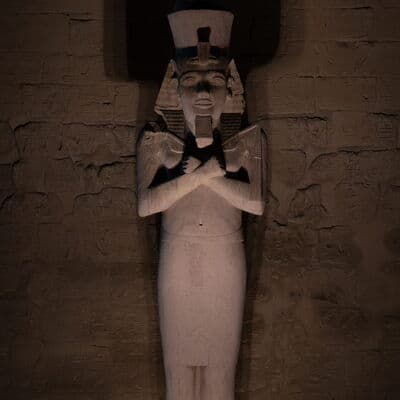
Luxor Temple sits right in the modern city center — a rare case where an ancient temple stands not in an archaeological zone but among houses, hotels, restaurants. Built under Amenhotep III and Ramesses II, dedicated to the Theban triad: Amun, Mut, and Khonsu. It lacks Karnak's scale but has its own charm. Colossal Ramesses II statues at the entrance (once six, now two), an obelisk (the other went to Paris, standing in Place de la Concorde), a columned courtyard, the sanctuary deep inside.
Luxor Temple is especially beautiful at night when illuminated. Columns glow gold against dark sky, statues cast long shadows. Locals stroll the corniche, music drifts from restaurants — the temple lives in the city, not behind a fence. An interesting detail: inside the temple stands Abu el-Haggag Mosque, built in the 13th century directly on ancient ruins. When the temple was excavated, the mosque ended up on the second floor — they chose to preserve it. Now the minaret calls to prayer above pharaonic columns — a symbol of Egypt's layered history.
The Avenue of Sphinxes connects Luxor Temple to Karnak — 1.7 miles / 2.7 kilometers, around 1,350 sphinxes lining both sides (once there were more). The processional road where god statues were carried during the Opet Festival. For thousands of years, it lay buried under the medieval city; houses stood directly on sphinxes. In 2021, the avenue was finally excavated, restored, and ceremonially opened. You can now walk the entire route — about 40 minutes, ideally at sunset. Not all sphinxes survived; many are reconstructions, but the scale impresses.
The West Bank — here begins the city of the dead. The Valley of the Kings is the world's most famous cemetery. In this valley, hidden among lifeless cliffs, New Kingdom pharaohs carved their tombs. No pyramids — they were too easy to find and plunder. Instead: underground labyrinths extending dozens of meters into rock, with false corridors, dead ends, traps. It didn't help: nearly all tombs were robbed in antiquity. Nearly — because one tomb reached us intact: Tutankhamun's tomb, discovered by Howard Carter in 1922. Its treasures now reside in the Grand Egyptian Museum, but the tomb itself remains here.
The Valley of the Kings contains 63 tombs, roughly 20 open to visitors on rotation. The basic ticket includes three tombs of your choice (which are open is indicated at the ticket office). Tutankhamun, Seti I, and Ramesses V/VI require additional payment. Seti I's is the most beautiful and expensive (around 1000 EGP / $20): 450 feet / 137 meters of corridors, preserved colors, astronomical ceilings, scenes from the Book of the Dead. Tutankhamun's is the smallest but most famous: the pharaoh's mummy still lies here in its sarcophagus. Ramesses V/VI offers excellent value: deep corridors, walls and ceilings completely painted.
Arrive at opening: 6:00 AM. This is necessity, not recommendation. By 10 AM, heat becomes unbearable (the valley is a stone bowl with almost no shade) and cruise buses arrive. Tombs are narrow with limited ventilation; crowds make visiting uncomfortable. Early morning, you might share a tomb with just two or three others. Photography inside is officially forbidden (but everyone photographs); guards sometimes request baksheesh to allow it. Officially — not allowed.
The Valley of the Queens is less known and visited, but contains a tomb worth a separate visit: Nefertari's tomb, wife of Ramesses II. Ramesses loved his wife so much he built her a tomb rivaling any king's. Colors survive as if painted yesterday: blue, gold, white, red — bright, saturated. Nefertari in a white dress, with ritual objects, before the gods. Visits are strictly limited (75 people daily), expensive (around 1400 EGP / $28), time inside restricted (10-15 minutes). But it's worth it — possibly the most beautiful tomb in all Egypt.
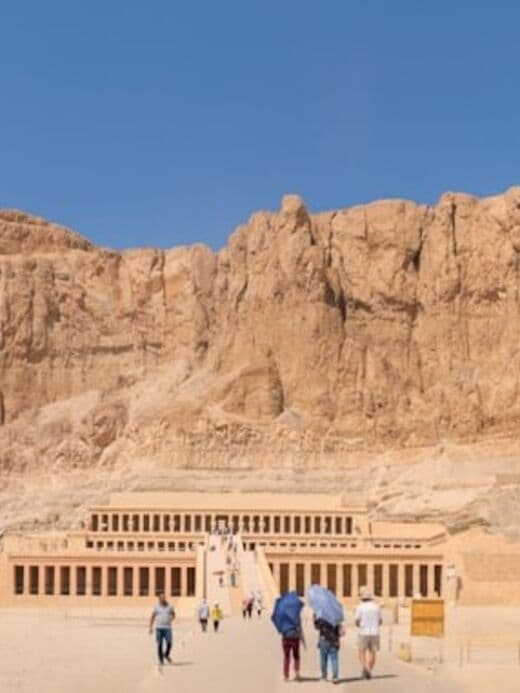
The Temple of Hatshepsut at Deir el-Bahari is an architectural masterpiece carved into cliffs. Three terraces, ramps, colonnades — modernist minimalism 3,500 years before modernism. Hatshepsut was a female pharaoh who ruled Egypt for 20 years (15th century BCE). In reliefs, she's depicted with a beard and male clothing — tradition required it. The temple honors Amun and the queen's mortuary cult. Walls show the expedition to Punt (probably Somalia), which brought back incense, gold, exotic animals. The temple suffered damage: after Hatshepsut's death, her successor Thutmose III ordered her images and inscriptions destroyed. Restoration continues.
Early morning, when the sun rises from behind cliffs, the temple looks especially striking — light stone against dark crags. Heat here is even worse than in the Valley of the Kings — no shelter anywhere. A tourist train runs from parking to entrance (included in admission), or walk — about 10 minutes.
The Colossi of Memnon are two giant statues of Pharaoh Amenhotep III greeting everyone entering the West Bank. Height: approximately 60 feet / 18 meters; weight: around 720 tons each. They stood at the entrance to Amenhotep III's mortuary temple, of which almost nothing remains — stones were carted off for other constructions. But the colossi remained. In antiquity, the northern statue made sounds at dawn — Greeks believed Memnon was greeting his mother Eos. After restoration under Septimius Severus, the statue fell silent. Today the colossi are a free roadside attraction, a five-minute stop en route to tombs.
Medinet Habu is the temple of Ramesses III, among Egypt's best-preserved. Fewer tourists than at the Valley of the Kings, yet relief colors are brighter. Walls depict battle scenes: Ramesses III defeating the 'Sea Peoples,' Libyans, Nubians. Detail is astonishing: you can make out weapons, hairstyles, facial expressions. The temple's high walls create shade — unlike other sites, you can shelter from sun here.
The Ramesseum is Ramesses II's mortuary temple, now majestic ruins. The main attraction: fragments of a colossal Ramesses statue, once approximately 62 feet / 19 meters tall, weighing around 1,000 tons. The statue fell and broke — and these fragments inspired Percy Bysshe Shelley's sonnet 'Ozymandias': 'My name is Ozymandias, King of Kings; Look on my Works, ye Mighty, and despair!' And around — desert. History's irony.
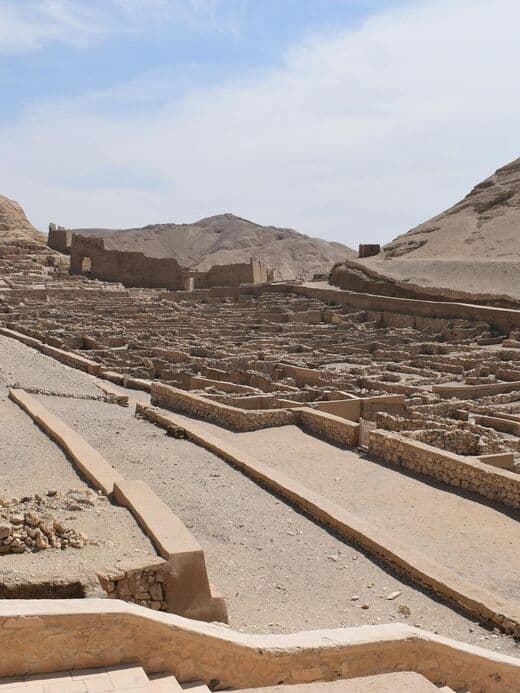
Deir el-Medina was the village of workers who built and decorated Valley of the Kings tombs. A closed settlement: residents knew where pharaohs' treasures lay and couldn't leave the village without permission. House foundations survive, along with a Hathor temple and — most interestingly — workers' own tombs. They buried themselves more modestly than pharaohs but decorated their tombs with equal skill. Sennejem's tomb is a gem: small but completely painted with afterlife scenes. Almost no tourists here.
The Tombs of the Nobles are another underrated treasure. Unlike royal tombs, these lack religious texts and underworld imagery. Instead: scenes of daily ancient Egyptian life — hunting, fishing, farming, winemaking, feasts, music, dancing. History without pomp — how people (well, not ordinary people — these were nobles) lived 3,500 years ago. Several tomb groups scatter across West Bank hills, each requiring a separate ticket. Most interesting: Rekhmire (vizier, detailed craft scenes), Nakht (astronomer, famous musicians), Sennefer ('tomb of the vines' — the ceiling painted with grape leaves).
The Luxor Museum is compact but excellently organized. None of the Cairo Egyptian Museum's chaos — everything is clear, well-lit, explained. The collection draws from Theban temples and tombs: statues, reliefs, mummies, Tutankhamun items (not all went to GEM). Two pharaoh mummies — Ahmose I and Ramesses I. Viewable in 2-3 hours. Open until 9 PM, a good evening option.
The Mummification Museum is for those wanting to understand the process's technology. A small museum on the corniche: mummification tools, canopic jars (for organs), amulets, human and animal mummies (crocodiles, cats, rams). Not for the squeamish, but educational.
A hot air balloon ride over the West Bank at sunrise ranks among Egypt's most impressive experiences. Wake at 4 AM, cross to the West Bank, take off in pre-dawn twilight. Below you: the Valley of the Kings, Temple of Hatshepsut, Colossi of Memnon, the green Nile strip, desert to the horizon. The sun rises, painting everything pink and gold. Flight lasts about 45 minutes; landing in a field, champagne (or juice), certificate. Costs around $100-150 per person. Book directly with operators (Magic Horizon, Hod Hod Soliman, Sindbad), not through your hotel — half the price, no middlemen.
Luxor's surroundings include temples worth adding if time permits. Temple of Dendera (44 miles / 70 km north) honors goddess Hathor, among Egypt's best-preserved. The hypostyle hall ceiling is astronomical: zodiac signs, sky goddess Nut, stars. The famous 'Dendera Zodiac' — a round bas-relief with 12 zodiac signs — went to the Louvre, but a copy remains. A late temple (Ptolemaic and Roman period), hence excellent preservation. The roof has chapels accessible via narrow stairs.
Temple of Abydos (100 miles / 160 km north) was the sacred city of Osiris, god of the underworld. The Temple of Seti I is among Egypt's most beautiful: reliefs not carved in relief but cut into the stone, creating light-and-shadow play. Colors survive on many walls. The famous 'Abydos King List' — 76 pharaohs carved on a wall. Also: mysterious reliefs that conspiracy theorists see as helicopters and submarines (actually a palimpsest, overlapping inscriptions from different periods). A long trip, but worth it.
Temple of Esna (34 miles / 55 km south) honors ram-god Khnum. Only the hypostyle hall survives, but what a hall: 24 columns with varied capitals, a ceiling with astronomical scenes, recently restored. The temple sits in the city center, below modern street level — the city grew around and above it. Usually visited en route between Luxor and Aswan or during cruises.
Aswan and Nubia
Aswan is Egypt's southernmost major city, the gateway to Nubia and Africa. Here the Nile looks its finest: islands with palm trees, granite boulders, feluccas with white sails, sunsets that take your breath away. After Cairo's chaos and Luxor's intensity, Aswan is an exhale. A small city (around 300,000 people), relaxed, without aggressive vendors and constant noise. The Corniche makes for pleasant strolls, with views of Elephantine Island and the West Bank. Here you can simply sit in a cafe, drink tea, and watch feluccas glide across the water.
Aswan is a border. To the north: Arab Egypt, fellahin (farmers), Sunni Islam. To the south: Nubia, a distinct people with their own language, culture, traditions. Nubians have darker skin; their language isn't related to Arabic (it's kin to Sudanese languages); their houses burst with colors. Nubia was flooded when the High Dam was built in the 1960s — dozens of villages went underwater, people relocated. But the culture survived, and in Aswan, you feel it.
Philae Temple (Temple of Isis) is Aswan's jewel. Located on Agilkia Island in the middle of the Nile, reached by motorboat (15 minutes; boat tickets separate from admission). The temple honors Isis, goddess of magic and motherhood, wife of Osiris and mother of Horus. This was ancient Egyptian religion's last functioning temple — priests served here until the 6th century CE, when Justinian closed it and converted it to a church.
The temple's rescue story is itself an epic. When the High Dam was built, Philae Island would be submerged. UNESCO organized an international campaign: the temple was disassembled into 40,000 blocks, moved to neighboring Agilkia Island (previously reshaped to replicate Philae's form), and reassembled. The operation took 10 years. Along with Abu Simbel, this was the 20th century's greatest archaeological rescue.
The temple is beautiful anytime but especially at sunset when the stone turns pink. Evenings bring a Sound and Light Show — one of Egypt's best. You sit in the temple courtyard as Isis and Osiris's story unfolds on the walls with music and lighting. English versions available (check schedule).
Abu Simbel holds Ramesses II's temples at the Sudanese border, 174 miles / 280 km south of Aswan. Not just temples but a declaration: four colossal Ramesses II statues, 66 feet / 20 meters tall, carved from the cliff face facing south — so Nubians would see Egypt's might. Nearby: a smaller temple for Ramesses' wife Nefertari and goddess Hathor. Inside the great temple: halls with pillar-statues, reliefs depicting the Battle of Kadesh, a sanctuary deep in the rock.
Twice yearly — February 22 and October 22 — a miracle occurs: the sun penetrates the sanctuary 200 feet / 60 meters deep and illuminates three of four god statues (Ra, Amun, and Ramesses; Ptah, god of darkness, remains shadowed). A phenomenon calculated by ancient architects 3,300 years ago. On these days, thousands gather at the temple — festival, music, atmosphere.
Abu Simbel was also saved from flooding: temples were cut into blocks and moved 213 feet / 65 meters higher and 656 feet / 200 meters back from the water. The artificial hill now housing the temples is a 20th-century engineering marvel. A museum tells the operation's story.
Three ways to reach Abu Simbel: Flight from Aswan — 30 minutes airtime, fastest and most expensive. Bus convoy — departure from Aswan at 3-4 AM, 3-4 hours each way, several hours at temples, return by midday. Exhausting but budget-friendly. Third option: overnight stay in Abu Simbel — a few hotels exist; you can see temples evening and morning without crowds, attend the Sound and Light Show. Best option if you have time.
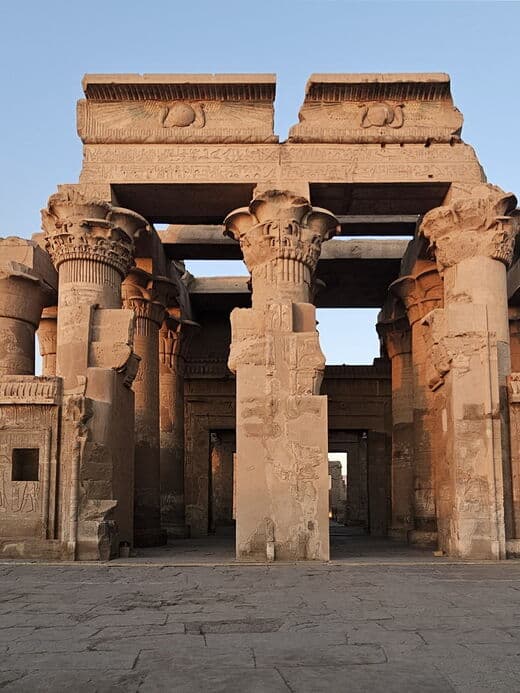
The Temple of Kom Ombo stands on the Nile bank between Aswan and Luxor. A unique double temple: one half honors Sobek (crocodile god), the other Haroeris (a form of Horus). Two entrances, two sanctuaries, symmetrical layout. Reliefs include surgical instruments (Kom Ombo was a medical center), crocodiles, offering scenes. Adjacent: a museum with crocodile mummies found in a nearby necropolis. The temple is beautifully lit at night — many cruises stop here at sunset.
Nubian villages feature brightly painted houses in every color: blue, yellow, orange, with ornaments, fish, birds, protective-eye images. Hospitable residents invite you for tea, show pet crocodiles (yes, it's tradition — keeping small crocodiles as talismans), sell souvenirs. Reach them by motorboat (30-40 minutes from Aswan) or camel from the West Bank. Organized tours exist, or go independently and simply wander the village. Nubians are used to tourists, but this isn't staged — people live their lives here.
From Aswan, Nile cruises to Luxor begin — the classic way to see Upper Egypt. 3-4 nights aboard, stops at temples (Kom Ombo, Edfu, sometimes Esna), arrival in Luxor. Options range from budget to ultra-luxury: from old steamers with fans to floating five-star hotels with pool decks. Best to sail north (downstream) — most cruises do this, and temple logistics work better.
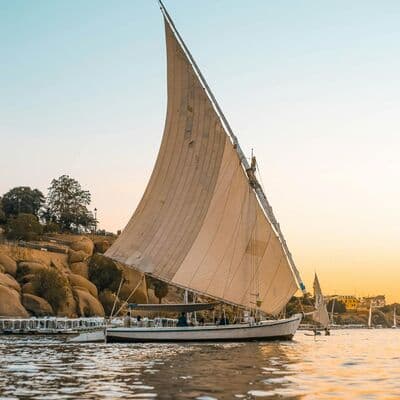
Alternatives to cruise ships: feluccas (traditional sailboats) and dahabiyas (small sailing yachts). Feluccas are romantic but basic: sleep on deck, the toilet is the river, cooking on a camp stove. Sail for 2-3 days, dependent on wind. Dahabiyas compromise: 10-12 passengers, cabins with facilities, but still sail, slow current, silence. More expensive than cruises but more atmospheric.
Alexandria and the Mediterranean
Alexandria is Egypt's second city and its Mediterranean face. Founded by Alexander the Great in 331 BCE, it was the Ptolemaic capital, Cleopatra's city, center of Hellenistic learning. Here stood the Pharos Lighthouse (one of the Seven Wonders) and the Great Library (the ancient world's largest knowledge collection). Here lived Euclid and Eratosthenes; here the Bible was translated into Greek. Then came Arabs, then Ottomans, then Europeans — each left marks. Today it's a port city with faded colonial charm, sea breezes, and the freshest seafood in Egypt.
Almost nothing remains of ancient Alexandria — earthquakes, wars, construction. Cleopatra's palace lies on the harbor floor (you can dive to it). The lighthouse is destroyed. The library burned. But the city's spirit survives — in cafes where Cavafy sat, in streets where they filmed 'The English Patient,' in the smell of sea and fried fish.
The Bibliotheca Alexandrina is a modern reincarnation of the legendary ancient library. Opened in 2002 with UNESCO support. The building is an architectural masterpiece: a tilted disk descending into earth and rising toward sky, symbolizing the sun rising from the Mediterranean. Walls are clad in granite with letters from all world alphabets. Inside: the world's largest reading room (2,000 seats on 8 levels), millions of books, several museums (antiquities, manuscripts, science), a planetarium, conference halls. Even if you don't plan to read — visit for the building itself.
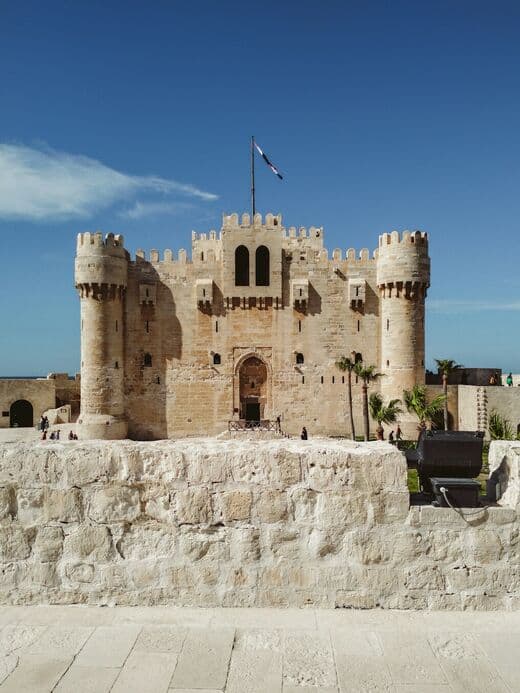
The Citadel of Qaitbay is a 15th-century fortress on the site of the ancient Pharos Lighthouse. Sultan Qaitbay built it from lighthouse debris — look closely and you'll see ancient columns and blocks in the walls. The fortress protected the Eastern Harbor entrance. Inside now: a small naval museum, but the main draw is the views. From the towers, panoramas of the Mediterranean, the harbor, the corniche. Especially beautiful at sunset.
The Catacombs of Kom el-Shoqafa are Egypt's largest Roman necropolis. Three underground gallery levels (the lowest flooded by groundwater), cut into rock in the 2nd century CE. An astonishing mix of traditions: Egyptian gods with Roman hairstyles, Greek columns with Egyptian capitals, Anubis in Roman armor. This was the period when Egyptian, Greek, and Roman cultures fused into something unique. A spiral staircase descends to the triclinium (dining hall for memorial meals), then burial chambers. Atmospheric and slightly creepy.
Pompey's Pillar is Egypt's tallest ancient column — 89 feet / 27 meters of red granite. The name is wrong: the column has nothing to do with Pompey; it was erected for Emperor Diocletian in the late 3rd century. It stands on a hill where the Serapeum once stood — temple of Serapis, a syncretic deity combining Osiris and Greek Apis. Temple ruins and underground galleries that stored books — a Great Library branch — remain.
The Roman Amphitheater is Egypt's only one. Small (around 800 seats) but well-preserved: marble seating, mosaic floors, galleries. Discovered accidentally in the 1960s during construction. Nearby: remains of Roman baths and villas. A brief visit, but pleasant.
Montazah Palace and Gardens was the Egyptian kings' summer residence on the city's eastern edge. Al-Haramlek Palace is closed to visitors (now a presidential residence), but the park is open. Vast grounds: palms, pines, flower beds, bridges, beaches. Alexandrians come with families for picnics, escaping city noise. A good place to decompress after museums.
The Corniche stretches 12 miles / 20 kilometers from the Eastern Harbor to Montazah. Here Alexandrians walk, fish, sit in cafes, watch sunsets. Colonial buildings with peeling paint, fish restaurants, children with kites. Stanley Bridge is a city symbol, an arched bridge over the bay, beautiful when lit at night.
The Royal Jewelry Museum houses Egyptian royal family jewels (pre-1952 revolution) in a beautiful palace. Tiaras, necklaces, medals, bejeweled objects. The palace itself is interesting — Art Deco style, mosaic floors, painted ceilings. The Alexandria National Museum offers a compact city history from pharaohs to the present in a restored Italian palazzo.
Alexandria isn't about beaches (overcrowded with Egyptians, especially in summer, and not very clean) or antiquities (few remain). It's about atmosphere, food, and the sea. Try fish at corniche restaurants — choose fresh fish from the display, tell them how to cook it. Sip coffee at historic Trianon or Delices cafes. Wander old center streets where Italian, French, Greek, and Arab architecture mingle. The city opens to those who don't rush.
Red Sea: Hurghada
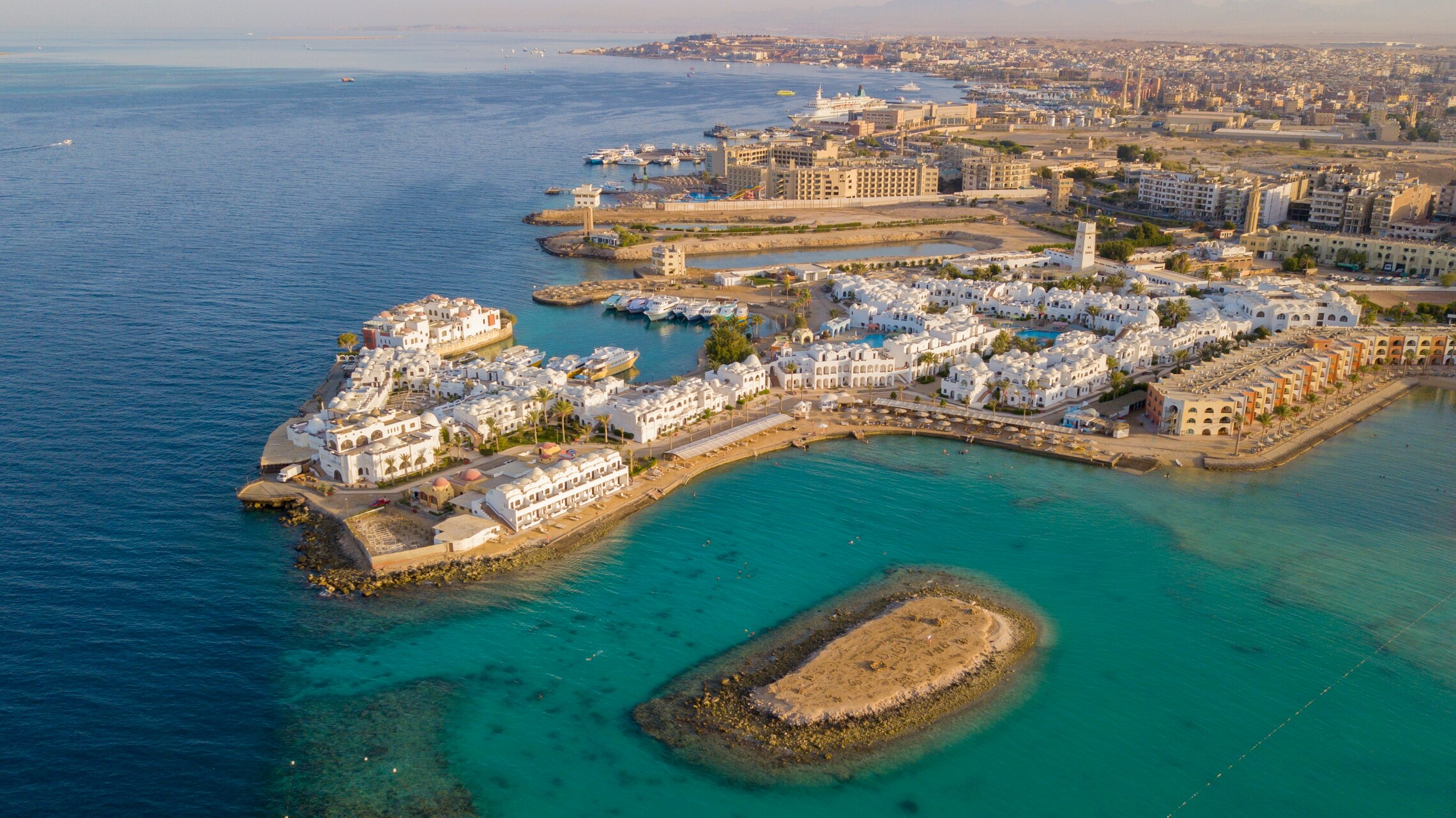
Hurghada is the main Red Sea resort and entry point for beach tourism. The town grew from a fishing village in the 1980s when Egypt developed beach tourism. Today Hurghada stretches 25 miles / 40 km along the coast — from El-Dahar (old town) through Sekalla (center, marina) to endless hotel zones southward. Thousands of hotels from budget three-stars to luxurious five-stars, infrastructure built for mass tourism: all-inclusive, animation, package holidays.
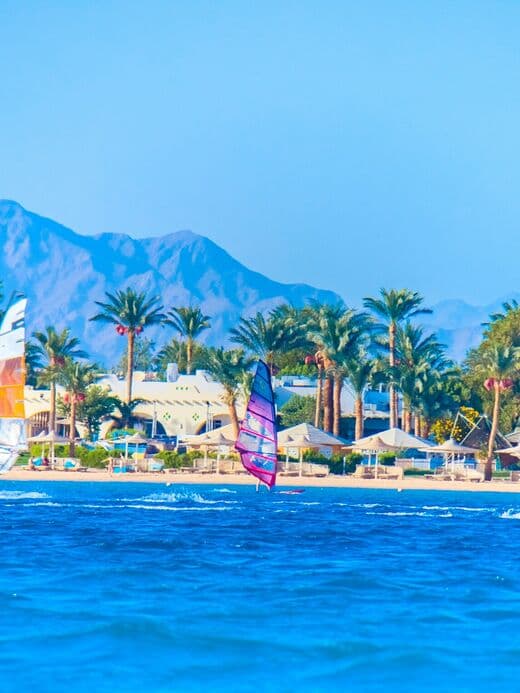
Hurghada isn't about history or culture. No antiquities exist here (Luxor is a 4-hour drive; day trips are possible but exhausting). This is about sea, sun, and relaxation. The Red Sea here is fantastic: crystal-clear water, temperatures of 75-82F / 24-28C year-round, coral reefs right off the beach (at some hotels), rainbow-colored fish. You could spend a week never leaving your hotel — pool, beach, buffet, bar. Or use Hurghada as a base for marine adventures.
Hurghada Marina is a developed waterfront in the Sekalla area, built in the 2000s. Yachts, boats, restaurants, cafes, shops. A pleasant evening stroll destination if you want to escape the hotel. Also here: piers where island excursions and dive safaris depart. Senzo Mall serves those missing air conditioning, shopping, and food courts.
Hurghada's main draw is marine excursions and diving. Giftun Island is a national park 45 minutes by boat. White sand, clear water, corals near shore, fish you can hand-feed. Typical excursion: boat with lunch and drinks, several snorkeling stops, beach time. Around $25-40 per person depending on operator. Worth going — it's a completely different sea level compared to hotel beaches.
Mahmya Island offers a more exclusive option with limited visitor numbers. An eco-beach with palm-leaf umbrellas, no plastic, a good restaurant. More expensive than Giftun but calmer and more maintained.
El Gouna is a resort town 15 miles / 25 km north of Hurghada, built from scratch by Egyptian billionaire Samih Sawiris. Canals, islands, bridges — 'Egyptian Venice.' Everything planned, manicured, expensive. Traditional Nubian-style architecture, golf courses, kite stations, yacht marina. Expats live here, wealthy Egyptians, European retirees. The atmosphere differs completely from Hurghada: less all-inclusive, more boutique hotels and villas. Worth a day trip even if staying in Hurghada — if only for the contrast.
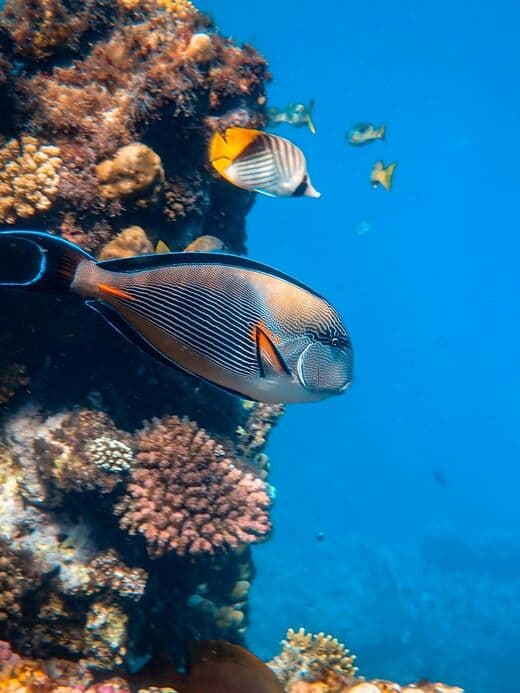
Diving around Hurghada is world-class. Reefs: Gota Abu Ramada, Umm Gamar, Shaab el-Erg (with dolphins). Wrecks: El-Mina, Rosalie Moller, Thistlegorm (a British WWII ship, one of the world's best dives — but distant, usually a two-day safari). Numerous dive centers offer courses from beginner (PADI Open Water) to professional. For snorkeling, island excursions or even hotel reefs (if available) suffice.
Red Sea: Sharm el-Sheikh
Sharm el-Sheikh sits at the Sinai Peninsula's southern tip, on the Red Sea between the Gulf of Aqaba and Gulf of Suez. If Hurghada represents mass tourism, Sharm positions itself slightly upmarket: more Europeans (British, Italian, German), higher prices. Sinai is a special economic zone with simplified visa rules: a free 'Sinai Stamp' grants 15 days, but you can't leave South Sinai (meaning Cairo and Luxor are off-limits). For a regular visa: standard $25.
Naama Bay is Sharm's historic heart, a pedestrian promenade with restaurants, clubs, shops. The resort began here in the 1970s; the first tourists came here. Now it's the nightlife center: Hard Rock Cafe, Pacha, discos, bars. During the day: a beach (one of Sharm's few public ones), dive centers, souvenir shops. Many hotels are within walking distance — you can live without taxis.
The Old Market (Sharm Old Town) is a more authentic alternative to Naama. An Eastern bazaar with souvenirs, spices, carpets, hookahs. Bargaining mandatory. Restaurants with local food cheaper than on the promenade. Coffee shops where you can sit with shisha and tea. Busy and loud in the evening — Egyptian flavor.
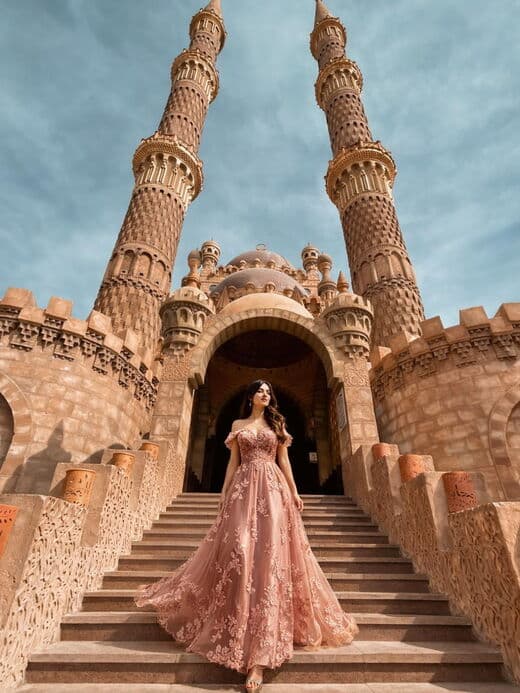
Soho Square is a modern entertainment complex built in the 2000s. Singing fountains (show every evening), ice rink (yes, in the desert), bowling, cinema, restaurants, shops. Targets families and those wanting something besides beach. A small mosque in traditional style stands here — beautiful, visitors welcome.
Ras Mohammed National Park is the region's main natural attraction, a cape at Sinai's southern tip. Mangrove forests (rare at these latitudes), coral reefs, fish, turtles. Considered one of the world's best diving and snorkeling locations. Shark Reef wall drops vertically dozens of meters; along it swim fish schools, moray eels, sometimes sharks (harmless). Come by car (the park is open for land visits; beaches and viewpoints exist) or by boat (dive excursions). A must for anyone who loves the sea.
Tiran Island — reefs around this island in the Strait of Tiran (strait between Sinai and Saudi Arabia). Four famous reefs: Jackson, Woodhouse, Thomas, Gordon — named for British cartographers. Rich underwater life: corals, Napoleon fish, barracuda, rays, sometimes whale sharks. Full-day excursions with onboard lunch are the standard format. The island itself belongs to Saudi Arabia (by 2017 treaty); landing is prohibited, only viewing from water.
From Sharm, you can visit Mount Sinai and St. Catherine's Monastery — an overnight trip. Departure around 11 PM, arrival at the mountain's base by 2 AM, climb to the summit (7,497 feet / 2,285 m, about 3 hours on foot or part way by camel), sunrise at the summit, descent, monastery visit, return to Sharm by midday. Mount Sinai is where, according to the Bible, Moses received the tablets with the commandments. St. Catherine's Monastery is one of the world's oldest continuously operating Christian monasteries (6th century), with a unique icon and manuscript collection. An exhausting trip but impressive — sunrise over Sinai is unforgettable.
Sharm also offers day trips to Cairo (by plane or bus — bus takes 6-7 hours, exhausting), Luxor (plane only, very long day), Petra, Jordan (by ferry or through the Taba border). But Sharm is best for the sea; for excursions, base yourself in Cairo or Luxor.
Siwa Oasis
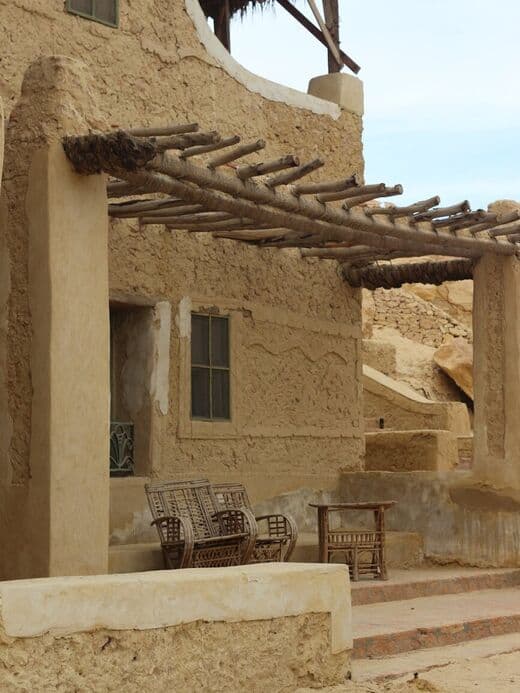
Siwa Oasis is another Egypt entirely. Lost in the Libyan Desert, 348 miles / 560 km from Cairo and 186 miles / 300 km from the coast, Siwa lived in isolation for centuries. Arab conquerors didn't reach here (well, they did, but didn't stay), mass tourism hasn't arrived, the globalized world hasn't touched it. People speak Siwi (a Berber-related language of North Africa), build houses from kershef (mud and salt mixture), live by traditions hundreds of years old. Siwa is where time flows differently.
The oasis stretches 50 miles / 80 km east to west — a chain of villages, date groves, olive gardens, salt lakes amid endless sand. Population: around 30,000, mostly Berber Siwans. The center is Siwa town with a few streets, a bazaar, a mosque, hotels. Everything else is nature: dunes, springs, palms.
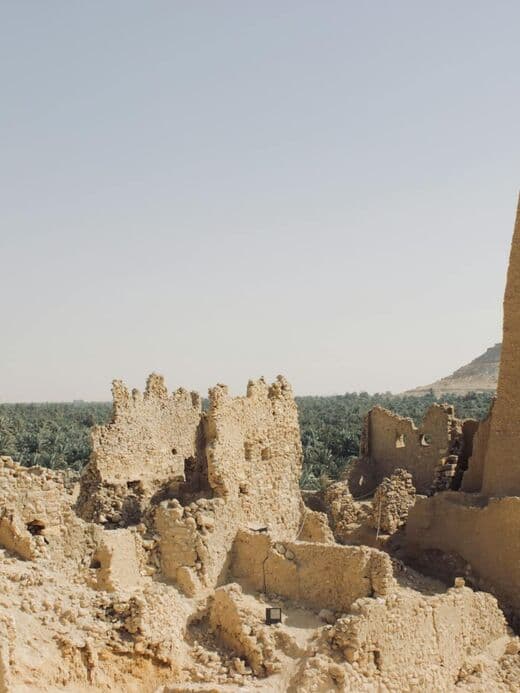
Shali Fortress comprises ruins of the medieval town that was Siwa until the 20th century. Siwans lived inside fortress walls — protection from Bedouin, Libyan, bandit raids. Kershef houses piled atop each other, narrow streets winding between them. In 1926, a rare three-day rain came to the desert — and kershef began dissolving. The town collapsed. Residents moved down, built new houses (from proper brick now). Shali's ruins remain — ghostly, eroded forms like a giant sandcastle. Climb to the top for the best oasis view: green palms, blue lakes, yellow dunes to the horizon.
The Temple of the Oracle (Temple of Amun) is where Alexander the Great received history-changing prophecy. 331 BCE: the young conqueror who had taken Egypt makes a grueling desert crossing to consult the Oracle of Amun, the ancient world's most authoritative after Delphi. What exactly the oracle said is unknown, but Alexander emerged convinced he was the son of a god. From then on, he demanded divine honors. The temple stands on Aghurmi rock; only ruins remain, but the place still impresses — history, views, silence.
Cleopatra's Spring (Ain Juba) is a natural pool with crystal-clear water bubbling from underground. Legend says the queen bathed here. True or not, the water refreshes after desert heat. A round stone pool about 50 feet / 15 meters in diameter, depth around 10 feet / 3 meters, water temperature about 82-86F / 28-30C year-round. Surrounding: palms, cafes, locals and tourists. Best to come early morning or at sunset — midday gets crowded (by Siwa standards).
Siwa Salt Lakes are a main attraction. Lakes Bir Wahed, Fetnas, Ag — salt so concentrated you can't sink; you float on the surface like on a mattress. White shores of salt deposits, turquoise water, cloud reflections — Instagram-worthy before that was a thing. The salt is healing, locals say — helps with skin diseases, arthritis, fatigue. After swimming, rinse with fresh water or salt will dry your skin.
Fatnas Island is a palm oasis in the middle of a salt lake, connected to shore by a causeway. Sunsets here are legendary: the sun descends behind Great Sand Sea dunes, reflected in the water. Sky turns orange, pink, purple. A simple cafe serves tea, coffee, fresh juices, shisha. Sitting on cushions, watching sunset, hearing silence — the ideal Siwa evening.
The Mountain of the Dead (Gebel al-Mawta) is a necropolis with 26th Dynasty and Ptolemaic tombs (6th-1st centuries BCE). The rock is riddled with burial chambers at various levels. Some tombs are painted — more modestly than Luxor's but impressive that they exist in this forgotten corner of the world. The Tomb of Si-Amun is best preserved, with Greco-Egyptian-style reliefs. Minimal tourists; the caretaker will give a tour for baksheesh.
The Temple of Umm Ubayd holds ruins of an Amun temple built under Nectanebo II (4th century BCE). It once rivaled Karnak — now only a few relief-carved walls remain. The temple was destroyed by earthquake and dismantled for building materials in the 19th century (a local ruler used stones for his house). But what remains impresses with its scale — huge blocks, fine carving.
Bir Wahed Hot Spring sits amid the Great Sand Sea — a surreal experience. A hot-water pool (about 100-104F / 38-40C) among endless dunes. Around you: only sand to the horizon. At night: billions of stars, the Milky Way like a river across the sky. Desert safaris bring you here: jeeps, sandboarding (riding down dunes on a board), barbecue, overnight camp under stars. This is one of those perspective-changing experiences.
Stargazing in Siwa is a separate attraction. Light pollution is virtually nonexistent — the nearest major city is hundreds of miles away. On moonless nights, thousands of stars are visible to the naked eye; the Milky Way is as bright as in long-exposure photographs. Some camps and hotels organize astronomy evenings with telescopes.
Mount Dakrur is a hill south of town, known for 'sand baths.' A traditional Siwan treatment: in July-August when sand heats to 140-160F / 60-70C, a person is buried to the neck for 15-20 minutes. Believed to help rheumatism, arthritis, infertility. Sounds extreme, but Egyptians come specifically. Even if you're not ready to be buried — the hill offers good oasis views.
The Siwa House Museum is an ethnographic collection of traditional life: clothing, jewelry, utensils, wedding costumes, tools. Small but gives a sense of how Siwans lived before modernization. Nearby: workshops making traditional crafts.
Reach Siwa by bus from Cairo (8-9 hours, West Delta Bus, departing from Turgoman Station), from Alexandria (5-6 hours), from Marsa Matruh (3 hours). Roads are good, buses air-conditioned. Best season: October through April. Summer temperatures reach 113-122F / 45-50C — that's not tourism, that's survival. Spend at least 2-3 days in Siwa to not rush: oasis, springs, desert, sunsets.
Marsa Matruh and the North Coast
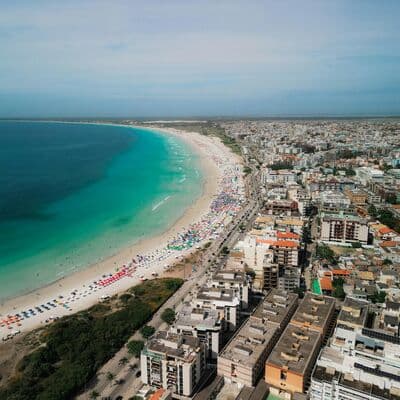
Marsa Matruh is a Mediterranean resort 180 miles / 290 km west of Alexandria. This isn't Hurghada or Sharm — no all-inclusive system, no tourist crowds. But it has some of Egypt's most beautiful beaches: white sand, turquoise water, rocky coves. Marsa Matruh is a resort for Egyptians: in summer, Cairenes and Alexandrians escape the heat here. Foreign visitors are rare, and that's part of the charm.
The town sits in a bay protected from waves by a rock barrier. The main beach is urban, with a promenade, restaurants, full infrastructure. Calm water, fine sand, gentle slope — good for families with children. Summer (June-September) the beach is packed; winter it's nearly empty.
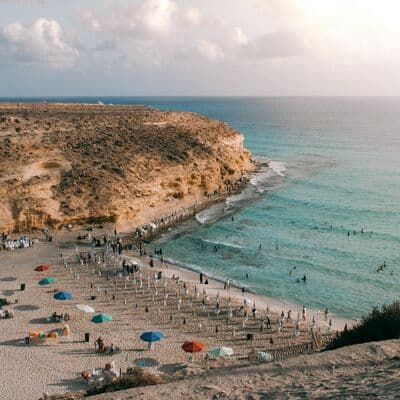
Agiba Beach means 'miracle' in Arabic, and it deserves the name. 15 miles / 24 km west of town: white cliffs, arches, caves, incredibly colored clear water. One of the country's most photogenic beaches. Descent to water via a cliff staircase. Minimal infrastructure — bring everything with you.
El Gharam Beach ('beach of love') is in a bay with caves and secluded coves. Legend says lovers met here, hiding from relatives. El Obayed Beach has white sand and shallow water, popular with families. Umm el-Rakham Beach is further from town, good for snorkeling.
Rommel Beach is named for the German field marshal whose headquarters were located here during World War II. The North African Campaign passed through here; the Battle of El Alamein was fought 100 miles / 160 km east. The Rommel Cave Museum is a small museum in the cave where, legend says, the 'Desert Fox' headquartered. Maps, photos, weapons — for military history enthusiasts. Graeco-Roman tombs are an archaeological site nearby.
Marsa Matruh is a summer resort: season runs June through September when Egyptians escape Cairo's heat. Mediterranean water is cooler than the Red Sea (72-79F / 22-26C in summer) but cleaner and calmer. The rest of the year, the town is half-empty — some hotels and restaurants closed, but beaches are yours. If visiting off-season, confirm your chosen hotel is open.
Marsa Matruh makes a convenient stop en route to Siwa or back. Buses to the oasis run from here (3 hours); you can break the journey with a seaside night.
Deserts and Oases
Egypt isn't just the Nile and sea. 96% of the country is desert, offering experiences found nowhere else. For most tourists, the desert is what's visible from the airport bus window. But those willing to dig deeper will find alien landscapes, ancient oases, nights under billions of stars.
The Western Desert occupies two-thirds of Egypt's territory — from the Nile to the Libyan border. Part of the Sahara: endless sands, rocky plateaus, rare oases. A chain of oases stretches from Siwa in the north to New Valley (Kharga, Dakhla) in the south. Each oasis is a separate world: its own history, architecture, character.
Bahariya is the oasis nearest Cairo (227 miles / 365 km, 4-5 hours by car). A green valley among black hills (basalt remains of ancient volcanoes). Here they found the 'Valley of the Golden Mummies' — a Greco-Roman necropolis with thousands of burials. The oasis itself is several villages, date groves, hot springs. Bahariya is the starting point for safaris to the White and Black Deserts.
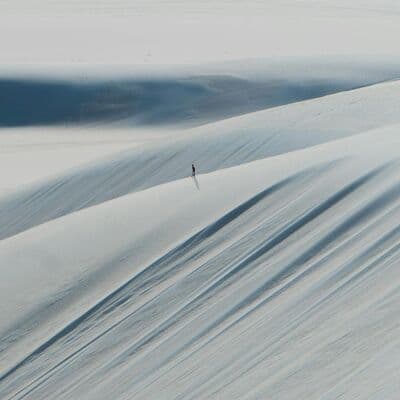
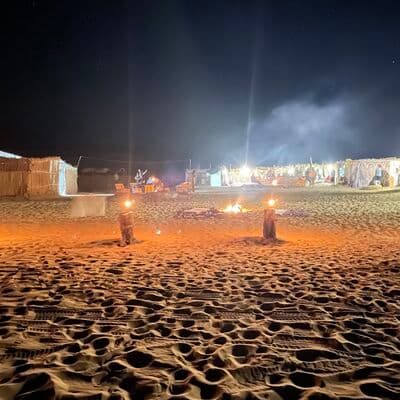
The White Desert (Sahara el-Beida) is one of the strangest places on Earth. White chalk rocks, wind-sculpted into fantastic shapes: mushrooms, towers, chickens, sphinxes. An alien landscape, especially at sunrise and sunset when stone turns pink, orange, purple. At night: absolute silence and stars. Visitors come with overnight stays: jeeps, tents, campfire, Bedouin dinner. Organized from Bahariya (half-day trip with return or overnight).
The Black Desert (Sahara el-Suda) lies en route from Bahariya to the White. Hills covered in black basalt gravel, like scattered coal. Striking contrast with yellow sand around. Crystal Mountain stands here — a hill with quartz crystals sparkling in sunlight.
Farafra is the oasis beyond the White Desert, smallest and most isolated. One main street, a few thousand residents, hot springs, silence. Badr Museum is a local artist's house, everything around decorated with strange sculptures and paintings. Farafra is for those wanting to disappear from the world for a few days.
Dakhla and Kharga are southern oases, part of the New Valley administrative region. Dakhla is more picturesque: the medieval fortress of Al-Qasr with narrow streets, hot springs, dunes on the horizon. Kharga is the administrative center, more developed, with the Temple of Hibis (Persian period) and Al-Bagawat necropolis (early Christian tombs with frescoes). From Kharga, the 'Pharaohs' Road' runs through the desert to Luxor — an ancient caravan route.
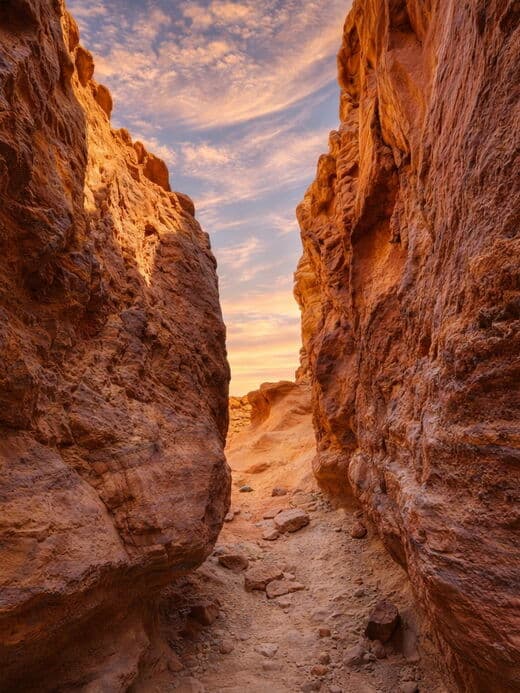
The Sinai Desert offers different beauty. Sinai is the peninsula between Africa and Asia, mountainous, ravine-cut. Red canyons, colored rocks, Bedouin camps. Main points: Mount Sinai and St. Catherine's Monastery (accessible from Sharm), the Colored Canyon — a geological wonder with rocks in every shade from yellow to purple. Sinai is Bedouin land; jeep safaris, treks, trips to Ain Khudra oasis are organized here.
The Eastern Desert lies between the Nile and Red Sea. Less touristed but interesting: Roman quarries at Mons Porphyrites (where porphyry for palaces was extracted), early Christian monasteries (St. Anthony's, St. Paul's — among the world's oldest), prehistoric rock art. From Hurghada, jeep safaris to Bedouins and desert quad-biking are organized, but these are more attractions than genuine immersion.
When to Visit
Egypt welcomes visitors year-round, but choosing the right region and season matters. Planning mistakes can turn a vacation into an ordeal: 113F / 45C heat in Luxor in July is no joke.
October through April is ideal for cultural sightseeing. Cairo, Luxor, and Aswan enjoy comfortable 68-86F / 20-30C daytime temperatures; you can spend hours walking through temples and tombs without heat-stroke risk. Nights are cool, especially December-January (can drop to 50-60F / 10-15C) — bring warm clothing for evening walks. December-January is peak season: maximum prices, crowds at Giza and the Valley of the Kings, need to book hotels and tours in advance. February brings khamsin risk — dry, dusty winds from the desert. They last 2-3 days; skies turn yellow, visibility drops, sand gets everywhere. Unpleasant but brief — wait it out in your hotel or a museum.
March-April and October-November are the 'golden' shoulder seasons. Warm (77-95F / 25-35C) but not deadly hot. Fewer tourists than winter. Slightly lower prices. Ideal for those wanting to combine sightseeing and beach.
May through September brings extreme inland heat. Luxor and Aswan reach 104-113F / 40-45C in the shade (and temple shade is scarce). Walking through the Valley of the Kings in July risks heat stroke. Locals don't go outside from 11 AM to 5 PM. If traveling to Upper Egypt in summer, start excursions at 6 AM, return to your hotel by 10, wait out the heat in air conditioning, go out in the evening.
Red Sea (Hurghada, Sharm) works year-round. Summer is hot (over 104F / 40C in air) but water saves you — 82-86F / 28-30C; you can spend all day in the sea. Best diving months: March-May and September-November: water is warm, visibility excellent (100-130 feet / 30-40 meters), no strong winds. Winter (December-February) water is around 72-75F / 22-24C — too cool for some; a wetsuit helps for comfortable diving. February-March winds can disrupt diving — waves, closed dive sites.
Siwa and deserts: October through April only. Summer temperatures reach 113-122F / 45-50C — not for tourism, but medical risk. Best time: October-November and March-April: warm days (86-95F / 30-35C), comfortable nights (59-68F / 15-20C). Winter (December-February) nights are cold (can drop to 41-50F / 5-10C); a warm sleeping bag is needed for desert overnights.
Mediterranean (Alexandria, Marsa Matruh): conversely, better in summer (June-September). That's when Egyptians come — escaping Cairo's heat. Air temperature 82-90F / 28-32C, water 75-79F / 24-26C — refreshing compared to the Red Sea. Winter brings rain, wind, and unpleasantness to the coast. Beach season is closed; some infrastructure doesn't operate.
Religious holidays affect travel. Ramadan is the Muslim fasting month: believers don't eat or drink during daylight. Many restaurants close until sunset, attraction hours shorten, the general life rhythm slows. On the other hand, iftar (the evening meal after sunset) is a unique cultural experience: streets come alive, tables are set, the atmosphere is festive. Ramadan dates shift annually (lunar calendar) — check in advance. In 2026, Ramadan runs approximately late February through late March.
Eid al-Fitr (end of Ramadan) and Eid al-Adha (Feast of Sacrifice, 70 days after Ramadan) trigger domestic tourism booms. Egyptians flock to resorts, prices spike, beaches overflow. If that's not your scene — avoid these weeks. If you want to see how Egyptians vacation — conversely, it's interesting.
Coptic Christmas (January 7) and Easter (movable date) are important for the Christian minority. They affect tourists little, but Coptic Cairo and monasteries may be crowded.
Getting There
Egypt's main international airports: Cairo (CAI), Hurghada (HRG), Sharm el-Sheikh (SSH), Luxor (LXR), and Alexandria (HBE — Borg El Arab, ALY — old airport).
From the United States: Direct flights to Cairo operate from New York (JFK) on EgyptAir — approximately 11 hours. From other US cities, connections through European hubs (London, Paris, Frankfurt, Amsterdam) or Middle Eastern hubs (Dubai, Doha, Istanbul) are common. Round-trip fares vary from $600-1500 depending on season and how far ahead you book. Peak season (December-January) and last-minute bookings cost more.
From the United Kingdom: Direct flights to Cairo from London (Heathrow, Gatwick) take about 5 hours; multiple airlines serve this route. Direct flights to Hurghada and Sharm also operate from various UK airports — around 5-6 hours. Budget carriers sometimes offer deals to Red Sea resorts, especially in off-season.
From Australia: No direct flights; connections through Dubai, Doha, or Singapore are typical. Flight time is 20+ hours total. Consider breaking the journey with a stopover.
Cairo is the country's main hub. From here, reaching anywhere is easy: domestic flights (EgyptAir, Air Cairo) to Luxor, Aswan, Abu Simbel, Hurghada, Sharm. Trains along the Nile to Alexandria, Luxor, Aswan. Buses in all directions — to Sinai, oases, Red Sea, Mediterranean.
Visa: US, UK, Australian, Canadian, and most EU citizens receive visas on arrival — a stamp in your passport at the airport. Cost: $25 USD (payable by card or cash in dollars/euros). Processing takes 5-10 minutes: approach the window, pay, they affix a sticker, proceed to passport control. No advance application needed. The visa is valid for 30 days, single entry. Extensions are possible at Cairo's Mogamma (huge administrative building at Tahrir Square) — bureaucratic but doable.
Exception: the Sinai Stamp — a free stamp for 15 days for those entering through Sharm, Taba, or Dahab and staying only in South Sinai. Pro: save $25. Con: you can't leave South Sinai — Cairo, Luxor, Hurghada are off-limits. If planning only beach time in Sharm, the stamp suffices. If wanting excursions beyond Sinai, get the regular visa.
Getting Around
Domestic flights are the fastest way to move. Cairo to Luxor: 1 hour. Cairo to Aswan: 1.5 hours. Cairo to Hurghada: 1 hour. Cairo to Sharm: 1 hour. Aswan to Abu Simbel: 30 minutes. Prices start from $50-70 one-way when booking ahead on airline websites. EgyptAir is the main carrier, the national airline. Air Cairo is a budget alternative, an EgyptAir subsidiary — lower prices, simpler service. Fares rise closer to departure date — book 2-4 weeks ahead.
Trains are a classic Egyptian travel experience. The railway runs along the Nile from Alexandria through Cairo to Aswan. These aren't high-speed trains — slow, with stops — but with views of Egyptian countryside: sugarcane fields, villages, water buffalo in canals.
Cairo to Alexandria route: 2.5-3 hours, frequent trains. First class costs around 100-150 EGP ($2-3), comfortable seats with air conditioning. Second class is cheaper but hot and noisy. 'Spanish' express trains (Talgo) are slightly faster and pricier.
Cairo to Luxor to Aswan route: 10-13 hours (9-10 to Luxor, 12-13 to Aswan). Daytime trains are exhausting — long, hot even with air conditioning. Overnight sleeper trains (Watania Sleeping Trains) are much better: two-berth cabins with beds, air conditioning, dinner and breakfast included; board in Cairo at night, wake up in Luxor or Aswan. Cost around $80-100 per person one-way. Book on the official website (wataniasleepingtrains.com) or through your hotel — at stations, foreigners are sometimes refused ticket sales (strange policy, but it happens).
First class on daytime trains is comfortable for short distances. Second class is for adventurers and backpackers: hot, noisy, locals with chickens and bundles, but authentic and very cheap (literally a dollar or two to Alexandria).
Buses cover the country extensively. Several companies, varying comfort levels. GoBus is a modern carrier with online booking, air conditioning, wifi, outlets. Website and app in English, card payment accepted. SuperJet is an old reliable company; buses slightly simpler but they run. Upper Egypt Bus goes to Luxor and Aswan, budget option. West Delta serves the Mediterranean and Siwa.
Main routes from Cairo: Hurghada — 5-6 hours, 200-400 EGP ($4-8). Sharm — 6-7 hours, 250-450 EGP ($5-9). Alexandria — 3 hours, 100-200 EGP ($2-4). Siwa — 8-9 hours, 200-300 EGP ($4-6). Luxor — 10-11 hours, 250-400 EGP ($5-8) (train or plane is better). Buses depart from various stations: Turgoman (center), Almaza (Heliopolis), 6th October (suburb). Confirm when booking.
Taxis and rideshare: In cities, use Uber, Careem (Middle Eastern equivalent), or InDrive. This eliminates bargaining and route worries. Fixed prices, GPS routing, card or cash payment. Works in Cairo, Alexandria, Hurghada, Sharm. Regular taxis require negotiating before boarding — exhausting, especially after a long flight. If taking a regular taxi, learn approximate fares beforehand (ask at your hotel), name your price, don't get in until you've agreed. Driver's initial price may be 3-5 times reasonable.
Car rental is for the brave and experienced. Egyptian traffic is chaos without rules. Horns instead of turn signals. Lanes are suggestions; on a three-lane road, five rows drive. At night, many drive without headlights ('to avoid blinding oncoming traffic' — the logic?). The shoulder is another lane. Donkeys, tuk-tuks, pedestrians on highways. Police stop you for bribes, not violations. If none of this scares you — rent from international companies (Hertz, Avis, Europcar) at airports or major cities. Get full insurance. International driving permits required. Outside cities, roads improve — highways along the Red Sea and in Upper Egypt are decent.
Feluccas, cruises, dahabiyas are ways to travel the Nile between Luxor and Aswan. Feluccas are traditional sailboats with a single lateen sail. Romantic, authentic, but basic: sleep on deck under stars, the toilet is the river (or shore stops), cooking on a camp stove. Sail 2-3 days, dependent on wind and current. Organized in Aswan — many boatmen offer tours. Cruise ships range from three-star (old but functional) to five-star (pool deck, spa, fine dining). 3-4 nights, temple stops, excursions included. Book ahead, especially in season. Dahabiyas are small sailing yachts for 10-12 passengers, compromising between authenticity and comfort. Cabins with facilities, but sailing, slow, quiet. More expensive than cruises but more atmospheric.
Cultural Code
Egypt is a Muslim country with rich cultural heritage and its own rules of engagement. Understanding local norms not only makes your trip more pleasant but helps avoid awkward situations. Egyptians are generally tolerant of tourists and their mistakes, but respect for local culture is always appreciated.
Dress: At Red Sea resorts, the dress code is relaxed — shorts, tank tops, swimsuits (on the beach) are fine. This is a tourist zone; they're used to it. In Cairo, Luxor, Aswan, and anywhere outside resorts, dress more modestly. Women should cover shoulders and knees, avoiding tight clothing. Men do better in long pants than shorts (though shorts aren't forbidden). This isn't law but respect — and practicality: in modest clothing, you attract less attention, receive fewer comments, are taken more seriously.
In mosques, rules are strict: long sleeves, long pants/skirts, women must cover their heads. Shoes are removed at the entrance. At major mosques (Al-Azhar, Muhammad Ali), robes are provided at the entrance if your clothing is unsuitable. Some mosques don't admit tourists during prayer times — check.
Photography: Ask permission before photographing people, especially women. 'Mumkin sura?' (May I take a photo?) is a useful phrase. Many agree; some don't. Children are photographed readily (but parents may request baksheesh). In military zones, near Nile bridges, at police stations, at government buildings — photography is forbidden and enforced. In museums and tombs, there's often a separate photo/video fee or a complete ban. In the Valley of the Kings, it's officially forbidden, but everyone photographs; guards look away (for baksheesh) or issue reminders. Officially — not allowed.
Baksheesh: The system of tips and small gratuities pervades all Egypt. This isn't corruption in the Western sense — it's a cultural norm, part of the social contract. A temple guard shows you a 'secret' room or lets you climb where usually prohibited — they expect baksheesh. Someone 'helps' you take a photo (stands in your shot and presses the button on your phone) — they expect money. Bathroom attendants, parking helpers, porters, waiters — everyone expects something. This isn't extortion (usually); it's expectation. You can refuse — smile, say 'la shukran' (no, thank you), walk on. Giving is also fine if the service was real. Keep small bills handy: 10-20 EGP for small help, 50-100 for something substantial. Don't overpay — it spoils the market for other tourists and locals.
Bargaining: In bazaars, souvenir shops, with taxi drivers — bargaining is mandatory. Initial prices may be 5-10 times real value. This isn't cheating — it's a game, part of the culture. Rules: smile, be friendly. Don't show you really want the item. Name your price (roughly a third of the initial). The seller will gasp, clutch their heart, say this is below cost. You smile, raise slightly. They lower slightly. If you can't agree — politely walk away. Often they'll call you back. If not — either your price was truly unrealistic, or that seller doesn't bargain. No bargaining in supermarkets, restaurants, hotels, for tickets — those are fixed prices.
Interaction: Egyptians are warm, hospitable, curious people. They'll ask where you're from, how you like Egypt, if you're married, if you have children. This is normal; don't perceive it as intrusive — it's genuine interest. In tourist areas, people are accustomed to seeing foreigners as income sources — hence the persistent vendors, touts, 'friends' offering help. Don't take it personally — a firm 'la shukran' (no, thank you), repeated without smiling, usually works. Outside tourist zones, attitudes differ: you'll be offered tea, invited home, shown family photos, asked for selfies together. This isn't a trick — it's Egyptian hospitality.
Religion: Islam is part of daily life. The call to prayer sounds five times daily; many men pray in mosques; women wear hijab (but not all — it's a choice). Respect this: don't be loud near mosques during prayer, don't criticize religion aloud, don't enter mosques in inappropriate clothing. During Ramadan, don't eat, drink, or smoke on the street during daytime (in front of fasting people, it's impolite). Inside hotels — you can.
Friday: The weekend day in the Muslim world. Many shops are closed or open from 2 PM. Attractions usually stay open but may have shortened hours. During Friday prayer (around 12:30-1:30 PM), life pauses — especially noticeable in old quarters where streets empty and sermons drift from mosques.
Alcohol: Egypt is Muslim but alcohol isn't banned. It's sold in special shops (Drinkies, Cheers), bars, restaurants, hotels. At resorts — no restrictions; at all-inclusive hotels — obviously. In cities — don't drink on the street; it's disrespectful. During Ramadan, alcohol sales are limited (shops closed, restaurants don't serve), but hotels provide for foreigners.
LGBTQ: Homosexuality isn't formally criminalized but is prosecuted under other statutes ('debauchery,' 'public morality violation'). Egypt is a conservative country; public same-sex displays are risky. For LGBTQ travelers: be discreet, avoid public displays, choose international hotels.
Safety
Egypt is generally safe for tourists. Violent crime rates are low — robberies, assaults are rare. Tourism is an important economic sector; authorities are invested in visitor safety. Terrorist threats concentrate in remote areas (North Sinai, Libyan border) where tourists aren't allowed anyway.
Petty crime: Pickpocketing occurs in crowds — at markets, on transport, at attractions. Watch your belongings; don't keep your wallet in your back pocket; don't flash expensive gear. Scams are common: inflated prices (especially for foreigners), 'closed' attractions with alternative suggestions, fake guides, 'free' services that turn out to be paid. Verify information, don't succumb to pressure, learn prices beforehand.
Typical scams: 'The museum is closed today, but I can show you something better' (the museum is open; they're taking you to a papyrus shop). 'Free tour' (then demanding huge tips). 'I'm not a seller, just a student wanting to practice English' (ending at their uncle's shop). 'This camel is free, just for photos' (dismounting costs money). Stay alert but not paranoid — most Egyptians are honest and friendly.
Road safety: The main real risk in Egypt. Egyptian roads rank among the world's most dangerous by accident statistics. Drivers are aggressive, rules ignored, lanes are suggestions. If renting a car — exercise extreme caution, trust no one. In taxis, buckle up (if belts exist). Night drives between cities — try to avoid: trucks without lights, tired drivers. Better to depart mornings.
For women: Harassment (verbal and physical) is unfortunately common. Street comments, staring, sometimes touching in crowds. This isn't normal; it isn't 'culture' — Egyptian women suffer from it even more. But reality is reality. What to do: dress modestly outside resorts; avoid deserted places alone (especially evenings and nights); don't respond to comments (it encourages); use women's cars on Cairo metro. If something happens — loudly attract attention: 'Haram! Ib'id!' (Shame! Go away!). Egyptians usually side with women; aggressors are shamed or detained.
Tourist Police: Present at all attractions, at airports, at stations. They wear white uniforms, speak English, generally help. If there's a problem — approach them. Emergency numbers: 122 (police), 123 (ambulance), 180 (tourist police).
Restricted zones: North Sinai (from El-Arish to the Gaza border) is a military operations zone against terrorists; entry forbidden. The Western Desert near the Libyan border requires permits; independent travel prohibited. Areas near the Sudanese border — likewise. Don't try to go — police will turn you back or detain you. Current advisory information is on your country's foreign affairs website under 'Egypt.'
Health and Medical
No special vaccinations are required for Egypt (unless arriving from a yellow fever country — then a vaccination certificate is needed). Standard vaccine updates are recommended: Hepatitis A (transmitted through water and food), typhoid (same). Hepatitis B and rabies — if planning extended rural stays or animal contact.
'Pharaoh's Revenge' (Egyptian belly, traveler's diarrhea) — the stomach upset that catches most tourists at least once. Cause: new bacterial environment the body isn't used to. Prevention: drink only bottled water (check the seal is intact); avoid ice in drinks (ice often made from tap water); don't eat fresh salads or cut fruits at questionable places (vegetables washed in tap water); wash hands before eating; be cautious with street food (hot is safer than cold). Bring anti-diarrheal medication: loperamide (Imodium), activated charcoal, oral rehydration salts (ORS). If symptoms are severe (blood in stool, high fever, dehydration) — see a doctor.
Sun and heat: Egyptian sun is aggressive — you can burn in 30 minutes, especially on water. Use SPF 50+, reapply every 2 hours, especially after swimming. Wear a hat, sunglasses. Drink lots of water — minimum 2-3 liters daily, more with activity. Heat stroke is a real danger, especially in temples and tombs without air conditioning or shade. Symptoms: dizziness, nausea, confusion, cessation of sweating. First aid: get to shade, apply cool water to the body, drink, call a doctor.
Marine life: The Red Sea is rich with life, including potentially dangerous. Don't touch anything with your hands — many fish, corals, mollusks are venomous or injure. Don't step on corals (for safety and ecology — corals are fragile). Stonefish camouflage on the bottom — watch where you step. Sea urchins — spines break under skin, painful to extract. Jellyfish — stings are painful. Sharks — attacks are extremely rare, but incidents happen (2010, 2015, 2022). Follow lifeguard instructions, don't swim far alone, don't swim at dusk. Coral cuts heal slowly and infect easily — treat with antiseptic immediately.
Travel insurance is essential. Ensure it covers evacuation and repatriation. Cairo and major cities have decent private clinics (As-Salam International Hospital, Dar Al Fouad). At resorts — basic hotel medical help and local clinics; serious cases mean evacuation to Cairo. If something happens — call your insurance company; they'll direct you to an appropriate clinic.
Money and Budget
Egypt's currency is the Egyptian pound (EGP, LE — from 'livre egyptienne'). The exchange rate is floating and volatile: in 2022-2024, the pound devalued multiple times (from 15 to 50+ per dollar). Check current rates before your trip — they affect all prices.
Currency exchange: At the airport is convenient (exchange offices work 24/7), rates slightly worse than in the city, but the difference is small. Exchange enough for your first few days. Banks and official exchange offices (in malls, hotels) offer the best rates. Don't exchange on the street — risk of fraud (miscounting, counterfeits) and it's technically illegal. ATMs are everywhere; withdraw Egyptian pounds with your card. Fees depend on your bank.
Cards: Visa and Mastercard are accepted at hotels, major restaurants, supermarkets, malls. At bazaars, small shops, taxis, markets — cash only. Have enough cash, especially outside major cities and resorts.
ATMs are widely available; some dispense both EGP and USD. Notify your bank before traveling to avoid card blocks for suspicious foreign activity.
Budget levels:
Budget ($30-50/day): Hostels or budget hotels ($10-20/night). Street food and local cafes (ful, koshari, falafel — 20-50 EGP per portion). Public transport (Cairo metro, buses). Self-guided walks. Attraction tickets are the main expense.
Mid-range ($70-120/day): Three-star hotels or decent guesthouses ($30-60). Mid-range restaurants (200-400 EGP per meal). Taxis and Uber for transport. Organized tours with guides. Occasional domestic flights.
Comfortable ($150-250/day): Four-five star hotels ($80-150). Good restaurants (500-1000 EGP). Private guides and cars with drivers. Domestic flights. Nile cruises. Diving tours.
Luxury ($300+/day): Legendary hotels (Old Cataract in Aswan, Sofitel Winter Palace in Luxor, Four Seasons in Cairo). Best restaurants. Personal tours with Egyptologists. Yachts, private planes. No upper limit.
Sample prices (2026, may change with exchange rate):
- Giza Pyramids entry: 450 EGP (~$9)
- Entry inside Great Pyramid (additional): 400 EGP (~$8)
- Grand Egyptian Museum: 600 EGP (~$12); Tutankhamun gallery additional 400 EGP (~$8)
- Valley of the Kings (basic ticket, 3 tombs): 400 EGP (~$8)
- Tutankhamun's tomb (additional): 300 EGP (~$6)
- Nefertari's tomb (Valley of the Queens): 1400 EGP (~$28)
- Hot air balloon ride (Luxor): $80-150
- Street ful or koshari: 20-50 EGP (~$0.50-1)
- Local restaurant lunch: 150-300 EGP (~$3-6)
- Nice restaurant dinner: 500-1000 EGP (~$10-20)
- Uber across Cairo (6 miles / 10 km): 50-100 EGP (~$1-2)
- Water bottle (1.5L): 10-20 EGP (~$0.25-0.50)
- Felucca hour in Aswan: 200-400 EGP (~$4-8) per boat
- Giftun Island excursion: $25-40
- PADI Open Water course (3-4 days): $300-400
Top Itineraries
7 Days: Egypt Classics
This itinerary covers the essentials in a week: pyramids, Luxor temples, a taste of Aswan. Intensive but achievable.
Day 1: Arrival in Cairo
Arrive at Cairo International Airport. Visa on arrival, currency exchange, transfer to hotel. If you arrive morning and have energy — stroll along the Nile corniche, dinner in Zamalek (island on the Nile with cafes and restaurants). If arriving evening — rest; early start tomorrow.
Day 2: Pyramids and Grand Egyptian Museum
Early morning (depart 7:00 AM) — Pyramids of Giza and Great Sphinx. 2-3 hours at the complex: exterior viewing, enter a pyramid (if desired), photos with Sphinx. By 11:00 AM — to the Grand Egyptian Museum (GEM), which is nearby. 4-5 hours at the museum, lunch at the museum cafe. Evening — return to central Cairo, dinner, rest. Optional — Sound and Light Show at the pyramids (if not too tired).
Day 3: Saqqara and Islamic Cairo
Morning — trip to Saqqara (Step Pyramid of Djoser, tombs). If time permits — Dahshur (Bent and Red Pyramids). Return by lunch. Afternoon — Islamic Cairo: Citadel with Muhammad Ali Mosque, walk down to Khan el-Khalili via Al-Muizz Street. Dinner at a bazaar cafe, tea, shisha.
Day 4: Fly to Luxor, East Bank
Morning flight Cairo to Luxor (about 1 hour). Check into hotel. Lunch. Afternoon (when heat subsides) — Karnak Temple. 2-3 hours of exploration, sunset among the columns. Evening — Luxor Temple illuminated, corniche stroll, dinner.
Day 5: Luxor West Bank
Very early wake-up (4:30 AM) — hot air balloon ride over the West Bank (optional but highly recommended). Landing around 7:00 AM. Then — Valley of the Kings (3 tombs on basic ticket + Tutankhamun for extra). Temple of Hatshepsut. Colossi of Memnon (free, en route). Lunch. If time remains — Medinet Habu or Valley of the Queens. Return to East Bank, rest.
Day 6: Aswan
Morning move to Aswan: train (about 3 hours) or car with stop at Temple of Kom Ombo. Arrival by lunch, check in. Afternoon — Philae Temple (boat to island, tour, return). Evening — felucca ride on the Nile (1-2 hours, negotiate on the corniche), sunset on water. Dinner at a Nubian restaurant.
Day 7: Aswan and departure
Morning — Nubian village (boat or camel, 2-3 hours). Or: free time, bazaar, corniche. After lunch — fly Aswan to Cairo, connect to your international flight home. Alternative: if you have time, add a day for Abu Simbel (early 3 AM departure or overnight there).
10 Days: Nile and Sea
Classics + Nile cruise + Red Sea relaxation. A balanced itinerary for those wanting both culture and beach.
Days 1-3: Cairo
As in the 7-day itinerary: pyramids, museum, Saqqara, Islamic Cairo. Add Coptic Cairo (day 3 morning), Ibn Tulun Mosque. If time remains — Cairo Tower at sunset or Baron Empain Palace.
Days 4-6: Nile Cruise (Luxor — Aswan)
Day 4: Morning flight to Luxor. Board cruise ship. Afternoon — Karnak Temple. Evening — Luxor Temple. Night on board.
Day 5: Early morning — Valley of the Kings, Temple of Hatshepsut, Colossi of Memnon. Return to ship, lunch, sail south. Evening — Temple of Esna stop (or pass through the lock). Night on board.
Day 6: Morning — Temple of Kom Ombo. Continue sailing. Afternoon — arrive in Aswan, Philae Temple. Night on board in Aswan.
Day 7: Abu Simbel
Early departure (3:00-4:00 AM) by bus or fly to Abu Simbel. Tour the temples (2-3 hours). Return to Aswan by midday. Free time: bazaar, corniche, Nubian village. Night in Aswan (hotel).
Days 8-10: Hurghada
Day 8: Fly or transfer from Aswan to Hurghada (flight via Cairo or direct transfer 4-5 hours). Check into hotel, beach, relax.
Day 9: Beach, pool, relaxation. Or: Giftun Island excursion (snorkeling, beach). Evening — Marina stroll.
Day 10: Beach until midday. Transfer to airport, fly home.
14 Days: Full Immersion
Two weeks allows seeing more without rushing. Cairo, cruise, Abu Simbel, sea — all with breathing room.
Days 1-4: Cairo and surroundings
Day 1: Arrival, rest, evening stroll.
Day 2: Pyramids of Giza, Sphinx, Grand Egyptian Museum.
Day 3: Saqqara, Dahshur. Evening — Citadel, Khan el-Khalili.
Day 4: Coptic Cairo, Ibn Tulun Mosque, old Egyptian Museum (if desired). Free evening or Cairo Tower.
Day 5: Day trip to Alexandria
Early train Cairo to Alexandria (2.5 hours). Bibliotheca Alexandrina, Citadel of Qaitbay, catacombs, fish lunch on the corniche. Evening train back to Cairo. Night in Cairo.
Days 6-9: Cruise Luxor — Aswan (4 days / 3 nights)
Day 6: Fly to Luxor. Board cruise. Karnak, Luxor Temple.
Day 7: Early morning — hot air balloon (optional). Valley of the Kings, Valley of the Queens (Nefertari), Temple of Hatshepsut, Medinet Habu. Sail.
Day 8: Esna, Kom Ombo. Arrive Aswan.
Day 9: Philae Temple. Disembark, check into hotel. Free time in Aswan.
Day 10: Abu Simbel
Trip to Abu Simbel with overnight. Arrive by evening, tour temples without crowds. Sound and Light Show. Night in Abu Simbel.
Day 11: Abu Simbel and transfer
Sunrise at temples (if you're up for it). Return to Aswan. Nubian village. Evening — fly to Hurghada (via Cairo) or night in Aswan.
Days 12-14: Red Sea
Hurghada or Sharm el-Sheikh — your choice. Beach, snorkeling, diving (if interested). Giftun Island or Ras Mohammed excursion. Final day — relax before flight.
21 Days: Everything
Three weeks allows deep immersion. Cairo, Alexandria, Siwa, Luxor, Aswan, Abu Simbel, Red Sea. This isn't a vacation; it's an expedition.
Days 1-4: Cairo
As in the 14-day itinerary, but without rushing. Add Baron Empain Palace, Nilometer, an evening at a jazz club or a rooftop with pyramid views.
Days 5-6: Alexandria
Train to Alexandria, 2 nights. Bibliotheca Alexandrina, Citadel of Qaitbay, catacombs, Pompey's Pillar, Montazah Gardens. Seafood, coffee, Corniche strolls.
Days 7-9: Siwa Oasis
Bus from Alexandria or Marsa Matruh to Siwa (5-6 hours). 3 nights in the oasis. Shali Fortress, Temple of the Oracle, Cleopatra's Spring, salt lakes. Desert safari with overnight in the Great Sand Sea, Bir Wahed hot spring, stars over the desert. Sunsets on Fatnas Island.
Days 10-11: Marsa Matruh and return
Bus to Marsa Matruh. Beach day: Agiba, El Gharam. Overnight. Next day — bus to Cairo (or Alexandria and train). Night in Cairo.
Days 12-15: Luxor and Aswan
Day 12: Fly or overnight train to Luxor. Karnak, Luxor Temple.
Day 13: Hot air balloon, Valley of the Kings, Hatshepsut, Medinet Habu.
Day 14: Excursion to Dendera and Abydos (long day but worth it).
Day 15: Move to Aswan with Kom Ombo stop. Philae Temple in the evening.
Day 16: Abu Simbel
Abu Simbel with overnight — as in the 14-day itinerary.
Day 17: Return and Nubian village
Morning at the temples. Return to Aswan. Nubian village by boat. Evening flight to the Red Sea.
Days 18-21: Red Sea
4 days of full relaxation in Hurghada or Sharm. Beach, diving (you could complete a PADI course in 3-4 days), snorkeling, Ras Mohammed or Giftun. A day in El Gouna for variety. Massage, spa, doing nothing. Fly home.
Connectivity and Internet
Mobile internet in Egypt is affordable and fast enough for most needs. Three main operators: Vodafone (red), Orange (orange), Etisalat (green). Coverage is roughly equal; cities and resorts have excellent 4G, remote areas less so.
Buy a SIM card at the airport — operator counters work 24/7 in arrival halls. Process: show passport, choose a plan, pay, they activate the SIM. Takes 10-15 minutes. Tourist packages typically include 10-20 GB of data plus calls for 30 days, costing 200-500 EGP ($4-10) depending on volume. City phone shops offer the same prices or slightly cheaper.
4G/LTE works in Cairo, Alexandria, Luxor, Aswan, all Red Sea resorts. In the desert, in Siwa, en route to Abu Simbel — connection is unstable, sometimes only 2G or nothing. In tombs and temples (underground, within thick walls) — often no signal; that's normal.
WiFi is available in almost all hotels — from free basic to paid fast. Quality varies: five-stars usually have good WiFi, budget places are hit-or-miss. Cafes, restaurants, malls usually have free WiFi. Trains and intercity buses — advertised but often non-functional or very slow.
What to Try
Egyptian cuisine is among the world's oldest, inheriting from pharaohs and resulting from millennia of mixing Arab, Mediterranean, and African influences. It deserves as much attention as the pyramids. Many tourists, especially at all-inclusive resorts, never try real Egyptian food — a mistake.
Koshari is the number-one national dish, which you won't find in any other world cuisine. Rice, pasta, lentils, chickpeas, fried onions, and spicy tomato sauce — all in one bowl, all mixed together. Sounds like a strange combination, but it's delicious, filling, and dirt-cheap (20-50 EGP / $0.50-1 per portion). The best koshari comes from Cairo street shops where it's made before your eyes in huge pots. The Abou Tarek chain is touristy but quality; real gems are tiny nameless joints.
Ful medames is stewed fava beans, the foundation of Egyptian breakfast for millennia. Beans cook overnight in a special pot; mornings they're served with olive oil, lemon juice, garlic, cumin. Eaten with Egyptian bread (aish), dipping it in the ful. Add taamiya (Egyptian falafel — made from fava beans, not chickpeas like Levantine versions) and you have the perfect local breakfast for 30-50 EGP ($0.75-1).
Molokhia is a soup or sauce from jute leaves (similar to spinach but with a characteristic slimy texture). Cooked with chicken, rabbit, or meat, served over rice. The texture is specific — not everyone likes it at first. But if you develop a taste, you'll be hooked. This is one of those dishes Egyptians abroad miss most.
Kebab and kofta are grilled meat, Middle Eastern classics. Kebab is marinated lamb or beef chunks. Kofta is spiced ground meat formed on skewers. Served with bread, salad, tahini. Try at local joints like Abou El Sid (Cairo) or simply street grills — fresh and tasty.
Hamam mahshi is stuffed pigeon, an Upper Egypt delicacy (Luxor, Aswan). Pigeons are raised specifically for eating — small, with dark meat. Stuffed with rice or freekeh (green wheat). Eaten with hands, sucking meat from bones. Looks unusual but tastes good.
Seafood — in Alexandria and along the Red Sea coast. Fish, shrimp, calamari, mussels — all fresh and affordable. In Alexandria, it works like this: enter a fish restaurant, choose fish from the display (or straight from a fisherman's tray), say how to cook it (grilled, fried, baked), they weigh it, cook it, serve with salads and bread. You pay by weight. Fish Market, Kadoura are famous places, but small corniche joints are also good.
Feteer is an Egyptian layered pie, similar to Turkish borek. Available sweet (with honey, powdered sugar, cream) or savory (with cheese, meat, vegetables). Feteer meshaltet is the version with many layers, airy and crispy.
Desserts: Basbousa is a semolina cake soaked in syrup, nuts on top. Kunafa is thin vermicelli (kataifi) with cheese or nut filling, drizzled with syrup. Om Ali is Egyptian bread pudding: puff pastry, milk, nuts, raisins, coconut, baked to a golden crust. One of the best desserts you'll ever try. Served hot.
Drinks: Karkade is hibiscus flower drink, ruby-colored, tart. Drunk cold (refreshing in heat) or hot. Sahlab is a milk drink with starch, cinnamon, nuts, served in winter. Asab is fresh sugarcane juice, sold on streets from special presses. Fresh juices — mango, guava, strawberry, orange — at any cafe, cheap and delicious.
Egyptian coffee (ahwa) is strong, sweet, brewed in a small pot (cezve), often with cardamom. Order: sada (no sugar), ariha (little sugar), mazboot (medium), ziyada (very sweet). Don't drink the grounds — leave them at the bottom. Tea (shai) is red, very sweet, sometimes with mint (shai bil na'na). Tea with milk is shai bil laban.
Alcohol: Egypt is Muslim but alcohol isn't banned. Local beers Stella (not Belgian Stella Artois) and Sakara are light, refreshing, decent. Wine is worse; Egyptian winemaking isn't developed (though Gianaclis and Omar Khayyam try). At resorts — everything available in hotels. In cities — at special shops (Drinkies, Cheers); few but findable. During Ramadan, sales are restricted.
Shopping
Egypt is a paradise for lovers of souvenirs, antiques (mostly fake), jewelry, spices, and textiles. But you need to distinguish real from fake and know how to bargain.
What to bring home:
- Papyrus: Real papyrus is made from the papyrus plant using ancient techniques — durable, doesn't crack when bent, expensive (from 100 EGP for small to thousands for large artistic pieces). Fakes are made from banana leaves; they crack, yellow. At bazaars, 90% are fakes at inflated prices. For genuine papyrus, go to specialized shops: Dr. Ragab's Papyrus Institute (Cairo, several locations), Papyrus Museum (Luxor). They'll also explain the history and show production.
- Essential oils and perfume: Egypt is a major essential oil producer: jasmine, rose, lotus, oud, sandalwood. Buy at verified places — many diluted and synthetic fakes. Aswan traditionally has higher quality. Don't fall for 'this is the same as Chanel No. 5, only real' — that's marketing.
- Egyptian cotton: Among the world's best — long-staple, soft, durable. Bedding, towels, shirts. Buy at brand shops (Mobaco, Concrete, Cotton Egypt) or malls. At bazaars — often not Egyptian cotton but Chinese passed off as Egyptian.
- Spices: Saffron (careful — many fakes), cumin, coriander, dukkah mix (spices with nuts, sesame), dried hibiscus for karkade. At Khan el-Khalili bazaar or Aswan market — wide selection, bargain.
- Alabaster: Figurines, vases, lamps made from local alabaster (stone resembling marble). Workshops concentrate in Luxor, near the Valley of the Kings. You can watch the carving process there. Quality varies — from crude souvenirs to fine craftsmanship.
- Copper and brass items: Trays, coffee pots, Arabic-style lamps. Khan el-Khalili is the best place, but prepare to bargain fiercely.
- Cartouches: Your name in Egyptian hieroglyphics on a gold or silver pendant, bracelet, ring. Made while you wait in 15-30 minutes. A popular souvenir, but check metal purity.
- Leather: Bags, belts, shoes. Average quality but cheap. Tourist areas have inflated prices.
Where to shop: Khan el-Khalili in Cairo is classic — huge selection, but requires bargaining skills and quality recognition. Aswan bazaar is more relaxed, with Nubian goods (baskets, jewelry). In Luxor — alabaster workshops, papyrus galleries. At resorts — malls and hotel shops: more expensive but no haggling, quality (relatively) guaranteed.
Tax Free: The system exists but is confusing and rarely worth the effort. Minimum purchase 1500 EGP, refund up to 10%, processing at shops with Tax Free stickers, collection at the airport. Queues, bureaucracy, refund often less than expected. If purchases are large — try; if small — don't bother.
Useful Apps
- Uber / Careem / InDrive — taxis without haggling, fixed prices, card or cash payment. Works in major cities and resorts.
- Google Maps — works but not always accurate in Cairo (streets get renamed, new ones aren't added). Adequate for navigation.
- Maps.me — offline maps, download Egypt's map beforehand. Useful in the desert and areas without signal.
- XE Currency — currency converter with current EGP rates. Rates fluctuate — check often.
- Elmenus / Talabat — food delivery in major cities. Interface in Arabic and English.
- GoBus — book intercity buses online, card payment.
- Booking.com / Hotels.com — hotels. Sometimes pricier than direct or through local agencies, but convenient.
- Google Translate — with camera for translating signs and menus. Recognizes Arabic fairly well.
Final Thoughts
Egypt might seem challenging for first-time independent travelers: language barriers (though English is widespread in tourist areas), persistent vendors (you get used to it), chaotic traffic (there's Uber), different culture (people are people everywhere). But all these obstacles pay off handsomely when you stand before the pyramids at dawn, sail the Nile past temples, dive among Red Sea coral reefs, or watch sunset over Saharan dunes.
Egypt isn't just a country; it's a time machine. Nowhere else can you touch five thousand years of history so directly: tombs 35 centuries old, temples where pharaohs prayed, mummies who were people when Rome didn't yet exist. And simultaneously — it's a living, chaotic, hospitable country where past and present are woven so tightly they can't be separated.
For American, British, Australian, and other English-speaking travelers, Egypt remains highly accessible: visa on arrival, direct flights from major hubs, widespread English in tourist areas, a tourism industry accustomed to international visitors. In return, you get something nowhere else offers: a living connection to a civilization that's five thousand years old.
Key advice: don't try to see everything in one trip. Egypt is huge and multilayered. Choose a region — Cairo and pyramids, Luxor and Aswan, the Red Sea, the desert — immerse yourself, feel it. And return for the rest. Egypt knows how to wait. It's been doing so for millennia. It will wait for you too.
Information current as of 2026. Check visa requirements, exchange rates, and attraction schedules before traveling. Prices may change depending on the Egyptian pound exchange rate.