Temple of Dendera
The Temple of Dendera is one of Egypt's best-preserved temples and possibly the most mysterious. Dedicated to goddess Hathor, its walls bear images that still spark debate: the famous "Dendera zodiac" and strange reliefs that some interpret as ancient light bulbs.
The Goddess Hathor
Hathor is one of Egypt's oldest goddesses, patron of love, music, dance, and motherhood. She was depicted with cow ears or as a whole cow—the sacred animal that gives milk and life.
For ancient Egyptians, Hathor was the goddess of joy and intoxication—in a good sense. Her festivals were accompanied by music, dancing, and abundant libations. This was a cult of joie de vivre, sharply contrasting with Osiris's funerary cult.
Dendera was the main center of Hathor worship. Temples existed here from deep antiquity, but the current building was constructed in the Greco-Roman period, between the 1st century BCE and 1st century CE.
Temple Architecture
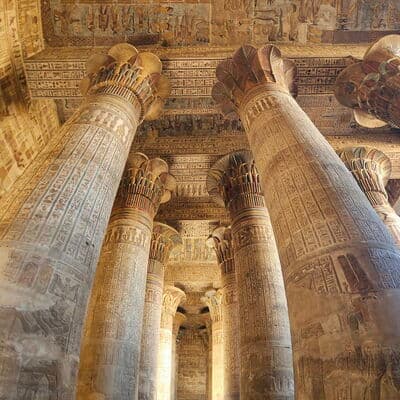
The temple amazes with its preservation. Roof in place, walls intact, reliefs readable. After the open ruins of Karnak and Luxor, this makes a strong impression—you enter a real ancient building.
The façade features columns with capitals shaped like Hathor's face—24 likenesses of the goddess greet visitors. This is characteristic of Hathor temples: the goddess watches you from everywhere.
Inside—a sequence of halls, each darker than the last. Hypostyle hall with 18 columns, hall of offerings, hall of nine gods, finally—the sanctuary. The path from entrance to holy of holies is a journey from light to darkness, from the human world to the divine.
The Dendera Zodiac
The temple's most famous artifact is the circular zodiac from a rooftop chapel ceiling. The original was taken to France in 1821 (it's in the Louvre), but a copy remains in the temple.
This is ancient Egypt's only known circular zodiac. It shows constellations combined with Egyptian deities. Scholars used it for dating—the star positions correspond to approximately 50 BCE.
The zodiac has spawned numerous pseudoscientific theories. Some see it as proof of alien contact, others as a map of ancient catastrophes. In reality, it's simply an astronomical ceiling, common in Egypt—this one just survived better than others.
The "Dendera Light Bulbs"
In the temple's underground crypts are reliefs that pseudohistorians call depictions of electric lamps. They show elongated objects resembling bulbs, with "filaments" inside and "cables" outside.
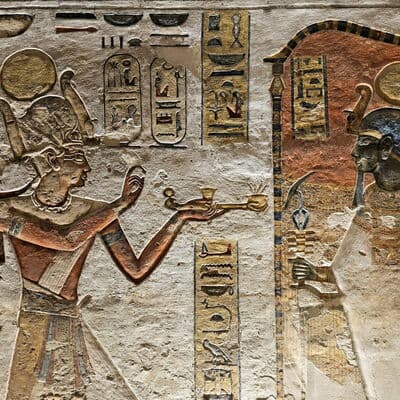
Egyptologists explain these images differently. They're lotuses—symbols of creation—from which emerge serpents—symbols of royal power. Such iconography is typical of Egyptian art, though at Dendera it looks especially striking.
There are several crypts in the temple, not all open to visitors. But if lucky—a guard may give a tour for a small tip. The underground atmosphere is appropriate: narrow passages, low ceilings, mysterious shadows.
The Rooftop
Don't miss the stairs to the roof. Here stand two chapels dedicated to Osiris—rare examples of preserved Egyptian rooftop structures. Reliefs depict Osiris's resurrection ritual.
Views from the roof are also worthwhile: the temple complex, surrounding desert, Nile valley in the distance. Sunsets here are spectacular.
Practical Information
Dendera is 60 km north of Luxor. By taxi—1.5 hours one way. Often combined with Abydos Temple in a day trip.
The temple is open 7:00-17:00. Fewer tourists than Luxor temples—sometimes you're alone in the halls.
Atmosphere and Tips
Dendera is a temple that rewards careful examination. No crowds, no vendors, just you and thousand-year-old walls. Study the Hathor faces, find the crypts, climb to the roof. This place reveals itself to those who take their time.