About
North Macedonia: The Complete Travel Guide You Actually Need
Why North Macedonia Deserves a Spot on Your Travel List
Let me be straight with you: North Macedonia is not a country most travelers think about. It does not appear on those glossy "top destinations" lists, Instagram influencers rarely tag it, and if you mention it at a dinner party, someone will inevitably ask, "Wait, is that part of Greece?" And honestly? That is exactly why you should go. While everyone else is fighting for a table in Dubrovnik, queuing for three hours at the Colosseum, or paying $18 for a mediocre espresso in Santorini, North Macedonia is quietly offering everything those places used to offer before they got overrun -- ancient cities, crystal-clear lakes, mountains you can hike without seeing another soul, and food that will make you question every meal you have had in Western Europe. All for a fraction of the cost.
Picture this: you are sitting on a terrace in Ohrid, overlooking a lake that is roughly 3 million years old -- one of the oldest in Europe. On your plate, freshly grilled trout that was swimming in that lake this morning. In your glass, a local Vranec red wine that would cost $30 in a New York wine bar. Your total bill? About $12. That is not a typo. North Macedonia is one of the last genuinely affordable countries in Europe, and the value you get for your money is almost absurd. A comfortable hotel room for $25-35 a night. A three-course dinner with wine for under $15. A full day of canyon kayaking for $10. If you have ever dreamed of traveling through Europe without constantly doing mental currency conversions and wincing, this is your place.
In 2025, North Macedonia saw a 27.7% increase in foreign visitors compared to the previous year, with over 101,000 international tourists arriving in May alone. The secret is getting out, slowly but surely. Travel publications are starting to notice. Budget travel bloggers are writing about it. But here is the thing -- it is still early. You will not find tour buses clogging narrow streets or overpriced "authentic experiences" designed for tourists. What you will find is genuine. Real people inviting you into their homes for coffee and homemade rakija. Real bazaars where craftsmen still make filigree silver jewelry by hand, a tradition that has survived for centuries. Real monasteries perched on cliffs above impossibly blue water, where monks have lived for a thousand years and will happily show you around if you ask politely.
What exactly makes North Macedonia special? Start with its location -- it sits at the crossroads of civilizations. Ottoman, Byzantine, Roman, and Slavic influences have layered on top of each other for millennia, and you can see it everywhere. Mosques stand next to Orthodox churches. Turkish bazaars lead into European squares. You can eat breakfast in a centuries-old Ottoman bakery and have lunch overlooking ancient Roman ruins with museum-quality mosaics. The cultural richness per square mile here is honestly staggering for a country most people cannot find on a map.
Then there is the nature. North Macedonia punches absurdly above its weight in this department. Within a country roughly the size of Vermont (or slightly smaller than Belgium, for European readers), you get deep canyons, alpine lakes, three national parks, Europe's oldest and deepest tectonic lakes, waterfalls hidden in primeval forests, and mountains topping 2,700 meters. Matka Canyon, one of the most spectacular gorges in southeastern Europe, is literally a 15-minute drive from the capital. Try finding that kind of proximity between raw natural beauty and a major city anywhere else on the continent.
And the people. Macedonians are warm in a way that feels almost old-fashioned -- a kind of hospitality that has been polished smooth over centuries of welcoming travelers. Ask someone for directions and there is a solid chance they will walk you there personally, stopping for coffee along the way. Get invited to someone's home and prepare to be fed until you physically cannot eat anymore, then fed some more. It is genuine, not performative, and it is one of those things that no guidebook can fully prepare you for.
For Americans, Brits, Australians, and Canadians, there is another practical advantage: you can visit visa-free for up to 90 days. No paperwork, no applications, no embassy visits. Just show up with your passport, get a stamp, and you are in. Given how much bureaucratic hassle some destinations require these days, that alone is refreshing.
The honest downsides? Infrastructure is not always polished. Public transport can be inconsistent. Some roads in the mountains will test your nerves. English is widely spoken in tourist areas but can be scarce in rural parts. And if you are looking for luxury resorts and Michelin-starred restaurants, you are in the wrong country. But if you are the kind of traveler who values authenticity over comfort, discovery over convenience, and genuine experiences over Instagram backdrops, North Macedonia will reward you in ways that more popular destinations simply cannot anymore.
Regions of North Macedonia: Where to Go and What to Expect
Skopje and Surroundings
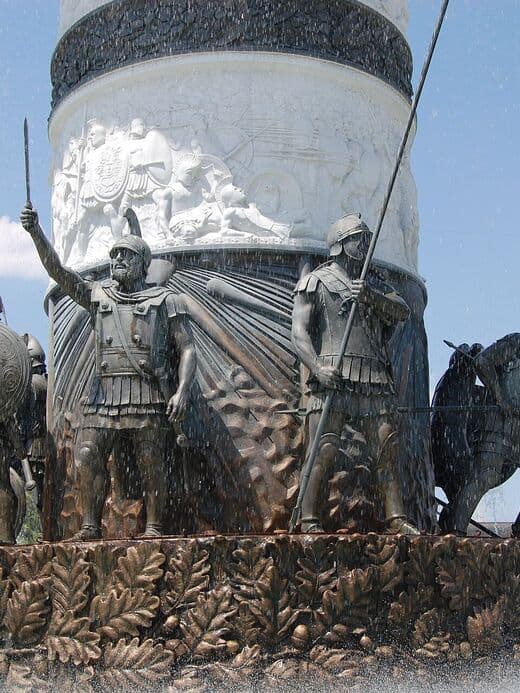
The capital of North Macedonia is a city that divides opinion like few others in Europe. Some people love it, some people find it baffling, and almost nobody feels indifferent. The reason is a government project called "Skopje 2014," which -- starting in the early 2010s -- blanketed the city center with neoclassical buildings, baroque facades, enormous statues, triumphal arches, and fountains. The stated goal was to give the city a grander historical identity. The result is... well, it is something you need to see for yourself. The aesthetic has been compared to everything from a theme park to a fever dream, but it is undeniably memorable. Love it or hate it, you will have an opinion.
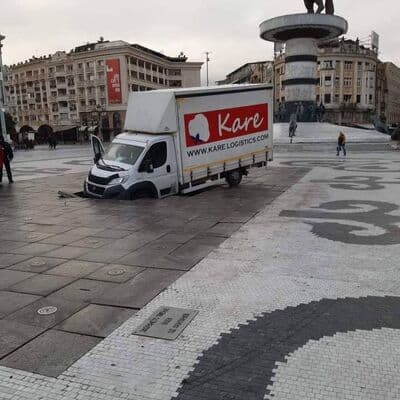
The centerpiece is Macedonia Square, one of the largest public squares in southeastern Europe. At its center stands the Warrior on a Horse statue -- a massive bronze figure on a column surrounded by fountains and lights. Everyone knows it represents Alexander the Great, but due to a long-running dispute with Greece over the use of that name, it is officially called "Warrior on a Horse." The political backstory is fascinating and worth reading up on, but we will get to that later. Flanking the square are neoclassical government buildings, museums, and hotels, all built or renovated as part of the 2014 project. At night, when everything is lit up and the fountains are running, the square genuinely looks impressive -- whatever you think of the aesthetic choices.
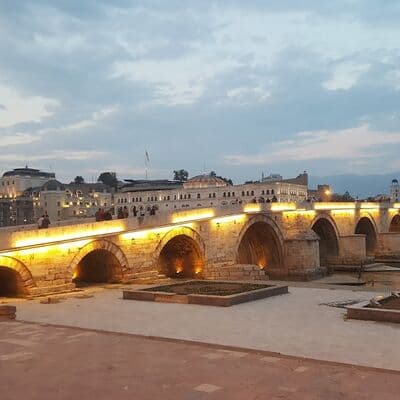
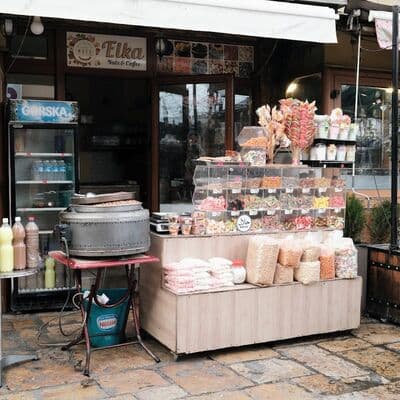
From the square, cross the Stone Bridge -- one of the city's oldest landmarks, dating back to the 15th century -- and you enter an entirely different world. The Old Bazaar of Skopje is the largest traditional bazaar in the Balkans outside of Istanbul, and stepping into it feels like walking through a portal into the Ottoman Empire. Narrow cobblestone alleys twist between workshops where craftsmen hammer copper, carve wood, and create intricate filigree silver jewelry using techniques passed down through generations. The air smells of freshly ground coffee, grilled meat, and spices. Tea houses serve Turkish tea in small tulip-shaped glasses. Mosques with elegant minarets rise above the rooftops. It is atmospheric, authentic, and utterly absorbing -- you could easily spend half a day here just wandering and getting gloriously lost.
Within the bazaar, look for the filigree workshops. Filigree is an ancient metalworking technique where thin silver or gold wire is twisted into delicate, intricate patterns -- earrings, pendants, bracelets, decorative boxes. Skopje's bazaar is one of the last places in Europe where this craft is still practiced by hand, and watching a craftsman work is mesmerizing. Prices are reasonable: a pair of silver filigree earrings starts at around $10-15, and elaborate pieces can run to $50-100. These make genuinely unique souvenirs -- far better than a fridge magnet.
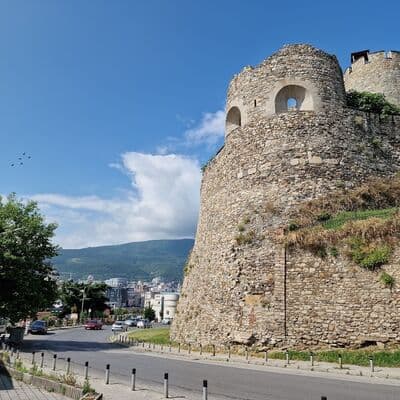
Above the bazaar, Kale Fortress sits on a hill overlooking the city. The fortress has stood here since at least the 6th century, though fortifications on this spot date back to the Bronze Age. Today the walls and towers are partially restored, and the views from the top are the best in Skopje -- the Vardar River below, the Old Bazaar spreading out in one direction, the neoclassical city center in the other, and mountains ringing the horizon. Entry is free. Come at sunset for the best light and atmosphere. The walk up from the bazaar takes about ten minutes and is well worth the slight effort.
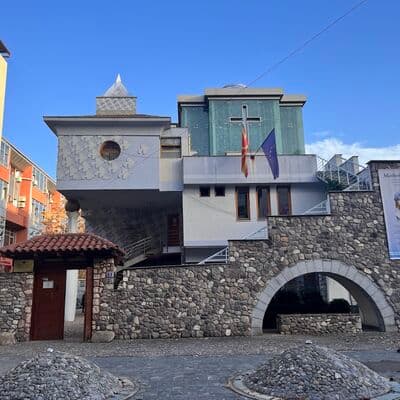
Do not miss the Mother Teresa Memorial House. Yes, Mother Teresa was born in Skopje in 1910, when the city was part of the Ottoman Empire. The memorial is built on the site where the church she was baptized in once stood (the original church was destroyed in the devastating 1963 earthquake that flattened most of Skopje). Inside you will find personal artifacts, photographs, and documents tracing her life from Skopje to Calcutta. Admission is free, and the exhibition is thoughtfully curated. Even if you are not particularly religious, it is a moving experience.
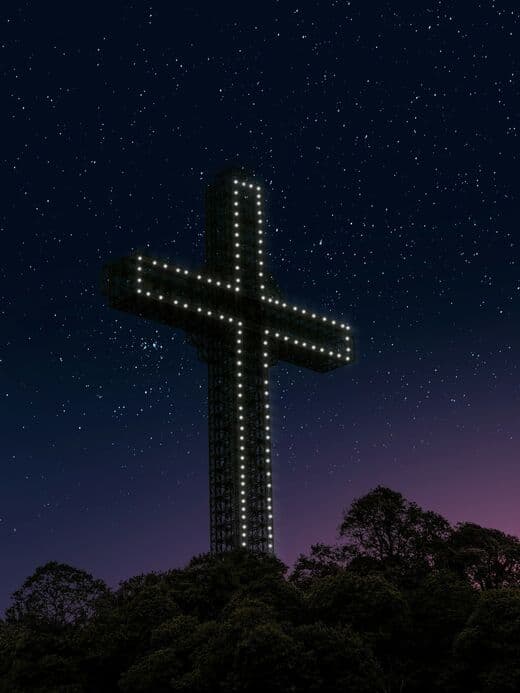
On Mount Vodno, directly above the city, stands the Millennium Cross -- a 66-meter (217-foot) illuminated cross erected in 2002 to mark 2,000 years of Christianity in Macedonia. A cable car takes you to the summit, and the panoramic views of Skopje and the surrounding mountains are spectacular. The cable car costs about 100 denars (roughly $1.80 / 1.60 EUR) each way. At the top there is a small cafe, and several hiking trails lead back down through forests if you prefer to walk. The sunset from up here is genuinely stunning.
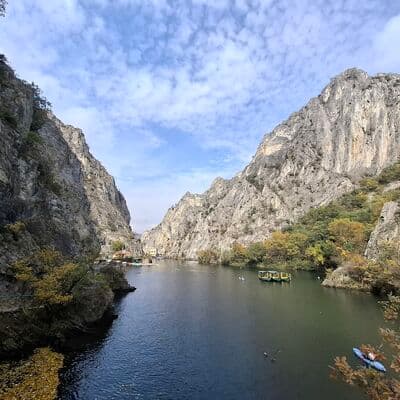
And then there is Matka Canyon -- the undisputed natural highlight of the Skopje region and arguably one of the most beautiful places in all of North Macedonia. The canyon is just 15 kilometers (about 9 miles) from downtown Skopje, reachable by local bus in 30 minutes. Once there, you can rent a kayak and paddle through a narrow gorge flanked by sheer cliffs draped in forest, or take a boat tour to Vrelo Cave -- one of the deepest underwater caves in the world, explored to a depth of 212 meters (695 feet) but with no bottom yet found. Medieval monasteries cling to the cliff faces, some accessible only by foot trails. The canyon itself is free to enter; you only pay for kayak rental (around 300-500 denars / $5-9) or the boat tour (roughly 350 denars / $6 per person). Pack a lunch, bring water, and plan to spend at least half a day here. It is genuinely world-class scenery, and the fact that it is practically in the suburbs of a European capital makes it even more remarkable.
Skopje is a one-to-two-day city. It does not need more than that, but it absolutely deserves that time. The ideal approach: fly in, spend a night, explore the bazaar and fortress and city center, hit Matka Canyon in the morning, then head out to the lakes and mountains. Think of it as the appetizer, not the main course.
The Ohrid Region
If there is one place that justifies the entire trip to North Macedonia, it is Ohrid. This ancient city on the shore of Lake Ohrid is a UNESCO World Heritage Site with dual status -- recognized for both its cultural and natural significance, which is exceptionally rare. Lake Ohrid itself is approximately 3 million years old, making it one of the oldest lakes in Europe. It is also one of the deepest in the Balkans at 288 meters (945 feet). The water is so clear that visibility reaches 20 meters (65 feet), and on calm days you can see the bottom from the waterfront promenade at surprising depths.
The city itself is a labyrinth of narrow streets climbing from the lakefront up to the hilltop fortress. Ohrid is sometimes called the "Balkan Jerusalem" because it once had 365 churches -- one for every day of the year. While not all survive, the density of historic churches is still remarkable. The most famous is the Church of St. John at Kaneo, a tiny 13th-century church perched on a cliff directly above the lake. It is one of the most photographed spots in the Balkans, and for good reason -- but photographs do not capture what it feels like to stand there at sunset, watching the lake turn gold and crimson beneath you while the mountains darken on the Albanian shore across the water. It is one of those rare travel moments that actually lives up to the hype.
Beyond churches, Ohrid is a living, breathing city with excellent restaurants, lively bars, and proper beaches. In summer, the Ohrid Summer Festival runs from mid-July through late August, featuring music, theater, and dance performances in the ancient Roman amphitheater and the grounds of Samuel's Fortress. Watching a concert in a 2,000-year-old theater as the sun sets over the lake is an experience that will stay with you.
The Monastery of St. Naum, on the southern shore of the lake near the Albanian border, is a must-visit. You can reach it by boat from Ohrid (about 90 minutes each way, and the ride itself is gorgeous) or by car. The monastery sits on a cliff above the water, surrounded by peacocks and natural springs that feed the lake. The grounds are peaceful and beautiful, and if you arrive early enough you might have the place almost to yourself. The springs are particularly impressive -- crystal-clear water bubbling up from the ground, forming pools where you can see every pebble on the bottom.
Also worth visiting is the Bay of Bones -- a reconstruction of a prehistoric settlement built on stilts over the water. This open-air museum gives you a vivid sense of how people lived on the shores of Lake Ohrid thousands of years ago. It is well done, family-friendly, and only takes about an hour.
You could easily spend three to five days in Ohrid without running out of things to do. It is the perfect base for exploring the wider region, including day trips to Galicica National Park (the mountain ridge between Lake Ohrid and Lake Prespa), Lake Prespa itself, and the nearby cities of Struga and Bitola. If you have to choose just one region in North Macedonia, choose this one.
Bitola and Pelagonia
Bitola is the second-largest city in North Macedonia and, in the opinion of many locals and travelers, the most beautiful. It has a refined, almost European feel that sets it apart from the rest of the country. In the 19th century, Bitola was home to more than a dozen foreign consulates -- earning it the nickname "City of Consuls" -- and that cosmopolitan heritage is still visible in the elegant neoclassical architecture lining its streets.
The main attraction is Sirok Sokak ("Wide Street"), the city's pedestrian boulevard. Lined with grand buildings, columns, and balconies, it is the social heart of Bitola. Every evening, the entire city seems to come out for a stroll -- the Macedonian version of the Italian passeggiata or the Spanish paseo. Grab a coffee at one of the many cafes, find a seat with a view, and watch the world go by. The coffee culture here is exceptional, and the atmosphere on a warm evening is genuinely lovely.
Just outside Bitola, you will find Heraclea Lyncestis -- the ruins of an ancient city founded by Philip II of Macedon (Alexander the Great's father) in the 4th century BC. The mosaics here are among the best-preserved in the region: vivid, detailed, depicting animals and mythological scenes in extraordinary detail. The site is not crowded, entry costs about 100 denars ($1.80), and you can usually explore at your own pace without jostling for space. Compare this to trying to see the mosaics at, say, Pompeii or Ravenna -- same quality of art, a fraction of the crowds and cost.
The Pelagonia Plain surrounding Bitola is one of the most fertile regions in the country and the heartland of ajvar production. Ajvar is a thick, smoky paste made from roasted red peppers and eggplant -- essentially the national condiment. In September and October, the entire valley smells of roasting peppers as families gather for the annual ajvar-making ritual, spending whole days roasting, peeling, and grinding peppers into this deeply flavorful spread. If you visit during this season, ask around -- someone will almost certainly invite you to join.
Above Bitola rises Pelister National Park, one of the oldest national parks in the Balkans, established in 1948. The park is home to endemic Macedonian pines (Pinus peuce), some of which are up to 900 years old, and the "Eyes of Pelister" -- two glacial lakes at roughly 2,200 meters (7,200 feet) elevation. The hiking here is excellent, with well-marked trails and views that stretch across the Pelagonia Plain all the way to Greece on clear days. The full hike to the lakes takes about 4-5 hours each way, but there are shorter trails for those who prefer something less demanding.
Mavrovo and the Western Mountains
Mavrovo National Park is the largest protected area in North Macedonia, covering 730 square kilometers (282 square miles) of mountains, forests, rivers, and gorges. This is where the country's wild side comes out. The highest peak in North Macedonia -- Mount Korab at 2,764 meters (9,068 feet) -- is here, along with dense forests, alpine meadows, and the dramatic Radika River valley.
The most famous sight in Mavrovo is the semi-submerged Church of St. Nicholas in Lake Mavrovo. When the water level rises, the church slowly disappears beneath the surface, leaving only its dome visible -- an eerie, hauntingly beautiful image that has become one of the most recognizable photographs from North Macedonia. When water levels drop, the full church emerges, sitting in a muddy lakebed. Either way, it is a fascinating and somewhat surreal sight.
In winter, Mavrovo operates as a ski resort -- one of the most affordable in Europe. A day lift pass costs around 1,200 denars (about $22 / 20 EUR), and equipment rental is similarly cheap. The slopes will not challenge expert skiers, but for casual skiing at prices that would make anyone from Colorado or the Alps weep with envy, it is hard to beat.
In summer, the park transforms into a paradise for hikers and rafters. The Radika River is considered one of the cleanest rivers in Europe, and whitewater rafting through its gorges is one of the best adventure activities in the country. Hiking trails range from easy valley walks to serious multi-day mountain routes. The Duf Waterfall is one of the most beautiful in North Macedonia and worth the trek to reach it.
Do not leave Mavrovo without visiting the Monastery of St. John Bigorski, one of the most important religious sites in the country. Its wooden iconostasis (the carved screen separating the nave from the altar) is considered a masterpiece of Balkan art -- the detail and craftsmanship are extraordinary. The monastery is still active, with monks living here year-round. You can stay overnight for free (donations appreciated), which is a remarkable experience if you are open to it.
Tikves and the Wine Region
Southern North Macedonia is wine country, and the Tikves region is its heart. If you enjoy wine, this is an essential stop on your itinerary. The region produces both international varieties (Cabernet Sauvignon, Merlot, Chardonnay) and local grapes -- particularly Vranec (a robust, full-bodied red with notes of cherry and plum) and Smederevka (a crisp white). North Macedonia has been making wine for over 3,000 years, and while it is not yet on most wine lovers' radar, the quality-to-price ratio is extraordinary.
The Tikves Winery is the largest in the Balkans and offers guided tours with tastings for around 500 denars ($9) per person, typically including five or six wines. But the real treasures are the small family wineries scattered around the region, where the owner will pour you a glass directly from the barrel and tell you stories about their vineyards over a plate of local cheese and cured meats. Names to look for include Popova Kula, Stobi, Kamnik, and Bovin -- all produce excellent wines at prices that would be unthinkable in comparable wine regions elsewhere.
Tikves Lake, an artificial reservoir created in 1968, has become a popular recreation spot. Several restaurants with terraces over the water serve fresh fish paired with local wines -- a perfect lazy afternoon. The city of Kavadarci is the unofficial wine capital and hosts the annual Tikves Wine Harvest Festival (Tikveski Grozdober) in October, with tastings, concerts, and celebrations.
Eastern Macedonia: Stip, Kocani, Kratovo
Eastern Macedonia is the least-visited part of the country, which is precisely what makes it interesting for travelers who want to go beyond the usual circuit. There are no tourist crowds here, no menus in English, no souvenir shops. What you will find is authentic everyday life, stunning landscapes, and a handful of places that genuinely deserve more attention.
Kratovo is the standout. This small town is built inside the crater of an extinct volcano, and it looks exactly as dramatic as that sounds. Medieval stone bridges span ravines, watchtowers rise from volcanic rock, and narrow streets twist through a landscape that feels more like a film set than a real place. Time seems to have stopped somewhere around the 14th century. Near Kratovo is the Kokino megalithic observatory -- an ancient astronomical site that NASA has listed alongside Stonehenge as one of the world's most important ancient observatories. Kokino is a rocky hilltop formation used for tracking celestial events during the Bronze Age. The views from the top are spectacular, especially at sunrise.
Stip, one of the larger eastern cities, is known for its thermal springs and the ruins of Isar Fortress, which offers panoramic views over the Bregalnica River valley. The city is also famous for "Stipska Buvka" -- traditional embroidery patterns that are recognized as intangible cultural heritage.
Kocani is, surprisingly, the rice capital of Macedonia. Yes, they grow rice here -- the rice paddies surrounding the town are an unexpected sight in the middle of a Balkan country. Nearby are the Kocani thermal springs, natural hot springs where you can soak for next to nothing.
The Prespa Region
Lake Prespa is the lesser-known sibling of Lake Ohrid, and it has a wilder, more remote character. Shared between three countries -- North Macedonia, Albania, and Greece -- Prespa sits at a higher elevation than Ohrid (853 meters vs. 695 meters above sea level) and feels genuinely off the beaten path. This is bird-watching paradise: the lake hosts nesting colonies of Dalmatian pelicans, cormorants, and herons, and it is designated as a transboundary nature reserve.
The village of Kurbinovo, perched above the lake, contains the Church of St. George, a 12th-century gem whose frescoes are considered among the finest examples of medieval painting in the Balkans. You will almost certainly be alone when you visit. On a small island in the lake sits the Church of St. Peter -- one of the smallest churches in the world.
Between Ohrid and Prespa, Mount Galicica rises as a national park offering jaw-dropping views of both lakes simultaneously. The road over the Galicica pass is one of the most scenic drives in the country, and hiking trails lead to the summit at 2,288 meters (7,507 feet), from where you can see brilliant blue Lake Ohrid on one side and the darker, more mysterious Prespa on the other. It is a view that belongs on a postcard.
Polog and Tetovo
The northwestern Polog region, centered on Tetovo, has a predominantly ethnic Albanian population, giving it a distinctly different atmosphere from the rest of the country. The main attraction is the Sarena Dzamija (Painted Mosque), decorated on the outside with vivid geometric patterns in bright colors. It is one of the most visually striking mosques you will see anywhere -- it looks like an abstract artist went to work on it.
Above Tetovo rises the Sar Mountains (Sar Planina), one of the most impressive mountain ranges in the country. The Popova Sapka ski resort operates here in winter, while summer brings excellent hiking on trails through alpine meadows. The Sar Mountains recently received national park status, helping to protect an ecosystem that includes lynx, bears, chamois, and over 200 bird species.
Strumica and the Southeast
Strumica, in the southeast corner, is best known for its carnival -- one of the largest in the Balkans. Held annually before Lent, it features elaborate masks, costumes, music, and processions with roots in pre-Christian pagan traditions. If you happen to be in the country during carnival season (usually February or March), it is absolutely worth the detour.
Near Strumica are the Smolare and Koleshino waterfalls. Smolare, at 39 meters (128 feet), is the tallest waterfall in North Macedonia, hidden deep in a lush forest. A scenic trail leads to it in about 30 minutes from the parking area. Koleshino is smaller at 15 meters (49 feet) but equally beautiful. Both are free to visit and rarely crowded.
The town of Vevcani, also in the region, is famous for its natural springs and its tongue-in-cheek "Republic of Vevcani" -- a self-declared micro-state with its own passport and flag. The annual Vevcani Carnival on January 13-14 is one of the oldest carnival celebrations in Europe and has been recognized by UNESCO for its cultural significance.
The Lakes of North Macedonia: Balkan Jewels
If you had to name a single reason to visit North Macedonia, it would be the lakes. The country possesses three major tectonic lakes -- Ohrid, Prespa, and Dojran -- each with its own distinct character and appeal. Add dozens of glacial mountain lakes scattered across peaks above 2,000 meters, and you have a lake landscape that rivals anything in the Alps or Scandinavia, at a fraction of the cost and with virtually none of the crowds.
Lake Ohrid is the undisputed star. At approximately 3 million years old, it is one of the oldest lakes in Europe (comparable in age to Italy's Lake Como and Russia's Lake Baikal, though much younger than the latter). The lake covers 358 square kilometers (138 square miles), reaches a maximum depth of 288 meters (945 feet), and harbors an extraordinary number of endemic species -- organisms that exist nowhere else on Earth. Most famous among these is the Ohrid trout (Salmo letnica), a delicate, slightly sweet fish that is the star of local cuisine. The water clarity is remarkable: visibility reaches 20 meters (65 feet), and on calm days you can see the lakebed at considerable depth right from the shore promenade in Ohrid city.
Swimming season on Lake Ohrid runs from June through September, with water temperatures reaching a comfortable 24-26 degrees Celsius (75-79 degrees Fahrenheit) in July and August. Beaches range from free public stretches in the city (crowded in peak season) to secluded coves reachable only by boat or on foot. One of the best is Ljubanista Beach near St. Naum Monastery on the southern shore -- fine pebbles, pristine water, mountain views, and enough space to actually lay your towel down without bumping into your neighbor. The boat ride from Ohrid to St. Naum along the eastern shore is itself a highlight -- 90 minutes of stunning lakeside scenery with church towers and fishing villages sliding past.
Lake Prespa, at 853 meters above sea level, sits higher than Ohrid and has a markedly different personality. It is wilder, quieter, and less developed. The water is not quite as clear as Ohrid's, but the surrounding landscape is more dramatic -- marshlands and reed beds teeming with birdlife, backed by the steep slopes of Mount Galicica. This is one of the most important wetland habitats in southeastern Europe. Dalmatian pelicans breed here -- they are enormous birds with wingspans up to 3.5 meters (nearly 12 feet), and seeing them glide over the lake is genuinely awe-inspiring. Lake Prespa is shared between three countries, and this tri-national character adds to its mystique. The Prespa Agreement, which settled the decades-long name dispute between Macedonia and Greece, was signed at Lake Prespa in 2018 -- a fitting symbol of the cooperative spirit this region has always represented, despite political tensions.
Lake Dojran, the smallest of the three major lakes, lies on the southeastern border with Greece. It went through a near-catastrophic ecological crisis in the early 2000s when water levels dropped dramatically due to excessive extraction. Thanks to restoration programs, the lake has recovered significantly. Dojran is famous for its unique traditional fishing method involving trained cormorants -- fishermen use the birds to drive fish into nets, a technique practiced here for centuries. It is one of the last places in Europe where this ancient method is still in use, and watching it is a fascinating experience even if you have zero interest in fishing.
The glacial mountain lakes are a different proposition entirely. The "Eyes of Pelister" -- Big Lake and Small Lake -- sit at roughly 2,200 meters (7,200 feet) elevation in Pelister National Park above Bitola. They are called "eyes" because they resemble two blue eyes staring up from the mountain. Getting there requires a 4-5 hour hike from the trailhead, but the reward is crystal-clear water surrounded by ancient Macedonian pines and silence so complete it feels almost physical. On Sar Planina (the Sar Mountains above Tetovo), Lake Bogovinsko offers a similar alpine experience, reached by even fewer visitors.
Lake Mavrovo, though technically an artificial reservoir, has become beautiful in its own right over the decades since its creation. Surrounded by mountains and forests, it changes color with the seasons -- turquoise in summer, deep green in autumn, frozen white in winter. The semi-submerged Church of St. Nicholas, which appears and disappears with changing water levels, gives it an ethereal, almost mystical quality. It is one of the most photographed spots in the country.
For the active traveler, the lakes offer outstanding opportunities beyond simple swimming. Kayaking through Matka Canyon is world-class. Stand-up paddleboarding on Lake Ohrid has become increasingly popular. Fishing (with proper permits) is excellent on multiple lakes. And for divers, Lake Ohrid offers underwater exploration of ancient archaeological sites and the fascinating geological formations of its spring-fed floor -- visibility in the deeper water can be extraordinary.
When to Visit North Macedonia
North Macedonia is a year-round destination, but different seasons offer dramatically different experiences. Choosing the right time depends on what you want to do and what kind of traveler you are.
The sweet spot: May-June and September-October. These shoulder months offer the best overall experience. Temperatures are ideal (68-82 degrees Fahrenheit / 20-28 degrees Celsius), tourist numbers are manageable, accommodation prices have not yet peaked, and the landscape is at its most beautiful. May brings wildflower-covered mountain meadows, warming lakes, and long sunny days. September and October deliver warm lake water (perfect for swimming well into October), vineyards blazing with autumn colors, harvest festivals, and wine-tasting season. If you can only visit once, aim for these months.
Summer (July-August) brings the heat. In Skopje and the Tikves valley, temperatures regularly hit 95-104 degrees Fahrenheit (35-40 degrees Celsius). Around the lakes and in the mountains it is more bearable (77-86 degrees Fahrenheit / 25-30 degrees Celsius), but this is peak season -- prices are higher, popular areas like Ohrid are crowded, and restaurant tables along the waterfront require reservations. The upside: long days, vibrant nightlife, and the best festivals. The Ohrid Summer Festival (mid-July through late August) is the big cultural event, featuring concerts in the ancient amphitheater and at Samuel's Fortress. Book accommodation well in advance if visiting Ohrid in August.
Winter (December-February) is cold but has genuine appeal. The ski resorts at Mavrovo and Popova Sapka operate from December through March with incredibly cheap lift passes. Skopje has a cozy, festive atmosphere with Christmas markets and mulled wine in the Old Bazaar cafes. Ohrid in winter is almost deserted -- atmospheric, foggy, with empty cobblestone streets and fireplaces crackling in restaurants. If you enjoy moody, quiet travel without crowds, winter is actually wonderful.
Spring (March-April) is transitional. March can be chilly and rainy, but April warms up nicely. Good for city exploration and cultural trips, too early for swimming.
Key festivals and dates:
- January 13-14 -- Vevcani Carnival (one of the oldest in Europe)
- February/March -- Strumica Carnival (before Lent, dates vary)
- June 21 -- International Music Day celebrations in Skopje
- July 12 - August 20 -- Ohrid Summer Festival (music, theater, dance)
- October -- Tikves Wine Harvest Festival in Kavadarci
- October 11 -- Day of the Uprising (national holiday)
How to Get to North Macedonia
North Macedonia is a small, landlocked country in the center of the Balkans, but reaching it is easier than you might think. The main international airport is Skopje Alexander the Great Airport (SKP), located about 20 kilometers (12 miles) from the city center. The secondary airport, St. Paul the Apostle Airport in Ohrid (OHD), operates primarily during summer months with seasonal flights.
From the US and Canada: There are no direct flights from North America to Skopje. The best connections route through major European hubs. Turkish Airlines via Istanbul is often the most convenient -- Istanbul has multiple daily flights to Skopje, and Turkish Airlines serves most major US and Canadian airports. Other good connecting options include Vienna (Austrian Airlines), Frankfurt (Lufthansa), and London (various carriers). Budget airline Wizz Air flies to Skopje from numerous European cities (London Luton, Basel, Vienna, Budapest, Dortmund, Malmoe, and many more) and frequently offers fares as low as $25-40 one way if you book early and travel light. The strategy for budget-conscious travelers: fly a legacy carrier to a European hub, then grab a Wizz Air connection to Skopje.
From the UK: Wizz Air operates direct flights from London Luton to Skopje, with fares starting around 25-30 GBP one way. This makes North Macedonia one of the most affordable European destinations reachable from Britain. Flight time is about 3 hours.
From Australia: You will need at least one connection, typically through the Middle East (Emirates, Qatar Airways) or Southeast Asian hubs to a European gateway, then onward to Skopje. The most practical route is usually through Istanbul or Vienna. Total travel time is roughly 20-24 hours depending on connections.
Overland: If you are already traveling through the Balkans or southern Europe, North Macedonia is easy to reach by bus. Regular services connect Skopje with Belgrade, Serbia (6-7 hours, around $15-25 EUR); Tirana, Albania (6 hours); Sofia, Bulgaria (5-6 hours); Thessaloniki, Greece (4-5 hours); and Pristina, Kosovo (2 hours). Buses run multiple times daily on most routes. North Macedonia fits perfectly into a Balkans circuit -- common combinations include Serbia-Macedonia-Greece, Kosovo-Macedonia-Albania, or Bulgaria-Macedonia-Albania.
By car: The drive from Thessaloniki to Skopje is about 250 kilometers (155 miles) on good roads. From Belgrade, it is roughly 450 kilometers (280 miles). Border crossings operate 24 hours and queues are generally short, except during summer weekends. If you are renting a car from a neighboring country, confirm in advance that your rental agreement allows cross-border travel into North Macedonia -- not all companies permit this.
Airport to city center: A shuttle bus connects Skopje Airport with the city center for just 250 denars (about $4.50 / 4 EUR). It runs in coordination with flight arrivals and departures. The ride takes 20-25 minutes. Taxis cost approximately 15-20 EUR to the center -- insist that the driver uses the meter (in Macedonian: "taksimetar, molam!").
TSA note for Americans: If you are buying local wine, rakija, or ajvar to bring home, remember that liquids over 3.4 ounces must go in checked baggage. Skopje Airport security follows European standards. Buy your liquid souvenirs early and pack them in your checked bag before you head to the airport.
Getting Around North Macedonia
Let me be honest upfront: public transportation in North Macedonia is functional but not great. It exists, it runs, but schedules can be approximate, some routes only operate once or twice daily, and the vehicles are not always new. If you want full flexibility to explore the country -- especially the national parks, lakes, and smaller towns -- rent a car. That said, it is absolutely possible to travel by bus if you are patient and plan ahead.
Renting a car: This is the best way to see the country. Rental prices start from 15-20 EUR per day for a compact car (Renault Clio, VW Polo, or similar). International companies like Europcar, Sixt, and Hertz operate at Skopje Airport, alongside local agencies that often offer better rates. A US, UK, Canadian, or Australian driver's license is accepted -- no international driving permit is required, though having one does not hurt. Gasoline costs roughly $1.50-1.60 per liter (about $5.70-6.00 per gallon for Americans -- cheaper than back home). Roads are generally decent: major highways are in good condition, but secondary mountain roads can be narrow, winding, and occasionally unpaved. The Skopje-Ohrid highway is the newest and fastest road in the country. Drive defensively, especially in mountainous areas, and be prepared for the occasional shepherd herding livestock across the road. Parking is easy and usually free or very cheap outside city centers.
Buses: The primary form of public transport between cities. Major routes include Skopje to Ohrid (3-3.5 hours, from 600 denars / $11), Skopje to Bitola (3 hours, from 500 denars / $9), and Skopje to Tetovo (1 hour, from 150 denars / $2.70). Large cities have proper bus stations with posted schedules, but in smaller towns the bus might just stop in the main square when flagged down. Schedules are available at the Skopje bus station and sometimes online, but always confirm at the station -- they change without much notice. Buying tickets in advance is generally not necessary except during peak summer season for the Skopje-Ohrid route.
Trains: North Macedonia has a rail network, but... let me put it diplomatically: it is not built for speed. Routes include Skopje-Bitola (via Prilep), Skopje-Gevgelija (via Veles), and Skopje-Kumanovo. Trains are slow (Skopje to Bitola takes about 4 hours) but cheap (from 200 denars / $3.60) and scenic. The railway infrastructure is being modernized, with upgrades to the Skopje-Zelenikowo line expected by mid-2026 and a "City Train" project planned for improved local service. Take the train if you enjoy the journey more than the destination -- the route through the Vardar valley has some beautiful stretches.
Taxis: Cheap and generally reliable. A ride within Skopje rarely exceeds 200-300 denars ($3.60-5.40). Always make sure the driver starts the meter -- say "taksimetar" and point at it. Uber does not operate in North Macedonia, but local taxi apps exist. In smaller cities, you can usually find taxis at designated stands near the main square or bus station.
Domestic flights: None. The country is too small -- you can drive from one end to the other in about 4-5 hours.
Boats: On Lake Ohrid, regular boat services run from Ohrid city to St. Naum Monastery (about 90 minutes, from 500 denars / $9) and to various beaches and coves. This is one of the best ways to experience the lake -- the views of the city and monasteries from the water are completely different from the land perspective.
Cultural Code: Understanding North Macedonia
North Macedonia is a country where cultures do not just coexist -- they interweave. Ethnic Macedonians (Slavic, predominantly Orthodox Christian) make up about 64% of the population. Ethnic Albanians (predominantly Muslim) account for about 25%. The remainder includes Turks, Roma, Serbs, Vlachs, and Bosniaks. Each group has contributed to a cultural mosaic that is richer and more complex than you might expect from a country of barely two million people. Understanding this context will help you navigate interactions and appreciate what you see.
Hospitality: Macedonians are hospitable in a way that can genuinely catch Western visitors off guard. If someone invites you to their home -- and there is a real chance this will happen, especially outside tourist areas -- refusing is considered impolite. You will be fed an amount of food that borders on the medically inadvisable, and your glass of rakija will be refilled before you notice it is empty. Every attempt to decline more food will be met with a firm "just a little more." This is not performance -- it is sincere, deeply ingrained cultural behavior. Go with it. Eat the food, drink the rakija (in moderation), compliment the cooking. You will make friends for life.
Coffee culture: Coffee in North Macedonia is not a beverage. It is a ritual, a social institution, and possibly a religion. Macedonians drink "domashno kafe" (home coffee) -- essentially Turkish coffee brewed in a small pot called a dzezve. It is served strong, with sediment at the bottom, and consumed slowly over long conversations. Being offered coffee is an invitation to connect, not just a caffeine delivery system. In cities, espresso and cappuccino are also popular, and coffee shops are the primary social venue -- people spend hours in them, often multiple times a day. Do not rush your coffee. Sit, sip, talk. This is how relationships are built here.
Tipping: Tips are appreciated but not obligatory. In restaurants, 10% of the bill is appropriate if you were happy with the service. In cafes, simply round up the bill. For taxi drivers, rounding up to the nearest convenient amount is the norm. In hotels, 50-100 denars ($1-2) per night for housekeeping is a nice gesture but not expected.
The name issue: Until 2019, the country was simply called "Macedonia," which caused a decades-long diplomatic dispute with Greece (which has a northern province also called Macedonia). The Prespa Agreement resolved the issue by changing the country's name to "North Macedonia." Not everyone in the country is happy about this -- it remains a sensitive topic for some. The safest approach: refer to the country as "North Macedonia" in official contexts, call its people "Macedonians" (which they prefer), and do not initiate conversations about "the real Macedonia" or suggest that the name change was right or wrong. If locals bring it up, listen more than you talk.
Language: The official languages are Macedonian and Albanian. Macedonian is a South Slavic language, closely related to Bulgarian and Serbian, and uses the Cyrillic alphabet. Signs are often displayed in both Cyrillic and Latin script, especially in tourist areas and larger cities. English is widely spoken in Skopje, Ohrid, and other tourist destinations, particularly among younger people. In rural areas and smaller towns, English speakers are rare. Having a few basic Macedonian phrases goes a long way -- "Zdravo" (hello), "Blagodaram" (thank you), and "Kolku chini?" (how much does it cost?) will cover most situations and earn you genuine smiles. Google Translate supports Macedonian, including the camera function for translating signs and menus.
Religion: About 65% of the population is Orthodox Christian and about 33% is Muslim. The two faiths coexist peacefully -- mosques and churches stand side by side throughout the country, and this is considered entirely normal. When visiting religious sites, follow standard dress codes: covered shoulders and knees, quiet behavior. In mosques, remove your shoes before entering. In Orthodox churches, women may be asked to cover their hair (a scarf is usually available at the entrance).
What not to do:
- Do not confuse Macedonians with Bulgarians or Greeks -- they have a distinct national identity and take it seriously
- Do not bring up the name dispute unless locals raise it first
- Do not photograph people without asking, especially in more conservative or Muslim neighborhoods
- Do not refuse food or drink when offered in someone's home -- it will genuinely offend your hosts
- Do not leave your shoes on when entering a home -- remove them and place them neatly by the door
- Do not discuss politics aggressively -- the country has complex ethnic dynamics and people are tired of outsiders offering opinions
Safety in North Macedonia
North Macedonia is one of the safest countries in the Balkans and in Europe generally. The US State Department assigns it a Level 1 advisory -- "Exercise Normal Precautions" -- placing it in the same category as Iceland, Norway, and Luxembourg. The UK Foreign Office and Australian DFAT similarly rate it as low-risk. Violent crime against tourists is extremely rare, and most visitors complete their trips without any problems whatsoever.
Real risks to be aware of:
- Pickpockets: As in any European country, petty theft can occur in crowded areas -- the Old Bazaar in Skopje, Macedonia Square, bus stations, and popular tourist sites. Keep your valuables secure, use a money belt or front-pocket wallet in crowds, and be aware of your surroundings. Occasionally, groups of children may approach asking for money while a companion attempts to pick your pocket -- a common tactic across southeastern Europe. A firm "no" and walking away is sufficient.
- Taxi scams: The most common tourist annoyance. Some taxi drivers will not start the meter or will take a longer route. Always insist on the meter ("taksimetar, molam!") before the car moves. Avoid unmarked or unofficial taxis, especially at the airport and bus stations. Use taxi apps where available.
- ATM skimming: Very rare, but use ATMs attached to banks or inside hotel lobbies rather than standalone machines on the street, as a precaution.
- Mountain roads: This is probably the most real danger you will face. Some mountain roads are narrow, winding, lack guardrails, and have no lighting at night. Drive carefully, especially in the Mavrovo and Galicica areas. If you are not comfortable with mountain driving, consider hiring a local driver or taking a bus.
Areas to avoid: There are no genuinely "dangerous zones" for tourists. Some neighborhoods on the outskirts of Skopje may look rough, but there is no aggression toward visitors. Border areas near Kosovo are occasionally mentioned in travel advisories but pose no real risk for regular tourists.
Emergency numbers:
- Police: 192
- Ambulance: 194
- Fire: 193
- General emergency (EU standard): 112
For solo female travelers: North Macedonia is generally safe for women traveling alone. Standard precautions apply (avoid walking alone in deserted areas late at night, do not accept rides from strangers), but overall the country is friendly and welcoming. Many solo female travelers report feeling very comfortable here -- the culture of hospitality extends to protecting guests. Harassment is uncommon, though it can happen in bars and nightlife areas as anywhere. Trust your instincts and you will be fine.
Natural hazards: North Macedonia sits in a seismically active zone -- the devastating 1963 earthquake destroyed much of Skopje. While major earthquakes are infrequent, minor tremors do occur. Flooding can affect some areas during heavy spring rains. In summer, heatstroke is a real concern in low-lying areas where temperatures exceed 100 degrees Fahrenheit (38+ Celsius). Stay hydrated, wear sun protection, and avoid prolonged outdoor activity during the midday hours.
Travel insurance: Always travel with comprehensive insurance that covers medical evacuation. North Macedonia is not an EU member, so the European Health Insurance Card (EHIC) does not apply. American travelers should check whether their existing health insurance covers international travel; many policies do not. Companies like World Nomads, SafetyWing, and Allianz offer good options for travelers to the Balkans.
Health and Medical Information
No special vaccinations are required for travel to North Macedonia. The country is not a risk zone for malaria, yellow fever, or other tropical diseases. Make sure your routine vaccinations (tetanus, hepatitis A and B, measles) are up to date, as you would for any European trip.
Water: Tap water in Skopje and major cities is safe to drink. In rural areas and smaller towns, bottled water is the safer choice. Mountain spring water is excellent quality -- hikers can drink from marked springs without concern. Bottled water is cheap: about 30-50 denars ($0.50-0.90) for a 1.5-liter bottle.
Medical care: Public hospitals exist in all major cities, but facilities and service levels can vary significantly from what Americans, Brits, or Australians are accustomed to. For serious medical issues, seek private clinics in Skopje -- Zan Mitrev Clinic is one of the best in the region and operates to international standards. Always have travel medical insurance before your trip -- without it, treatment must be paid out of pocket, though costs are far lower than in the US (a doctor's visit might cost $20-40, compared to $200+ back home).
Pharmacies: Called "apteka" in Macedonian (conveniently similar to the English "apothecary"), pharmacies are found in every town. Many medications that require prescriptions in the US, UK, or Australia are available over the counter here, including some antibiotics. Basic pain relievers, antihistamines, and stomach medications are readily available. Most pharmacies close around 8 PM, but Skopje has 24-hour emergency pharmacies.
Sun exposure: Summer sun is intense, especially at lake level and in the mountains where reflection off water and snow amplifies UV radiation. Use SPF 30+ sunscreen even on cloudy days. Sunburn can happen surprisingly quickly, particularly on Lake Ohrid boat trips where the water reflection catches you off guard.
Ticks: In forested and mountainous areas from spring through autumn, check yourself for ticks after hiking. Tick-borne encephalitis and Lyme disease are present in the region, though not common. Long pants tucked into socks and insect repellent reduce the risk significantly.
Food safety: Standards are generally good. Street food -- burek, kebabs, grilled corn -- is safe as long as the vendor looks clean and has a steady stream of customers. The rule of thumb everywhere in the world applies here: if locals are eating there, it is probably fine. If it looks sketchy and empty, walk on.
Money and Budget
The currency of North Macedonia is the Macedonian denar (MKD). The exchange rate is relatively stable: 1 EUR is approximately 61 MKD, and 1 USD is approximately 56-58 MKD. 1 GBP gets you around 72-74 MKD. Coins come in denominations of 1, 2, 5, 10, and 50 denars; banknotes in 10, 50, 100, 200, 500, 1,000, 2,000, and 5,000 denars.
Where to exchange money: Exchange offices (called "menuvachnici") are found in every city and generally offer better rates than banks. In Skopje, the best rates are at exchange offices in the Old Bazaar and near Macedonia Square. Avoid exchanging at the airport -- rates are significantly worse. Euros are accepted in many tourist-oriented businesses (restaurants, hotels), but change will be given in denars at an unfavorable rate. Your best bet is simply withdrawing denars from ATMs using your debit card -- you will get the interbank rate minus a small fee. ATM withdrawal fees are typically 100-200 denars ($1.80-3.60).
Cards: Visa and Mastercard are accepted nearly everywhere in cities -- restaurants, shops, hotels, gas stations. In small towns and rural areas, cash is king. ATMs are available in all cities and most towns. American Express is rarely accepted. If you use a Charles Schwab, Wise, or Revolut debit card that reimburses foreign ATM fees, you will get the best deal on cash withdrawals.
Daily budget estimates (per person):
- Budget ($20-30 / 18-27 EUR): Hostel or budget Airbnb ($8-15), street food and simple restaurants ($5-8), public transport ($2-3), free attractions. This is genuinely achievable -- North Macedonia is one of the cheapest countries in Europe for budget travelers.
- Mid-range ($40-60 / 36-54 EUR): 3-star hotel ($20-35), sit-down restaurants ($10-15), taxis or car rental share ($10-15), paid attractions and occasional tours ($5-10). Very comfortable traveling at this level.
- Comfortable ($80-120 / 72-108 EUR): 4-5 star or boutique hotel ($50-80), best restaurants ($20-30), rental car ($15-20), wine tastings, spa visits, guided tours ($15-20). You will feel like royalty.
Typical prices:
- Espresso in a cafe -- 50-80 MKD ($0.90-1.45)
- Burek (savory pastry) -- 40-80 MKD ($0.70-1.45)
- Lunch at a restaurant -- 300-600 MKD ($5.40-10.80)
- Dinner with wine -- 600-1,200 MKD ($10.80-21.60)
- Bottle of local wine at a shop -- 150-400 MKD ($2.70-7.20)
- Liter of gasoline -- 80-90 MKD ($1.45-1.60)
- Taxi ride within Skopje -- 100-300 MKD ($1.80-5.40)
- Bus ticket Skopje to Ohrid -- 600-800 MKD ($10.80-14.40)
- Domestic beer (0.5L) in a bar -- 80-120 MKD ($1.45-2.15)
- Museum entrance -- 50-200 MKD ($0.90-3.60)
To put this in perspective: North Macedonia is one of the most affordable countries in all of Europe. Only Albania and Kosovo are consistently cheaper. You can realistically travel here on $20-25 a day if you stay in hostels and eat street food. On $50-60 a day, you will live extremely well -- good hotels, proper restaurants, wine with dinner. At $100+ a day, you are in the luxury tier, enjoying the best the country has to offer. Compare that to the $150-200 a day you would need for a similar experience in Italy, France, or the UK, and the value proposition becomes almost comically one-sided.
Itineraries: How to Plan Your Trip
7 Days -- The Golden Triangle
This is the classic first-timer's route, hitting the three essential stops: Skopje, Ohrid, and Bitola. It gives you a well-rounded introduction to the country without feeling rushed.
Day 1: Arrive in Skopje. Fly into Skopje, take the shuttle bus to the city center, check into your hotel. Spend the evening on an orientation walk: stroll along the Vardar River promenade, cross the Stone Bridge, take in Macedonia Square with its illuminated fountains and statues, and wander into the Old Bazaar for your first taste of Macedonian food. Order tavche gravche (baked beans in a clay pot -- the unofficial national dish) and shopska salad (tomatoes, cucumbers, peppers, onion, and white cheese). Welcome to North Macedonia.
Day 2: Explore Skopje. Morning -- dive deep into the Old Bazaar. Start with Turkish coffee at one of the traditional cafes, then explore the filigree workshops, spice shops, and the Mustafa Pasha Mosque. Climb up to Kale Fortress for panoramic views of the city. Visit the Mother Teresa Memorial House. For lunch, try kebapchinja (grilled minced-meat sausages) at Destan restaurant in the bazaar -- it is a local institution. After lunch, take the cable car up Mount Vodno to the Millennium Cross. Watch the sunset from the top, then ride back down (or hike down through the forest if you have energy).
Day 3: Matka Canyon + Transfer to Ohrid. Morning -- head to Matka Canyon (30 minutes by bus or 15 minutes by taxi from the center). Rent a kayak and paddle through the gorge (2-3 hours is ideal) or take the boat tour to Vrelo Cave. Have lunch at the canyon entrance restaurant -- the grilled trout is excellent. After lunch, take the afternoon bus to Ohrid (3-3.5 hours) or drive if you have a rental car. Evening walk along the Ohrid waterfront, settling into the rhythm of this magical lakeside city.
Day 4: Ohrid. A full day in the city. Morning -- explore the Old Town, climbing through narrow streets to Samuel's Fortress for sweeping views over the lake. Visit the Church of St. Clement and Panteleimon with its remarkable mosaic floor, then the ancient Roman amphitheater. Make your way down to the Church of St. John at Kaneo -- the iconic cliff-top church overlooking the lake. This is your Instagram moment, but forget your phone for a minute and just take it in. Lunch at a terrace restaurant with lake views -- order the Ohrid trout (ask if it is genuinely local). Afternoon: swim at a city beach or wander the waterfront. Evening: dinner with live music at one of the Old Town restaurants.
Day 5: St. Naum + Lake Prespa. Morning -- take the boat from Ohrid to St. Naum Monastery (90 minutes each way, and the journey is gorgeous). Explore the monastery, watch the peacocks, walk to the natural springs. Lunch near the monastery. If you have a car, drive over the Galicica mountain pass to Lake Prespa in the afternoon (30-40 minutes) -- the viewpoint at the pass offers simultaneous views of both lakes. Return to Ohrid for the evening.
Day 6: Bitola. Morning -- drive or take the bus to Bitola (1.5-2 hours). Walk Sirok Sokak, the grand pedestrian boulevard, and have coffee at one of its beautiful cafes. Visit Heraclea Lyncestis -- the ancient ruins with those incredible mosaics. Lunch in Bitola -- try the local peppers and traditional dishes. Afternoon -- explore the city's Ottoman-era hammams, the Yeni Mosque, and the charming side streets. Overnight in Bitola.
Day 7: Return to Skopje + Departure. Morning -- drive or bus back to Skopje (about 3 hours). If driving, stop in Prilep along the way to see Markovi Kuli (Marko's Towers) -- a fortress perched on dramatic rock formations. Arrive in Skopje with time for last-minute shopping in the bazaar before your flight.
10 Days -- Deep Macedonia
This itinerary adds Mavrovo National Park, the western mountains, and the wine region for a more complete picture of the country.
Days 1-2: Skopje -- as in the 7-day itinerary.
Day 3: Matka Canyon + Tetovo. Morning -- Matka Canyon for kayaking and the Vrelo Cave boat tour. Lunch at the canyon. Afternoon -- drive to Tetovo (40 minutes from Skopje). Visit the Painted Mosque (Sarena Dzamija) and the Arabati Baba Teke (a Bektashi dervish lodge -- an atmospheric, slightly mysterious complex). Overnight in Tetovo or continue to Mavrovo.
Day 4: Mavrovo National Park. Full day in the park. Morning -- see the semi-submerged Church of St. Nicholas on Lake Mavrovo (a must-photograph). Hike to Duf Waterfall, one of the most beautiful cascades in the country. Lunch at a mountain restaurant -- try the river trout. Afternoon -- visit the Monastery of St. John Bigorski and its extraordinary carved wooden iconostasis. Overnight in Mavrovo.
Day 5: Mavrovo to Ohrid. Morning -- another hike in the park, or white-water rafting on the Radika River if the season and operators allow. Then drive to Ohrid via Debar, following the scenic road along the lake's western shore. Arrive in Ohrid by evening.
Days 6-7: Ohrid -- as Days 4-5 in the 7-day itinerary, but with an extra day to explore at a slower pace. Use the additional time for beaches, the archaeological museum, or a day trip to Struga (a town on the northern shore where the Black Drin River flows out of the lake). Struga hosts an annual poetry festival and has a pleasant waterfront with good restaurants.
Day 8: Bitola + Pelister. Transfer to Bitola. Explore the city and Heraclea. Afternoon -- if you are up for it, hike in Pelister National Park (the full trek to the "Eyes of Pelister" is a day-long effort). Otherwise, take one of the lower, shorter trails with views over the Pelagonia Plain. Overnight in Bitola.
Day 9: Tikves Wine Region. Drive to the Tikves wine region (2-2.5 hours from Bitola). Visit a winery for a tasting -- try Tikves Winery for the big-name experience or seek out a smaller family operation for a more intimate one. Lunch with wine on a terrace. Visit Tikves Lake for a short walk. Drive to Skopje (about 2 hours).
Day 10: Skopje + Departure. Last morning in the capital -- final shopping in the bazaar (filigree silver, ajvar, rakija), a last Turkish coffee, and head to the airport.
14 Days -- All of Macedonia
Two weeks allows you to cover the entire country at a comfortable pace, including the less-visited east and all the major national parks.
Days 1-2: Skopje -- as before.
Day 3: Kratovo. Drive to Kratovo (1.5 hours east of Skopje). Explore the medieval bridges and towers, the volcanic landscape, and the atmospheric stone streets. Lunch in town. Afternoon -- drive to Kokino megalithic observatory (20 minutes from Kratovo) for stunning views and ancient astronomical structures. Overnight in Kratovo (guesthouses).
Day 4: Kratovo to Tetovo. Morning -- wander Kratovo again in the early light (the stone streets are beautifully photogenic in morning sun). Drive via Kumanovo to Tetovo. Visit the Painted Mosque and Arabati Baba Teke. Overnight in Tetovo.
Day 5: Mavrovo. Full day in the national park -- as in the 10-day itinerary.
Day 6: Mavrovo to Ohrid. Drive via Debar, with an optional stop at the Debar thermal springs if time allows. Arrive in Ohrid.
Days 7-9: Ohrid and Surroundings. Three full days. Explore the city thoroughly, visit St. Naum, Bay of Bones, Lake Prespa, hike in Galicica National Park. Take a boat along the coastline. Rent a bicycle and ride along the lakeshore. This is where you slow down and let the magic of the place soak in.
Day 10: Bitola. Transfer to Bitola, explore the city and Heraclea. Overnight.
Day 11: Pelister National Park. Full hiking day. The trek to the "Eyes of Pelister" and back takes 6-8 hours -- bring water, snacks, and proper footwear. For a less demanding option, there are 3-4 hour trails to mountain lodges with excellent views. Overnight in Bitola.
Day 12: Strumica and Waterfalls. Drive to Strumica (3-4 hours via Prilep and Veles, or 2.5 hours directly through the mountains). Visit Smolare and Koleshino waterfalls. Explore the town. Overnight in Strumica.
Day 13: Tikves Wine Region. Drive to the wine country. Tastings, a wine-paired lunch, Tikves Lake. Continue to Skopje in the evening.
Day 14: Skopje + Departure.
21 Days -- The Grand Balkan Journey
Three weeks gives you time to explore every region of North Macedonia at a leisurely pace, with room for spontaneous detours and lazy afternoons by the lake. This is the itinerary for those who want to truly know the country.
Days 1-3: Skopje and Surroundings. Thorough exploration of the city: the bazaar, fortress, memorials, cable car, Matka Canyon. Plus a day trip to Kumanovo (fortress, the Monastery of St. Prohor Pcinjski near the Serbian border).
Days 4-5: Kratovo and the East. Kratovo, Kokino observatory, Stip (Isar Fortress, thermal springs). Optionally extend to Berovo -- a mountain town with a lake and coniferous forests that feels like a different country entirely.
Days 6-7: Tetovo and Sar Planina. Tetovo sightseeing, then hiking in the Sar Mountains (possible overnight in a mountain hut). Popova Sapka makes an excellent summer base for mountain trails through alpine meadows with views to rival anything in the Alps.
Days 8-9: Mavrovo. Two unhurried days in the national park -- hike, raft, visit monasteries. Take your time. Stop at a riverside restaurant for grilled trout and do nothing for an afternoon. This is not a race.
Days 10-13: Ohrid and Prespa. Four days on the lakes. Ohrid city in depth, St. Naum, Prespa, Galicica, Struga, beaches. Take a kayak along the coastline. Rent a bicycle and explore the lakeshore. Watch a concert at the Ohrid Summer Festival if your timing works. Let yourself get genuinely bored for an afternoon -- sometimes the best travel moments happen when you have nowhere to be.
Days 14-15: Bitola and Pelister. City exploration and serious hiking in the national park.
Day 16: Prilep. The city where Skopsko beer is brewed (yes, Macedonia's most famous beer is brewed in Prilep, not Skopje). Visit Markovi Kuli (Marko's Towers) -- a fortress on fantastically shaped rock formations that look like they belong on another planet. Hike to Treskavec Monastery perched on a mountain peak above the city -- the views are some of the best in the country.
Days 17-18: Strumica and the Southeast. Waterfalls, old fortresses, Bansko thermal springs (natural hot springs where you can soak for next to nothing). Day trip to Lake Dojran on the Greek border -- watch the traditional cormorant fishing if you can find it.
Day 19: Tikves Wine Country. A full day of wine -- tastings at multiple wineries, vineyard walks, a long lunch with local wine.
Day 20: Veles. A town on the Vardar River that most tourists skip entirely, which is a shame -- the Old Town, built on steep cliffs above the river, is one of the most dramatic urban landscapes in the country. Tower houses, churches, bridges, and views that reward the visitor who takes the trouble to come. This is genuine off-the-beaten-path travel.
Day 21: Skopje + Departure. Last day -- final shopping, last coffee, farewell to a country that has probably gotten under your skin more than you expected. Head to the airport.
Connectivity: Staying Online
North Macedonia has three main mobile operators: Makedonski Telekom (T-Mobile branded), A1, and Lycamobile. 4G coverage is good in cities and along major roads. In mountainous and rural areas, coverage can be spotty -- do not count on reliable data when hiking in national parks.
SIM cards: Available at operator shops and some kiosks. You will need your passport to register. Starter packages cost 300-500 MKD ($5.40-9) and typically include 5-10 GB of data. Makedonski Telekom has the best coverage overall. Top up at shops, gas stations, or through self-service terminals.
eSIM: If your phone supports eSIM, this is the most convenient option. Services like Airalo, Holafly, and Nomad offer packages for North Macedonia or broader Balkans coverage starting from $5-10 for 1-3 GB. Activation is instant -- no store visit needed, no waiting in line, no language barrier. This is what I recommend for most travelers.
Wi-Fi: Free Wi-Fi is available at virtually all hotels, hostels, restaurants, and cafes. Speed is generally adequate for messaging and social media but may struggle with video calls. Skopje has free public Wi-Fi in some areas.
Roaming: North Macedonia is not in the EU, so European roaming regulations do not apply. If you have a European SIM, check roaming rates before you travel -- they may be significant. US, UK, Canadian, and Australian carriers typically charge substantial roaming fees. An eSIM or local SIM is almost always cheaper.
VPN: Not needed. North Macedonia has no website blocks or social media restrictions. All your usual services -- Facebook, Instagram, YouTube, WhatsApp, Google, everything -- work without any issues. No censorship, no Great Firewall, no restrictions.
What to Eat: Macedonian Cuisine
Macedonian food is a crossroads cuisine -- a point where Mediterranean, Ottoman, and Slavic culinary traditions collide and produce something genuinely delicious. It is hearty, generous, built on fresh ingredients and simple recipes that have been perfected over centuries. If you love meat, vegetables, bread, cheese, and grilled things, you are about to have a very good time. If you are vegetarian, you will still eat well -- the vegetable dishes are excellent -- but this is not a vegetarian-first food culture.
The essential dishes:
Tavche gravche -- the unofficial national dish. Baked white beans in a clay pot with onions, peppers, and spices. It sounds simple -- and it is -- but the flavor is extraordinary. Every restaurant has its own version, every grandmother has her secret recipe, and debates about who makes the best tavche gravche can get heated. It is served as a main course or as a side with meat, and it costs almost nothing. This is comfort food elevated to an art form.
Ajvar -- a thick, smoky spread made from roasted red peppers and eggplant. It is not an exaggeration to call this a national obsession. Every autumn, the entire country smells of roasting peppers as families gather for "ajvar season" -- days spent roasting, peeling, and grinding peppers, then jarring the result for winter. You can buy factory-made ajvar in any supermarket (look for the Vitaminka or Mother's Recipe brands), but homemade ajvar is in a different league entirely. Macedonians eat it with bread, meat, cheese -- basically everything. Buy a jar (or several) to bring home. It is the single best edible souvenir from the Balkans.
Burek -- a flaky, layered pastry with filling. The classic version is filled with minced meat (mesen burek), but you will also find cheese (sirenje), spinach (zelenik), and pumpkin varieties. This is the national breakfast -- every morning, lines form outside bakeries ("burekdzilnici") across the country. You eat it with your hands, washed down with yogurt drink (ayran). A burek costs 40-80 MKD ($0.70-1.45) -- one of the cheapest and most satisfying breakfasts in Europe. Find the bakery with the longest line of locals and get in it. That is where the best burek is.
Kebapchinja (kebabs) -- small grilled sausages made from minced meat, served with flatbread, raw onion, ajvar, and kajmak (a creamy dairy spread similar to clotted cream). Cooked over charcoal, the smoky flavor is addictive. This is street food at its finest -- cheap, filling, and devastatingly good. A portion with bread and sides runs about 150-250 MKD ($2.70-4.50).
Shopska salad -- cucumbers, tomatoes, peppers, onions, and sirenje (a white brined cheese similar to feta, but with its own distinct tang). The most popular salad across the entire Balkans. Simple, fresh, and perfect in hot weather. It appears on every restaurant table and pairs with absolutely everything.
Ohrid trout -- an endemic species found only in Lake Ohrid. The flesh is delicate, slightly sweet, and nothing like the farmed trout you get at home. It is typically grilled whole with lemon and olive oil -- minimal preparation to let the quality of the fish speak for itself. A word of honesty: Ohrid trout fishing is strictly regulated (complete ban from November through March), and some restaurants may serve imported trout while calling it "Ohrid trout." Ask specifically whether it is local. When it is genuinely the real thing, it is an unforgettable meal.
Turli tava -- a rich oven-baked dish of mixed vegetables (potatoes, peppers, eggplant, tomatoes) with chunks of pork or lamb, slow-cooked in a clay pot. Portions are enormous -- one serving could easily feed two people. Order it to share.
Pastrmajlija -- sometimes called "Macedonian pizza," though it is really its own thing. An elongated bread base topped with seasoned meat (usually pork or chicken), sometimes with an egg on top. Rich, oily, filling, and cheap -- a popular fast food option.
Drinks:
Rakija -- the national spirit, distilled from grapes, plums, apricots, or other fruits. It ranges from 40 to 60 percent alcohol, though homemade versions can go higher. Every household has its own rakija supply, and you will be offered it constantly -- refusing the first glass is considered impolite. Macedonian rakija tends to be smoother than Serbian or Croatian versions, which makes it dangerously easy to drink. Pace yourself. The hangover from homemade rakija is not something you want to experience on a hiking day.
Wine: North Macedonia is one of the oldest wine-producing regions in the world, with a winemaking history spanning over 3,000 years. The signature red grape is Vranec -- full-bodied, fruity, with notes of dark cherry and plum. It is genuinely excellent and criminally underpriced. A good bottle of Vranec in a shop costs 150-400 MKD ($2.70-7.20) -- we are talking about wine that would retail for $15-25 in the US or UK. In restaurants, a glass starts at about 80 MKD ($1.45). The whites -- Smederevka and Zilavka -- are crisp and refreshing, perfect for hot summer afternoons by the lake. Do yourself a favor and drink local wine throughout your trip. The quality-to-price ratio is genuinely among the best in the world.
Boza -- a fermented drink made from millet or corn, slightly sweet and thick in texture. It is an acquired taste -- many first-time tasters are not sure what to make of it. But it is an authentic Ottoman-era drink that has been consumed across the Balkans for centuries. Try it at least once, if only for the cultural experience. It is sold at bakeries and bazaar stalls.
Coffee: As mentioned in the cultural section, "domashno kafe" (Turkish-style coffee) is the default order. Strong, with sediment at the bottom of the cup, served in a small cup with a glass of water. Order it by saying "Domashno kafe, molam" (home coffee, please). You can get it sweet ("so sheker"), medium sweet ("sredni"), or unsweetened ("bez sheker"). Espresso, cappuccino, and filter coffee are also widely available in urban cafes.
Desserts:
Tulumba -- fried dough tubes soaked in sugar syrup. Crispy on the outside, soft inside, intensely sweet. The perfect accompaniment to Turkish coffee. You will find them in bakeries and at bazaar stalls.
Baklava -- layered phyllo pastry with walnuts and honey. The version served in the Old Bazaar in Skopje is some of the best in the Balkans -- rich, sticky, and absolutely worth the sugar rush.
Where to eat:
- Bakeries (burekdzilnici) -- on every corner. Fresh burek, pita, simit (sesame bread rings). Breakfast for 50-100 MKD ($0.90-1.80).
- Traditional restaurants (kafana/restoran) -- ranging from simple taverns to upscale dining rooms. A three-course meal runs 400-800 MKD ($7.20-14.40).
- Street food -- kebabs, pljeskavica (large meat patties), grilled corn. Cheap, filling, universally good.
- Lakeside fish restaurants -- the best are on the shores of Lake Ohrid. Fresh fish with sunset views -- from 300 MKD ($5.40).
- Wine bars and tasting rooms -- increasingly common in Skopje and the Tikves region. Great for sampling the country's wine scene in a relaxed setting.
Dietary considerations: Vegetarians will find that Macedonian cuisine offers good options -- tavche gravche (baked beans), shopska salad, grilled vegetables, various cheese dishes, and ajvar-based preparations are all meat-free. Vegans will have a harder time, as dairy (especially cheese and kajmak) appears in many dishes. Gluten-free travelers should know that bread and pastry are central to the cuisine, but grilled meats, salads, and rice dishes are naturally gluten-free. For those with food allergies, menus rarely list allergens -- ask directly (or use Google Translate's camera function on the Macedonian-language menu).
What to Buy: Shopping and Souvenirs
North Macedonia is a country where you can actually bring home souvenirs that are genuine, handmade, and meaningful -- not mass-produced "I Heart [Country Name]" merchandise stamped out in a factory overseas. Traditional crafts are still alive here, and many of the items sold in bazaars and markets are made by hand using techniques that have been passed down for generations.
Ajvar -- the ultimate edible souvenir. A jar of homemade ajvar is the single best thing you can bring back from North Macedonia. Buy it at markets or supermarkets (Vitaminka and Mother's Recipe are reliable commercial brands). Factory-made jars cost 100-200 MKD ($1.80-3.60) each; homemade versions cost more but taste vastly better. Buy several jars -- you will go through them faster than you expect, and everyone you give one to will want more. Ajvar keeps well for months unopened, and it goes through checked luggage without problems (wrap jars in clothes to prevent breakage).
Wine -- an excellent and affordable gift. A bottle of Vranec from Tikves, Popova Kula, Stobi, or Kamnik starts at 200 MKD ($3.60) in shops. The best selection is at wineries themselves or at specialty wine shops in Skopje (Wine Story on Partizanski Odredi boulevard is well-regarded). Remember to pack wine in checked luggage if flying -- wrap bottles in bubble wrap or clothing. Some shops will pack bottles for transport if you ask.
Rakija -- if your luggage allows it. Homemade rakija is the best but difficult to bring through airports. Commercially produced brands like Loza and Tikves cost from 300 MKD ($5.40) and are available at any supermarket. Some producers sell in decorative bottles that make nice gifts.
Ohrid pearls -- a traditional craft product from Ohrid. These are not natural pearls -- they are handmade using an old technique that coats glass beads with a paste made from the scales of a local fish (plastica). The result is surprisingly beautiful and distinctive. Prices start at about 500 MKD ($9) for a simple strand. Buy from reputable shops in Ohrid rather than random street vendors, who may sell cheap plastic imitations instead of the genuine article. The Talev family workshop in Ohrid is one of the last remaining traditional pearl producers and is worth seeking out.
Filigree silver jewelry -- exquisitely delicate silver work made by hand in workshops at the Old Bazaar in Skopje. Earrings, pendants, bracelets, and decorative boxes crafted from thin silver wire twisted into intricate patterns. Each piece is unique. Prices range from 500 MKD ($9) for simple earrings to several thousand denars for complex work. This is genuine artisan craft, and watching a silversmith at work is part of the experience. If you buy only one souvenir in North Macedonia, make it a piece of filigree.
Ceramics -- handmade pottery with traditional patterns. Plates, mugs, and the small clay pots used for tavche gravche are popular choices. The best ceramics come from Ohrid and Bitola. Prices are very reasonable -- a decorated plate might cost 200-500 MKD ($3.60-9).
Spices and teas -- sharena sol (colorful herb salt), dried peppers, and mountain tea (planinski chaj) gathered by hand in the highlands. Mountain tea from Sar Planina is particularly prized -- it has been used as a medicinal and everyday beverage for centuries. A bag of mountain tea costs about 100-200 MKD ($1.80-3.60) and makes a wonderful gift for tea lovers. Light, easy to pack, and genuinely useful.
Traditional embroidery -- handmade textiles with traditional Macedonian patterns on towels, tablecloths, and napkins. Stipska buvka (embroidery from Stip) is particularly valued for its intricate geometric designs.
Icons -- hand-painted religious icons in the Ohrid school tradition. Available in Ohrid and at monasteries throughout the country. Prices start at about 1,000 MKD ($18) for small pieces. These are genuine artworks, not mass-produced prints, and can be stunning.
Tax Free: North Macedonia has a Tax Free system for purchases exceeding 6,000 MKD (approximately 100 EUR / $108). Ask for the Tax Free form at participating shops, fill it out, and present it at the border or airport for a refund of the 18% VAT. It is worth doing for larger purchases like jewelry or multiple bottles of wine.
Useful Apps
Navigation:
- Google Maps -- works well throughout the country, including public transport directions in Skopje. Download offline maps before heading to areas with spotty coverage.
- Maps.me or Organic Maps -- excellent offline maps, essential for hiking in national parks and mountain areas where data signal disappears.
Transport:
- Moovit -- public transport schedules and routes for Skopje
- BlaBlaCar -- ridesharing between cities, popular on the Skopje-Ohrid route and a good way to meet locals
Translation:
- Google Translate -- supports Macedonian, including the camera function for translating signs, menus, and labels in real time. Download the Macedonian language pack for offline use.
Accommodation:
- Booking.com -- the dominant platform in the country with the widest selection
- Airbnb -- good options in Ohrid and Skopje, especially for longer stays or if you want a kitchen
Food and dining:
- TripAdvisor -- useful for finding restaurants with English-language reviews
- Wolt -- food delivery app that works in Skopje (handy for lazy evenings at the hotel)
Final Thoughts
North Macedonia is one of those rare countries that fundamentally changes your perspective on what travel can be. There is no polished tourist veneer here, no scripted experiences, no sense that you are one face in a million-strong crowd of identical visitors. What you find instead is something increasingly rare in modern Europe: authenticity. Real people, real food, real history, real landscapes -- unfiltered and unpackaged.
This is a country where $30 a day buys you a level of experience that $150 cannot replicate in Western Europe. Where a 3-million-year-old lake with crystalline water is not a glossy brochure fantasy but an everyday reality accessible to anyone who shows up. Where mountains are not gated behind expensive lift tickets and reservation systems but open to anyone willing to lace up their boots and walk. Where a canyon of genuine world-class beauty sits 15 minutes from the national capital. Where wine costs less than water in a Parisian cafe but holds its own in quality against bottles three times the price.
The numbers tell part of the story -- that 27.7% increase in tourist arrivals in 2025 signals that the word is getting out. In a few years, North Macedonia could look very different: more hotels, higher prices, longer lines, tour buses on narrow streets that were never built for them. Right now is the sweet spot. The infrastructure is developed enough that travel is comfortable and convenient. The tourism industry is mature enough that you will not struggle to find good accommodation, restaurants, and information. But the country is still unspoiled enough that the experience feels genuine and personal.
If you are tired of the usual European circuit -- if you have done Paris and Rome and Barcelona and want something that will actually surprise you -- North Macedonia is waiting. Come here, eat burek for breakfast at a bakery with a line of locals out the door, drink rakija with strangers who become friends, watch the sunset over Lake Ohrid from a 13th-century church on a cliff, hike through a canyon where the only sounds are water and birdsong, and taste wine that has been made on this land for 3,000 years. You will understand why those who come here keep coming back.
And when you get home and someone asks where you went, enjoy the look on their face when you say "North Macedonia." Then watch it change as you tell them about it.
Information current as of 2026. Please verify visa requirements and transport schedules before your trip.