Florence - Birthplace of the Renaissance and Treasury of World Art
Florence is a city that changed the course of world history. Here, on the banks of the River Arno, the Renaissance was born in the 14th - 16th centuries - a magnificent cultural revolution that shaped the development of European civilization. The capital of Tuscany holds such a concentration of artistic and architectural masterpieces that its entire historic center is a UNESCO World Heritage Site. Dante, Michelangelo, Leonardo da Vinci, Botticelli, Galileo - all are connected to this extraordinary city that Italians proudly call Firenze.
History of Florence: From Roman Settlement to Capital of the Arts
Florence was founded in 59 BCE as a Roman colony for veterans of Julius Caesar's army. The name "Florence" derives from the Latin "Florentia" - "flourishing," reflecting the fertility of the Arno valley. The Roman city had a typical grid layout centered on a forum - today's Piazza della Repubblica.
After the fall of the Roman Empire, Florence survived barbarian invasions, Lombard rule, and incorporation into the Carolingian Empire. True prosperity began in the 11th - 12th centuries when the city became an independent commune with republican government. Florentine merchants and bankers created one of Europe's most powerful economies, and the gold florin became the international currency of the medieval world.
Florence's golden age coincided with the rule of the Medici family - a banking dynasty that effectively governed the city from 1434 to 1737. Cosimo the Elder, Lorenzo the Magnificent, and their descendants transformed Florence into the center of European art and science. Under their patronage, the greatest artists, sculptors, and architects of the Renaissance created their masterpieces.
From 1865 to 1871, Florence served as the capital of unified Italy. This brief period left a notable mark on the city's appearance - medieval walls were demolished, wide boulevards laid out, new districts built. In 1966, catastrophic flooding of the Arno caused enormous damage to the city and its artistic treasures, but international restoration efforts saved the priceless heritage.
Santa Maria del Fiore: The Cathedral with Brunelleschi's Dome
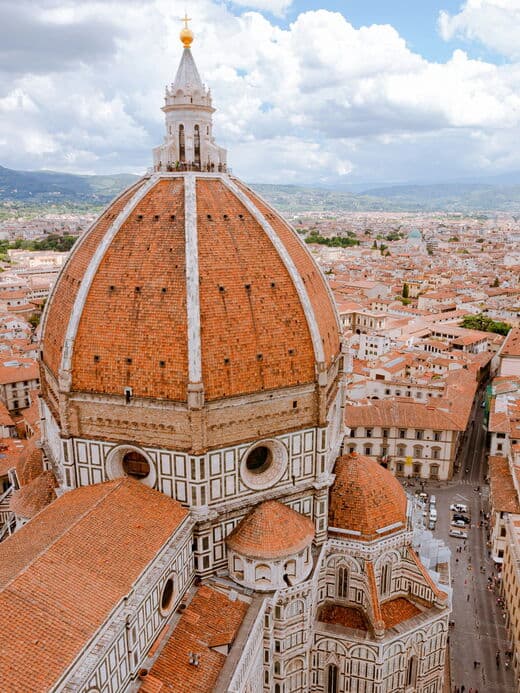
The Florence Cathedral, dedicated to the Virgin Mary of the Flower, is the city's main symbol and the greatest achievement of Renaissance architecture. Construction began in 1296 according to designs by Arnolfo di Cambio and continued for nearly 150 years. The façade of white, green, and pink marble creates an unmistakable image recognized worldwide.
The cathedral's crowning glory is the magnificent dome measuring 42 meters in diameter, built by Filippo Brunelleschi between 1420 and 1436. This was the greatest engineering achievement of its time: the architect developed a unique double-shell dome construction without scaffolding, employing technologies centuries ahead of their time. Climbing to the dome's summit (463 steps) rewards visitors with breathtaking panoramas of Florence and close-up views of Vasari and Zuccari's "Last Judgment" frescoes.
The cathedral interior impresses with its scale - the nave extends 153 meters in length. Here you'll find Paolo Uccello's famous clock running counterclockwise, Domenico di Michelino's fresco with Dante's portrait, and stained glass by Donatello and Ghiberti. The cathedral crypt reveals remains of the ancient Santa Reparata church and Brunelleschi's tomb.
Baptistery of San Giovanni
Opposite the cathedral stands the octagonal Baptistery - one of Florence's oldest buildings, dating to the 11th century. But its main attraction is the bronze doors. The south doors by Andrea Pisano (1330) depict scenes from the life of John the Baptist. The north and east doors were created by Lorenzo Ghiberti, who won the famous competition of 1401. The east doors, which Michelangelo called the "Gates of Paradise," are considered a masterpiece of Renaissance sculpture - 10 gilded panels depicting Old Testament scenes with incredible detail and perspective.
Giotto's Campanile
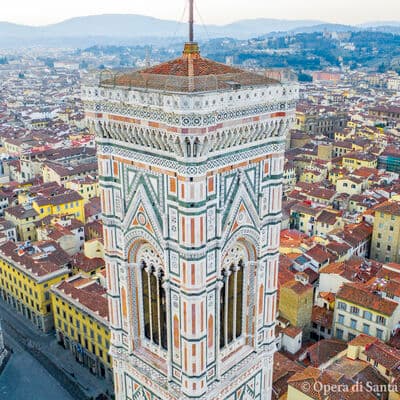
The cathedral's bell tower, standing 84.7 meters tall, was designed by Giotto and begun in 1334. The master completed only the lower level with reliefs depicting the creation of the world and human activities before his death. Construction was continued by Andrea Pisano and Francesco Talenti. Climbing the tower (414 steps) offers magnificent views of the cathedral dome and city.
The Uffizi Gallery: Treasury of World Art
The Uffizi is one of the world's oldest and most important art museums, housing an unsurpassed collection of Renaissance art. The building was constructed between 1560 and 1580 by Giorgio Vasari to house administrative offices (uffizi means "offices") for Duke Cosimo I de' Medici. The last Medici heiress, Anna Maria Luisa, bequeathed all the family's art collections to the city of Florence in 1737.
The Uffizi collection comprises over 100,000 works, with approximately 2,300 on permanent display. Masterpieces include Botticelli's "Birth of Venus" and "Primavera," Leonardo da Vinci's "Annunciation," Michelangelo's "Doni Tondo," Titian's "Venus of Urbino," and Raphael's "Madonna of the Goldfinch." The gallery also holds outstanding collections of ancient sculpture, Flemish painting, and artists' self-portraits.
The Vasari Corridor - a covered passage approximately one kilometer long connecting the Uffizi with Palazzo Pitti across the Ponte Vecchio - was built in 1565 in just five months so that Cosimo I could move between residences without going outside. The corridor walls are decorated with a collection of artists' self-portraits from the Renaissance to the present day.
The Accademia Gallery and Michelangelo's David
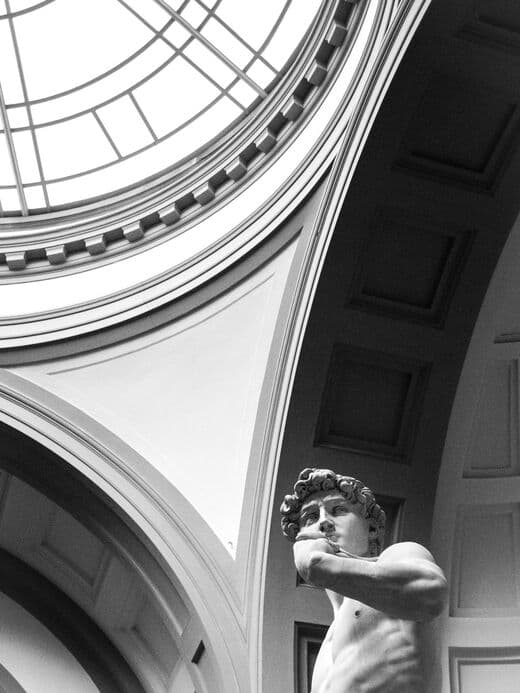
The Accademia Gallery was founded in 1784 at the Academy of Fine Arts as a teaching collection for students. Today it is Florence's second most-visited museum, and the main reason is Michelangelo's David. This 5.17-meter marble sculpture, created between 1501 and 1504 from a "spoiled" block of Carrara marble, is considered the supreme achievement of Renaissance sculpture.
David is depicted in the moment before his battle with Goliath - tense, focused, ready for action. Michelangelo was only 26 when he completed this work, exceeding all expectations. Originally the statue stood in Piazza della Signoria as a symbol of the Florentine Republic, but in 1873 it was moved to the museum for protection from the elements.
The gallery also displays four unfinished Michelangelo statues - the "Slaves" or "Prisoners," intended for Pope Julius II's tomb. These figures, seemingly struggling to emerge from the stone, provide unique insight into the master's creative process. The museum also holds a rich collection of Florentine painting from the 13th - 16th centuries and a collection of musical instruments.
Piazza della Signoria and Palazzo Vecchio
Piazza della Signoria has been Florence's political heart for seven centuries. Here citizens of the republic gathered to make crucial decisions, here Savonarola was executed, here the Medici held triumphal processions. The square is an open-air museum: a copy of David stands in the original's place, alongside Cellini's "Perseus," Giambologna's "Rape of the Sabine Women," and Ammannati's Neptune Fountain.
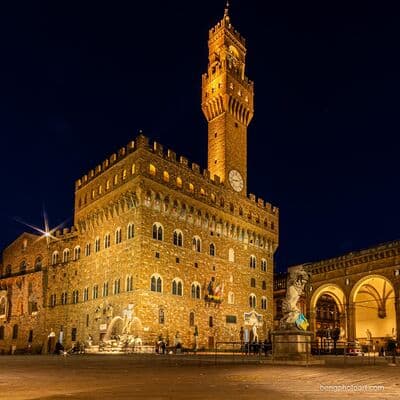
Palazzo Vecchio (the Old Palace) - a magnificent fortress with its 94-meter Tower of Arnolfo, built between 1299 and 1314 as the seat of republican government. After the Medici moved to Palazzo Pitti in 1565, the palace received its current name. The interiors were redesigned by Vasari and decorated with magnificent frescoes depicting Florentine victories and glorifying the Medici dynasty.
The Hall of the Five Hundred deserves special attention - a vast assembly hall painted by Vasari with scenes of military victories. Here too is Michelangelo's sculptural group "Genius Conquering Brute Force." Francesco I's Studiolo is a small cabinet decorated with Mannerist paintings concealing cupboards for storing curiosities. Today the palace houses Florence's city hall, but most halls are open to visitors.
Ponte Vecchio: The Bridge of Jewelers
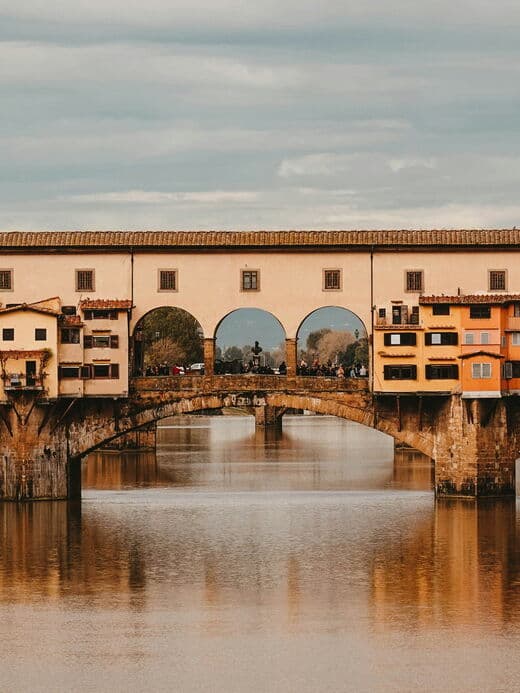
Ponte Vecchio is Florence's oldest and most famous bridge, the only one preserving its medieval appearance. The current structure dates from 1345, when the bridge was rebuilt after a flood. Its unique feature is the rows of shops hanging over the River Arno. Originally butchers and tanners operated here, but in 1593 Ferdinando I expelled them due to unpleasant odors and gave the shops to jewelers and goldsmiths.
Legend has it that Ponte Vecchio was the only Florentine bridge not blown up by retreating German forces in August 1944, supposedly by Hitler's personal order. However, historical evidence points to more prosaic reasons: the bridge was too narrow for military vehicles. Whatever the case, Ponte Vecchio remains a symbol of the city, especially romantic at sunset when golden light reflects on the waters of the Arno.
Palazzo Pitti and the Boboli Gardens
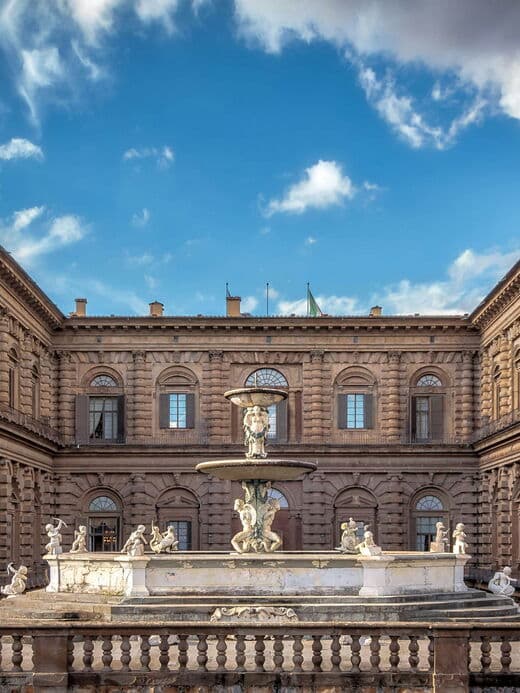
Palazzo Pitti is a grand palace on the Arno's south bank, the main residence of the Grand Dukes of Tuscany from 1549. The palace was begun in 1458 for banker Luca Pitti, a Medici rival, to a design attributed to Brunelleschi. After the Pitti family's financial ruin, Eleonora of Toledo, wife of Cosimo I, purchased the building, and the palace became the center of Tuscan court life.
Today Palazzo Pitti houses several museums. The Palatine Gallery occupies the state rooms with a rich collection of paintings by Raphael, Titian, Rubens, and Caravaggio. Pictures are hung in the old manner - from floor to ceiling, creating a "tapestry" effect. The Gallery of Modern Art, Silver Museum with the Medici treasure collection, Costume Museum, and Porcelain Museum complete the artistic ensemble.
The Boboli Gardens are one of the finest examples of Italian garden art, created for the Medici in the 16th century. Across 4.5 hectares you'll find fountains, grottoes, statues, and an amphitheater where the first opera performances in history took place. Buontalenti's Grotto with artificial stalactites and statues is a Mannerist masterpiece. The upper terraces offer magnificent views of Florence and the surrounding hills.
Basilica of Santa Croce: Pantheon of Geniuses
Santa Croce is the world's largest Franciscan church and the resting place of Italy's greatest figures. Construction began in 1294, possibly to designs by Arnolfo di Cambio. The Gothic interior with wooden trusses extends 115 meters in length. The walls are decorated with frescoes by Giotto and his pupils - the Bardi and Peruzzi chapels are considered among the most important monuments of the early Renaissance.
Santa Croce holds the tombs of Michelangelo, Galileo, Machiavelli, Rossini, and Ghiberti. Michelangelo's monument by Vasari is adorned with allegorical figures of Painting, Sculpture, and Architecture. Dante's cenotaph commemorates the great poet whose remains stay in Ravenna despite Florence's numerous attempts to reclaim them. Galileo's monument was erected only in 1737 - nearly a century after the scientist's death, condemned by the Church.
The basilica museum holds Cimabue's crucifix - the greatest masterpiece of pre-Giotto art, seriously damaged during the 1966 flood. The Pazzi Chapel in the cloister is a perfect example of early Renaissance architecture created by Brunelleschi.
San Lorenzo and the Medici Chapels
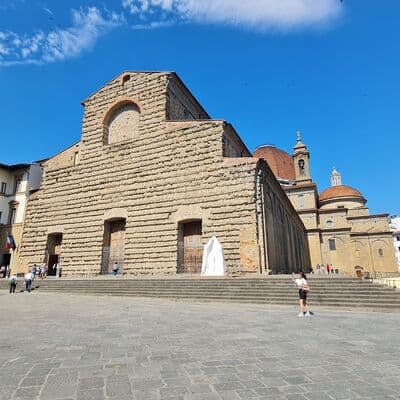
The Basilica of San Lorenzo is the Medici family's parish church and one of Brunelleschi's most important works. The architect rebuilt the ancient church between 1419 and 1480, creating a standard of Renaissance church architecture with its harmonious proportions and classical columns. The façade remained unfinished - Michelangelo created a design that was never realized.
The complex's main treasure is the New Sacristy, designed by Michelangelo as a Medici burial chapel between 1520 and 1534. Here you'll find the master's famous sculptures: the allegorical figures "Day" and "Night" at the tomb of Giuliano de' Medici, Duke of Nemours, and "Dawn" and "Dusk" at the tomb of Lorenzo de' Medici, Duke of Urbino. These works, filled with deep philosophical meaning, are considered the pinnacle of Michelangelo's sculptural art.
The Chapel of the Princes is a grand 17th-century mausoleum faced with semi-precious stones - jasper, lapis lazuli, agate. The octagonal hall rising 59 meters high overwhelms with the richness of its decoration. The Laurentian Library, designed by Michelangelo, is a masterpiece of Mannerist architecture with its legendary vestibule staircase.
The Oltrarno District: Bohemian Florence
Oltrarno ("beyond the Arno") is Florence's southern district, preserving the atmosphere of old Tuscany. There are fewer tourists here, more artisan workshops, authentic trattorias, and local life. The district grew up around Palazzo Pitti and was traditionally home to craftsmen - cabinetmakers, restorers, gilders. Many workshops still operate today.
Piazza Santo Spirito is the soul of Oltrarno, surrounded by cafés and restaurants. The Basilica of Santo Spirito is Brunelleschi's last great work, with perfect proportions and a rich art collection including a crucifix by the young Michelangelo. A market operates in the square each morning; in the evenings, locals gather.
The Church of Santa Maria del Carmine contains the Brancacci Chapel with frescoes by Masaccio - revolutionary works that determined the development of Renaissance painting. "The Expulsion from Paradise" and "The Tribute Money" demonstrate an unprecedented rendering of volume, space, and human emotion. Michelangelo copied these frescoes in his youth.
Views of Florence: The Best Panoramas
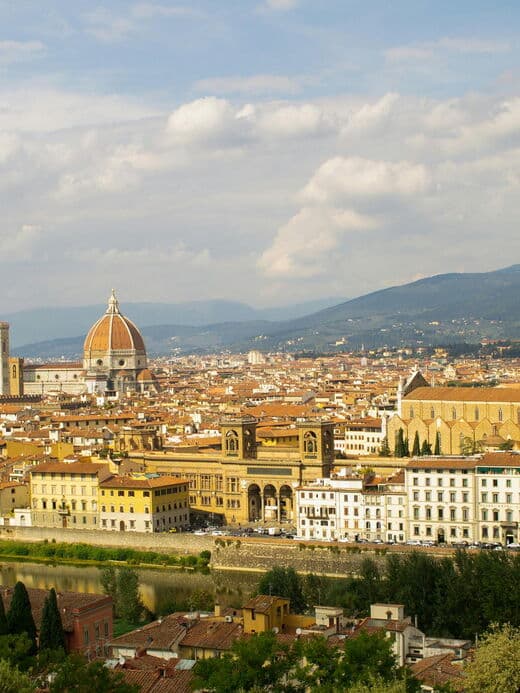
Piazzale Michelangelo is Florence's most famous viewpoint, located on a hill south of the historic center. From here you get the classic view of the city with Brunelleschi's dome, Giotto's campanile, the tower of Palazzo Vecchio, and the bridges across the Arno. It's especially beautiful at sunset when Florence turns golden. A bronze copy of David stands in the center of the square.
Just above lies the Basilica of San Miniato al Monte - a gem of 11th - 13th century Romanesque architecture. The green-and-white marble façade, mosaic floor, and Chapel of the Cardinal of Portugal make this church, which remains an active Benedictine monastery, a must-visit. The monks sell liqueurs and honey of their own production.
The hill town of Fiesole - an ancient city founded by the Etruscans long before Florence - lies 8 kilometers to the northeast. You can get there on bus number 7 from Santa Maria Novella station. Besides magnificent views, the town preserves a Roman theater, baths, archaeological museum, and Romanesque cathedral. Fiesole was a favorite retreat of Florentine aristocracy - Medici villas surround the town.
Florentine Cuisine: Tuscan Traditions
Florence's cuisine reflects Tuscan philosophy - simple, quality ingredients without excess. Bread is baked without salt (legend says due to medieval disputes with Pisa, which controlled the salt trade), making it a perfect accompaniment to flavorful dishes. New-harvest olive oil is a sacred product without which Tuscan cuisine is unthinkable.
Famous Dishes
- Bistecca alla fiorentina - the legendary Florentine steak from young Chianina cattle. A huge cut (minimum 1 kg) on a T-bone is grilled over charcoal and served rare. This iconic dish requires real skill and quality meat
- Ribollita - a thick peasant soup of black cabbage, beans, vegetables, and stale bread. The name means "reboiled" - the soup becomes tastier the second day
- Pappa al pomodoro - another bread soup, this time with tomatoes, basil, and olive oil. A simple and delicious dish made famous by a children's song
- Lampredotto - typical street food: a sandwich with boiled cow's stomach in green sauce. Sold at special kiosks called "lampredottai"
- Schiacciata - flat bread with olive oil and salt, similar to focaccia. The version with grapes ("schiacciata con l'uva") is a seasonal autumn treat
- Cantucci and vin santo - almond cookies dipped in sweet dessert wine. The traditional ending to a Florentine meal
Tuscan Wines
Florence is the gateway to great wine regions: Chianti Classico, Brunello di Montalcino, Vino Nobile di Montepulciano. Sangiovese is the main grape variety, producing elegant red wines with aromas of cherry and violet. "Super Tuscan" wines - modern blends with Cabernet Sauvignon and Merlot - revolutionized Italian winemaking.
Practical Information
Getting There
Florence's Amerigo Vespucci Airport (Peretola) receives flights from major European cities. The center is 20 minutes away by T2 tram (€1.50) or taxi (about €25). Many travelers fly into Pisa Airport (Galileo Galilei), from where a direct train runs to Florence (about 1 hour, €15). High-speed Frecciarossa and Italo trains connect Florence with Rome (1.5 hours), Milan (2 hours), Venice (2 hours), and Naples (3 hours).
City Transport
Florence's historic center is compact - it's a 15-minute walk from Santa Maria Novella station to Piazza della Signoria. The ZTL (limited traffic zone) prohibits private vehicles in the center. ATAF buses are useful for trips to Piazzale Michelangelo, Fiesole, and outlying areas. A 90-minute ticket costs €1.50, a 24-hour pass €5.
When to Visit
The best times to visit are spring (April - May) and autumn (September - October), when the weather is pleasant and there are relatively fewer tourists. Summer is hot and crowded - temperatures often exceed 35°C. Winter is mild, museums are empty, but some attractions may be closed. Tourist season peaks in June and at Easter.
Museum Tickets
The Uffizi and Accademia Gallery require advance booking - lines without reservations can take several hours. The Firenze Card (€85) provides priority entry to 72 museums for 72 hours. The first Sunday of each month, state museums are free, but lines are enormous. Many churches charge admission (usually €5 - 8).
Where to Stay
The center (Duomo, Santa Croce) is convenient but expensive and noisy. Oltrarno is more atmospheric and quieter, with easy access to the center. Santa Maria Novella is practical for those arriving by train. San Lorenzo is near the market with budget options. Outside the ZTL, prices are lower but getting to the center takes longer.
Useful Tips
- Book Uffizi and Accademia tickets at least a week ahead in high season
- Churches close for lunch (usually 12:00 - 15:00) - plan visits for morning or evening
- For bistecca alla fiorentina, reserve ahead and order the steak for two
- Avoid restaurants with menus in five languages and photos of dishes - look for places where locals eat
- San Lorenzo Market for leather goods, Sant'Ambrogio Market for food and local atmosphere
- Piazzale Michelangelo is best at sunset - arrive an hour before to get a spot
- Gelato in Florence is excellent - look for gelaterias with natural colors and covered containers
- Many museums are closed Mondays (Uffizi, Accademia are exceptions)
Day Trips from Florence
Siena - Florence's medieval rival with stunning Piazza del Campo and Gothic cathedral (1.5 hours by bus). Pisa - the famous tower and Square of Miracles (1 hour by train). Lucca - a charming town with fully preserved walls and Romanesque churches (1.5 hours). San Gimignano - the "medieval Manhattan" with 14 tower-skyscrapers (1.5 hours by bus). Chianti wineries - tastings and Tuscan landscapes (best by car or organized tour).
Florence is a city impossible to exhaust in one visit. Every alley holds history, every museum reveals new masterpieces, every meal becomes a gastronomic discovery. This is a place you'll want to return to again and again, discovering new facets of the city that gave the world the Renaissance.