About
Belarus: The Complete Travel Guide for Western Visitors
Why Visit Belarus
Belarus is a country that will surprise you. Not with flashy resorts or Instagram-famous landmarks, but with something you probably did not expect: streets so clean you could eat off them, a palpable sense of safety at any hour, primeval forests covering nearly half the country, and genuine hospitality that cannot be bought because it simply exists.
When I first arrived in Belarus, I was struck by the gap between what I expected and what I found. I had anticipated a gray post-Soviet backwater, perhaps a bit dreary and stuck in the past. Instead, Minsk revealed itself as a modern European capital with wide boulevards, an immaculate metro system, and Stalinist architecture that here looks not oppressive but monumental, even majestic. Yet drive an hour from the capital, and you enter an entirely different world: medieval castles rising from misty fields, villages where time has stopped, ancient forests where European bison still roam wild.
Belarus is a country of contrasts that do not advertise themselves. They wait quietly for you to discover them. Soviet heritage stands beside baroque Catholic churches. Draniki (potato pancakes) appear on the menus of fine dining restaurants. IT professionals earning global salaries live in cities where apartments cost less than a studio in a Prague suburb. This is a country where everything works, where nobody will try to scam you, where you can walk alone at night without looking over your shoulder. And yet it is also a country with a complicated history that people here remember and honor.
For Western travelers, Belarus offers something increasingly rare: authentic European travel without the crowds, without the tourist markup, without the feeling that you are following a well-worn path trampled by millions before you. You will not find selfie sticks at every corner. You will not queue for hours to see famous sights. What you will find is a country that has not yet learned to perform for tourists, because it has not needed to.
There is a certain honesty to Belarus that is hard to describe until you experience it. Prices are what they are, without tourist inflation. Restaurant portions are generous, not because marketing told them to be, but because that is how Belarusians eat. When someone helps you with directions, they genuinely want to help, not guide you toward their cousin's souvenir shop. This absence of tourism-industry artifice makes Belarus feel refreshingly real.
Is Belarus for everyone? Probably not. If you need constant stimulation, world-famous attractions, and a developed tourist infrastructure in English, you might struggle here. But if you are the kind of traveler who values discovery over confirmation, who finds joy in being genuinely off the beaten path, who wants to see a place before it changes, Belarus will reward you richly. This is one of Europe's last undiscovered destinations, and it will not stay that way forever.
The country also offers exceptional value for money. Your dollars, euros, or pounds will stretch remarkably far here. A comfortable mid-range trip in Belarus costs roughly what a budget trip would cost in Western Europe. Fine dining is affordable, quality accommodation is reasonable, and experiences that would be premium-priced elsewhere come at accessible rates. For travelers from expensive countries, Belarus can feel almost startlingly cheap without sacrificing quality.
And then there is the nature. Belarus is one of the greenest countries in Europe, with forests, lakes, and wetlands that have survived because industrialization and intensive agriculture touched this land more lightly than others. Belovezhskaya Pushcha, Europe's last primeval forest, straddles the border with Poland and shelters the continent's largest land mammal, the European bison. The Braslav Lakes offer a Baltic landscape of water and islands. The Pripyat marshes form a vast wetland sometimes called the Belarusian Amazon. If you love natural landscapes, Belarus delivers.
Consider Belarus if you want to see a country at a crossroads, a place where East meets West in ways both literal and metaphorical. Consider it if you are curious about Soviet history and its aftermath, about how a small nation navigates between larger powers, about what daily life looks like in a place Western media rarely covers except in headlines. Consider it if you want to travel somewhere your friends have not been, somewhere that will give you stories nobody else has. Consider it, quite simply, if you want an adventure that actually feels adventurous.
Regions of Belarus
Belarus divides into six regions (oblasts) plus the capital city of Minsk, which has its own administrative status. Each region has a distinct character, history, and set of attractions. Understanding this geography will help you plan a trip that matches your interests.
Minsk City and Region
Minsk is where most travelers begin, and many spend their entire trip here, which is a mistake. The capital deserves two to three days, but Belarus is much more than its largest city. That said, Minsk is essential for understanding the country.
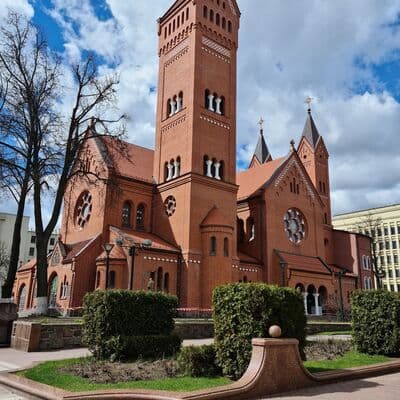
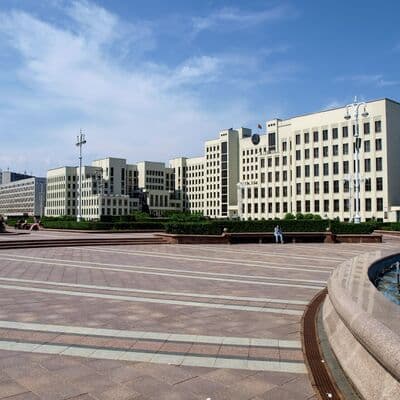
The city was almost completely destroyed during World War II. What you see today is largely a planned reconstruction in the Stalinist style, which gives Minsk a unique architectural coherence. The wide boulevards, the monumental buildings, the carefully maintained public spaces all create a particular urban experience unlike any other European capital. The Independence Square anchors the city center, dominated by the Government House and the Red Church, one of the few pre-war structures remaining.
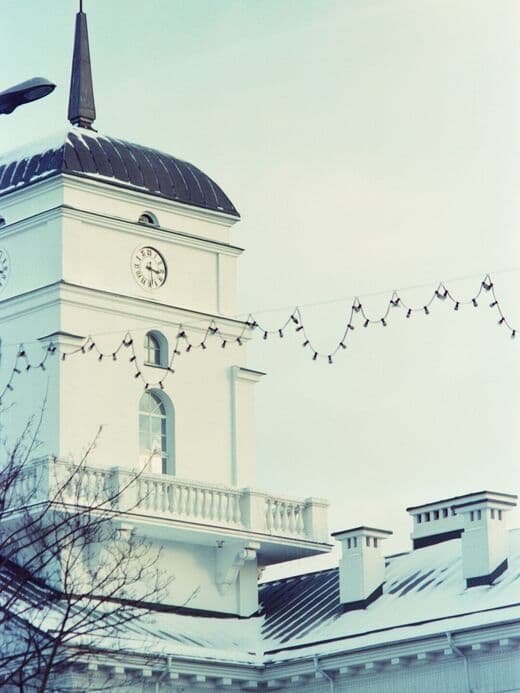
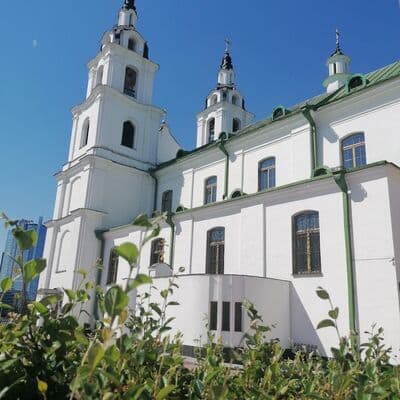
Walking along Independence Avenue, the main artery stretching 15 kilometers through the city, you pass through Soviet urban planning at its most ambitious. The Gates of Minsk welcome you at the train station, twin towers that appear on countless postcards. Victory Square with its eternal flame commemorates the war dead. The Upper Town offers a more intimate scale, with the restored City Hall, the Holy Spirit Cathedral, and cobblestone streets that hint at the pre-war city.
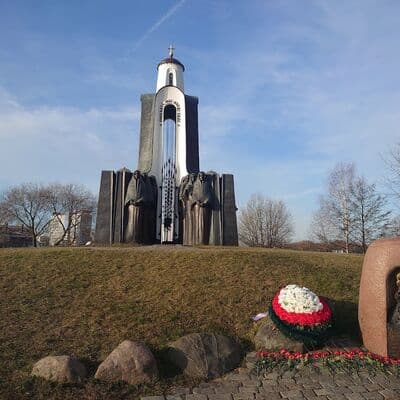
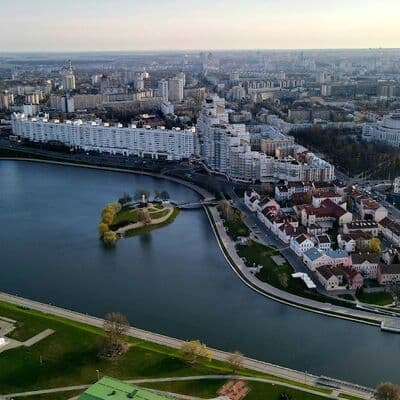
The Trinity Suburb provides Minsk's most picturesque quarter, a reconstructed neighborhood of pastel-colored houses along the Svisloch River. Nearby, the Island of Tears memorializes Belarusian soldiers who died in the Soviet-Afghan War. For many visitors, this small island with its weeping willow trees and crying angel statues provides the most emotionally moving experience in Minsk.
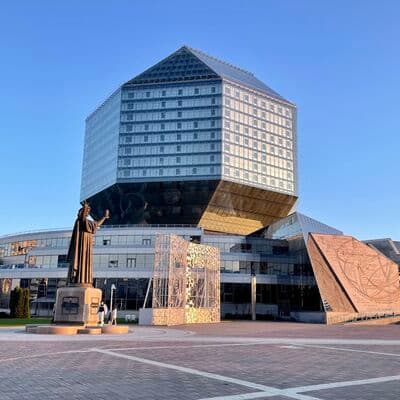
Do not miss the National Library of Belarus, a striking geometric structure nicknamed the diamond that offers panoramic views from its observation deck. The Museum of the Great Patriotic War ranks among the world's finest World War II museums, with extraordinary exhibits that convey the enormity of Belarus's wartime suffering. The Bolshoi Theatre of Belarus offers world-class opera and ballet at remarkably affordable prices.
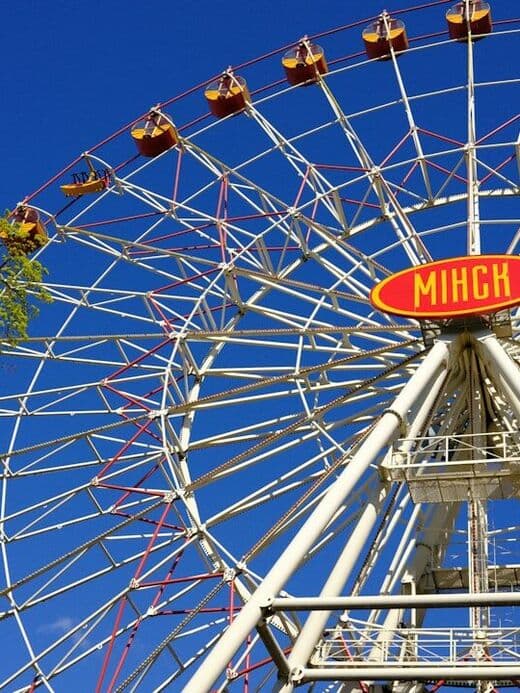
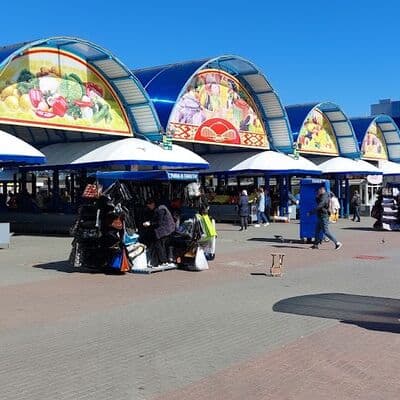
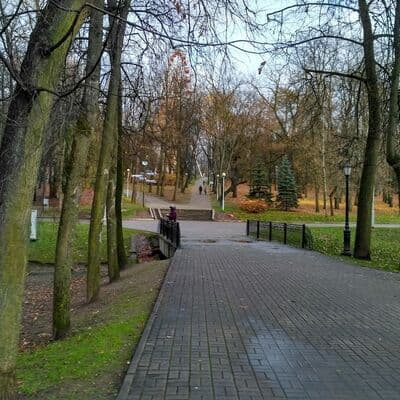
The Komarovsky Market gives you a taste of daily life, with vendors selling everything from cheese and sausages to pickles and honey. The Central Botanical Garden provides a peaceful retreat, while Gorky Park offers both amusement rides and quiet walking paths. Loshitsa Park, slightly outside the center, feels like countryside within the city.
Minsk Region surrounding the capital contains several important day-trip destinations. The Mir Castle Complex, a UNESCO World Heritage Site, rises dramatically from the flat landscape about 90 kilometers southwest. This 16th-century fortress combines Gothic, Renaissance, and Baroque elements in a uniquely Belarusian synthesis. Thirty kilometers further lies Nesvizh Palace, another UNESCO site, a sprawling aristocratic residence with extensive landscaped grounds. Together, these two castles make the most popular excursion from Minsk.
The Khatyn Memorial Complex, about 60 kilometers north of Minsk, commemorates the village of Khatyn and 186 other Belarusian villages destroyed by Nazi forces with all their inhabitants. This is not an easy place to visit, but it is essential for understanding Belarus. The haunting memorial, with its symbolic chimneys representing lost homes and bells that ring every 30 seconds, leaves no visitor unmoved.
The Stalin Line, a defensive fortification from the 1930s, has been converted into an open-air military museum where you can climb on tanks, explore bunkers, and even fire historical weapons. It appeals particularly to those interested in military history and to children who enjoy interactive experiences.
Brest Region
Brest lies in the southwest corner of Belarus, on the border with Poland. This is perhaps the most historically significant city in the country, most famous for the Brest Fortress, where Soviet soldiers made a legendary last stand against German invasion in June 1941. The fortress complex includes impressive fortifications, evocative ruins, and a powerful memorial with a massive concrete soldier's head and an obelisk. Allow at least half a day for a proper visit.
The city of Brest itself offers pleasant walking, particularly along Sovetskaya Street, the main pedestrian thoroughfare. Each evening at dusk, a lamplighter in 19th-century costume lights the street's gas lamps by hand, a charming tradition that draws crowds. The Railway Museum displays antique locomotives in an outdoor setting. The Brest Regional Museum of Local Lore covers regional history with well-curated exhibits.
Brest Region's greatest natural treasure is Belovezhskaya Pushcha National Park, Europe's last primeval lowland forest and a UNESCO World Heritage Site. This ancient woodland has never been cleared, and trees here are up to 600 years old. The forest shelters the largest population of European bison, saved from extinction in the early 20th century. You can see these magnificent animals in enclosures or, with luck, spot them on walking trails.
The national park offers various ways to explore: walking paths, bicycle routes, safari tours in open vehicles, and even horse-drawn carriages. Father Frost's Residence, the Belarusian equivalent of Santa's village, operates year-round and delights children regardless of season. Allow a full day for Belovezhskaya Pushcha, or better yet, spend a night in one of the park's guesthouses to experience the forest at dawn.
Other attractions in Brest Region include the Kossovo Palace, a magnificent neo-Gothic manor currently under restoration, and the nearby museum dedicated to Tadeusz Kosciuszko, the Polish-Lithuanian-Belarusian military leader who also fought in the American Revolution. The Ruzhany Palace, once one of the grandest aristocratic residences in the region, stands in romantic ruin, partially restored but still atmospheric.
Grodno Region
Grodno, in the northwest corner bordering both Poland and Lithuania, is often called the most beautiful city in Belarus, and with good reason. Unlike Minsk, Grodno was largely spared during World War II, preserving a historic center with architecture spanning several centuries. If any Belarusian city feels European in the traditional sense, it is Grodno.
The Old Castle and New Castle overlook the Neman River, their strategic position explaining why Grodno served as a royal residence for Polish-Lithuanian kings. The Farny Church (St. Francis Xavier Cathedral) contains one of the most elaborate Baroque interiors in Eastern Europe, with ornate altars, frescoes, and an astronomical clock. The Borisoglebsk (Saints Boris and Gleb) Church dates to the 12th century, making it one of the oldest structures in Belarus.
Walking through Grodno's old town, you encounter a mix of Baroque, Renaissance, and Art Nouveau buildings, Jewish heritage sites, and Soviet-era additions that somehow coexist without jarring. The city has an artistic, slightly bohemian atmosphere, with galleries, antique shops, and atmospheric cafes. The Grodno Zoo, one of the oldest in the former Soviet Union, sprawls across a forested hillside.
From Grodno, the Augustow Canal offers a unique excursion. This 19th-century waterway connecting the Neman and Vistula basins is now a tranquil route for boat trips through the forest. The canal crosses the Polish border, and cruises sometimes include crossing into Poland and back, though visa requirements mean this works best for EU citizens.
Grodno Region also contains Lida, with its 14th-century castle, and numerous smaller towns and villages that preserve traditional Belarusian architecture and ways of life. This is excellent territory for those seeking authenticity beyond major tourist sites.
Vitebsk Region
Vitebsk in the northeast is the birthplace of Marc Chagall, and the city proudly claims this heritage. The Chagall House Museum occupies the building where the artist spent his childhood, while the Marc Chagall Art Center displays original works. Each summer, the Slavianski Bazaar festival transforms Vitebsk into a major music destination, drawing performers and audiences from across the former Soviet Union.
Beyond the Chagall connection, Vitebsk offers a pleasant provincial city experience, with a restored historic center, riverside walks along the Western Dvina, and a relaxed atmosphere quite different from Minsk. The regional museum occupies a former city hall, and several churches showcase different architectural periods.
The real treasure of Vitebsk Region is Polotsk, a small city with enormous historical significance. Polotsk was the first major center of Slavic civilization in what is now Belarus, and its Saint Sophia Cathedral, built in the 11th century and rebuilt in the Baroque style, stands as a symbol of Belarusian national identity. The city also claims to be the geographical center of Europe, marked by a monument you can visit.
Polotsk's compact historic center is easily walkable, with the Epiphany Monastery, several museums including a museum of Belarusian book printing, and monuments to figures like Francysk Skaryna, who printed the first book in the Belarusian language in 1517. For those interested in Eastern European Christianity's development, Polotsk is essential.
The northern part of Vitebsk Region borders Russia and contains the Braslav Lakes National Park, a landscape of over 60 lakes formed by glacial retreat. This is prime territory for fishing, kayaking, birdwatching, and simply enjoying lake scenery. Accommodation ranges from simple guesthouses to comfortable resort hotels, and the area draws Belarusians seeking summer relaxation. Foreign tourists remain rare here, which adds to the appeal.
Mogilev Region
Mogilev, in the east, receives fewer foreign visitors than other regions, yet offers genuine experiences for those who make the journey. The city of Mogilev has a restored city hall with observation tower, impressive Orthodox churches, and a theatrical atmosphere along its main pedestrian street.
The Buynichi Field memorial complex outside Mogilev commemorates a pivotal 1941 battle with a chapel, museum, and zoo. The zoo is unusual, placing emphasis on animals native to Belarus in naturalistic enclosures. Literary enthusiasts may appreciate that Konstantin Simonov, the famous Soviet war correspondent and writer, asked to have his ashes scattered at Buynichi.
Bobruisk, south of Mogilev, was once one of the most Jewish cities in the Russian Empire, with over 60% Jewish population before World War II. Little remains of that heritage physically, but the city has embraced an unlikely symbol: the beaver. A large beaver monument in the center has become a beloved landmark and selfie spot. Bobruisk's 19th-century fortress, built to defend the western frontier, has crumbling walls and overgrown ramparts that appeal to those who like their history atmospheric rather than restored.
Mogilev Region may lack the star attractions of other areas, but it offers something valuable: the least touristy experience in Belarus, with genuine encounters and undiscovered corners.
Gomel Region
Gomel, the second largest city in Belarus, anchors the southeast corner near the borders with Russia and Ukraine. The Rumyantsev-Paskevich Palace, an 18th-century aristocratic residence set in extensive parkland along the Sozh River, is the city's main attraction. The palace interior displays period furnishings and family collections, while the park offers pleasant walking with a magnificent cathedral, a chapel mausoleum, and river views.
Gomel has a different feel from other Belarusian cities, perhaps because of its location far from the capital and close to Ukraine. Russian and Ukrainian influences are stronger here, and the local dialect reflects this borderland position. The city's pre-war Jewish heritage is remembered in surviving architecture and a small but active Jewish community.
South of Gomel lies Polesie, a vast wetland region that is one of Europe's most important and least known natural areas. The Pripyatsky National Park, sometimes called the Belarusian Amazon, protects floodplain forests and marshes that shelter rare birds, including aquatic warblers and greater spotted eagles. Boat trips along the Pripyat River reveal a landscape that seems unchanged since medieval times.
Mozyr, in the south of Gomel Region, is unusual for Belarus in having actual hills, with a dramatic ravine cutting through the city. The topography and wooden architecture give Mozyr a distinctive character. This is deep Polesie, where local dialects, customs, and ways of life differ noticeably from the rest of Belarus.
Note that eastern Gomel Region lies relatively close to the Chernobyl Exclusion Zone in Ukraine. Some areas experienced fallout from the 1986 disaster and remain affected, though places tourists visit are safe. Organized tours to the Belarusian side of the exclusion zone operate from Minsk and Gomel for those interested in nuclear tourism.
Planning Your Regional Itinerary
Most first-time visitors focus on Minsk, Brest Region (for the fortress and forest), and Grodno (for the historic city), which is a solid introduction. Adding Vitebsk Region brings Chagall and Polotsk. Adding Mogilev and Gomel provides a deeper, more comprehensive picture but requires more time and tolerance for less developed tourism infrastructure.
Distances in Belarus are manageable. The country is roughly 350 kilometers from east to west and 560 kilometers from north to south. You can drive from Minsk to any regional capital in four to five hours at most. Public transport reaches everywhere, though schedules may require flexibility.
Unique Experiences in Belarus
Beyond the standard sightseeing, Belarus offers experiences you will not find elsewhere, or at least not in the same form. These are the things that make a trip here memorable rather than merely competent.
European Bison Encounters
The European bison, or wisent, is the continent's largest land mammal, and Belarus is one of the best places to see them. These magnificent animals were hunted to extinction in the wild by 1927, surviving only in zoos. A careful breeding program brought them back, and today over 2,000 roam Belovezhskaya Pushcha and other reserves.
In the national park, you can see bison in large enclosures that simulate wild conditions. But the real thrill is spotting them on a walking trail or during a safari tour. Early morning and late evening offer the best chances, particularly at forest clearings where bison graze. Winter is actually ideal for bison viewing, as the animals concentrate near feeding stations and are easier to find against the snowy landscape.
Beyond Belovezhskaya Pushcha, the Ozery bison nursery near Grodno and reserves in other regions also shelter bison populations. For the dedicated wildlife enthusiast, a multi-day bison-focused itinerary is possible.
Soviet Time Capsule
Belarus preserves Soviet heritage to a degree unmatched anywhere else. This is not accidental. The government has maintained monuments, symbols, and institutions that most post-Soviet states dismantled. For visitors interested in 20th-century history, this creates an extraordinary living museum.
Minsk's architecture is the most visible example, but the phenomenon goes deeper. State farms (kolkhozes) still operate in something like their Soviet form. Lenin statues stand in virtually every town square. State-run shops selling bread and basic goods exist alongside modern supermarkets. The metro's aesthetics remain true to Soviet subway design principles.
Whether you find this fascinating, disturbing, or both, it offers an opportunity to understand the Soviet era in a way no museum can replicate. Walk through a Minsk suburb built for workers in the 1960s. Visit a collective farm museum. Shop in a state grocery store. These experiences provide context for understanding both the Soviet past and Belarus's present.
Castles and Palaces
Belarus was part of the Grand Duchy of Lithuania and later the Polish-Lithuanian Commonwealth, and the aristocratic heritage from those centuries survives in numerous castles and palaces. Unlike their equivalents in Western Europe, these are not overrun with tourists. You might explore a UNESCO World Heritage castle and encounter only a handful of other visitors.
Mir Castle, with its red brick towers reflected in an artificial lake, is the most famous and perhaps the most photogenic. Nesvizh Palace, with its landscaped English-style park, conveys aristocratic grandeur. But beyond these well-known sites lie dozens of lesser-visited fortifications and manor houses.
The Lida Castle, in Grodno Region, is a massive brick fortress from the 14th century that hosts medieval festivals. The Krevo Castle, now in atmospheric ruins, witnessed the Union of Kreva that joined Lithuania and Poland. The Golshansky Castle, associated with ghost stories, crumbles romantically in a small town. For castle enthusiasts, Belarus provides weeks of exploration.
Orthodox and Catholic Heritage
Belarus sits at the boundary between Eastern and Western Christianity, and both traditions left architectural legacies. Orthodox churches with onion domes stand near Catholic churches with Baroque facades. This coexistence reflects centuries of shifting borders and competing influences.
For Orthodox heritage, the Saint Sophia Cathedral in Polotsk represents the oldest major church, though rebuilt. The Epiphany Monastery there contains remarkable frescoes. Minsk's Holy Spirit Cathedral houses a wonder-working icon. Mogilev and Vitebsk have significant Orthodox churches.
For Catholic heritage, Grodno's Farny Church offers the most impressive interior, with rococo decoration that rivals anything in Bavaria. The Red Church in Minsk, officially the Church of Saints Simon and Helena, provides a neo-Romanesque contrast to surrounding Soviet architecture. Numerous smaller towns preserve wooden Catholic churches with painted interiors.
The Uniate (Greek Catholic) Church, suppressed under Russian rule and Communism, has only a small presence today, but its former churches, converted to Orthodox or Catholic use, remain architecturally distinctive.
War Memorials
No country suffered more from World War II, proportionally, than Belarus. One in four Belarusians died during the conflict. This tragedy is memorialized throughout the country in ways that are sobering, sometimes overwhelming, and ultimately essential for understanding this place.
The Brest Fortress, where Soviet soldiers held out for weeks against overwhelming German forces, is the most famous site. The memorial complex combines heroic monumentalism with genuine historical power. The Museum of the Great Patriotic War in Minsk, recently rebuilt, uses cutting-edge museum technology to immerse visitors in the experience of total war.
But the smaller memorials may be even more affecting. Khatyn represents all the villages burned with their inhabitants, a crime that happened 628 times in Belarus. The Maly Trostenets Memorial commemorates one of the largest Nazi death camps, finally receiving proper commemoration in recent years. Throughout the countryside, modest obelisks mark massacre sites, partisan battles, and destroyed communities.
These memorials are not presented neutrally. The narrative emphasizes Soviet victory and Belarusian suffering, often eliding complexities like collaboration or the specific targeting of Jewish victims. Understanding this framing adds another layer to the experience.
Agrotourism and Rural Life
Belarus has developed a distinctive form of agrotourism, with hundreds of farmstays and rural guesthouses offering accommodation, traditional food, and country experiences. These range from basic to surprisingly comfortable, but all provide immersion in rural Belarus that hotels cannot match.
Activities vary but often include traditional cooking lessons, fishing, mushroom and berry foraging, banya (sauna) experiences, horseback riding, and simply enjoying the countryside. Some estates cultivate heritage crops and livestock, preserving agricultural traditions. Others offer hunting and fishing for those interested.
The best agrotourist estates combine comfortable rooms with genuine hospitality, serving meals featuring products raised or gathered on the property. Expect potato dishes prepared every conceivable way, fresh dairy, garden vegetables, wild mushrooms, and homemade preserves. Vodka or local spirits often accompany evening meals.
Agrotourism works best for those with some Russian language ability, as English is rare in rural areas. However, hospitality transcends language barriers, and translation apps help bridge gaps. For a deeper Belarus experience, at least a few nights in the countryside reward richly.
Primeval Forest Walks
Belovezhskaya Pushcha is not the only ancient forest in Belarus, though it is the most famous. Throughout the country, forests cover 40% of the territory, and many are old growth or minimally managed woodlands that feel primeval even if not technically so.
Walking or cycling through these forests connects you to landscapes that have characterized this land for millennia. The silence, the bird calls, the play of light through ancient canopy, the mushroom scent after rain, the unexpected encounter with wildlife create experiences impossible to replicate elsewhere in increasingly urbanized Europe.
National parks and nature reserves offer marked trails with varying difficulty. The Berezinsky Biosphere Reserve, north of Minsk, protects diverse habitats including European beaver colonies viewable from observation points. The Narochansky National Park surrounds Belarus's largest lake. The Pripyatsky National Park preserves the wetlands and flooded forests of Polesie. Each offers different ecosystems and experiences.
Living Folk Culture
Belarusian folk culture survives not just in museums but in practice. Traditional crafts continue, particularly in smaller towns and rural areas. Straw weaving, pottery, linen working, and wood carving all maintain practitioners who create functional and decorative items.
Traditional music and dance appear at festivals and special events. The Kupalle Festival in late June, marking the summer solstice, involves jumping over fires, floating flower wreaths on water, and searching for the mythical fern flower. Religious holidays, particularly Orthodox Christmas and Easter, involve traditional foods and customs.
Dudutki, an open-air museum complex near Minsk, demonstrates traditional crafts and technologies, offering workshops where visitors can try blacksmithing, pottery, baking, and other skills. The Belarus State Museum of Folk Architecture and Rural Life in Minsk Region preserves historic buildings relocated from across the country. For deeper immersion, seek out local festivals and markets in smaller towns.
When to Visit Belarus
Belarus has a continental climate with four distinct seasons. Each offers different advantages, and the best time depends on your priorities.
Summer (June to August)
Summer is the most popular season, with warm weather averaging 20-25 C (68-77 F), long days, and everything open. This is ideal for nature activities, lake holidays, and outdoor festivals. The Slavianski Bazaar festival in Vitebsk (July) draws huge crowds. Accommodation books up, especially around weekends and holidays, so reserve in advance.
Downsides include occasional heat waves, mosquitoes in forested and wetland areas, and higher prices. July and August bring Belarusian and Russian vacationers to lakes and resorts. Summer thunderstorms are common but usually brief.
Winter (December to February)
Winter means snow, cold temperatures averaging -5 to -10 C (23 to 14 F), and sometimes severe frosts. Short days (darkness by 4:30 PM) limit outdoor activities. However, winter has its charms: snow-covered landscapes, cozy interiors, fewer tourists, and lower prices.
Winter is actually excellent for bison viewing, when animals concentrate near feeding stations. Castles and historic sites have atmospheric emptiness. Cross-country skiing is possible in forested areas. New Year and Orthodox Christmas bring festive decorations and markets. If you dress warmly and embrace the season, winter Belarus rewards.
Spring (March to May)
Early spring (March-April) is the worst time to visit. Snow melts into mud, temperatures hover around freezing, and landscapes look bleak. Late April and May improve dramatically, with warming weather, blooming trees, and celebrating Orthodox Easter bringing the country to life.
May offers pleasant conditions, fewer crowds than summer, and spring colors in parks and gardens. This is an underrated time to visit, though weather can be unpredictable.
Autumn (September to November)
September and early October offer ideal conditions: warm days, cool nights, autumn foliage, and forest mushroom season. This is perhaps the best time for nature and outdoor activities, with perfect conditions and minimal crowds.
Late October brings rain and shortened days. November can be quite gray and gloomy, with bare trees and cold rain. Like early spring, late autumn is best avoided unless you specifically seek solitude.
Bottom Line
For first-time visitors, late May through September offers the safest bet, with June and September providing the best balance of weather and crowd levels. Adventure-minded travelers might consider January or February for a unique winter experience. Avoid April and November unless you have specific reasons.
How to Get to Belarus
Visa Requirements for Western Citizens
Belarus offers visa-free entry for citizens of over 70 countries, including the United States, United Kingdom, European Union member states, Canada, Australia, and most other Western nations. You can stay up to 30 days without a visa if you arrive and depart through Minsk National Airport. This visa-free regime has operated since 2017 and transformed Belarus's accessibility.
Important conditions apply. You must enter and exit through Minsk airport specifically. Land border crossings and travel through Russia require visas or different arrangements. You need travel insurance with minimum 10,000 euro coverage from a company authorized to operate in Belarus. You need proof of sufficient funds, roughly 50 USD equivalent per day of stay. Immigration officers rarely check these strictly but can ask.
For stays longer than 30 days, or for entry via land borders, you need a visa obtained in advance from a Belarusian embassy or consulate. The process involves application forms, photos, invitation letters or hotel confirmations, insurance, and fees. Processing takes about a week.
Travelers arriving from or departing to Russia face a special situation. The Russia-Belarus Union State creates open borders between the two countries, but this is intended for citizens of both. Third-country nationals technically need Russian transit visas to pass through Russia, and the legal situation is murky. Many foreigners have traveled between Russia and Belarus without problems, but others have faced difficulties. If your itinerary involves Russia, research carefully and consider consulting both embassies.
Flights to Minsk
Minsk National Airport (MSQ) receives flights from numerous destinations. European connections include Istanbul, Dubai, and various cities in former Soviet states. Direct flights from Western Europe have become limited due to sanctions imposed following 2020 political events and the 2021 Ryanair incident when Belarus forced down a commercial flight to arrest a dissident.
Currently, most Western travelers connect through Istanbul (Turkish Airlines), Dubai (FlyDubai or Emirates), or Gulf hubs. Some reach Belarus via Georgian Airways through Tbilisi or via Serbian connections through Belgrade. Routes change frequently due to political situations, so check current options when planning.
Flight times from major hubs: Istanbul 2.5 hours, Dubai 5.5 hours, Tbilisi 2.5 hours. Connecting via these cities adds travel time but provides options when direct routes are limited.
At the airport, immigration usually proceeds smoothly. English signage exists, and officers at international arrival counters often speak basic English. Have your return ticket, accommodation confirmation, and insurance policy accessible. The visa-free entry stamp goes in your passport. Total processing rarely exceeds 30 minutes even at busy times.
Arriving by Land
If you have a visa, you can enter Belarus by land from Poland, Lithuania, Latvia, Ukraine, or Russia. Border crossings exist at numerous points, with the Poland-Belarus border at Brest being the most commonly used by Western travelers.
Crossing from Poland, whether by car, bus, or train, involves thorough checks that can take several hours at busy times. Both Belarusian and Schengen-zone controls apply. Expect vehicle searches and document inspections. Having all paperwork in order speeds the process.
The train from Warsaw to Minsk takes about 10 hours, running overnight and handling border formalities en route. This is a classic European train journey for those with time. Buses from Warsaw and other Polish cities also serve Minsk.
From Lithuania or Latvia, buses connect to Vilnius and Riga. These routes are less commonly used by tourists but straightforward with proper documentation.
The Russia border is open for authorized travelers but complicated for third-country nationals without Russian visas. The train from Moscow to Minsk takes about 9 hours overnight and does not stop for border control, as the Union State eliminates formal borders. However, Russian visa requirements for transit remain an issue.
Current Complications
Following events since 2020, including contested elections, forced landing of a commercial aircraft, and Belarus's support for Russia's actions in Ukraine, Western governments advise against travel to Belarus. Many airlines have suspended flights. Insurance companies may exclude Belarus from coverage or charge premiums.
These advisories deserve consideration, but thousands of Western tourists visit Belarus annually without incident. The practical reality is often less dramatic than official warnings suggest. However, you should:
- Check your government's current travel advisory before booking
- Ensure your travel insurance explicitly covers Belarus
- Understand that consular assistance may be limited if problems arise
- Stay informed about the political situation
- Avoid any activities that could be construed as political
Make an informed decision based on current conditions rather than outdated assumptions in either direction.
Getting Around Belarus
Trains
The Belarusian railway system, operated by Belarusskaya Chygunka, provides comfortable and affordable intercity travel. Trains connect Minsk to all regional capitals and major towns. The network inherited Soviet-era infrastructure that has been modernized on main routes.
Train types range from fast intercity services taking 3-4 hours between Minsk and regional capitals to slower regional trains stopping at every station. Express trains offer comfort comparable to Western European standards, with reserved seats, air conditioning, and buffet cars. Regional trains are simpler but functional.
Overnight trains serve longer routes, particularly Minsk-Brest (convenient for arriving early to visit the fortress) and connections to Russia and Ukraine (when operating). Sleeping compartments range from third-class open bunks (platzkart) to two-berth first-class compartments (SV). Second-class four-berth compartments (kupe) offer a good balance of comfort and cost.
Tickets can be purchased at stations, through the official railway website (in Russian, but manageable with translation), or through aggregator sites. Booking in advance guarantees seats on popular routes. Prices are low by Western standards: expect 10-25 BYN (roughly 3-8 USD) for intercity journeys, more for sleeping compartments.
Buses
Long-distance buses supplement trains, often serving routes with infrequent rail service or reaching smaller towns. The main operator is state-run, but private companies also compete on popular routes. Buses range from comfortable coaches with air conditioning and WiFi to older vehicles on rural routes.
Minsk's Central Bus Station near the train station serves most long-distance routes. Regional capitals have their own bus stations. Tickets can be purchased at stations or increasingly online. Prices are comparable to or slightly below train fares.
For reaching places like Mir Castle, Nesvizh Palace, and Khatyn Memorial, where train stations are distant, buses provide the main public transport option. Schedules require attention, as return buses may be infrequent.
Marshrutkas
Marshrutkas are minibuses that fill gaps in the transport network. They run fixed routes but with more frequency and flexibility than regular buses, departing when full rather than on strict schedules. Marshrutkas serve both urban and intercity routes.
Finding the right marshrutka can be confusing, as stations are chaotic and signs may be only in Cyrillic. Ask locals for help or use mapping apps. Pay the driver directly. Marshrutkas are cheap but less comfortable than buses or trains, especially on longer journeys.
Taxis and Ride-Sharing
Taxi apps work throughout Belarus, with Yandex Go being the dominant service. Download the app before arrival, as it requires phone verification. The app works in English and shows prices upfront, eliminating negotiation and overcharging risks. Rides are cheap: a cross-city journey in Minsk rarely exceeds 10-15 BYN (3-5 USD).
Traditional taxis also operate but tend to charge more and sometimes much more if they think you are a tourist. If using street taxis, agree on the price before getting in. Taxis waiting at airports and train stations are particularly prone to overcharging.
Rental Cars
Renting a car provides the most flexibility for exploring Belarus, particularly for reaching castles, national parks, and smaller towns. Roads are generally good, with well-maintained highways connecting major cities. Traffic is lighter than in Western Europe.
International rental agencies have limited presence due to sanctions. Local companies fill the gap, offering vehicles at reasonable rates, typically 30-60 USD per day depending on the car type. Your home country license is accepted for short-term rentals. Insurance arrangements vary, so understand coverage before signing.
Driving in Belarus follows European conventions: right-hand traffic, speed limits in kilometers, well-marked roads. Speed cameras are common, and fines for speeding are significant. Petrol prices are low by European standards. Outside major highways, roads can be rough, and navigation to rural destinations sometimes challenging.
One warning: driving in winter requires experience with snow and ice. If you are not comfortable with winter driving, do not attempt it. Rental cars should have winter tires from November to March, but verify this with the rental company.
Public Transport in Minsk
Minsk has excellent public transport, including a two-line metro system, extensive bus and trolleybus networks, and trams. The metro is the fastest way to cross the city, with Soviet-era stations featuring marble, mosaics, and grand chandeliers. Trains run frequently from early morning until midnight.
A single trip costs about 0.80 BYN (around 0.25 USD). Tokens for the metro or tickets for surface transport can be bought at stations or from drivers. Travel cards with multiple trips offer small savings. Transport maps in Cyrillic are posted at stations. The Yandex Maps app shows routes and real-time arrivals in English.
Other cities have bus and trolleybus networks but no metro. Service is less frequent than Minsk but adequate for getting around. In regional cities, many attractions are walkable from the center.
Cultural Code: Understanding Belarus
Mentality and Communication
Belarusians are calm, measured, friendly people. Do not expect effusive displays of emotion or overwhelming hospitality. The temperament here is more reserved than in southern countries but warmer than it might first appear. Initial coolness gives way to genuine warmth once a connection forms.
The linguistic situation is complex. Belarusian and Russian are both official languages, but Russian dominates daily life. Most urban Belarusians speak Russian, though Belarusian appears on signs, in some schools, and among nationalists. Learning a few Belarusian phrases shows respect: dziakuj (thank you), kali laska (please), dobry dzen (good day). But Russian will serve you better practically.
English proficiency is limited outside tourist contexts in Minsk. Younger Belarusians are more likely to know some English, but do not count on it. Having translation apps ready helps enormously. Speaking slowly and clearly, using simple words, and supplementing with gestures facilitates communication.
Belarusians value order and cleanliness. The spotless streets reflect national pride. Do not litter, do not jaywalk, do not make scenes in public. Behavior that might seem relaxed elsewhere can come across as disrespectful here.
Tipping
Tipping is appreciated but not obligatory. In restaurants, 10% of the bill is generous if service was good. Rounding up the bill in cafes and bars shows appreciation. Taxi drivers do not expect tips, but keeping the change is fine. In hotels, 1-2 BYN for housekeeping or porters is appropriate.
Time and Pace of Life
Belarus operates on Eastern European Time (UTC+3). The pace of life is relaxed compared to major Western cities. Shops typically open 9-10 AM and close 8-10 PM. Many businesses, especially outside Minsk, close for lunch. Sunday hours are often reduced, and some establishments close entirely.
Punctuality matters but without German rigidity. Arriving on time for appointments shows respect. Trains and buses generally run on schedule. Museums and attractions observe posted hours reliably.
Things to Avoid
Politics is the most sensitive topic. Belarus has experienced political turmoil, contested elections, and protests met with force. As a foreign visitor, expressing political opinions publicly is unwise and potentially dangerous. Do not attend protests or any gatherings that could be political. Do not photograph protests or police activities. Keep political discussions private and among trusted friends only.
Photographing government buildings, military installations, and border facilities is restricted and can cause serious problems. When in doubt, do not photograph official structures. Police and security personnel should not be photographed without permission.
Public criticism of the government, even in casual conversation, should be avoided. You do not know who is listening. This may feel paranoid, but it reflects reality in Belarus. Keep opinions to yourself.
LGBT travelers should exercise discretion. While homosexuality is not illegal, public displays of same-sex affection can attract negative attention or worse. Belarus is socially conservative, and legal protections for LGBT individuals are minimal.
Religion
Belarus is predominantly Orthodox Christian, with significant Catholic and smaller Protestant minorities. Religious freedom exists, and churches are actively used. When visiting churches, dress modestly: long pants or skirts, covered shoulders, and women may need head coverings in Orthodox churches. Behavior should be quiet and respectful.
Jewish heritage exists throughout Belarus, though the community was largely destroyed during the Holocaust. Some synagogues have been restored or rebuilt, and Jewish historical sites are increasingly commemorated.
Safety in Belarus
General Security
Belarus is one of the safest countries in Europe for ordinary crime. Violent crime is rare, theft is uncommon, and streets feel safe at any hour. Women travelers report feeling secure even alone at night. This safety is genuine and one of Belarus's strongest appeals.
Police presence is high, which contributes to security but also means authority is ever-present. Police can ask for documents at any time and sometimes do. Carry your passport and registration documents. Encounters are usually brief and bureaucratic rather than confrontational.
Specific Concerns
Pickpocketing: Rare, but basic precautions apply in crowded places like markets and public transport. Keep valuables secure and be aware of your surroundings.
Taxi scams: Using apps eliminates this risk. If you must use street taxis, agree on prices beforehand. Taxis at airports and stations may attempt to overcharge foreigners.
Drink spiking and bar scams: Occasional reports of friendly strangers suggesting a drink at a bar that then presents an enormous bill. Use common sense about accepting invitations from people you just met.
Photography restrictions: As mentioned, photographing military, government, and border facilities can create problems. Enforcement is unpredictable. When questioned, comply politely and delete photos if requested.
Political situations: The risk of being caught up in political events, protests, or security operations is real. Stay informed about current events. Avoid crowds that could be demonstrations. The consequences of being at the wrong place at the wrong time can be serious, including detention.
Emergency Numbers
101 - Fire, 102 - Police, 103 - Ambulance, 112 - Universal emergency number. These work from any phone, including without a SIM card. Operators may not speak English, so have a translation app ready or ask a Belarusian to help.
Border Regions
The border with Ukraine, particularly in the south, carries elevated risks due to the ongoing conflict. While fighting is not in Belarus, the situation is volatile. Avoid border areas unless necessary. The border with Russia is normally calm but can see increased security checks.
Health and Medical Care
Healthcare System
Emergency medical care is free for all, including foreigners. The quality of care is decent, particularly in Minsk and regional capitals. Hospitals are clean, and basic treatment is competent. However, facilities and equipment may not match Western standards, particularly for specialized care.
Non-emergency care for foreigners is paid, but costs are low compared to Western countries. A doctor's visit might cost 20-50 BYN, roughly 7-15 USD. For anything beyond basic care, comprehensive travel insurance is essential.
Pharmacies
Pharmacies (apteka in Russian) are everywhere, many open 24 hours. Most medications are available without prescription, and prices are low. Pharmacists can recommend treatments for common ailments, though language may be a barrier. Bring any essential medications from home with prescriptions in case of customs questions.
Water and Food Safety
Tap water is technically safe but often tastes of chlorine. Bottled water is cheap and widely available. Food safety standards are high. Dairy products, meat, and prepared foods are reliably safe. Food poisoning is rare.
Vaccinations
No special vaccinations are required. The CDC recommends routine vaccinations be up to date (tetanus, diphtheria, measles, etc.). Hepatitis A and B vaccines are suggested for some travelers. If spending significant time in forests, consider tick-borne encephalitis vaccination, as the disease exists in Belarus.
Insurance
As noted, travel insurance with at least 10,000 euro medical coverage is required for visa-free entry. Beyond the legal requirement, good insurance provides peace of mind for medical emergencies, evacuations if needed, and trip disruption coverage. Verify that your policy explicitly covers Belarus, as some exclude the country due to travel advisories.
Money and Budget
Currency
The Belarusian ruble (BYN) is the only legal currency. A 2016 redenomination removed four zeros, so be careful not to confuse old and new rubles. Current exchange rates fluctuate but approximate 1 USD = 3.2 BYN, 1 EUR = 3.5 BYN, 1 GBP = 4.0 BYN. Check current rates before traveling.
Exchanging Money
Exchange offices in banks, at train stations, airports, and in shopping centers offer fair rates. City center rates are usually better than airport rates, but the difference is not dramatic. USD, EUR, and GBP exchange easily. Other currencies may be difficult or impossible to exchange.
Bring clean, undamaged bills. Torn, stained, or heavily worn notes may be refused. Large bills (100 USD/EUR) sometimes get better rates. Keep exchange receipts in case of any questions, though checks are rare.
Cards and Cash
Western bank cards face significant problems in Belarus due to sanctions. Visa and Mastercard from US and EU banks often do not work, as both networks suspended operations. Some transactions may process, but do not count on it.
Bring sufficient cash for your entire trip as backup. Even if you find an ATM that works with your card, it may stop working tomorrow. Cash is king in Belarus for foreign visitors.
If you have cards from banks in countries not participating in sanctions (some Middle Eastern, Asian, or other nations), these may work. UnionPay cards generally function. Test any card at an ATM early in your trip rather than discovering problems when you need funds.
Local payment apps like Oplati exist but require Belarusian bank accounts or cards to use fully. As a short-term visitor, cash remains your most reliable option.
Budget Estimates
Budget travel (hostels, canteens, public transport): 40-60 BYN per day (12-18 USD)
Mid-range travel (3-star hotels, restaurants, occasional taxis): 80-120 BYN per day (25-40 USD)
Comfortable travel (4-5 star hotels, fine dining, car rental): 150+ BYN per day (50+ USD)
Sample prices: Coffee 4-7 BYN (1.25-2.20 USD), lunch in a canteen 10-15 BYN (3-5 USD), dinner in a restaurant 30-60 BYN (10-20 USD), 3-star hotel room 80-120 BYN (25-40 USD), museum admission 5-15 BYN (1.50-5 USD), taxi across Minsk 10-15 BYN (3-5 USD).
By Western standards, Belarus is remarkably affordable. Your money goes far here, allowing comfortable travel without luxury prices.
Suggested Itineraries
7 Days: Classic Belarus
This itinerary covers the essential highlights, suitable for a first visit.
Day 1: Arrive in Minsk
Settle into your accommodation. Walk to Independence Square and the Red Church. Stroll down Independence Avenue, the city's main artery, absorbing the Stalinist architecture. Evening in the Upper Town: City Hall, Holy Spirit Cathedral, dinner at one of the square's restaurants.
Day 2: Minsk Museums and Parks
Morning at the Museum of the Great Patriotic War, allowing 3-4 hours for a thorough visit. This is essential for understanding Belarus. After lunch, walk to Trinity Suburb and the Island of Tears. Stroll along the Svisloch River. Evening at the National Library for sunset views from the observation deck.
Day 3: Mir and Nesvizh Day Trip
Full day excursion to the two UNESCO castles. Depart early, spend 2-3 hours at Mir Castle, drive 30 kilometers to Nesvizh Palace for 3-4 hours, return to Minsk evening. This can be done by organized tour, rented car, or public transport (more challenging timing).
Day 4: Travel to Brest
Morning train to Brest, about 3.5 hours. Afternoon at Brest Fortress, allowing plenty of time for the memorial complex, museum, and ruins. Evening walk on Sovetskaya Street, watching the lamplighter at dusk. Overnight in Brest.
Day 5: Belovezhskaya Pushcha
Day trip to the primeval forest, 60 kilometers from Brest. See bison in enclosures, visit the nature museum, walk or cycle forest trails. If traveling with children, include Father Frost's Residence. Return to Brest or continue to overnight in the park for early morning wildlife viewing.
Day 6: Brest to Grodno
Travel to Grodno, about 270 kilometers by bus or car, 4-5 hours. Afternoon exploring Grodno's historic center: Old and New Castles, Farny Church with its magnificent interior, Borisoglebsk Church. Walk the old town streets, absorbing the most European-feeling city in Belarus. Overnight in Grodno.
Day 7: Grodno and Return
Morning to complete Grodno sightseeing: Bernardine Monastery, Neman River embankment, any sites missed yesterday. After lunch, travel to Minsk, about 4-5 hours by bus or car. Evening in Minsk or departure.
10 Days: Comprehensive Belarus
Add three days to explore the northeast.
Days 1-7: As above
Day 8: Minsk to Vitebsk
Train to Vitebsk, 3-4 hours. Afternoon visiting the Chagall House Museum and Art Center. Walk the historic center, see the city hall, Annunciation Church, and Western Dvina riverside. This is where the Slavianski Bazaar festival takes place each summer. Overnight in Vitebsk.
Day 9: Polotsk Day Trip
Day excursion to Polotsk, 1.5 hours from Vitebsk. Saint Sophia Cathedral, one of only three in ancient Rus. Epiphany Monastery. The geographic center of Europe monument. Museum of Book Printing. Return to Vitebsk or continue to Minsk.
Day 10: Return and Departure
If not yet seen: Komarovsky Market, National Art Museum, Botanical Garden, Loshitsa Park. Shopping for souvenirs. Departure.
14 Days: Deep Dive
Add nature and memorial experiences.
Days 1-10: As above
Days 11-12: Braslav Lakes
Travel north to Braslav Lakes National Park, 4-5 hours from Minsk. Two days exploring the lake district by boat, kayak, or on foot. Fishing opportunities. Overnight in park accommodation or agrotourist estates. This is time for nature and tranquility, away from sightseeing.
Day 13: Lake Naroch
Travel to Lake Naroch, Belarus's largest lake, 2-3 hours from Braslav. Beach time in summer, walks and sanatorium relaxation in other seasons. Overnight here or continue to Minsk.
Day 14: Khatyn and Departure
Morning visit to Khatyn Memorial, 60 kilometers from Minsk. Allow 2-3 hours for this profoundly moving site. Return to Minsk for departure.
21 Days: The Complete Picture
Add the eastern regions for the fullest experience.
Days 1-14: As above
Days 15-16: Gomel
Train to Gomel, about 4 hours from Minsk. The Rumyantsev-Paskevich Palace and park, the city's centerpiece. Walk along the Sozh River. Explore the city center. Overnight in Gomel.
Day 17: Mozyr and Polesie
Travel to Mozyr, 2 hours from Gomel. Experience Polesie's distinctive landscape: ravines, wooden architecture, wetland atmosphere. Return to Gomel or continue toward Minsk.
Days 18-19: Mogilev and Bobruisk
Travel to Mogilev. City hall with observation tower, Orthodox churches, pedestrian street. Day trip to Bobruisk with its fortress ruins and beaver monument. Return to Minsk.
Day 20: Additional Sites
Choose from sites not yet visited: Kossovo Palace and Kosciuszko Museum, Ruzhany Palace, Golshansky Castle, Augustow Canal from Grodno, Dudutki folk complex near Minsk. Alternatively, a relaxed day in Minsk revisiting favorites or discovering new neighborhoods.
Day 21: Final Day and Departure
Last walks, final souvenirs, departure. You now know Belarus as few Western travelers do.
Connectivity: Phones and Internet
Mobile Service
Three mobile operators serve Belarus: MTS, A1 (formerly Velcom), and life:). All offer tourist SIM cards with data packages. Coverage is excellent in cities and along main roads, adequate in rural areas. 4G works in urban areas, with 3G elsewhere.
Purchasing a SIM requires your passport. Visit operator stores at the airport or in city centers. Expect to pay 10-20 BYN for a SIM with a reasonable data package. Top up via terminals, online, or with prepaid cards sold at stores.
Alternatively, international eSIMs work in Belarus if your phone supports them. Services like Airalo, Holafly, and others offer Belarus data plans purchasable before arrival. This avoids the need to find an operator store and deal with language barriers.
Roaming
Roaming with your home carrier is expensive and potentially limited due to sanctions affecting some operators. Check with your provider before traveling. If roaming is available, expect high per-megabyte charges that can accumulate quickly.
Wi-Fi
Free Wi-Fi exists in hotels, cafes, shopping centers, and train stations. Minsk has city Wi-Fi in central areas. Connection quality varies but is usually acceptable for basic tasks. For reliable connectivity, mobile data beats public Wi-Fi.
VPN Considerations
Some websites and services are blocked or restricted in Belarus. Having a VPN installed before arrival provides access to blocked content and adds privacy to your connection. Download VPN apps in your home country, as VPN websites may be blocked in Belarus. Popular options include ExpressVPN, NordVPN, and others, though some may face blocks, so having multiple options is wise.
Belarusian Cuisine: What to Eat
The Foundations
Belarusian cuisine is built on potatoes, meat, mushrooms, and dairy. It is hearty, satisfying, and designed for cold climates and hard work. Polish, Lithuanian, and Russian influences blend with distinctly Belarusian traditions. The result is comfort food that delivers on taste without pretension.
Draniki are the iconic dish, potato pancakes that are crispy outside, soft inside, served with sour cream. Every family has a recipe, every restaurant has a version, and you will never tire of them. They come plain, with meat, with mushrooms, with cheese, in countless variations. Eat them often.
Machanka is a thick meat stew, usually pork-based, served with pancakes for dipping. This is traditional winter food, warming and substantial. When properly made, the gravy is rich with meat fat and flavored with onion and pepper.
Kolduny are potato dumplings stuffed with meat, similar to draniki but with a filling inside. The contrast between crispy potato exterior and savory meat interior makes these addictive.
Babka is a potato casserole with meat or mushrooms, baked in a clay pot until the top becomes crispy while the interior stays moist. It arrives at the table bubbling and aromatic.
Vereshchaka is an old dish of sausages in onion sauce, revived by restaurants seeking to preserve traditions. When done well, the sauce balances sweet onion with savory meat.
Kholodnik is cold beet soup, similar to Lithuanian saltibarsciai, perfect for summer. The pink color surprises, but the cool, tangy flavor refreshes.
Borsch exists here too, the Belarusian version differing subtly from Ukrainian but equally satisfying. Served with sour cream and fresh bread, it makes a meal.
Dairy Excellence
Belarusian dairy products are genuinely outstanding. The country exports cheese, butter, and other dairy throughout the former Soviet states. Local cheeses range from mild semi-hard varieties to more characterful aged types. Sour cream (smetana) accompanies almost everything. Fresh cottage cheese (tvorog) appears in breakfast dishes and desserts. Butter is rich and flavorful.
At Komarovsky Market in Minsk, you can taste before buying. Ask vendors for recommendations. Names like Brest-Litovsk, Savushkin Product, and Babushkina Krynka indicate quality.
Meat Products
Sausages, cured meats, and smoked products showcase Belarusian craft. Cold-smoked sausages last for weeks without refrigeration, making them popular souvenirs. Polendvitsa (dried pork tenderloin) resembles Italian bresaola. Salo (cured pork fat) is an acquired taste but worth trying. Market halls and specialty shops offer the best selection.
Drinks
Beer from local breweries like Lidskoe, Alivaria, and Krinitsa offers solid lagers and wheat beers. The Lida Brewery runs tours with tastings. Craft beer is emerging in Minsk, with several microbreweries and bars.
Krambambula is a traditional Belarusian drink made with honey, herbs, and spices. Served warm, it resembles mulled wine but sweeter. The taste is distinctive, and one glass is usually enough.
Kvass, fermented bread drink, appears in summer from street barrels and in bottles year-round. Slightly sweet, slightly sour, mildly alcoholic, it quenches thirst like nothing else.
Spirits include vodka (of course) and various fruit brandies. Agrotourist estates often make their own, sometimes excellent, sometimes rough. Sample cautiously.
Where to Eat
Lido is a cafeteria chain where you point at what you want. Cheap, fast, fresh, and actually good. Locals eat here, which tells you something. Locations throughout Minsk and other cities.
Vasilki offers Belarusian cuisine in a slightly more upscale setting with folk-themed decor. The menu covers all traditional dishes. Prices are moderate, portions generous. Multiple locations.
Kamyanitsa in Minsk provides upscale Belarusian dining with creative interpretations of traditional recipes. For those wanting a refined experience of local cuisine, this is the place.
Grai outside Minsk combines restaurant dining with folklore performances and traditional village atmosphere. Touristy but enjoyable, especially for groups.
Beyond chains, seek out local restaurants in smaller cities, where traditional cooking persists without self-consciousness. Ask hotel staff or locals for recommendations. The best meals often happen in places without English menus.
Vegetarian Options
Traditional Belarusian cuisine is heavily meat-focused, and vegetarianism is not widely understood. In Minsk, vegetarian and even vegan restaurants exist, and international restaurants offer meatless options. Outside the capital, options narrow. Potato dishes without meat, mushroom dishes, dairy-based foods, and salads provide sustenance. Explaining vegetarianism may require patience and translation apps.
Shopping: What to Bring Home
Food Products
Chocolates and sweets from Kommunarka and Spartak factories make excellent gifts. Quality is high, prices are low, and packaging often features traditional designs. Popular items include pralines, chocolate-covered nuts, and hard candies.
Cheese and sausages transport well if you have cool storage and short travel times. The quality justifies the effort. Vacuum-sealed products last longest.
Honey and bee products from Polesie are renowned. Look for propolis, pollen, and mead alongside regular honey. Market vendors let you taste before purchasing.
Lida beer in bottles or cans brings a taste of Belarus home. Not heavy to carry and not widely available outside the country.
Crafts and Souvenirs
Linen goods represent Belarus's national fabric. Tablecloths, napkins, clothing, and decorative items range from traditional patterns to contemporary designs. Quality is excellent, and prices are reasonable. Lyanok shops specialize in linen products.
Straw crafts continue a centuries-old tradition. Dolls, pictures, boxes, and decorative items made from woven straw showcase intricate skill. These are lightweight and distinctly Belarusian.
Ceramics from various workshops include both functional dishes and decorative pieces. Traditional patterns and modern interpretations coexist. Some workshops offer painting classes.
Wood carvings include spoons, bowls, toys, and decorative items. Look for hand-carved pieces rather than machine-made souvenirs.
Slutsk belts are reproductions of the ornate sashes worn by Polish-Lithuanian nobility. The original belts were woven in Slutsk and are museum pieces. Modern reproductions, while expensive, make unique keepsakes for those interested in historical textiles.
Tax-Free Shopping
Belarus has a tax-free system for purchases over 400 BYN at participating stores. You can recover 20% VAT when leaving the country. Request tax-free forms at the store, keep receipts, and present everything at customs before departure. The process is straightforward but requires time at the airport.
Essential Apps for Belarus
- Yandex Maps is indispensable for navigation, public transport routes, and finding places. Download offline maps before traveling in case of connectivity issues.
- Yandex Go handles taxi bookings throughout Belarus. Fair prices, clear routing, no negotiation needed.
- Google Translate with downloaded Russian language pack enables offline translation of text, speech, and camera-captured signs.
- Minsktrans provides Minsk public transport schedules and real-time information.
- 2GIS offers an alternative to Yandex Maps with detailed city maps and business listings.
- VPN app of your choice ensures access to blocked content and privacy protection.
- Your bank's app for monitoring accounts, noting that transfers and notifications may be delayed or blocked.
Conclusion
Belarus is not the easiest destination. Getting there requires routing through third countries. Payment cards may not work. English is scarce. Political sensitivities require care. Your friends may question why you chose this place.
But for those who make the journey, Belarus rewards in ways that easier destinations cannot. You will see places genuinely undiscovered by mass tourism. You will walk through history that shaped a continent. You will encounter people whose warmth reveals itself slowly but genuinely. You will experience a country at a crossroads, neither fully East nor West, preserving the past while navigating an uncertain future.
The bison in the primeval forest. The silence of Khatyn's bells. The taste of draniki with sour cream. The sunset from the National Library. The lamplighter on Sovetskaya Street. The vastness of Independence Avenue. These experiences accumulate into something more than a trip, they become an understanding of a place most Westerners never consider.
Belarus is not for everyone. But if you are the traveler who seeks authentic experience over comfortable familiarity, who finds meaning in places where tourism has not yet smoothed all edges, who wants to tell stories that nobody else has, Belarus is waiting.
Come with an open mind. Bring enough cash. Learn a few Russian phrases. Exercise appropriate caution around political matters. And allow yourself to be surprised by a country that has much more to offer than its reputation suggests.
The best time to visit Belarus is before it changes. That time is now.
Practical Tips From Experienced Travelers
Money-Saving Strategies
Accommodation: Minsk hotel prices start around 80-100 BYN per night for a decent 3-star property, but significant savings come from apartments. Booking through local sites like kvartirant.by or onliner.by can find excellent central apartments for 50-60 BYN. In regional cities, prices drop further. Grodno, Brest, and Vitebsk offer comfortable rooms from 50-70 BYN.
Food: Self-service cafeterias like Lido are not a compromise on quality. Locals eat there, portions are large, and everything is freshly prepared. A full lunch costs 10-15 BYN instead of 30-50 BYN in a restaurant. For even cheaper options, supermarket delis sell prepared foods. At Komarovsky Market, buy cheese, sausage, bread, and vegetables for picnics that cost a fraction of restaurant meals while letting you try local products.
Transport: If using Minsk public transport frequently, buy a multi-ride card for savings over individual tickets. Intercity buses often cost less than trains, especially for shorter routes like Minsk to Mir or Minsk to Nesvizh. Overnight trains with sleeping berths can substitute for one night's accommodation cost.
Attractions: Organized tours to Mir and Nesvizh cost 80-120 BYN per person. Going independently by bus costs 15-20 BYN round trip, plus 20-30 BYN for castle entry. For two or more travelers, independent transport saves significantly. Many museums have free or reduced admission days, usually one day per month posted on their websites.
What to Know Before You Go
Cash management: Bring more cash than you think you need. Western cards are unreliable, ATMs may not work with your card, and running out of money creates serious problems. Divide cash between luggage and your person, keeping some in a secure money belt. Exchange money gradually rather than all at once, in case rates improve or your plans change.
Language preparation: Beyond Minsk's tourist zone, English barely exists. Even young Belarusians often lack confidence speaking English. Download offline translation, learn Cyrillic letters (takes an afternoon), and memorize essential phrases. The effort pays dividends in smoother interactions and warmer reception.
Timing of visits: Museums close Mondays, sometimes Tuesdays. Restaurants outside Minsk may close early, around 20:00-21:00. Churches open for services, otherwise may be locked; check times. The lamplighter in Brest appears at dusk, so arrive on Sovetskaya Street by early evening to witness this tradition.
Photography: Museums often charge separately for photography permission, usually 5-10 BYN. Outside, photograph freely except for military installations, government buildings, and border facilities. If in doubt, do not photograph. If questioned, comply politely and delete if requested.
Seasonal Considerations
Summer visitors: Book accommodation in advance, especially weekends and around the Slavianski Bazaar festival in July. Lakes and agrotourist estates fill up with Belarusian vacationers. Mosquitoes are fierce in forests and near water, so bring effective repellent. Thunderstorms roll in quickly, so carry a light rain layer.
Winter visitors: Dress in layers with warm core, windproof outer layer, insulated boots, hat, and gloves. Daylight is short, with darkness by 16:00-17:00, so plan outdoor sightseeing for mornings and early afternoons. Interior spaces are well heated, often excessively so. Bison viewing is actually excellent, as animals gather near feeding stations. Castles and museums are empty of crowds.
Shoulder seasons: April and November are the least pleasant months, with gray skies, mud, and cold rain. If visiting then, focus on indoor attractions, museums, and urban exploration. Late May and September-early October offer optimal conditions: pleasant weather, minimal crowds, and either spring freshness or autumn colors.
Traveling With Children
Belarus is family-friendly: safe, clean, and full of attractions that children enjoy.
- Father Frost's Residence in Belovezhskaya Pushcha operates year-round and enchants children regardless of season. Christmas atmosphere, characters, and small gifts make this memorable for young visitors.
- Minsk Zoo ranks among the largest in the former Soviet Union with over 400 species. Allow half a day.
- Dinopark features moving dinosaur models that appeal to children roughly 3-10 years old.
- Lebyazhy Aquapark is a modern water park with slides and pools.
- Strana Mini (Mini Country) displays miniature models of Belarus's main attractions in one place, useful for seeing what the country offers and for children with shorter attention spans.
- Stalin Line lets children (and adults) climb on tanks, explore bunkers, and interact with military history. Boys especially enjoy this.
Off the Beaten Path
For those seeking experiences beyond standard itineraries:
Polesie: The southern wetlands feel like a different country. Villages preserve dialects nearly incomprehensible to standard Russian speakers. Traditional crafts persist from necessity, not tourism. Pripyatsky National Park offers boat trips through flooded forests. This is the Belarusian Amazon, and access requires effort but rewards with genuine remoteness.
Poozerye: The northern lake district attracts Belarusians but few foreigners. Fish in lakes, gather mushrooms in forests, stay in agrotourist estates with traditional food and banya (sauna). The pace of life here has not changed in decades. For those seeking tranquility over sightseeing, this is paradise.
Small towns: Mstislavl, Shklov, Kopyl, Kletsk, and similar towns preserve atmosphere lost in larger cities. Former centers of Jewish life, with synagogues now converted to other uses, old market squares, and provincial rhythms offer glimpses of a vanishing Belarus.
Industrial tourism: Tours of the BelAZ factory, which builds the world's largest dump trucks, draw tens of thousands of visitors annually. This is a working production facility, not a museum, and seeing these massive machines under construction fascinates engineering-minded visitors. Lida Brewery tours include tastings. Confectionery factory visits can be arranged. If you find factories as interesting as castles, Belarus delivers.
Gastronomic Discoveries
Beyond the famous dishes lies a deeper culinary landscape:
Klyotski are potato dumplings served with meat, mushrooms, or just sour cream. Every region has its version. Simple but satisfying.
Tsepelinai (zeppelins) are large potato dumplings stuffed with meat, showing Lithuanian influence. Enormous, filling, and delicious.
Nalistniki are thin crepes filled with cottage cheese, meat, or mushrooms. More delicate than regular pancakes.
Polendvitsa is cured pork tenderloin, similar to Italian bresaola. Buy at markets for picnics or to take home.
Sbiten is a hot honey drink with spices, warming in cold weather and distinctive in flavor.
Minsk's dining scene is evolving with craft breweries, specialty coffee shops, and restaurants reinterpreting Belarusian cuisine creatively. Rakovsky Brovar brews on-site and serves substantial food. Simple offers modern European cooking. Grunvald provides medieval atmosphere with meat-focused menus. Beyond these, explore independently, letting recommendations from locals or fellow travelers guide you to discoveries.
If You Only Have One Day
Sometimes transit through Minsk allows only hours for exploring. Here is how to maximize limited time:
Morning (09:00-12:00): Start at Independence Square, see the Red Church, walk Independence Avenue toward Victory Square. This stretch captures Minsk's architectural character.
Midday (12:00-13:30): The Upper Town offers City Hall, Holy Spirit Cathedral, and numerous restaurants for lunch. This area concentrates historic atmosphere and dining options.
Afternoon (13:30-17:00): Choose between Trinity Suburb and Island of Tears for picturesque walking, or the Museum of the Great Patriotic War for historical immersion. Both options are valuable; history buffs choose the museum, casual visitors the riverside.
Evening (17:00-20:00): The National Library observation deck at sunset provides panoramic views and memorable photography. Alternatively, Oktyabrskaya Street offers murals, bars, and creative spaces for those preferring contemporary atmosphere.
One day provides a taste of Minsk and creates desire to return. And you will want to return, because Belarus has much more than one day can reveal.
Beyond the Guide: Understanding Belarus Today
Travel guides typically avoid politics, but understanding Belarus requires acknowledging the country's situation. Since 2020, Belarus has experienced its most significant political crisis since independence. Contested elections, mass protests, brutal crackdowns, and ongoing repression have marked recent years. The country's support for Russia's actions in neighboring Ukraine has further isolated Belarus internationally.
These events affect travelers practically: flight restrictions, insurance complications, and consular limitations all result from political tensions. They also affect the atmosphere you may encounter. Belarusians are living through difficult times, and while daily life continues, an underlying tension exists.
As a foreign visitor, you have responsibilities. Do not engage in political activities. Do not photograph protests or police actions. Do not express political opinions publicly. Do not seek out dissident contacts unless you fully understand the risks to both yourself and them. Your presence as a tourist is accepted; your involvement in domestic affairs is not.
At the same time, do not let political situations prevent human connection. Belarusians distinguish between individuals and governments. Your nationality does not define you, and theirs does not define them. Conversations can happen, friendships can form, and understanding can grow, all while respecting appropriate boundaries.
Some travelers avoid Belarus entirely due to political concerns. This is a legitimate choice that each person must make based on their values and risk tolerance. Others visit specifically to see a country in transition, to form their own impressions rather than relying solely on media coverage. This too is legitimate.
Whatever your choice, make it informed. Read current news. Check your government's travel advisory. Understand what you are entering. And if you go, go with awareness, sensitivity, and openness to experiences that may challenge assumptions.
Final Words
Belarus waits for visitors who seek something different. It does not market itself, does not smooth its edges for tourist comfort, does not perform authenticity for foreign cameras. It simply is what it is: a country with deep history, remarkable nature, warm people, and complex present.
Your visit will not change Belarus, but it may change you. Walking where empires clashed, where partisans fought, where communities were destroyed and rebuilt, where ancient forests still stand, you encounter history at a scale and proximity that Western travelers rarely experience. Eating food made from recipes unchanged for generations, you taste continuity. Meeting people navigating circumstances beyond their choosing, you glimpse resilience.
This guide provides information, but information is not understanding. Understanding comes from being there. From the weight of Brest Fortress walls. From the peace of Belovezhskaya Pushcha morning. From the taste of draniki still sizzling from the pan. From the evening walk when a stranger offers directions before you even ask.
Belarus is worth the effort it requires to visit. Go while it remains undiscovered. Go while authenticity has not been packaged for sale. Go before it changes, because everything eventually changes. Go, and when you return, you will know a place that most never will.
Safe travels. Dobry shlyakh. Good road.
Information current as of 2026. Visa requirements, transport options, and political situations change. Verify details before travel and monitor current conditions during your trip.