Taormina
Taormina - Sicily's Pearl Between Etna and the Sea
Taormina is one of the most beautiful and romantic towns in the Mediterranean, perched on a rocky terrace between majestic Mount Etna and the azure Ionian Sea. This place has enchanted travelers for centuries: from Goethe to Oscar Wilde, from Hollywood stars to royalty. An ancient Greek theater overlooking the volcano, medieval streets lined with boutiques and bougainvillea-draped terraces - Taormina remains the quintessence of Sicilian dolce vita.
History - From Greeks to Grand Tour
Taormina was founded by Greeks in the 4th century BC under the name Tauromenion. The town grew on the site of an earlier Sicel settlement and quickly became an important cultural center. It was then that the famous theater was built, one of the largest in the Greek world.
After the fall of Syracuse, Taormina became the capital of Byzantine Sicily until it was conquered by the Arabs in 902. The Normans recaptured the town in 1078, beginning an era of medieval prosperity. During this period, Palazzo Corvaja and the cathedral were built.
Taormina achieved true worldwide fame in the 19th century when it became an essential stop on the Grand Tour route for European aristocracy. Goethe, who visited in 1787, praised its beauty in "Italian Journey." By century's end, luxury hotels had appeared, and Taormina transformed into a world-class resort.
In the 20th century, the town attracted bohemians and celebrities: D.H. Lawrence wrote part of "Lady Chatterley's Lover" here, Truman Capote worked on "Breakfast at Tiffany's." Today Taormina remains one of the Mediterranean's most prestigious resorts and hosts the Taormina Film Fest.
Greek Theater - Symbol of Taormina
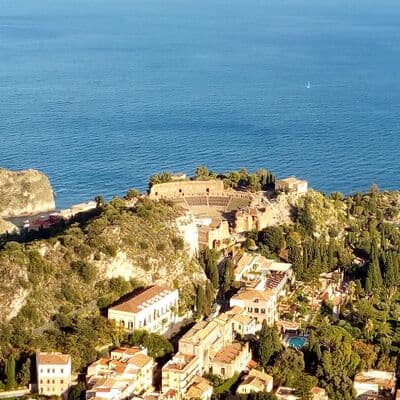
The Teatro Greco is Taormina's main attraction and one of the most impressive ancient monuments in the world. The theater was built by the Greeks in the 3rd century BC, then expanded by the Romans for gladiatorial combat.
The theater seats about 5,400 spectators and has a diameter of 109 meters - the second largest in Sicily after Syracuse. But its greatest asset is the stunning view from the seats: the azure sea, smoking Etna, coastal cliffs. Goethe called it "the greatest work of art and nature."
Today the theater is an active concert venue. Summer brings opera performances, classical and popular music concerts, and film screenings during Taormina Film Fest. Performing on a stage with such a backdrop is any artist's dream.
Practical Information
The theater is open daily, hours depending on season (usually 9:00 AM until sunset). Best times to visit are early morning or the hour before sunset, when lighting is most dramatic. Tickets cost about 10 euros, with combined tickets available for other attractions.
Historic Center
Corso Umberto
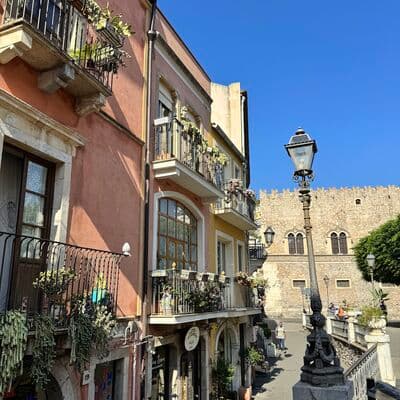
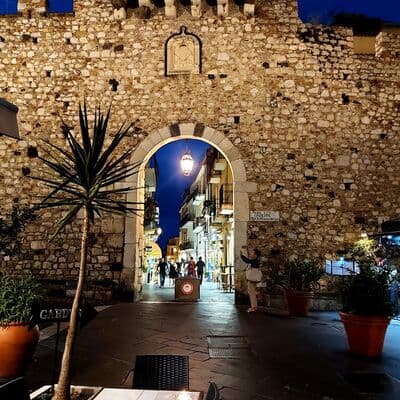
Taormina's main street is a pedestrian zone about 800 meters long, connecting two city gates - Porta Messina and Porta Catania. This is the heart of town life: boutiques of famous brands, jewelry shops, cafes and restaurants with terraces. The evening passeggiata along Corso Umberto is an essential ritual.
Piazza IX Aprile
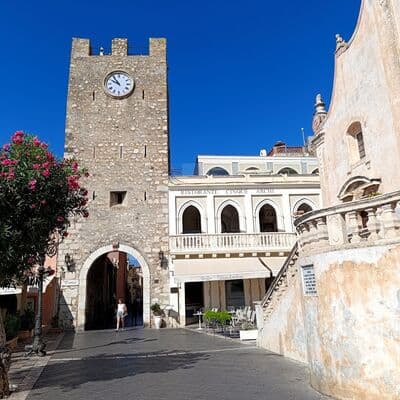
Taormina's main square is one of the most beautiful in Italy. A terrace with checkered marble flooring opens to panoramas of the sea, Etna, and the coastline. On the square stand the 17th-century Church of San Giuseppe, a Gothic clock tower (former city gates), and the famous Cafe Wunderbar, frequented by Marlene Dietrich, Greta Garbo, and Tennessee Williams.
Cathedral
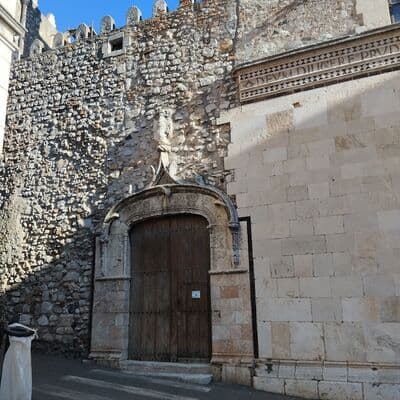
The Duomo di Taormina (13th century) is dedicated to Saint Nicholas. Its austere Romanesque facade with crenellated buttresses resembles a fortress. Inside are 15th-16th century polyptychs and an alabaster Madonna statue. Before the cathedral stands a baroque fountain with a Minotaur - Taormina's symbol.
Palazzo Corvaja
A 13th-15th century palace exemplifying Sicilian Norman architecture. The black-and-white facade of lava stone and limestone features Gothic windows and reliefs. In 1410, the Sicilian parliament met here. Today the palace houses the tourist office and a small folklore museum.
Naumachie
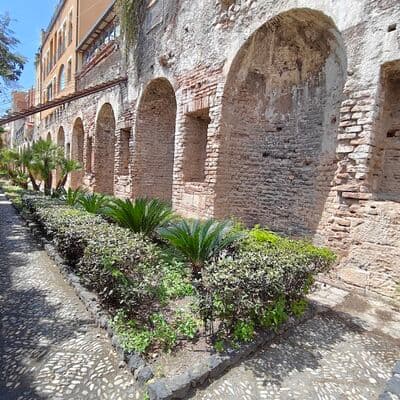
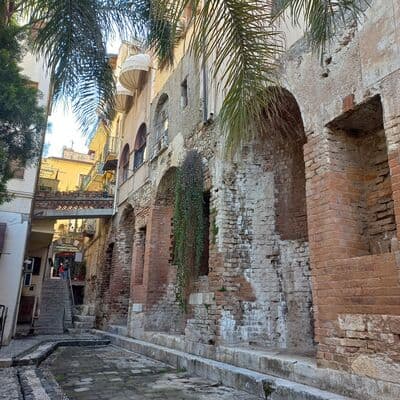
A 1st-century AD Roman monument - a brick wall 122 meters long with niches. Its exact purpose is unknown: perhaps part of a gymnasium or water cistern. The name "naumachie" (naval battle) is a later misconception. The impressive wall is visible from Via Naumachia.
Panoramic Viewpoints
Villa Comunale
A public garden with subtropical plants, created in the 19th century by English Lady Florence Trevelyan. Terraces overlooking the sea, whimsical "folly" pavilions, palms, cypresses, and exotic flowers. An ideal spot to rest on a hot day.
Madonna della Rocca
A sanctuary in the rock above Taormina (398 m), offering the best panorama of the town, sea, and Etna. Accessible by steep path or car. The sunset view is especially impressive.
Castelmola
A medieval village atop a mountain (529 m) above Taormina. Norman castle ruins, tiny streets, bars serving almond wine, and 360-degree panoramas. Castelmola is accessible by bus, taxi, or a scenic walking path (about an hour uphill).
Beaches and Isola Bella
Isola Bella
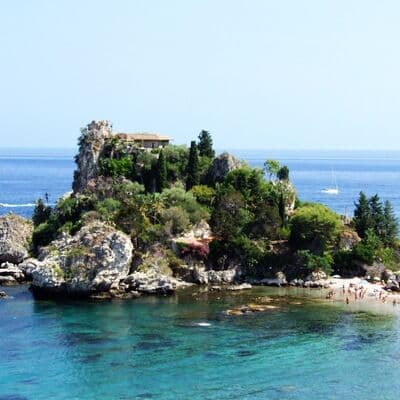
The "Beautiful Island" is Taormina's calling card: a tiny rocky islet connected to shore by a narrow sandbar. Isola Bella is a nature reserve with endemic plants and rich marine life. The beach is pebbly, the water crystal clear. Descend to the beach via steep stairs or cable car.
Mazzarò
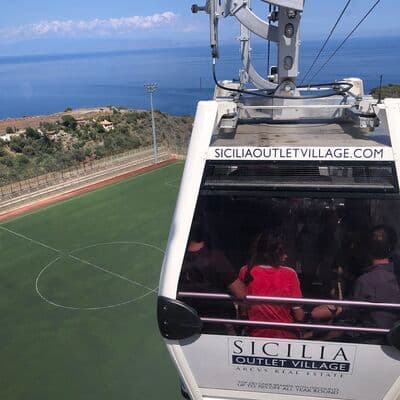
Taormina's main beach area at the base of the cliff. A pebble beach with pristine water, cabanas, loungers, restaurants. A cable car from the town center leads here - the descent itself is an attraction with stunning views.
Letojanni and Giardini-Naxos
Neighboring resort villages with longer, sandier beaches. Giardini-Naxos was the site of Sicily's first Greek colony (734 BC) and has a small archaeological museum. Accessible by bus or taxi.
Shopping and Gastronomy
What to Buy
Handmade ceramics in Sicilian style - from traditional Moor's heads to contemporary design. Jewelry with coral and Etna lava. Local delicacies: almond wine from Castelmola, pistachios from Bronte, olive oil, capers from the Aeolian Islands.
Gastronomy
Taormina's cuisine combines Sicilian traditions with resort town sophistication. The freshest fish and seafood: granita with brioche for breakfast, pasta alla Norma and with sea urchins, grilled swordfish. Sweets: cannoli, cassata, almond pastries. Many restaurants offer dinner with views of the sea and Etna.
Etna and Surroundings
Etna Excursions
Day tours to the volcano depart from Taormina. The north slope (via Linguaglossa) is closer and less touristy. Tours include ascent to about 3,000 meters, walks over solidified lava, and guided crater visits.
Alcantara Gorges
20 km from Taormina, the Alcantara River has carved a gorge through basalt rock, creating unique geometric columns of solidified lava. Walk through the canyon (wading through cold water in summer), admiring fantastic rock formations. There's an equipped park with elevators and pathways.
Savoca - The Godfather Village
30 km from Taormina is the village where Coppola filmed the Sicilian scenes of "The Godfather." Bar Vitelli, the Church of Santa Lucia, the atmosphere of old Sicily - all preserved nearly unchanged. A popular excursion for film fans.
Practical Information
Getting There
The nearest airport is Catania (50 km). Interbus buses connect Taormina with Catania (1-1.5 hours), Messina (1 hour), Syracuse (2.5 hours). The Taormina-Giardini train station is below by the sea; buses run up to town.
Getting Around
The historic center is a pedestrian zone. Cars are best left in parking lots at the entrance (paid). A cable car connects the center with Mazzarò beach. Buses link Taormina with surrounding villages.
When to Visit
Best times are late spring (May-June) and early fall (September-October). Summer (July-August) is very hot and crowded, but festivals are running. Winter is mild with few tourists, but some establishments are closed.
Budget
Taormina is expensive by Sicilian standards. Hotels and restaurants in the center are significantly pricier than in neighboring towns. To save money, stay in Giardini-Naxos or Letojanni and visit Taormina for day trips.
Related Destinations
- Catania - 45 minutes by bus, Sicily's second city at the foot of Etna
- Syracuse - 1.5 hours, ancient city of Archimedes
- Messina - 1 hour, gateway to Sicily with ferries to the mainland
- Palermo - 3 hours, capital of Sicily
- Cefalù - 2 hours, picturesque resort with Norman cathedral
- Aeolian Islands - ferry from Milazzo, UNESCO volcanic archipelago