Catania
Catania - City at the Foot of Etna, Sicily's Baroque Jewel
Catania is Sicily's second-largest city, sprawling at the base of Europe's highest active volcano - Mount Etna. This city of contrasts astounds with its energy: black lava streets and snow-white baroque facades, ancient Greco-Roman ruins and bustling fish markets, elegant squares and chaotic alleyways. Catania is Sicily at its most authentic: passionate, noisy, delicious, and incredibly beautiful.
History - A City Rising from the Ashes
Catania was founded by Greek colonists from Naxos in 729 BC under the name Katane. The city flourished during the Hellenistic era, then passed under Roman rule in 263 BC. The Romans built a forum, amphitheater, theater, and baths - their ruins survive to this day.
In the Middle Ages, Catania experienced turbulent times: Arab conquest (902), Norman liberation (1071), rule by the Hohenstaufen, Angevins, and Aragonese. Frederick II Hohenstaufen founded Sicily's first university here in 1434 (some sources say 1445).
But the true trials came in the 17th century. In 1669, a massive eruption of Etna destroyed the western part of the city, with lava flows reaching the sea. Just 24 years later, in 1693, a catastrophic earthquake destroyed Catania almost entirely, killing over 16,000 of the 20,000 inhabitants.
From this double catastrophe emerged a new city - the baroque Catania we see today. Architect Giovanni Battista Vaccarini and his colleagues created a harmonious urban ensemble of black lava stone and white plaster. In 2002, the baroque monuments of Catania and surrounding towns were inscribed on the UNESCO World Heritage List.
Piazza del Duomo - Heart of the City
Catania's central square is a masterpiece of Sicilian baroque, created by Vaccarini in the 18th century. Here stand the city's main symbols.
Fountain of the Elephant
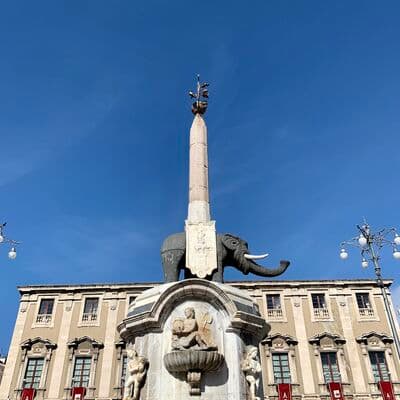
The "Liotru" is Catania's main symbol: an elephant carved from black lava with an Egyptian obelisk on its back. According to legend, the elephant protects the city from Etna's eruptions. The fountain was created by Vaccarini in 1736, modeled on Bernini's elephant in Rome's Piazza della Minerva.
The Cathedral
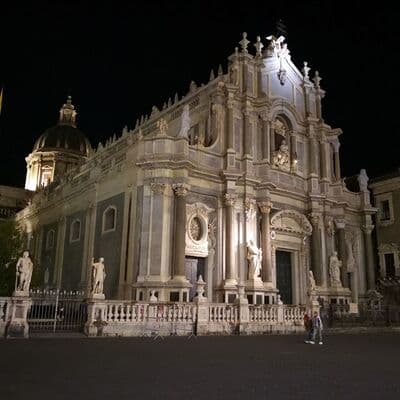
The Cathedral of Saint Agatha (Cattedrale di Sant'Agata) is the city's main church, dedicated to Catania's patron saint. The original Norman church (1094) was destroyed by the 1693 earthquake. The current baroque building was erected by Vaccarini between 1711-1761. The facade of white marble and black lava stone is adorned with columns from the Roman theater.
Inside is the Chapel of Saint Agatha with a silver reliquary containing the saint's remains. Here too are the tombs of the Aragonese kings and composer Vincenzo Bellini, a native of Catania. Don't miss the frescoes depicting the 1669 eruption.
The Fish Market
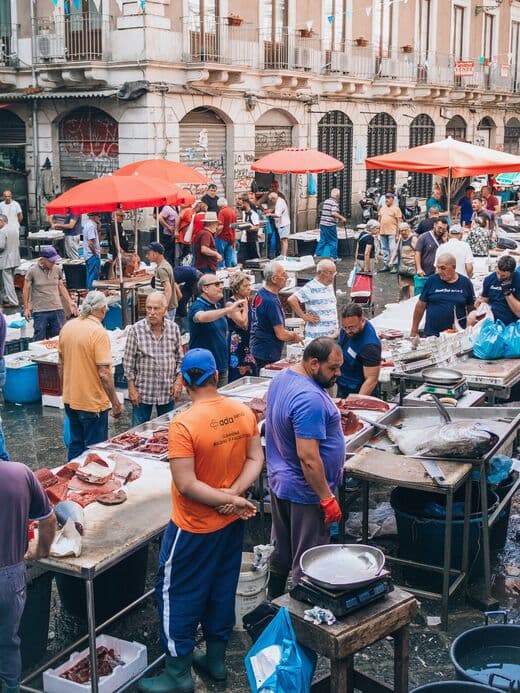
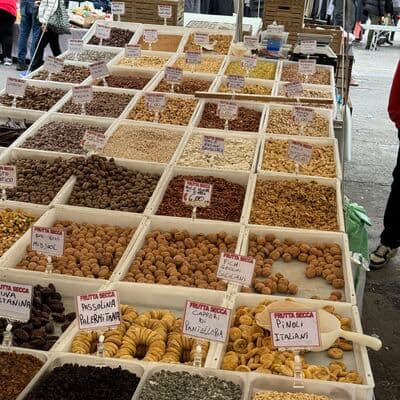
Just behind the square, through the Porta Uzeda gate, lies Catania's famous Pescheria - the fish market. Every morning (except Sunday), a true spectacle unfolds: vendors shouting prices, customers bargaining, tons of fresh fish and seafood displayed on stalls. Swordfish, tuna, sardines, shrimp, octopus, sea urchins - the riches of the Ionian Sea. An atmosphere of an Oriental bazaar with Sicilian character.
Baroque Treasures
Via Etnea
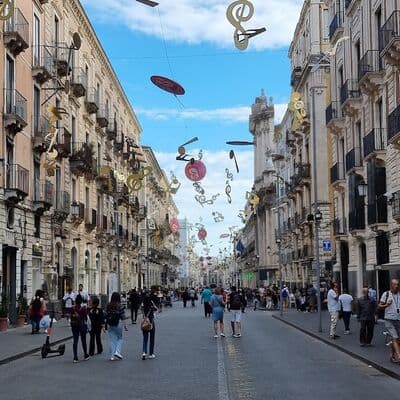
Catania's main street, straight as an arrow, stretching about 3 km from Piazza Duomo to the foot of Etna. Baroque palazzi, shops, and cafes line both sides. The volcano is visible in the street's perspective, creating an unforgettable landscape. The evening passeggiata (stroll) along Via Etnea is an essential ritual for Catanians.
Benedictine Monastery
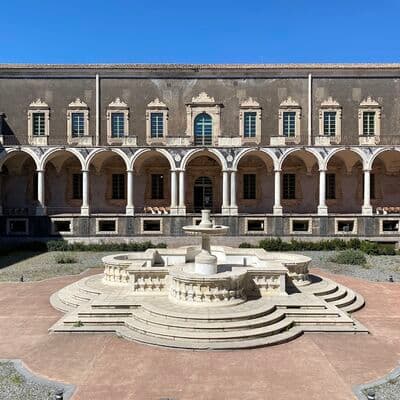
The Monastero dei Benedettini di San Nicolò l'Arena is one of Europe's largest Benedictine monasteries and a UNESCO site. Construction began in 1558, and the complex was expanded after the earthquake. Today it houses the humanities faculty of the University of Catania.
The monastery impresses with its scale: two huge cloisters, a monumental staircase, richly decorated halls. The archaeological zone with Roman structures discovered beneath the monastery deserves special attention. Tours are offered daily.
Church of San Nicolò l'Arena
Next to the monastery stands Sicily's largest church, with an unfinished facade. Construction began in 1687 but was never completed due to the earthquake. The vast interior impresses with its emptiness and grandeur. A meridian line on the floor (1841) allowed time to be determined by sunlight.
Via Crociferi
One of Europe's most beautiful baroque streets, included on the UNESCO list. Along 300 meters stand four magnificent 18th-century churches: San Benedetto, San Francesco Borgia, San Giuliano, and Sant'Agata la Vetere. The Arch of San Benedetto connects monastery buildings above the street.
Palazzo Biscari
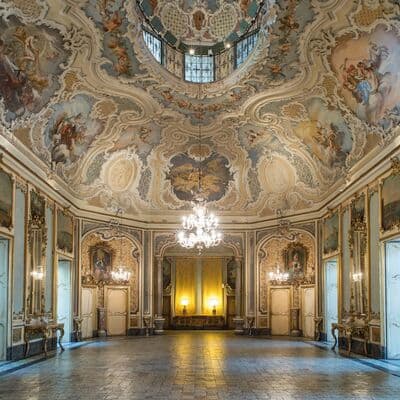
Catania's most luxurious private palace, built by the Biscari princes in the 18th century. The ballroom with frescoes, mirrors, and gilded stucco is the pinnacle of Sicilian rococo. The palace still belongs to the Biscari family descendants and is open for tours.
Ancient Heritage
Roman Amphitheater
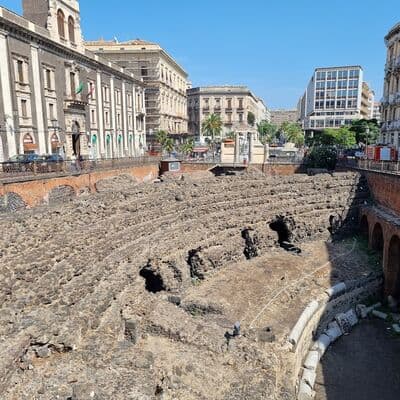
Italy's second-largest Roman amphitheater after the Colosseum, holding up to 15,000 spectators. Built in the 2nd century AD from lava stone. Most of it is hidden beneath Piazza Stesicoro and surrounding buildings - only a small section is visible. Underground galleries can be visited with a guide.
Roman Theater and Odeon
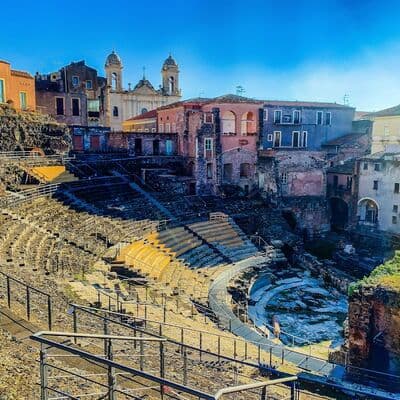
A 2nd-century AD theater for 7,000 spectators located in the historic center, built into medieval structures. Nearby is a small odeon for musical performances. Both monuments are built from lava stone and excellently preserved. Concerts and performances are held here in summer.
Baths of Achilles
4th-century Roman baths beneath Piazza Duomo. Discovered by chance during construction and now open to visitors. Rooms with hypocaust (underfloor heating system) and mosaic fragments are preserved.
Saint Agatha - Patron of the City
Agatha of Sicily (231-251) was a Christian martyr who rejected the advances of a Roman proconsul and suffered a terrible death. She is the patron saint of Catania and protector against Etna's eruptions and fires.
Festival of Saint Agatha
From February 3-5, Catania hosts one of the world's largest religious festivals, attracting a million pilgrims. A silver reliquary with the saint's statue is carried through the city on the shoulders of thousands of "devoti" in white robes and black caps. Fireworks, candles, prayers, cries of "Cittadini, viva Sant'Agata!" - for three days the city doesn't sleep. In emotional intensity, the festival is compared to the Brazilian carnival.
Museums of Catania
Bellini Museum
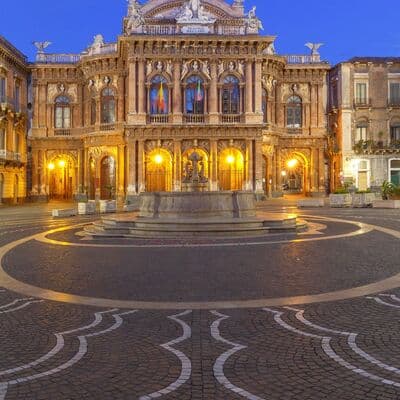
The house museum of composer Vincenzo Bellini (1801-1835), author of the operas Norma, La Sonnambula, and I Puritani. The house where he was born displays personal belongings, scores, and portraits. Bellini is Catania's national pride - streets, a square, a theater, and even a famous pasta dish are named after him.
Civic Museum of Castello Ursino
Castello Ursino is a mighty 13th-century fortress built by Frederick II Hohenstaufen. After the 1669 eruption, lava surrounded the castle but didn't destroy it. Today it houses the civic museum with archaeological finds, medieval art, and a painting collection.
Allied Landing Museum
In July 1943, the Allies landed in Sicily, beginning the liberation of Italy. The museum tells the story of Operation Husky and the battles for Catania. Located in a historic bunker.
Etna - The Fiery Mountain
Etna (3,357 m) is the region's main natural attraction, Europe's highest active volcano and a UNESCO World Heritage Site. The volcano is in constant activity: smoking craters, lava flows, ash emissions are common occurrences.
How to Visit
South slope: bus from Catania to Rifugio Sapienza (1,910 m), then cable car and jeeps to 2,900 m. The main craters can only be approached with a guide. North slope: from Linguaglossa, a less touristy route.
What to See
Lunar landscapes of solidified lava, active craters (from a safe distance), panoramas of Sicily and Calabria. In winter, ski slopes operate on Etna - a unique experience of skiing with sea views.
Around the Volcano
Vineyards on volcanic soils produce the famous Etna wines (Etna DOC). The towns of Randazzo, Bronte (birthplace of pistachios), and Nicolosi offer an authentic Sicilian atmosphere.
Catanian Cuisine
Catania's cuisine is one of Italy's richest, combining marine and mountain traditions.
Street Food
Arancini - fried rice balls with meat ragù or cheese, a symbol of Sicilian cuisine. In Catania they're cone-shaped (in Palermo, round). Cartocciate - fried pastries with various fillings. Cipuddi - battered onion rings. Seltz-limone-sale - a refreshing drink of seltzer water with lemon.
Pasta
Pasta alla Norma is Catania's signature dish: pasta with fried eggplant, tomato sauce, ricotta salata, and basil. Named after Bellini's opera. Pasta with sea urchins is a spring season delicacy.
Fish and Meat
The freshest fish from the Pescheria: fried swordfish, grilled tuna, sardines a beccafico. Horse meat is Catania's traditional meat, served in special butcher shops (macelleria equina) as steaks or raw (sfilacci).
Sweets
Minne di Sant'Agata ("Breasts of Saint Agatha") - round pastries with ricotta covered in white icing with a cherry - a reference to the saint's martyrdom. Granita with brioche is the Sicilian breakfast. Pistachio sweets from Bronte.
Coast and Beaches
La Playa
Catania's main beach - 18 km of sandy coastline south of the city. Part equipped (lido), part free. Very crowded in summer. The black volcanic sand heats up more than regular sand.
Aci Trezza
A picturesque fishing village 10 km from Catania with views of the Cyclops Rocks (Faraglioni dei Ciclopi) - basalt rocks that, according to legend, Polyphemus hurled at the fleeing Odysseus. Luchino Visconti filmed "La Terra Trema" (1948) here.
Acireale
A baroque town on lava cliffs above the sea. Famous for its carnival, thermal springs, and panoramic views. Included on the UNESCO list together with Catania.
Practical Information
Getting There
Catania-Fontanarossa Airport (CTA) is Sicily's main airport, 7 km from the center. The Alibus connects the airport with the train station and center (20 minutes). Trains link Catania with Messina (1.5 hours), Syracuse (1 hour), Taormina (45 minutes), and Palermo (3 hours).
City Transportation
The historic center is compact and best explored on foot. The metro (one line) connects the station with northern districts. AMT buses cover the entire city.
When to Visit
Best times are spring (April-June) and fall (September-October). Summer is hot (up to 40°C) and crowded. Winter is mild but rainy. The Festival of Saint Agatha (February 3-5) is an unforgettable spectacle, but the city is packed.
Safety
Catania is safer than its reputation suggests, but standard precautions should be observed. The area around the station and market requires attention to belongings.
Around Catania
Taormina
50 km north is Sicily's gem with a Greek theater, medieval streets, and stunning views of Etna and the sea. One of Italy's most romantic towns.
Syracuse
60 km south is the ancient city of Archimedes with a grand Greek theater, the Ear of Dionysius, and the baroque island of Ortigia. A UNESCO site.
Caltagirone
The city of ceramics 70 km from Catania. The famous Santa Maria del Monte staircase has 142 steps, each decorated with unique majolica.
Related Destinations
- Palermo - 2.5-3 hours by train, Sicily's capital with Arab-Norman heritage
- Taormina - 45 minutes, Sicily's gem with Greek theater
- Syracuse - 1 hour, city of Archimedes
- Cefalù - 2.5 hours, picturesque resort with Norman cathedral
- Agrigento - 2.5 hours, Valley of the Temples
- Naples - ferry or plane, gateway to southern Italy