Palermo
Palermo - Capital of Sicily, Crossroads of Civilizations, and Treasure of Arab-Norman Art
Palermo is the capital of Sicily and one of the most colorful cities in the Mediterranean, where Greek, Roman, Arab, Norman, and Spanish cultures have intertwined. This city astounds with contrasts: magnificent Arab-Norman cathedrals stand alongside bustling street markets, baroque palazzi next to crumbling facades, and refined cuisine alongside folk traditions. Palermo's historic center with its nine Arab-Norman monuments is a UNESCO World Heritage Site.
History - Crossroads of Civilizations
Palermo was founded by the Phoenicians in the 8th century BC under the name "Ziz" (flower). Greeks and Carthaginians competed for control until the Romans conquered it in 254 BC. After Rome's fall, the city passed from Vandals to Ostrogoths, then to Byzantium.
Palermo's golden age began with the Arab conquest in 831. Under the emirs, the city became one of the largest and wealthiest in the world - travelers reported it rivaled Constantinople and Córdoba. The Arabs built 300 mosques, created irrigation systems and botanical gardens, and developed silk production.
In 1072, the Normans led by Roger I reconquered Palermo from the Arabs. Norman kings - Roger II, William I, and William II - created a unique synthetic culture, uniting Arab, Byzantine, and Latin masters. During this period, the magnificent Arab-Norman monuments were built: the Palatine Chapel, Monreale Cathedral, and the Martorana Church.
After the Norman dynasty ended, Sicily passed to the Hohenstaufen, then the Angevins, and from 1282 to the Crown of Aragon. Spanish rule continued until Italian unification in 1860, leaving a rich baroque legacy. In the 20th century, Palermo suffered devastating World War II bombings and a long period of decline, but today it's experiencing a cultural renaissance.
Arab-Norman UNESCO Heritage
In 2015, nine Arab-Norman monuments in Palermo and its surroundings were inscribed on the UNESCO World Heritage List. These masterpieces reflect a unique synthesis of Western European, Islamic, and Byzantine cultures.
Palatine Chapel
The jewel of Arab-Norman art, built by Roger II from 1132-1140 as the palace church of the Norman Palace. The interior is stunning: walls and apse are covered with golden Byzantine mosaics depicting Christ Pantocrator, Gospel scenes, and saints. The wooden ceiling in Arab muqarnas style (honeycomb vaulting) is decorated with paintings of court life, hunting, and fantastical creatures. The marble floor with geometric patterns in Cosmatesque technique completes the ensemble.
Norman Palace
The royal residence built on the foundations of an Arab fortress. Today it houses the Sicilian Regional Parliament, but the historic halls are open to visitors. Besides the Palatine Chapel, see the Room of Roger with 12th-century hunting mosaics, the palace gardens, and archaeological excavations beneath the palace.
Palermo Cathedral
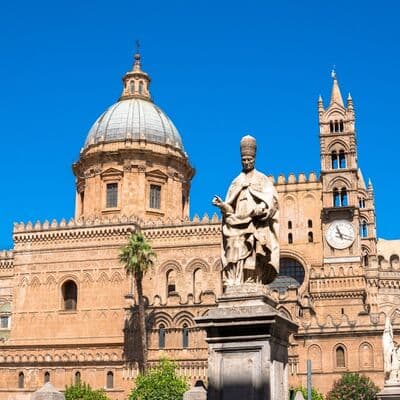
A grand cathedral founded in 1185 on the site of a Byzantine church that Arabs had converted into a mosque. The architecture reflects all eras: Norman apses, Gothic portals, an 18th-century baroque dome. Inside are royal tombs of Roger II, Frederick II Hohenstaufen, and other rulers, plus a treasury with the Crown of Constance of Aragon. The cathedral roof offers panoramic city views.
Church of San Giovanni degli Eremiti
A church with five red domes, built by Roger II around 1136 on the site of a mosque. Arab influence is evident in the dome shapes and minimalist interior. The Norman cloister with double columns and citrus garden are particularly charming - a romantic oasis in the city center.
Martorana Church
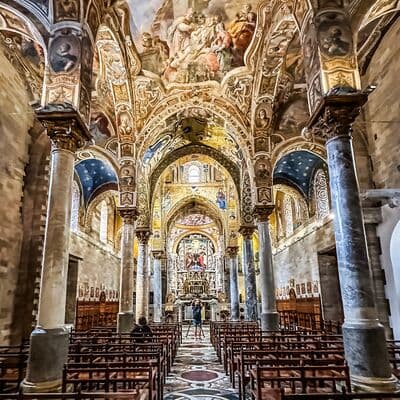
Officially Santa Maria dell'Ammiraglio, built in 1143 by Admiral George of Antioch. The brilliant Byzantine mosaics on gold backgrounds are among the finest in Italy outside Ravenna. The mosaic showing Roger II being crowned by Christ is a unique example of medieval political iconography. The church belongs to the Italo-Albanian Catholic community.
Church of San Cataldo
Next to Martorana stands a small church with three red domes and an austere interior without decoration. Built around 1160, it perfectly preserves Norman architecture. It belongs to the Knights of the Holy Sepulchre.
Zisa Palace
The summer palace of Norman kings, built by William I from 1165-1180 in Arab style. The name comes from Arabic "al-aziz" (magnificent). Inside, the fountain hall with mosaic decoration and air-cooling system - a medieval "air conditioner" - is preserved. Today it houses the Museum of Islamic Art.
Admiral's Bridge
A Norman bridge over the Oreto River, built in 1131 by Admiral George of Antioch. One of the oldest bridges in Europe, though the river has long since dried up. Near the bridge in 1860, Garibaldi's forces fought the battle for Sicily's liberation.
Monreale Cathedral
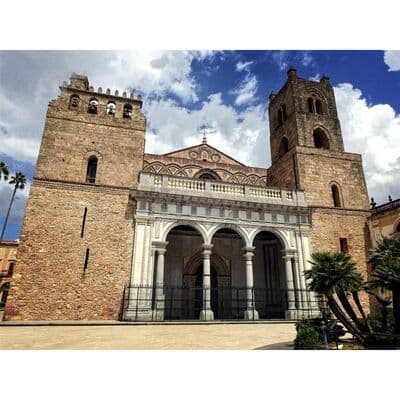
Eight kilometers from Palermo stands the greatest monument of Arab-Norman art - the Cathedral of Santa Maria Nuova in Monreale, also UNESCO-listed. Built by William II from 1174-1185, the cathedral holds 6,340 square meters of Byzantine mosaics - the largest cycle in the world outside Constantinople.
The mosaics illustrate the Old and New Testaments: from creation to the acts of the apostles. The apse features a colossal Christ Pantocrator - one of the most majestic images in Christian art. The Benedictine monastery cloister with 228 double columns adorned with carved capitals is a masterpiece of Romanesque sculpture.
Baroque Splendor
The 17th-18th centuries left Palermo a rich baroque legacy, especially after the devastating 1693 earthquake.
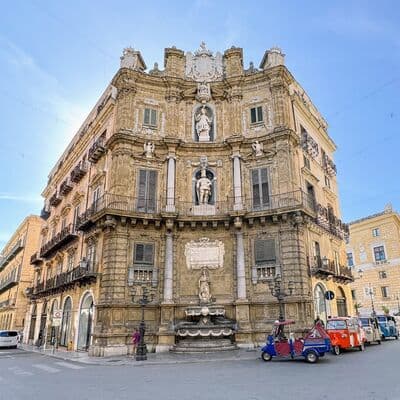
Quattro Canti
A theatrical baroque piazza at the intersection of the main streets - Via Vittorio Emanuele and Via Maqueda. Four concave facades (1609-1620) are decorated with statues of the seasons, Spanish kings, and Palermo's patron saints. Officially Piazza Villena, it symbolizes Spanish rule.
Piazza Pretoria
Near Quattro Canti stands the square with a grand Renaissance fountain, created in Florence in 1554 and moved to Palermo in 1574. The nude sculptures of river gods and nymphs shocked nuns from the neighboring convent, who nicknamed it the "Fountain of Shame." The square is framed by Palazzo Pretorio (City Hall) and the churches of Santa Caterina and San Giuseppe.
Church of the Gesù
Also known as Casa Professa - Palermo's main Jesuit church (1564-1633). The interior is an apotheosis of Sicilian baroque: every inch is covered with marble inlay, carving, gilding, and frescoes. The contrast with the austere facade is striking.
Oratories
Palermo is famous for small 17th-18th century oratories with exquisite stucco work by Giacomo Serpotta - an unsurpassed master of this art. The oratories of San Lorenzo, del Rosario in Santa Cita, and del Rosario in San Domenico are decorated with thousands of putti figures, allegories, and biblical scenes in snow-white stucco.
Street Markets - The Soul of Palermo
Palermo's historic markets are living heritage from the Arab era, where you can experience the city's authentic atmosphere.
Vucciria
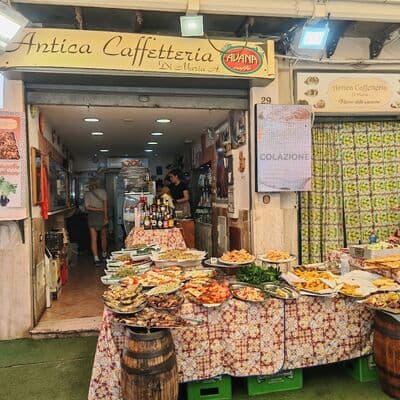
The city's oldest market, immortalized by painter Renato Guttuso. Once Palermo's main fish market, Vucciria has transformed: by day vendors sell produce, while in the evening the narrow streets become a lively street food and bar zone. The atmosphere is chaotic but authentic.
Ballarò
Palermo's largest and most colorful market in the historic Albergheria district. Fresh vegetables and fruits, fish and meat, spices and cheeses are sold here. The vendors' cries called "abbanniate" create a unique soundscape. Numerous stalls offer street food: panelle, crocchè, sfincione.
Capo
A market in the eponymous historic quarter, less touristy than Ballarò. Narrow streets filled with produce stalls, antique shops, and artisan workshops. Nearby is the Church of Sant'Agostino with its beautiful Gothic portal and rose window.
Theaters and Cultural Life
Teatro Massimo
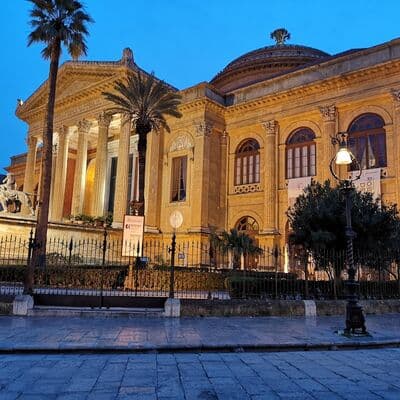
Italy's largest opera house and Europe's third largest after the Paris Opera and Vienna State Opera. Built from 1875-1897 in neoclassical style, the theater seats about 3,000. The final scene of "The Godfather Part III" was filmed here. Daily tours are available; evening performances run from October to June.
Teatro Politeama
Palermo's second-largest theater, built from 1867-1891 in Pompeian style. The quadriga on the facade has become one of the city's symbols. Today it's home to the Sicilian Symphony Orchestra.
Capuchin Catacombs
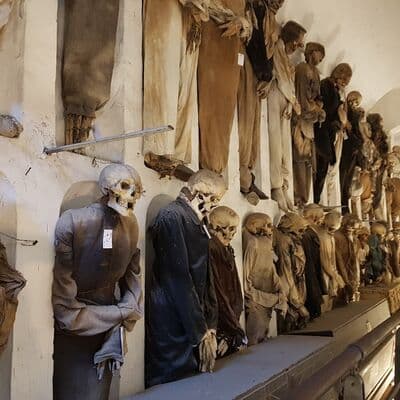
A unique and macabre monument - the underground galleries of the Capuchin monastery with mummified bodies of more than 8,000 Palermitans from the 16th-20th centuries. Monks, aristocrats, priests, women, and children are displayed in niches, dressed in their finest clothes. Particularly famous is the perfectly preserved two-year-old Rosalia Lombardo (1920), called "Sicily's Sleeping Beauty."
Botanical Garden and Parks
Botanical Garden
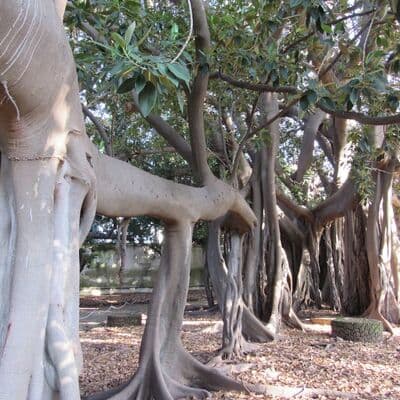
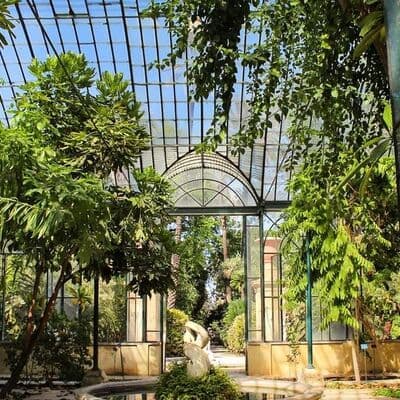
Founded in 1789 at the University of Palermo, this is one of Europe's largest botanical gardens (10 hectares). Thanks to the mild climate, tropical and subtropical plants thrive: giant ficus trees, palms, bamboo, exotic succulents. Neoclassical buildings - the Gymnasium, Calidarium, and Tepidarium - complement the landscape.
Villa Giulia Park
Palermo's oldest public park (1778) next to the Botanical Garden. Italian-style geometric layout, fountains, sculptures, and exotic trees create a pleasant atmosphere for strolling.
Monte Pellegrino
A 606-meter mountain above Palermo that Goethe called "the most beautiful headland in the world." At the summit is the Sanctuary of Santa Rosalia, Palermo's patron saint, whose relics are kept in a cave converted into a baroque church. The panorama of the city and bay from the top is stunning.
Palermo's Beaches
Mondello
Palermo's main beach, 11 km from the center - an arc of white sand between two headlands. Turquoise water, Art Nouveau villas including the famous Stabilimento Balneare on stilts (1912) create a resort atmosphere. Very crowded in summer. Nearby is the Capo Gallo nature reserve.
Other Beaches
Addaura - rocky coast with cozy coves; Sferracavallo - fishing village with pebble beach; Isola delle Femmine - an island with pristine nature.
Sicilian Cuisine
Palermo's cuisine is one of the most diverse and delicious in Italy, reflecting centuries of different cultural influences.
Street Food
Palermo is the capital of Italian street food. Panelle - fried chickpea flour fritters; crocchè - potato croquettes; arancini - rice balls stuffed with ragù or cheese; sfincione - thick pizza with onion, anchovies, and breadcrumbs. For the adventurous - "stigghiola" (grilled lamb intestines) and "pani câ meusa" - a spleen sandwich.
Seafood
Pasta with sardines, fennel, raisins, and pine nuts is Palermo cuisine's signature dish. Fish couscous - an Arab legacy. The freshest fish at markets - tuna, swordfish, sardines, sea urchins.
Sweets
Cannoli - crispy tubes filled with ricotta; cassata - richly decorated cake with ricotta, candied fruit, and marzipan; frutta Martorana - marzipan sweets shaped like fruits and vegetables, invented in the namesake monastery; granita with brioche - an icy dessert for breakfast.
Day Trips
Palermo is an excellent base for exploring western Sicily.
Cefalù
A picturesque coastal town 70 km from Palermo with a magnificent Norman cathedral (another UNESCO site), Byzantine mosaics, and atmospheric streets beneath the rock La Rocca. The beach in the town center is one of Sicily's best.
Segesta
An ancient city with a beautifully preserved 5th-century BC Doric temple and Greek theater overlooking mountains and sea. One of Sicily's most impressive archaeological sites.
Erice
A medieval town atop a mountain (750 m) above Trapani. Narrow cobblestone streets, Norman castle, panoramic views to Tunisia on clear days. Famous almond sweets.
Valley of the Temples at Agrigento
130 km from Palermo - one of the wonders of the ancient world: a complex of 5th-century BC Doric temples, including the magnificently preserved Temple of Concordia. A UNESCO World Heritage Site.
Practical Information
Transportation
Palermo Falcone-Borsellino Airport (PMO) is 35 km from the center, with bus and train connections. Palermo Centrale station connects to other Sicilian cities and mainland Italy. Catania is 2.5-3 hours away, Messina 3 hours, overnight train to Rome 11 hours. Ferries connect Palermo to Naples (10 hours), Genoa (20 hours), and Tunisia.
City Transportation
The historic center is compact and walkable. AMAT buses cover the whole city. Two tram lines and Passante ferroviario trains operate. Taxis are available but not cheap.
When to Visit
Best times are spring (April-June) and fall (September-October), when it's warm but not hot. Summer is very hot (up to 40°C) and crowded with tourists. Winter is mild but rainy. The Feast of Santa Rosalia (July 10-15) is the main city celebration with processions and fireworks.
Safety
Palermo is much safer than its reputation suggests. Take normal precautions: watch your bags and don't display valuables. Some areas outside the center are best avoided at night.
Related Destinations
- Catania - 2.5 hours by train, Sicily's second city at the foot of Mount Etna
- Taormina - 3.5 hours, Sicily's gem with Greek theater
- Syracuse - 4 hours, ancient city of Archimedes
- Cefalù - 1 hour, picturesque resort with Norman cathedral
- Agrigento - 2 hours, Valley of the Temples
- Naples - 10 hours by ferry, gateway to southern Italy