Bologna
Bologna - Italy's Culinary Capital and Home to Europe's Oldest University
Bologna, the capital of Emilia-Romagna, is celebrated as Italy's gastronomic capital, home to the oldest university in the Western world, and guardian of remarkably preserved medieval architecture. Known as "La Rossa" (the Red) for its terracotta rooftops and brick buildings, "La Dotta" (the Learned) for its university, and "La Grassa" (the Fat) for its abundant cuisine, Bologna offers a unique blend of history, culture, and culinary pleasures.
History - From Etruscans to Modern Day
Bologna's history spans nearly three millennia. The first settlement was founded by the Etruscans around the 9th century BC, called Felsina. In the 4th century BC, the Gallic Boii tribe captured the city, giving it the name from which modern Bologna derives. In 189 BC, the Romans transformed it into the colony of Bononia, making it a crucial node on the Via Emilia - the road connecting Rimini to Piacenza.
After the fall of the Roman Empire, Bologna experienced periods of barbarian invasions and Byzantine rule. In the Middle Ages, the city became an independent commune and one of the largest cities in Europe. In 1088, the University of Bologna was founded - the first university in the Western world, attracting students from across the continent. Bologna's law school became the model for all European universities.
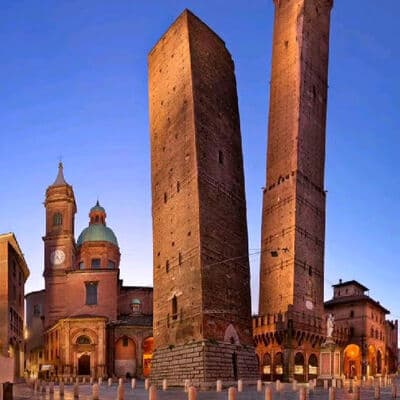
During the 13th and 14th centuries, Bologna reached its zenith. The city had approximately 50,000 inhabitants, making it one of the ten largest in Europe. During this period, the famous towers were built, of which about twenty survive today. The Two Towers - Asinelli and Garisenda - became the city's symbol.
From the 16th century, Bologna became part of the Papal States and remained under papal rule until Italian unification in 1860. This period saw massive construction of Baroque churches and palaces. In the 20th century, the city became an important industrial center and maintained its left-wing political traditions, earning the nickname "Red Bologna."
Medieval Center - Towers and Porticoes
Bologna's historic center is one of the best-preserved in Italy. Its distinctive features are medieval towers and endless porticoes (covered walkways) stretching 40 kilometers, now included in the UNESCO World Heritage List.
The Two Towers (Due Torri)
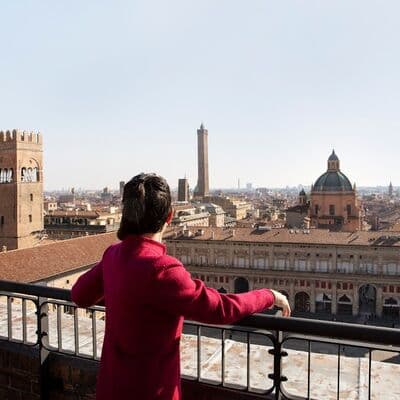
Bologna's symbol - two medieval towers built in the 12th century by noble families. The Asinelli Tower, at 97.2 meters, is the tallest leaning tower in Italy. Its 498 steps lead to breathtaking views of the city and surrounding countryside. The neighboring Garisenda Tower is shorter (48 meters) and leans more severely, remaining closed to visitors. Dante mentions it in his Divine Comedy.
The Porticoes of Bologna
Bologna's unique feature - 40 kilometers of covered portico galleries that allow walking through the city in any weather. This tradition began in the Middle Ages when the growing city needed more space. Porticoes allowed upper floors to extend over the streets. In 2021, Bologna's porticoes were added to the UNESCO World Heritage List.
Piazza Maggiore
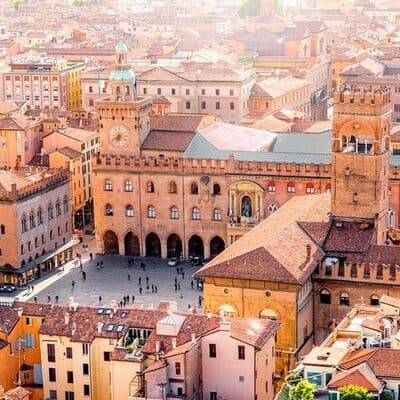
Bologna's main square has been the heart of city life since the 13th century. Here stand the most important buildings: Palazzo d'Accursio (city hall), Palazzo del Podestà, Palazzo Re Enzo, and the Basilica of San Petronio. The square is surrounded by elegant porticoes and serves as a gathering place for concerts and public events.
Basilica of San Petronio
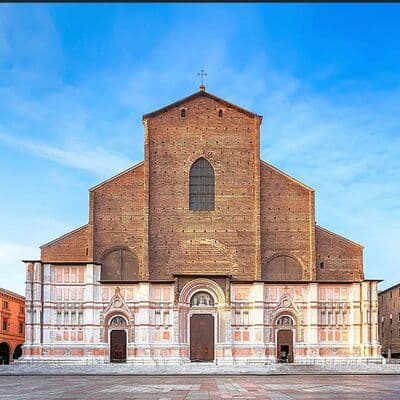
Bologna's main church, dedicated to the city's patron saint, is one of the largest churches in the world. Construction began in 1390 with the ambitious plan to surpass St. Peter's in Rome, but work was never completed - the facade remains only half-clad in marble. Inside is Cassini's meridian line (1655) - the world's largest astronomical instrument, used for calculating the date of Easter.
University of Bologna - Alma Mater Studiorum
The University of Bologna, founded in 1088, is considered the oldest continuously operating university in the Western world. The name "Alma Mater Studiorum" (Nourishing Mother of Studies) became the term used for all universities.
The Archiginnasio
The historic 16th-century university building is a masterpiece of Bolognese Renaissance. Ceilings and walls are decorated with thousands of coats of arms of students and professors. Particularly notable is the Anatomical Theatre (1637) - one of the first in Europe, where public dissections were performed. The wooden interior features statues of famous physicians and the "Écorché" sculpture - a figure showing a man without skin.
University Museums
Palazzo Poggi, the current rectorate, houses unique scientific collections: a natural history museum, 18th-century anatomical wax models, astronomical instruments, and geographical maps. The university library contains 250,000 volumes, including rare manuscripts.
Famous Alumni
Graduates of the University of Bologna include Dante Alighieri, Francesco Petrarca, Nicolaus Copernicus, Erasmus of Rotterdam, and Guglielmo Marconi. In 1732, Laura Bassi became the first female professor at a European university, teaching physics in Bologna.
Churches and Religious Art
Bologna is rich in outstanding churches representing various eras and styles.
Santo Stefano (Seven Churches)
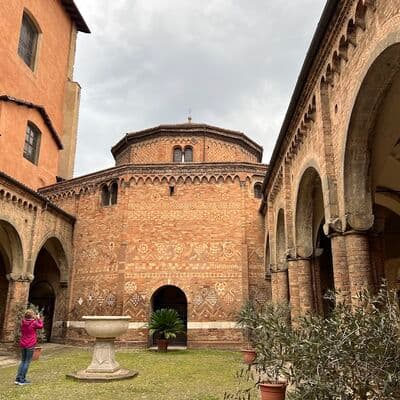
A unique complex of seven (now four) interconnected churches, built on the site of a Temple of Isis. Founded in the 5th century by Saint Petronius as a copy of the Church of the Holy Sepulchre in Jerusalem, the complex creates an atmosphere of early Christianity. The Courtyard of Pilate with its Romanesque basin and the crypt with saints' relics are deeply impressive.
Basilica of San Domenico
The church where the founder of the Dominican Order, Saint Dominic, is buried (1221). The Arca di San Domenico is a sculptural masterpiece from the 13th century with later additions by Niccolò dell'Arca and the young Michelangelo, who created three statues. The interior features works by Bolognese painters.
Basilica of San Petronio
The fifth-largest church in the world (132 meters long), dedicated to the city's patron. The unfinished marble facade contrasts with the grandiose Gothic interior. The Chapel of the Magi contains 15th-century frescoes by Giovanni da Modena, including a controversial depiction of Muhammad.
Santa Maria della Vita
A small church housing the terracotta sculptural group "Lamentation over the Dead Christ" by Niccolò dell'Arca (1463) - one of the most emotionally powerful works of Italian art. The facial expressions are so realistic they continue to move viewers today.
Palaces and Museums
Bologna possesses a rich museum heritage housed in historic palaces.
National Pinacoteca
Bologna's main art museum contains an outstanding collection of Emilia-Romagna painting from the 14th to 18th centuries. Masterpieces by Giotto, Raphael, Titian, Guido Reni, and Annibale and Lodovico Carracci are displayed. The 17th-century Bolognese school of painting greatly influenced European art.
Medieval Museum
Palazzo Ghisilardi-Fava houses a collection of medieval art: weapons, armor, tomb monuments, and sculpture. Particularly interesting are the bronze statue of Pope Boniface VIII and the collection of Bolognese professors' tombstones.
Museum of the History of Bologna
An interactive museum in Palazzo Pepoli tells the city's story from the Etruscans to the present day through multimedia installations, models, and authentic artifacts.
MAMbo - Museum of Modern Art
Located in a former bakery, the museum presents Italian and international 20th and 21st-century art. Permanent exhibitions and temporary shows reflect contemporary artistic trends.
Bolognese Cuisine - La Grassa
Bologna rightfully claims the title of Italy's gastronomic capital. The Emilia-Romagna region has given the world Parmesan, Parma ham, balsamic vinegar, and countless other delicacies.
Tagliatelle al Ragù
The famous Bolognese ragù sauce (known worldwide as "Bolognese") - a meat sauce of beef, pork, soffritto, tomatoes, and wine, cooked for several hours. Authentic ragù is served only with tagliatelle (flat pasta) or lasagna, never with spaghetti - that's nonsense to Bolognesi.
Tortellini
Small dumplings filled with pork, prosciutto, mortadella, and Parmesan, shaped to resemble a navel. Legend has it they were created in honor of Venus's navel. Tortellini are served in rich meat broth (tortellini in brodo) - a traditional Christmas dish.
Mortadella
The delicate cooked sausage with white fat and pistachios - Bologna's pride. Authentic Mortadella di Bologna IGP is produced only here following strict standards. American "bologna" is merely a pale imitation of the original.
Lasagna Verde
Layered pasta with green (spinach) sheets, ragù, béchamel, and Parmesan - a Bolognese classic. Every family guards their own recipe, passed down through generations.
Other Specialties
Crescentine (fried dough), tagliere boards with local cured meats and cheeses, certosino (Christmas cake with almonds and chocolate), and Lambrusco - the region's sparkling red wine. The Quadrilatero market near Piazza Maggiore is a gourmet paradise with shops trading since the 13th century.
Products of Emilia-Romagna
The Emilia-Romagna region is Italy's gastronomic treasure house. Many world-famous products are made in the area surrounding Bologna.
Parmigiano-Reggiano
The "King of Cheeses" has been made using unchanged techniques for 800 years. The cheese is aged for a minimum of 12 months, with the best examples aged 24-36 months. Visiting a cheese dairy in the province of Modena or Reggio Emilia is an unforgettable experience.
Prosciutto di Parma
Cured ham from Parma is aged 12-36 months in the unique microclimate of the foothills. Its delicate, slightly sweet flavor is unmatched.
Balsamic Vinegar
Traditional Balsamic Vinegar of Modena (Aceto Balsamico Tradizionale) is aged in wooden barrels for 12-25 years or more. It's not just a condiment but a gastronomic treasure - a few drops transform any dish.
Around Bologna
Day trips from Bologna to explore the Emilia-Romagna region are easily arranged.
Sanctuary of San Luca
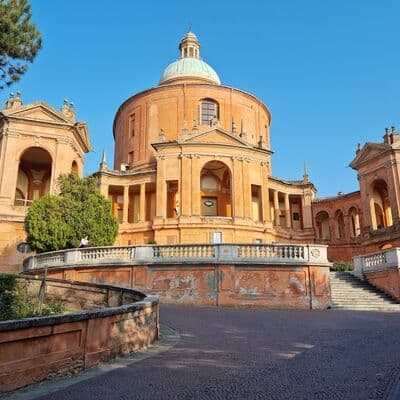
A temple on Guardia Hill, 5 km from the center, connected to the city by the world's longest portico (3.8 km, 666 arches). Annually, the icon of the Madonna of San Luca is solemnly carried into the city. The hill offers panoramic views of Bologna and the Apennines.
Modena
Birthplace of balsamic vinegar, Ferrari, and Pavarotti, 30 minutes away. The Romanesque cathedral is a UNESCO site, the Enzo Ferrari Museum and Galleria Estense with masterpieces by Velázquez and El Greco are worth visiting.
Parma
The city of prosciutto and Parmesan, with a beautiful Romanesque cathedral and baptistery, Teatro Regio, and works by Correggio. One hour from Bologna.
Ravenna
Capital of the Western Roman Empire with incomparable 5th-6th century Byzantine mosaics - eight UNESCO sites in one city. Dante's tomb is here.
Ferrara
City of the Este dynasty with the magnificent Castello Estense, Renaissance palaces, and medieval streets. A UNESCO site one hour from Bologna.
Practical Information
Practical tips for visiting Bologna to make your trip comfortable.
Transportation
Bologna Guglielmo Marconi Airport (BLQ) is 6 km from the center, connected by monorail. Bologna Centrale station is a major transport hub on the Milan-Florence-Rome line. Florence is 35 minutes by high-speed train, Milan one hour, Rome two hours.
Bologna Welcome Card
The tourist card provides free transport and discounts at museums and restaurants. Particularly worthwhile for two or three-day visits.
When to Visit
Spring and autumn are ideal for visiting. Summer can be hot and humid. Winter is quieter, but university life keeps the city energetic. Christmas markets create a festive atmosphere.
Food Tourism
Bologna offers numerous culinary tours: visits to cheese dairies, prosciutto producers, balsamic vinegar tastings. Cooking schools teach fresh pasta making. The Quadrilatero market is essential for food lovers.