Arles
Arles 2026: What You Need to Know Before You Go
Arles is where Van Gogh found his light, the Romans built an arena to rival the Colosseum, and every summer photographers from around the world descend for the legendary Les Rencontres festival. A small Provencal city on the Rhone that packs more culture per square foot than many European capitals.
In a nutshell: Visit Arles for its remarkably preserved Roman monuments, Van Gogh landmarks on every corner, the contemporary art powerhouse LUMA with Frank Gehry's tower, Provencal cuisine, and a Saturday market ranked among the best in southern France. Plan 2-3 days for the city, 4-5 days with the Camargue and day trips.
Arles is for travelers who have had their fill of Parisian chaos and Nice's resort crowds. You can sit on a cafe terrace at Place du Forum -- the very square Van Gogh painted in 'Cafe Terrace at Night' -- and watch Provencal life at its own pace. Honestly though: Arles is not polished. Parts of the old town are rough around the edges, many places close out of season, and summer heat can be brutal. But that rawness is what makes it real.
Arles Neighborhoods: Where to Stay
Historic Center (Centre Historique) -- Classic and Convenient
The compact core within the old fortification walls. Everything is here: the Roman Amphitheatre, Saint-Trophime Church, Place du Forum, restaurants, and shops. Narrow lanes, stone buildings with colorful shutters. Walk to any sight in 5-10 minutes.
Pros: everything within walking distance, authentic old Provence atmosphere, restaurants on every corner
Cons: noisy in peak season, parking is a nightmare, accommodation is pricier
Prices: $$$ (hotels from EUR 90-150 / $95-160, B&Bs from EUR 70 / $75)
Arena Quarter (Quartier des Arenes) -- In the Shadow of the Amphitheatre
The streets surrounding the Roman Amphitheatre. Touristy but with character: small squares with fountains, artisan workshops, galleries. Once day-trippers leave in the evening, it becomes quiet. Upper floors offer the best arena views at sunset.
Pros: arena views, galleries, authentic architecture
Cons: limited dining options in the evening, steep streets
Prices: $$-$$$ (hotels from EUR 80 / $85, apartments from EUR 60 / $65)
La Roquette -- Bohemian and Lively
A former fishermen's quarter between the historic center and the Rhone. The most atmospheric neighborhood in Arles: alleyways barely wide enough for two people, street art, independent boutiques, natural wine bars, and bistros. Artists and young locals live here. The Saturday market on Boulevard des Lices is around the corner.
Pros: authentic atmosphere, close to the market, trendy cafes and bars
Cons: can feel a bit rough after dark, very limited parking
Prices: $$ (apartments from EUR 50 / $55, B&Bs from EUR 65 / $70)
LUMA / Parc des Ateliers -- Contemporary Art District
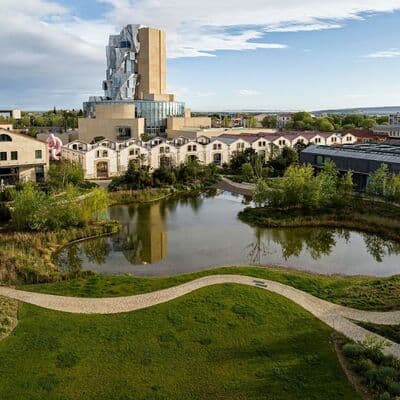
Former SNCF railway workshops transformed into the LUMA Arles cultural campus. Gehry's tower clad in 11,000 aluminum panels is the new city icon. Parkland, exhibition halls, and cafes surround it. The neighborhood is developing fast with new hotels and restaurants.
Pros: striking modern architecture, green spaces, quiet, newer hotels
Cons: a 15-minute walk from the historic center, not much nightlife
Prices: $$-$$$ (newer hotels from EUR 100 / $105)
Trinquetaille -- Across the River, Budget-Friendly
The neighborhood on the right bank of the Rhone, across the bridge from the center. Quiet, residential, no tourists. Beautiful views of the old town across the river. The accommodation selection is more limited, but prices are significantly lower. It is a 10-minute walk across the bridge to all the main sights.
Pros: affordable, quiet, city views, easy parking
Cons: far from restaurants, deserted in the evening
Prices: $ (apartments from EUR 35-45 / $38-48)
Outskirts and Countryside -- For Road Trippers
If you are driving, consider a mas -- a traditional Provencal farmhouse -- outside town. Swimming pools, silence, vineyards all around. But without a car, you are stranded.
Pros: pool, space, tranquility, full Provencal immersion
Cons: car required, far from restaurants
Prices: $$-$$$ (mas from EUR 80-200 / $85-215 depending on season)
Best Time to Visit Arles
Arles is a southern, Mediterranean city, and seasonality matters enormously here. Choosing the right month can make the difference between a magical trip and a miserable one.
Best Months: April-June and September-October
Spring means poppy fields, lavender by June, comfortable 68-80F (20-27C), few tourists. May is ideal: the Fete des Gardians (May 1st) brings Camargue cowboys and bull runs. September-October: heat fades, the market overflows with figs, peaches, and young wine.
July-August: Hot, Crowded, but Festival Season
Temperatures climb above 95-104F (35-40C). The Mistral can bring relief or worsen the heat. But summer brings the big events: Les Rencontres de la Photographie (July-September) and bullfighting in the Amphitheatre. Book accommodation 2-3 months ahead.
November-March: Quiet, Cheap, Windy
Winter Arles is an acquired taste. Many places close, tourists vanish. January-February Mistral: gusts to 60 mph, bone-chilling at 40-50F (5-10C). But prices drop by half and you get the city to yourself. December Christmas markets add warmth.
Festivals and Events
- Fete des Gardians -- May 1. Camargue traditions, white horses, bull runs
- Les Rencontres de la Photographie -- Early July through late September. Dozens of exhibitions across the entire city
- Feria de Paques -- Easter weekend. Bullfighting and bull runs in the amphitheatre
- Feria du Riz -- Mid-September. Celebration of the Camargue rice harvest
- Festival Arelate -- August. Roman reenactments, gladiator shows
- Les Suds -- July. World music festival
Arles Itinerary: 3 to 7 Days
3 Days in Arles: The Essentials
Day 1: Roman Arles and Van Gogh
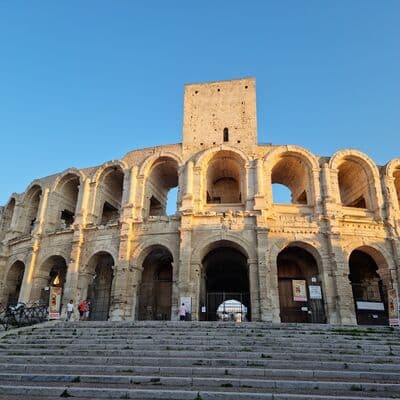
9:00-11:00 -- Start at the Roman Amphitheatre. Arrive at opening to beat the crowds. Climb to the upper tier for panoramic views. This 2nd-century arena held 20,000 spectators and still hosts events. Entry EUR 9 ($10), or buy the Pass Monuments for EUR 16 ($17) covering all Roman and medieval sites.
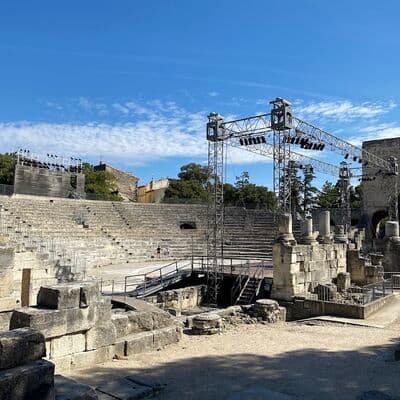
11:00-12:00 -- Walk to the Roman Theatre, 100 yards away. Two columns and stage fragments survive from this 1st-century BC theater. In summer, it hosts live performances.
12:00-13:30 -- Lunch near Place de la Republique. Look for a 'plat du jour' at a bistro -- EUR 12-16 ($13-17) for a full meal with wine.
14:00-15:30 -- Fondation Vincent van Gogh. Do not expect many originals -- the foundation showcases contemporary artists in dialogue with Van Gogh's legacy. Always quality exhibitions. Entry EUR 9-11 ($10-12).
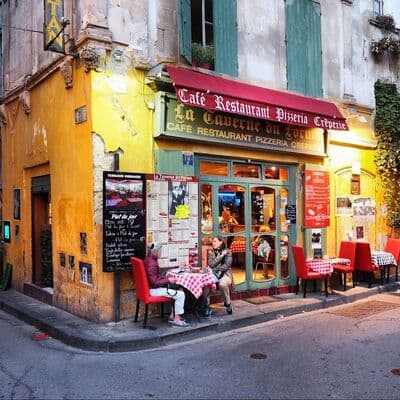
15:30-17:00 -- Walk the Van Gogh trail. Reproduction panels mark the exact spots where he painted. 'Starry Night Over the Rhone' -- the riverbank. 'Cafe Terrace at Night' -- Place du Forum (the yellow-awning cafe is still there, but prices are tourist markup).
18:00-20:00 -- Aperitif and dinner at Place du Forum or in La Roquette. Order a pastis -- the anise aperitif that is the essence of Provence.
Day 2: Medieval, Modern, and the Market
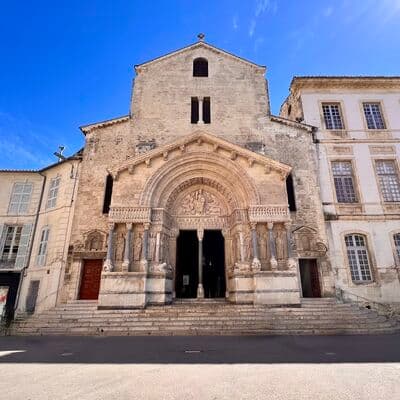
9:00-10:30 -- Saint-Trophime Church and its cloister. The 12th-century Romanesque portal is a masterpiece of medieval sculpture. The cloister is cool and quiet, with carved capitals depicting biblical scenes. Cloister entry EUR 5.50 ($6).
10:30-11:00 -- If Saturday, the market on Boulevard des Lices is mandatory: 15 varieties of olives, local cheeses, saucisson de taureau, lavender honey, fresh fruit. On non-Saturdays, a smaller market runs Wednesdays.
11:30-14:00 -- LUMA Arles. Gehry's tower must be seen in person: 11,000 aluminum panels reflecting Provencal light in ways photos cannot capture. Observation deck is free with exhibition ticket (about EUR 12 / $13). The park features works by Liam Gillick and Olafur Eliasson. Rooftop cafe for lunch with a view.
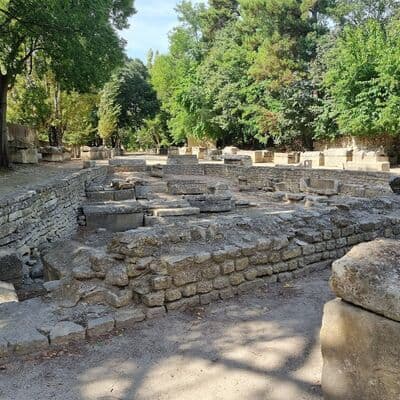
15:00-16:30 -- Alyscamps, the ancient Roman necropolis. Stone sarcophagi under plane trees. Van Gogh and Gauguin painted here together in autumn 1888. Quiet and away from tourist routes. Entry EUR 5.50 ($6).
17:00-18:00 -- Walk along the Rhone. Cross the bridge, watch the sunset light that captivated Van Gogh.
19:00 -- Dinner in La Roquette. Look for chalkboard menus outside -- a sign of fresh daily cooking.
Day 3: The Camargue -- Wild Provence
9:00-17:00 -- Full-day trip to the Camargue, the Rhone delta -- white horses, black bulls, pink flamingos, vast salt flats. Your options:
- By car: Saintes-Maries-de-la-Mer (30 min). Stop at Parc Ornithologique du Pont de Gau for flamingos (EUR 8 / $9). The D570 through the marshlands has pull-offs for photos.
- By bicycle: Flat cycle path to Salin-de-Giraud (15 miles / 25 km). Bike rental EUR 15-20 ($16-22/day), e-bikes EUR 25-30 ($27-32/day).
- On horseback: Guided rides from EUR 30 ($32) per hour. Book ahead in Saintes-Maries.
18:00 -- Return to Arles. Farewell dinner on a terrace.
5 Days in Arles: Taking Your Time
Add to the 3-day itinerary:
Day 4: Les Baux-de-Provence and the Alpilles
9:00-12:00 -- Les Baux-de-Provence (20 min by car). Medieval fortress on a cliff with panoramic views. The main draw: Carrieres de Lumieres -- paintings projected onto 45-foot quarry walls. Entry EUR 16 ($17), book online.
13:00-17:00 -- Saint-Remy-de-Provence (30 min from Les Baux). Where Van Gogh spent a year in the Saint-Paul-de-Mausole asylum. Part is open to visitors: his reconstructed room, gardens, and a painting trail. Charming town with a Wednesday market.
Day 5: Pont du Gard and Nimes
9:00-12:00 -- Pont du Gard (35 min by car). A 1st-century Roman aqueduct -- three tiers of arches, 160 feet (49 m) above the Gardon River. Swim in the river in summer. Entry EUR 9.50 ($10).
13:00-17:00 -- Nimes (30 min from Pont du Gard). The 'French Rome': an arena better preserved than Arles, the Maison Carree temple, Jardins de la Fontaine. Try the local brandade de morue for lunch.
7 Days in Arles: The Full Provence Experience
Add to the 5-day itinerary:
Day 6: Aigues-Mortes and the Coast
Aigues-Mortes (40 min) -- a 13th-century walled city with fully intact fortifications you can walk along. Nearby pink salt lakes of Salins du Midi offer tours. Beaches at Le Grau-du-Roi are 10 minutes further.
Day 7: Deep Provence
Abbaye de Montmajour (3 miles from Arles) -- a hilltop monastery Van Gogh painted. Then the villages of Fontvieille and Mausanne-les-Alpilles. Lunch at a farmhouse table d'hote (EUR 25-35 / $27-38 for multiple courses with wine). Evening wine tasting at a Rhone Valley domaine -- Chateauneuf-du-Pape is 40 minutes north.
Where to Eat in Arles: Restaurants and Cafes
Street Food and Markets
The Saturday market on Boulevard des Lices is the main culinary event of the week. Arrive between 8:30 and 9:00 before the crowds descend. What to eat right at the market:
- Socca -- a chickpea flour pancake cooked on a huge flat pan over a flame. EUR 3-4 ($3-4) per portion. Hot, crispy, sprinkled with pepper. If you have had Italian farinata, this is its Provencal cousin.
- Saucisson de taureau -- cured sausage made from Camargue bull meat. EUR 3-5 ($3-5) for a sliced portion. Gamey, dense, delicious.
- Olives -- dozens of varieties: green from Mouriès, black from Nyons, herbed, garlic-stuffed. EUR 3-6 ($3-7) per cup.
- Fromage de chevre -- goat cheese in every stage of aging, from soft and spreadable to firm and crumbly.
On Wednesdays there is a smaller market on the same boulevard. In Saintes-Maries-de-la-Mer (Camargue), markets run on Mondays and Fridays.
Local Bistros
Look for bistros with a 'formule du midi' -- lunch set of 2-3 courses for EUR 14-18 ($15-19). Signs of quality: chalkboard menu, locals at the bar, daily-changing dishes. La Roquette has the best concentration -- try Rue du Refuge and Rue de la Liberte.
Mid-Range Restaurants
Arles is not a culinary capital, but several places stand out:
- Le Galoubet -- honest Provencal cooking in the old town. Mains EUR 18-26 ($19-28).
- Le Criquet -- tiny, seasonal, market-driven. Book ahead. Set menu EUR 28-38 ($30-41).
- L'Atelier de Jean-Luc Rabanel -- Michelin-starred, creative Provencal cuisine. Tasting menu from EUR 65 ($70).
- Cargo de Nuit -- cultural cafe with live music and simple food. Good for evenings.
Top-End Dining
Fine dining is rare in Arles itself, but within 30 minutes: L'Oustau de Baumaniere in Les Baux-de-Provence (two Michelin stars, lunch from EUR 95 / $100, book a month ahead). In Arles, the restaurant at Hotel L'Arlatan (Maja Hoffmann's designer hotel) offers refined Mediterranean cuisine.
Cafes and Breakfast
Breakfast in France is not a production. A croissant and a coffee -- that is 'petit dejeuner.' The best boulangeries are not on the main squares but in residential streets. Follow the queue of locals.
- Cafe La Nuit on Place du Forum -- the Van Gogh painting cafe. Photo-worthy, but food is mediocre and coffee is EUR 4 vs EUR 1.50 elsewhere.
- Patisseries -- try the navette, a Provencal cookie with orange blossom water.
- Best breakfast: Saturday market -- standing coffee plus fresh pastries.
What to Try: Arles Food Guide
Arles sits at the crossroads of Provence, the Camargue, and the Mediterranean. The cuisine here is not resort food -- it is peasant cooking: generous, aromatic, built on olive oil, garlic, and herbs. Here are the dishes and drinks you should not leave without trying.
Gardiane de taureau -- The Camargue's signature dish. Black bull meat braised in red wine with olives, garlic, and herbs, served with local Camargue rice. EUR 16-22 ($17-24). The meat should be dark and falling apart -- if tough, the kitchen is cutting corners.
Tellines -- Tiny clams sauteed with garlic, parsley, and olive oil. A Camargue coast delicacy. EUR 8-14 ($9-15). Eat with your hands, soaking bread in the garlicky juices. Best in Saintes-Maries-de-la-Mer.
Tapenade -- Olive paste with capers, anchovies, and olive oil. Spread on toasted bread as a starter. A jar at the market: EUR 5-8 ($5-9).
Aioli -- Not just garlic mayo, but a full dish: salt cod and vegetables with powerful garlic sauce. Traditionally served Fridays. 'Le grand aioli' is a communal feast. If you see it on a menu, order it.
Riz de Camargue -- Red and black wild rice from the Rhone delta. Nutty, chewy, nothing like standard rice. EUR 3-4 ($3-4) at the market. Great lightweight souvenir.
Saucisson de taureau -- Cured bull meat sausage. Dense and gamey. EUR 4-7 ($4-8) at the market. Perfect with local wine.
Fougasse -- A Provencal flatbread with slashes cut into it, resembling a leaf. Comes in varieties: olives, anchovies, bacon, cheese. EUR 3-5 ($3-5) at a bakery. Eat it fresh, the day it is baked -- it does not keep.
Calissons d'Aix -- Almond-melon candies with white icing. From Aix-en-Provence, sold everywhere. Box from EUR 8 ($9). Delicate, not cloyingly sweet.
Pastis -- Anise aperitif diluted with cold water until cloudy. The Provencal ritual. EUR 3-5 ($3-5). Ricard and 51 are common; Henri Bardouin is the connoisseur's pick.
Rhone Valley wines -- Chateauneuf-du-Pape (40 min north), Tavel rose, Costieres de Nimes. At the market, a good bottle: EUR 6-12 ($6-13). Many stalls offer tastings.
What NOT to order: Bouillabaisse (a Marseille dish, done poorly here). Croissants at tourist cafes -- overpriced and stale. Walk two blocks to a real boulangerie.
For vegetarians: Provence is paradise. Ratatouille, zucchini gratin, chevre chaud salad, vegetable tian, soupe au pistou. Vegans have it harder -- cheese and eggs are everywhere.
Arles Insider Tips: Local Secrets
1. The Mistral is no joke. This wind blows 3-5 consecutive days at up to 60 mph (100 km/h). Pleasant in summer, brutal in winter. Bring a jacket even in June if Mistral is forecast. Silver lining: post-Mistral skies are crystal clear -- best light for photography.
2. Saturday market -- arrive at 8:30. By 10:00 it is a crush. Early morning: calm vendors, best selection. By 12:30, stalls pack up.
3. Buy the Pass Liberte for EUR 16 ($17). A combined ticket covering all Roman and medieval monuments (amphitheatre, theatre, Alyscamps, Saint-Trophime cloister, Musee de l'Arles Antique). You save at least EUR 15 ($16) if you visit four or more sites. Available at any ticket office.
4. Parking strategy. Do not even try to park in the center. Use the free parking at P0 Pont de Trinquetaille (across the bridge, 5-minute walk to the center) or P2 near the train station. Paid parking in the center runs EUR 1.50 ($1.60) per hour, and spaces are almost always full.
5. Use Arles as your Provence base. Day-tripping from Arles is cheaper than moving between towns. Camargue 30 min, Les Baux 20 min, Saint-Remy 25 min, Avignon 40 min, Nimes 30 min, Pont du Gard 35 min. Arles is cheaper than Avignon and quieter than Aix.
6. Van Gogh's yellow cafe is a tourist trap. Cafe La Nuit on Place du Forum is painted to look like the artwork, but Van Gogh actually painted a different building (destroyed in WWII). Photo: yes. Eat there: skip it.
7. Free days and discounts. First Sunday of each month: free municipal museums. EU students under 26: free entry to most monuments. LUMA occasionally hosts free evenings. Bring your ISIC card if you have one.
8. The photo festival is not just for photographers. Les Rencontres (July-September) turns the city into a gallery. Exhibitions in churches, palaces, abandoned buildings. Full pass EUR 35-40 ($38-43), but free outdoor installations exist too.
9. Late lunch = closed kitchen. French lunch: 12:00-1:30 PM. After 2:00 PM, kitchens close until 7:00 PM. For dinner in summer, reservations are essential, not optional.
10. Camargue by bike -- bring water. The route to Salin-de-Giraud (15 miles) is flat but shadeless. Minimum 2 liters of water, hat, serious sunscreen.
11. Course camarguaise is not a bullfight. The local tradition is bloodless: raseteurs pluck ribbons from the bull's horns. The bull is unharmed. This is NOT Spanish-style bullfighting (which also occurs in Arles -- a separate topic).
12. Rhone sunsets are free. Riverbank around 8:00-9:00 PM in summer. The same light Van Gogh chased. Best spots: the bridge or quayside near the old docks.
Getting Around Arles: Transport and Connectivity
Getting to Arles
Nearest airport: Marseille-Provence (MRS), 47 miles (75 km). Direct Navia bus to Arles -- 1.5 hours, EUR 8 ($9). By train: TGV Paris to Avignon (2h40), then TER to Arles (20 min, EUR 8). Or direct TGV Paris-Arles (4 hours, from EUR 35 / $38 booked early vs EUR 80 last-minute). The station is a 10-minute walk from the center. From Nice: ~4 hours by train. From Barcelona: ~5 hours via Montpellier.
Getting Around the City
Arles is compact and entirely walkable. Station to amphitheatre: 15 minutes. LUMA to Place du Forum: 12 minutes.
- On foot: The only sensible way around the center. Streets are too narrow for cars.
- Bicycle: Ideal for the Camargue. Rental EUR 12-15 ($13-16/day), e-bikes EUR 25-30 ($27-32/day).
- Bus: ENVIA network connects surrounding villages. EUR 1.10 ($1.20) per ride. Every 30-60 min, less on weekends.
- Taxi: Few and expensive. No Uber/Lyft. Call Artaxi or Taxi Arles. Station to center: EUR 8-10 ($9-11).
- Car rental: Essential for Camargue, Les Baux, Pont du Gard day trips. Book in Marseille or Avignon -- limited selection in Arles. EUR 35-50 ($38-54/day).
Internet and Connectivity
- Wi-Fi: Free in most hotels, cafes, restaurants. LUMA park has open Wi-Fi.
- SIM / eSIM: Prepaid SIM at any tabac shop: Orange, SFR, Free from EUR 10 ($11) for 20 GB. Or order eSIM before travel (Airalo, Holafly -- from $5/1 GB). EU residents have free roaming. US travelers: check your carrier's international plan.
Useful Apps
- SNCF Connect -- French rail tickets. Book early: Paris-Arles from EUR 19 vs EUR 80 last-minute. Works in English.
- Google Maps -- Works well for Provence including bus schedules. Download offline maps.
- BlaBlaCar -- Ridesharing for intercity trips, cheaper than trains. Works in English.
- TheFork -- Restaurant reservations with discounts up to 50%.
- Windy -- Mistral forecast is critical. Check it every morning.
Who Should Visit Arles: Final Verdict
Arles is for travelers who want real Provence without the gloss of Saint-Tropez or the crowds of Nice. Roman history, Van Gogh's light, LUMA's contemporary art, and one of the best markets in southern France -- all within a 20-minute walk. An ideal base for the Camargue, Alpilles, and Rhone Valley.
Ideal for: history and art lovers, photographers, food enthusiasts, couples, solo travelers. If you loved Bruges, Toledo, or Siena, Arles belongs on your list.
Not the best fit for: beach vacations (coast is 45 min away), nightlife (no clubs), shopping (minimal retail), families with small children (limited kid infrastructure).
How long: Minimum 2 days for the city, ideal 4-5 days with the Camargue and day trips, maximum 7 days for a full Provence immersion using Arles as your base.
Information current as of 2026. Prices may vary by season and exchange rates.