About
The Complete Laos Travel Guide: Everything You Need to Know Before Your Trip
Why Visit Laos
Laos is Southeast Asia without the crowds, without the commercialization, and without the rush. If you are tired of Thailand's packed beaches, the endless selfie sticks at Vietnamese landmarks, and Singapore's polished perfection, welcome to a country that seems to have paused in time. But not in a bad way: everything works, you can travel comfortably, and most importantly, you can finally exhale and feel like an explorer rather than part of a tourist conveyor belt.
Laos is the only landlocked country in Southeast Asia. Sounds like a disadvantage? Actually, it is a plus. There are no resort crowds, no drunken beach parties, no all-inclusive resorts with animation programs. Instead, you get the mighty Mekong River flowing through the entire country, mountains covered in jungle, and cities where time moves differently. Luang Prabang is a UNESCO World Heritage site that is not just beautiful temples but a living city where monks walk out every morning for alms collection, and the streets smell of coffee and fresh baguettes (French colonial heritage makes itself known).
In 2025, Laos welcomed 4.6 million tourists, an 11% increase from the previous year. By 2026, the country expects 5-6 million visitors, and the main reason for this growth is the launch of the China-Laos Railway in 2021. Now you can get from Vientiane to Luang Prabang in 2 hours instead of 8 hours by bus. And from Kunming, China to the Lao capital in a single day by high-speed train. This changed everything: the country became more accessible but has not yet lost its charm.
What makes Laos unique? First, Theravada Buddhism here is not a tourist attraction but a way of life. About 60% of Lao men spend time in a monastery at least once in their lives, not for show but because it is part of the culture. Second, Laos is one of the most ecologically pristine countries in the region. There is no heavy industry here, but there are national parks home to rare animal species. Third, this is the country with the most relaxed pace of life in the region. A local saying goes: Vietnamese plant the rice, Cambodians watch it grow, and Laotians listen to it grow. Nobody is in a hurry here, and after a couple of days, you will catch this rhythm.
Laos is not about rushing through temples and snapping photos for Instagram. It is about slowing down. About morning mist over the Mekong, the sound of temple bells, evenings with Beerlao on the riverbank, conversations with locals who are genuinely happy to see visitors. If you are looking for exactly this kind of experience, keep reading.
For Americans, Brits, Australians, and Canadians, Laos offers something increasingly rare in Southeast Asia: authenticity. While neighboring countries have fully embraced mass tourism with its predictable amenities and Disney-fied cultural experiences, Laos remains refreshingly real. Yes, you might have to work a little harder to get around. Yes, the infrastructure is not as polished. But that is precisely the point. You are not here for convenience. You are here for an experience that will stay with you long after the jet lag fades.
The economics work in your favor too. Laos remains one of the cheapest countries in Southeast Asia. A comfortable mid-range trip runs about $50-80 per day, including decent accommodation, good food, transportation, and activities. Budget travelers can get by on $25-40 per day without feeling deprived. Compare that to Thailand's tourist zones or Vietnam's major cities where similar comfort levels cost significantly more. Your dollars, pounds, or Australian dollars stretch remarkably far here.
There is also something to be said for visiting a destination before it changes irreversibly. The railway from China is bringing increasing numbers of Chinese tourists. New hotels are being built. Infrastructure is improving. In ten years, Laos will likely feel quite different. Not necessarily worse, but different. Coming now means experiencing the country in a transitional moment, when the old charm remains but modern conveniences are arriving. It is a sweet spot that will not last forever.
Regions of Laos: Which One to Choose
Northern Laos: Mountains, Tribes, and Adventure
Northern Laos features dramatic mountain landscapes, ethnic villages, trekking, and the feeling that you have reached the edge of the world. Dozens of ethnic groups live here, including the Hmong, Akha, Yao, and Khmu, each with their own traditions, clothing, and language. Tourism is less developed here than in the south, but that is exactly what attracts those seeking authentic experiences.
Luang Namtha is the gateway to the Nam Ha National Protected Area, one of the largest national parks in the country. Multi-day treks through the jungle with overnight stays in ethnic minority villages start from here. These are not Disney-style authentic villages but real settlements where people live just as their ancestors did hundreds of years ago. A 2-3 day trek costs $80-150 including guide, meals, and accommodation.
Muang Xai is a town on the Nam Ou River from where boats depart to remote villages. There is an interesting morning market here where everything is traded, from live ducks to forest mushrooms. The town itself is not touristy, but it is an excellent base for exploring the region.
Nong Khiaw is the jewel of the north. A small town wedged between limestone cliffs on the banks of the Nam Ou River. You can spend several days here walking to surrounding villages, climbing to viewpoints, and simply enjoying the views. The sunsets here are fantastic. From here, you can kayak or take a boat to Luang Prabang.
Phonsavan is the gateway to the Plain of Jars, one of Asia's main archaeological mysteries. Thousands of stone jars, some weighing up to 6 tons, are scattered across the plain. Nobody knows exactly what they were created for, with theories ranging from burial urns to containers for rice wine. Here you can also learn about the tragic history of the Secret War: the US dropped more bombs on Laos than on Germany and Japan combined during World War II. About 30% of the ordnance did not explode and still lies in the ground, with demining work continuing to this day.
For Western travelers, the north offers something special: genuine off-the-beaten-path experiences that are increasingly hard to find in Asia. The trekking here rivals anything in Nepal or Patagonia, but without the crowds. You will sleep in villages where electricity arrived only recently, eat meals cooked over open fires, and wake to roosters rather than alarm clocks. This is the Laos that backpackers discovered in the 1990s, and remarkably, much of it remains unchanged.
The physical demands of northern Laos should not be underestimated. Many treks involve significant elevation gain on narrow, sometimes slippery trails. The homestays are basic: squat toilets, cold bucket showers, and thin mattresses on wooden floors. But that is part of the appeal. You are not paying for comfort; you are paying for access to a way of life that is vanishing elsewhere in Asia. The guides who lead these treks often come from the villages themselves, and the tourism income helps communities maintain their traditional lifestyles rather than abandoning them for cities.
The best time for trekking in northern Laos is November through February, when temperatures are cool and trails are dry. March and April bring increasing heat that makes long hikes exhausting. The rainy season from May through October makes some trails impassable and adds the risk of leeches, though the landscape is at its most lush and beautiful.
Central Laos: Vientiane and Luang Prabang
Vientiane is one of Asia's quietest capitals. No megacity chaos here: the population is only about one million, traffic is calm, and the atmosphere is more provincial than metropolitan. The city stretches along the Mekong, and an evening walk along the riverfront is a mandatory ritual. Thailand (the city of Nong Khai) is visible across the river, and many Lao people go there for shopping.
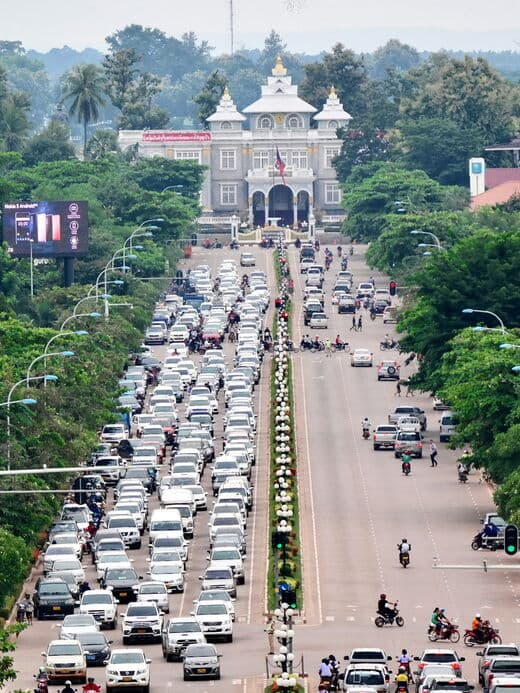
The capital's main attractions include Pha That Luang, a 16th-century golden stupa that is the national symbol of Laos (depicted on the coat of arms and currency); Patuxai, the Lao Arc de Triomphe, built from concrete that the US had donated for airport construction (the irony of history); and Buddha Park (Wat Xieng Khuan), an eclectic collection of concrete sculptures 25 km from the center, created by an eccentric monk in the 1950s.
Luang Prabang is the spiritual capital of Laos and the country's main tourist gem. The entire historic center is a UNESCO World Heritage Site: more than 30 temples, French colonial architecture, and traditional Lao houses all harmoniously combine on the peninsula between the Mekong and Nam Khan rivers.
The main attraction is the morning alms giving ceremony (Tak Bat). Every day around 5:30 AM, hundreds of monks in orange robes leave their monasteries to collect alms. Locals and some tourists sit along the streets with baskets of sticky rice and place it in the monks' bowls. This is not a tourist show but a living tradition more than 1,000 years old. Unfortunately, mass tourism has begun to spoil it: some tourists get too close with cameras, buy low-quality rice from street vendors who profit from this. If you want to participate, do it respectfully: buy rice from the monastery or a verified shop, dress modestly, and do not use flash.
Wat Xieng Thong is the most beautiful temple in Laos, built in 1560. The main building is decorated with mosaics of colored glass depicting the tree of life. The roofs slope almost to the ground, a characteristic Luang Prabang architectural style. Entrance is 20,000 kip (about $1).
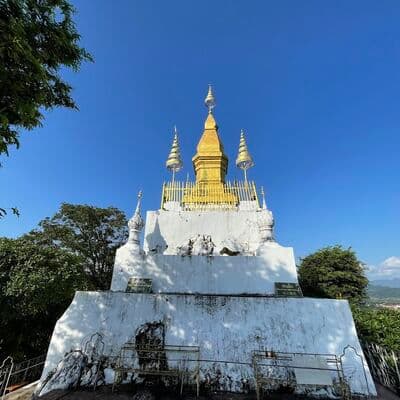
Mount Phousi rises 100 meters above the city, with 328 steps to the top. At the summit is a small stupa and panoramic views of both river channels and the city between them. It is best to climb at sunset, but be prepared for crowds as this is the most popular viewpoint. Entrance is 20,000 kip.
The Royal Palace Museum is the former residence of Lao kings, now a museum. Inside are the throne room, royal chambers, and a collection of gifts from foreign states. Photography inside is prohibited. Entrance is 30,000 kip.
Haw Pha Bang Temple is a golden pavilion on the palace grounds, built to house the Phra Bang, a golden Buddha statue that, according to legend, was brought from Sri Lanka in the 14th century. The statue is considered the palladium of Laos, the sacred protector of the country.
The Luang Prabang Night Market transforms the main street into endless rows of textile, souvenir, and street food vendors every evening. This is an excellent place to buy silk and cotton scarves, handmade bags, and jewelry. Bargaining is expected and encouraged: initial prices are usually reduced by 30-50%.
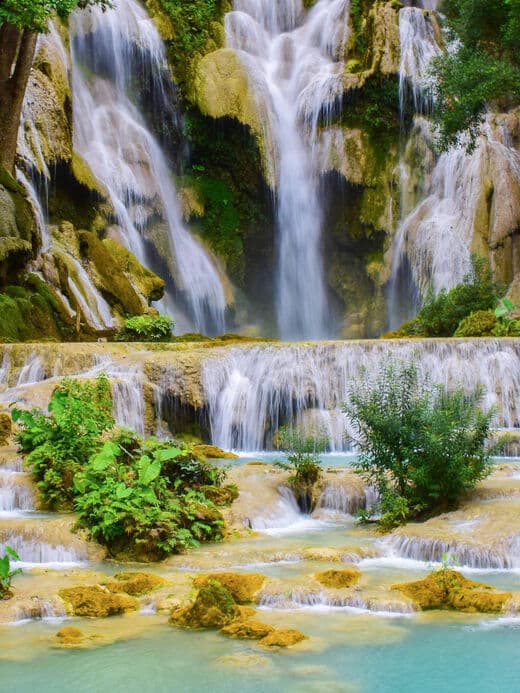
Kuang Si Falls is the main hit of the Luang Prabang area, 29 km from the city. A cascading waterfall 60 meters high with turquoise natural pools for swimming. The water really is that color due to minerals in the limestone rocks. Arrive early morning (opening at 8:00 AM) to catch the falls without crowds. At the entrance is an Asian black bear rescue center where animals saved from poachers are rehabilitated. Entrance is 20,000 kip ($1).
Pak Ou Caves are 25 km up the Mekong from Luang Prabang. Two caves in a limestone cliff filled with thousands of Buddha statues from different eras and sizes. Believers have been bringing statues here for centuries, some hundreds of years old. You can reach them by boat (2 hours one way, $15-20 per person) or by tuk-tuk by road. The boat is part of the experience: you will see villages along the river and landscapes invisible from the road.
Central Laos: Vang Vieng
Vang Vieng is a town between Vientiane and Luang Prabang that has undergone an amazing transformation. In the 2000s, it was the capital of backpacker alcohol tourism: bars with happy shakes (mushroom cocktails), river tubing with stops at bars, and drunken cliff jumping. Dozens of tourists died or were injured.
By 2015, authorities closed most of the river bars and introduced safety regulations. Today, Vang Vieng is about a different kind of active tourism: kayaking, trekking, rock climbing, and hot air balloon rides. The karst landscapes here are truly impressive: jungle-covered limestone cliffs rise from rice paddies like scenes from Avatar.
What to do in Vang Vieng: explore caves (Blue Lagoon, Tham Chang, Tham Phu Kham), take a kayak and paddle down the Nam Song River, climb to viewpoints (Pha Ngern, Nam Xay), rent a quad bike and ride through the villages. Tubing still exists but is now a calm float down the river without the extreme element.
For Americans who might remember the wild stories from Vang Vieng in the early 2010s: the town has genuinely reformed. Yes, you can still have a beer by the river, but the dangerous bars, drug-laced drinks, and reckless rope swings are gone. What remains are some of the most spectacular karst landscapes in Southeast Asia and a range of adventure activities that are now properly supervised. It is like the town grew up, and most visitors agree it is better for it.
Southern Laos: Waterfalls, Islands, and Coffee
Southern Laos is the least touristy region, and that is its main advantage. There are no crowds, infrastructure is simpler, but the impressions are stronger.
Thakhek is the starting point for the famous Thakhek Loop motorcycle route. 450 km through mountain roads, caves, villages, and Hin Nam No National Park, a UNESCO World Heritage Site (since 2023, jointly with Vietnam's Phong Nha-Ke Bang). The route takes 3-4 days, and you can rent a motorcycle in town for $15-20 per day.
Pakse is the largest city in the south and a hub for exploring the region. The city itself is not particularly interesting, but it is convenient for reaching the Bolaven Plateau and the 4,000 Islands.
The Bolaven Plateau is the Lao coffee region. Thanks to volcanic soils and climate, excellent coffee is grown here. You can visit coffee plantations, taste freshly roasted coffee, and buy beans to take home. Tad Fane Waterfall is one of the most beautiful in the country: a double cascade falls from a height of 120 meters into a jungle-surrounded gorge.
4,000 Islands (Si Phan Don) is an archipelago on the Mekong at the Cambodian border. Four thousand is an exaggeration, but there really are many islands. Tourists usually stay on Don Det or Don Khon: wooden bungalows on the shore, hammocks, sunsets, absolute peace. Here you can see the rare Irrawaddy freshwater dolphins (best time is early morning during dry season). Khone Phapheng Falls is the largest waterfall by volume in Southeast Asia, though not very high. During the rainy season, it is an impressive sight.
Champasak is a sleepy town, former capital of an ancient kingdom. The main attraction is Wat Phou, an 11th-century temple complex that predates Angkor Wat. A UNESCO site since 2001. The temple stands on a hillside, and the views of the valley from here are stunning.
For those coming from the US or UK who have done Thailand or Vietnam already, southern Laos offers something different: complete tranquility. The 4,000 Islands area is where you go when you want to do absolutely nothing except read books in hammocks and watch the Mekong flow by. After weeks of temple-hopping and city-navigating, it is exactly what you need.
The south also offers the easiest border crossing to Cambodia. From Don Det or Don Khon, you can arrange transport that takes you across the border and onward to Siem Reap (for Angkor Wat) or Phnom Penh. The journey is long but straightforward, and many travelers combine Laos with Cambodia in a single trip. Allow at least two weeks if you want to do both countries justice.
Wildlife enthusiasts should note that southern Laos harbors some significant biodiversity. The Xe Pian National Protected Area is home to elephants, tigers, and numerous bird species. While sightings are not guaranteed, the jungle trekking here offers a genuine wilderness experience. The region around Attapeu is particularly wild and sees almost no tourists, perfect for those seeking true isolation.
Unique Experiences: What You Can Only Do in Laos
The Laos-China Railway
Opened in December 2021, this railway transformed travel in the country. 414 km from the Chinese border (Boten) to Vientiane in 3.5 hours on a high-speed train. Previously, this journey took an entire day by bus on winding mountain roads.
The main route for tourists is Vientiane to Luang Prabang: under 2 hours instead of 8 hours by bus. The trains are modern, comfortable, and air-conditioned. There are two classes: regular (seated) and business. Prices are symbolic: about $10-15 for the entire journey.
Schedule: 5 trains per day in each direction, of which 4 are high-speed (160 km/h) and 1 is regular (120 km/h). Tickets are best purchased in advance through the LCR app (requires a Lao phone number) or at station ticket windows. Sales open 3 days before departure.
The Luang Prabang station is 7 km from the city center, so factor this in when planning. Tuk-tuk transfer costs about 50,000 kip ($2.50).
This railway is a game-changer for Western travelers on tight schedules. Previously, seeing both Vientiane and Luang Prabang meant either a grueling 8-hour bus ride or an expensive domestic flight. Now you can zip between them in under two hours, making a week-long trip far more feasible for those with limited vacation time.
Mekong River Cruises
The Slow Boat from Huay Xai (Thai border) to Luang Prabang is a classic backpacker route. Two days floating down the Mekong with an overnight stay in the village of Pak Beng. The boats are basic: wooden benches or bus seats, no amenities. But the views are stunning: mountains, jungle, fishing villages, water buffalo on the banks.
A more comfortable option is Luang Say Cruises: 2 days/1 night with accommodation at Luang Say Lodge in Pak Beng. Air-conditioned cabins, meals included, stops in villages. Price is approximately $300-400 per person.
Short cruises from Luang Prabang include trips to Pak Ou Caves (2 hours), sunset cruises (1.5 hours), and day trips to weaving villages and whisky village.
The slow boat experience is something uniquely Southeast Asian. For Americans used to efficient point-to-point transportation, spending two full days just getting somewhere might seem absurd. But that is entirely the point. You are not just traveling; you are experiencing the rhythm of the Mekong, watching life unfold along its banks, and arriving in Luang Prabang in a completely different mindset than if you had flown in.
Homestays in Ethnic Villages
In northern Laos, you can spend the night in ethnic minority villages of the Hmong, Akha, and Khmu peoples. These are not tourist attractions but real homestays: you sleep in a local family's house (usually on floor mattresses), eat the same food they do, and participate in daily life.
Such treks are organized from Luang Namtha, Muang Xai, and Nong Khiaw. Usually these are 2-3 day hikes through the jungle with overnight stays in different villages. Cost is $80-150 for the tour, including guide, meals, and accommodation. A guide is necessary as without one, you simply will not be accepted in the village.
The Secret War and UXO
From 1964 to 1973, the US conducted massive bombing of Laos, the most intensive in human history. More than 2 million tons of bombs were dropped on a country that was officially not even participating in the Vietnam War. About 30% of the ordnance did not explode and still lies in the ground today.
In Phonsavan, the UXO Lao Visitor Centre operates as a free museum telling about this tragedy and the demining work. In Luang Prabang, there is the COPE Visitor Centre with a similar exhibition. This is a heavy but important experience: understanding the history helps you better understand the country.
The practical aspect: if you travel off-road, especially in Xiangkhouang and Savannakhet provinces, do not leave well-trodden paths. UXO is a real danger, not a museum exhibit.
For American visitors in particular, this aspect of Laos can be profound. The US dropped over 270 million cluster bombs on Laos during the Secret War, making it the most heavily bombed country per capita in history. This is not ancient history; its effects are still felt daily. Children still lose limbs to unexploded ordnance. Learning about this history on the ground, in the places where it happened, offers a perspective that no textbook can provide. The COPE Centre in particular is thoughtfully presented and not designed to make Americans feel guilty, but rather to educate and to highlight the ongoing humanitarian work.
Lao Coffee
The Bolaven Plateau is one of Asia's best coffee regions. The French began growing coffee here in the early 20th century, and the tradition continues. The climate (altitude 1,000-1,300 meters, volcanic soils) is ideal for Arabica.
Lao coffee has a mild taste without bitterness. It is usually served Lao-style: very strong, with a lot of condensed milk at the bottom of the glass. Sounds too sweet, but it is worth trying as it is part of local culture.
On the Bolaven Plateau, you can visit plantations, learn about the growing and processing methods, try different varieties, and buy beans. Popular brands include Dao Coffee, Sinouk Coffee, and Jhai Coffee.
Coffee lovers from Portland to Melbourne will find the Bolaven Plateau a genuine discovery. Lao coffee has flown under the radar for years, overshadowed by Vietnamese coffee and Indonesian varieties. But connoisseurs increasingly recognize its quality, and visiting a working plantation where beans are grown, processed, and roasted on-site offers an experience that fancy urban roasteries cannot match.
Meditation and Buddhist Retreats
Several monasteries in Laos accept foreign visitors for meditation retreats. These are not the commercialized wellness programs found in Thailand but genuine monastic experiences. Wat Pa Phon Phao near Luang Prabang offers silent meditation sessions that visitors can join. The experience is simple: wake at 4 AM, meditate, eat two vegetarian meals before noon, meditate more, sleep. No phones, no talking, no distractions.
For those seeking a deeper experience, some monasteries accept long-term visitors who participate in monastery life. This typically requires advance arrangement and a commitment of at least a week. The experience is transformative for those willing to embrace the austerity, though it is not for everyone. If you are interested, contact monasteries directly through their Facebook pages or ask at tourism offices in Luang Prabang.
Weaving Villages and Traditional Crafts
Lao weaving traditions have been passed down for generations, and visiting weaving villages offers insight into this art form. Ban Phanom and Ban Xang Khong near Luang Prabang are particularly known for their textiles. You can watch weavers work on traditional looms, learn about the meaning of different patterns, and purchase directly from the creators.
What makes Lao textiles special is the level of handwork involved. A single sinh (traditional skirt) can take a month to weave. The patterns often tell stories or represent regional identity. Unlike mass-produced souvenirs, these textiles are genuine expressions of culture. Prices reflect the labor involved: $50-200 for quality pieces, but you are buying something irreplaceable.
When to Visit Laos
Dry Season (November to April)
The best time to visit. Almost no rain, roads are passable, and rivers are at convenient navigation levels. Temperatures are comfortable, especially in mountainous areas.
November to February is the cool season. In Luang Prabang and the north, nighttime temperatures can drop to 50-60F (10-15C), so bring warm clothes. Daytime is 77-82F (25-28C), ideal for trekking and sightseeing. This is high season: more tourists and higher accommodation prices.
March to April is the hot season. Temperatures reach 95-104F (35-40C) with high humidity. In April is Lao New Year, Pi Mai (April 13-16), the biggest holiday in the country. Three days of water battles in the streets, and you will get drenched no matter what. It is fun, but plan accordingly: many things are closed, transport is overcrowded, and accommodation must be booked in advance.
Rainy Season (May to October)
The monsoon brings daily downpours, usually in the afternoon. Mornings are often sunny. Temperatures are 77-90F (25-32C).
Disadvantages: some roads wash out, especially dirt roads in the north. River water levels are high, affecting boat routes. The Mekong overflows its banks, and the slow boat from Huay Xai can be dangerous.
Advantages: far fewer tourists, lower prices, nature is lush green, and waterfalls are at full force. Kuang Si Falls in rainy season is an impressive sight, though the water is murkier and swimming is prohibited.
June to August is peak monsoon. The rainiest period, but if you are prepared for downpours, travel is entirely possible.
September to October marks the end of the rainy season. A good compromise: rain is less frequent, but tourists are still few. The Boat Racing Festival (Boun Suang Heua) in September-October is a colorful event in Luang Prabang and Vientiane.
For travelers coming from the Northern Hemisphere, the dry season coincides nicely with winter escape timing. If you are planning a two-week trip in January or February to escape the cold at home, Laos offers perfect weather. The shoulder months of November and March offer the best combination of good weather and fewer crowds.
Climate varies significantly by region. Vientiane and the Mekong valley can be hot and humid even in the cool season, while the mountains of the north see genuinely cold nights in December and January. Luang Prabang sits at a pleasant middle ground, with comfortable temperatures year-round but occasional morning fog that burns off by midday. Pack layers if you are traveling between regions.
One often overlooked factor is air quality. During March and April, agricultural burning in Laos and neighboring countries can create significant haze. This is particularly noticeable in the north. If you have respiratory sensitivities, the November-February window is preferable. The haze rarely reaches problematic levels in the south.
Major Holidays and Festivals
Pi Mai (Lao New Year) is April 13-16. Three days of celebrations, water throwing, processions, and temple ceremonies. The country essentially stops.
Boun Pha Wet occurs in February. This Buddhist festival is dedicated to the Buddha's last rebirth. Temple ceremonies and sutra chanting take place.
Boun Bang Fai (Rocket Festival) happens in May or June. Homemade rockets are launched into the sky to call for rain. Particularly vibrant in Savannakhet Province.
Boun Ok Phansa occurs in October, marking the end of Buddhist Lent. Boat races, the festival of lights, and particularly beautiful celebrations in Luang Prabang.
That Luang Festival in November is the largest religious festival at That Luang stupa in Vientiane. Thousands of monks, night processions, and a fair.
How to Get to Laos
By Air
Laos has two international airports:
Vientiane (VTE), Wattay International Airport, is the main gateway to the country. Direct flights from Bangkok (Thai Airways, Lao Airlines, Bangkok Airways, 1 hour), Hanoi (Vietnam Airlines, 1 hour), Ho Chi Minh City, Siem Reap, Kuala Lumpur, Singapore, Seoul, Kunming, and Chengdu.
Luang Prabang (LPQ), Luang Prabang International Airport, has direct flights from Bangkok (1.5 hours), Hanoi, Siem Reap, Chiang Mai, and Kunming.
There are no direct flights from the United States, United Kingdom, Canada, or Australia. Optimal connections include Bangkok (most convenient option with many flights), Hanoi, or Kuala Lumpur and Singapore.
From the US, typical routing goes through major Asian hubs. Los Angeles to Bangkok is a common first leg, with onward connections to Vientiane or Luang Prabang. Total travel time is typically 20-24 hours depending on layover. From the UK, flights through Bangkok are usually 14-16 hours total. From Australia, routes through Bangkok or Singapore are most efficient, with total travel time of 12-15 hours.
Budget option: fly to Bangkok, then travel overland to Laos (bus to Vientiane via Nong Khai is 10-12 hours, about $25).
By Rail from China
Since 2021, you can travel by train from Kunming (China) to Vientiane in one day. Train D887 departs Kunming at 8:08 AM and arrives in Vientiane at 5:38 PM. Return train D888 leaves Vientiane at 10:30 AM, arriving in Kunming at 7:38 PM.
Price: approximately $40-50 for second class, $70-80 for first class. You need a Chinese visa (unless transiting) and a Lao visa (on arrival or in advance).
This is an excellent option if you are traveling through southern China: high-speed train from Beijing or Shanghai to Kunming, then into Laos. The entire journey takes 2 days.
Land Border Crossings
From Thailand:
The Friendship Bridge Nong Khai to Vientiane is the main crossing, operating 6:00 AM to 10:00 PM. You can walk across (a shuttle runs on the bridge) or take a direct bus from Bangkok.
Huay Xai to Chiang Khong is the northern crossing at the Golden Triangle. This is where the slow boat to Luang Prabang begins.
Other crossings include Mukdahan to Savannakhet and Nakhon Phanom to Thakhek.
From Vietnam:
Several crossings exist, with popular ones including Nam Eo (from Hanoi), Cha Lo (from Hue), and Bo Y (from Da Nang). Buses from Hanoi to Vientiane take about 24 hours at $30-40.
From Cambodia:
The Dong Kalor to Veun Kham crossing is at the 4,000 Islands area. From Siem Reap, you can reach Don Det in one (very long) day. More comfortable to split into two days.
From China:
The Boten (Laos) to Mohan (China) crossing exists. Now it is easier to travel by train, but buses from Kunming are also available.
For American travelers: if you are planning an extended Southeast Asia trip, Laos fits naturally into overland routes. A classic circuit might go Bangkok to Vientiane to Luang Prabang to Chiang Mai (Thailand) by slow boat and bus. Or you can combine Laos with Vietnam, crossing at one of several land borders. The Laos-China railway has also opened up interesting possibilities for trips combining southern China with Southeast Asia.
Flight prices vary dramatically by season and how far in advance you book. For US travelers, the best deals from the West Coast to Bangkok (the most common Laos gateway) typically run $600-900 round trip in economy during shoulder seasons. Peak season (December-January) and last-minute bookings can push prices to $1,200 or more. Using flight comparison tools and being flexible with dates can yield significant savings.
British travelers have slightly cheaper options through Middle Eastern carriers (Qatar, Emirates, Etihad) routing through their hubs. Expect 300-500 GBP round trip to Bangkok with good advance planning. Australian travelers can find competitive fares through Singapore Airlines, Thai Airways, or budget carriers like Scoot, typically AUD 600-1000 round trip from Sydney or Melbourne.
Getting Around Laos
Trains
The China-Laos Railway is the major transportation breakthrough. The line connects Boten (border), Luang Namtha, Muang Xai, Luang Prabang, Vang Vieng, and Vientiane.
Schedule: 5 trains per day in each direction. High-speed (C-series) trains run at 160 km/h, regular (K-series) at 120 km/h.
Travel time Vientiane to Luang Prabang: 1 hour 50 minutes to 2 hours 10 minutes.
Tickets: through the LCR app (requires Lao number and Visa card), at station ticket windows (1-3 days in advance), or through agencies (with markup). Popular trains sell out quickly, especially on weekends and holidays.
Important: stations are outside city centers. Luang Prabang station is 7 km from the center, Vientiane station is also not central. Factor in time and money for transfers.
Buses
Buses were the main transport before the railway appeared and remain relevant for routes the train does not cover.
VIP buses have air conditioning, reclining seats, and sometimes Wi-Fi. They run between major cities. Vientiane to Pakse takes 10 hours, Vientiane to Savannakhet takes 8 hours, Luang Prabang to Phonsavan takes 6 hours.
Local buses are old, slow, and stop everywhere. They are cheap but tiring. Used for short distances.
Minivans (songthaew) are converted pickup trucks with benches in the back. They run on local routes and depart when full. Cheap but not comfortable.
Tickets are purchased at bus stations or through hotels and guesthouses (with markup but more convenient). Schedules are approximate; in Laos, time is a flexible concept.
Boats
Slow boat is a legend of backpacker tourism. Huay Xai to Luang Prabang takes 2 days with an overnight in Pak Beng. Cost is $25-30 per person. Boats depart around 11:00 AM and arrive in Pak Beng by evening. The next day is the final leg to Luang Prabang.
Speedboat covers the same route in 6 hours instead of two days. But this is an adrenaline experience: narrow boats holding 6-8 people fly down the river while you wear a helmet and life jacket. There have been fatal accidents. Not recommended, especially in high water.
Tourist boats offer day trips from Luang Prabang (Pak Ou Caves, whisky village) and sunset cruises. These are booked through agencies or hotels.
Motorcycle Rental
This is the freest way to travel. Semi-automatic bikes (110-125cc) cost $8-15 per day, scooters cost $5-10. License: theoretically you need an international license with category A, but in practice this is rarely checked. However, if something happens without a license, insurance will not cover it.
Popular routes include the Thakhek Loop (3-4 days, 450 km), Bolaven Plateau Loop (2-3 days), and Nong Khiaw to Muang Ngoi.
Important: road quality varies. Asphalt on main highways is good, but side roads and secondary routes can be dirt, especially in the north. In rainy season, some sections are impassable.
Gas stations exist in every town. In villages, gasoline is sold from bottles (more expensive but no choice). Always leave with a full tank.
A note for Americans: driving a motorcycle without proper licensing carries real risk. While enforcement is lax, hospitals in Laos are basic, and medical evacuation to Thailand can cost $10,000 or more. Your travel insurance may not cover motorcycle accidents if you are not properly licensed. Consider whether the freedom is worth the risk, and at minimum, wear a helmet and drive defensively.
Tuk-tuks and Taxis
Tuk-tuks are the main urban transport. Prices are negotiable, so bargain. In Vientiane, a ride around the center costs 20,000-40,000 kip; in Luang Prabang, 15,000-30,000 kip.
LOCA is the Lao equivalent of Uber and Grab. It works in Vientiane and Luang Prabang. Prices are fixed, and you can pay by card through LOCA Pay. Recommended as it eliminates the need to bargain.
Regular taxis are rare, mainly found at airports. Prices are fixed and posted at stands.
The Cultural Code of Laos
Buddhism in Daily Life
About 65% of the population are Theravada Buddhists. Buddhism here is not a tourist attraction or formality but the foundation of life. Monks command enormous respect, and any disrespect to them or temples is a serious offense.
Temple rules: remove shoes before entering (even if the floor is dirty), dress modestly (shoulders and knees covered), women cannot touch monks or hand them anything directly (place the item down and the monk will take it), do not point the soles of your feet at Buddha statues or people.
The morning alms giving ceremony (Tak Bat): if you want to participate, do so respectfully. Buy rice from the monastery or a verified shop (not from street vendors who often sell stale rice). Dress modestly. Kneel and keep your head below the level of the monk's bowl. Do not use flash and do not get too close. It is better to simply observe from a distance if you are unsure.
Social Norms
Lao people are among the calmest in the region. Aggression, loud arguments, and public expressions of dissatisfaction are all considered losing face. If something goes wrong, smile and solve the problem calmly. Shouting at a waiter or taxi driver is the worst thing you can do.
Bo pen nyang is the national philosophy, meaning roughly do not worry about it or it is all fine. The bus is an hour late? Bo pen nyang. The dish is not what you ordered? Bo pen nyang. Get used to this rhythm, or you will burn out from frustration.
Public displays of affection: holding hands is normal, kissing is not accepted. Same-sex relationships: officially not criminalized, but society is conservative, and public displays are frowned upon.
The head is considered the sacred part of the body, so do not pat children on the head. The feet are the unclean part, so do not point them at people or sacred objects, and do not step over things or people.
For Western visitors accustomed to direct communication and assertive problem-solving, the Lao approach can be challenging. That restaurant getting your order wrong is not an invitation for confrontation. The tuk-tuk driver who quoted you double the normal price is not trying to swindle you; he is opening a negotiation. The key is maintaining equanimity. A smile and gentle negotiation accomplish far more than frustration ever will.
Language barriers can be significant outside tourist areas. English is spoken in hotels, restaurants, and tour agencies in Vientiane and Luang Prabang, but fades quickly once you leave these zones. Learning a few Lao phrases earns enormous goodwill. Sabaidee (hello), khop jai (thank you), and bo pen nyang (no problem) will get you far. Google Translate with the Lao language downloaded for offline use is invaluable.
Photography etiquette deserves mention. Always ask before photographing people, especially in ethnic villages. Some groups have spiritual beliefs about photography. Monks should not be photographed in certain situations (during meditation, eating, or bathing). If in doubt, keep your camera down. The most meaningful interactions happen when you put the phone away and simply engage with people directly.
Tipping
Tipping is not obligatory and historically not customary. But in tourist areas, people have become accustomed to it.
Restaurants: round up the bill or leave 5-10% in tourist places. In local establishments, tips are not expected.
Guides and drivers: $5-10 per day for a guide, $3-5 for a driver if you were satisfied.
Hotels: 10,000-20,000 kip for porters per bag. For housekeeping, it is not obligatory but you can leave 20,000-50,000 kip for several days.
Massage: 20,000-50,000 kip if you enjoyed it.
Dress Code
Laos is a conservative country. Tank tops, shorts above the knee, and bare shoulders are acceptable only at beaches and in tourist areas. When visiting temples, villages, and official places, cover your shoulders and knees.
For women: a long skirt or pants with a shirt or blouse. A sarong is a universal solution: wear it around your hips as a skirt or throw it over your shoulders.
For men: long pants and a short-sleeved shirt is the basic outfit. Knee-length shorts are acceptable in most places but not in temples.
Safety in Laos
General Safety Level
Laos is one of the safest countries in Southeast Asia. Violent crimes against tourists are extremely rare. The main risks are petty theft and scams.
Crime level: very low. Even in Vientiane, you can safely walk at night. But follow standard precautions: do not leave valuables in sight, do not carry a lot of cash.
Common Scams
Motorcycle rental: The classic scheme involves you returning the motorcycle and the owner finding damage that was not there before. Solution: photograph the motorcycle from all sides BEFORE renting, record all existing scratches in the contract. Never leave your passport as a deposit; only a copy or cash deposit.
Torn banknotes: In Laos, damaged banknotes are not accepted. Scammers give tourists torn bills as change. Check every bill and do not hesitate to refuse damaged ones.
E-visa scam: The official visa on arrival costs $30-45 depending on nationality. Some websites charge $100-135 for e-visa processing. The official site is laos-evisa.gov.la. Or simply get your visa at the border.
Alms ceremony: Vendors near temples sell expensive low-quality rice and aggressively push participation in the ceremony, then demand inflated payment. Ignore them or buy rice at the monastery itself.
Taxis and tuk-tuks: Inflated prices for tourists are the norm. Use LOCA, find out approximate prices at your hotel, and bargain.
UXO: Unexploded Ordnance
This is a real danger, not a historical footnote. About 30% of bombs dropped by the US between 1964 and 1973 did not explode. Dozens of people are killed or injured every year.
Rules: do not leave well-trodden paths, especially in Xiangkhouang Province (Plain of Jars), Savannakhet, and Attapeu. Do not touch metal objects in the ground. If you see something suspicious, back away and notify authorities.
Tourist routes and attractions are safe as they were cleared long ago. Risk arises only with independent hiking in remote areas.
Road Safety
Road quality is improving, but accidents are a frequent cause of tourist injuries. Local drivers do not always follow rules, and traffic is chaotic.
If renting a motorcycle: always wear a helmet (fines are real), do not speed on unfamiliar roads, be especially careful after rain (slippery), and do not drive intoxicated (obvious but many ignore this).
Night driving: not recommended. Roads are not lit, animals wander onto roads, and some drivers do not use headlights.
Water Activities
Tubing in Vang Vieng is now safer than before but still carries risks. Currents can be strong, especially during rainy season. Do not dive in unfamiliar places as depth is unpredictable.
Speedboats: high risk. Boats flip and people get injured. If you choose this option, wear the life jacket and helmet (which should be provided).
Emergency Contacts
Emergency services number: 191 (police)
Tourist police in Vientiane: +856 21 251 128
Ambulance: 195
Fire: 190
US Embassy in Vientiane: +856 21 487 000
UK Embassy in Vientiane: +856 21 413 606
Australian Embassy in Vientiane: +856 21 353 800
Canadian Embassy (in Bangkok, covers Laos): +66 2 636 0540
Health and Medical Care
Vaccinations
There are no mandatory vaccinations for entry (unless you are arriving from a yellow fever country).
Recommended: Hepatitis A and B, typhoid, tetanus. If you plan to spend extended time in rural areas, consider Japanese encephalitis and rabies.
Malaria: risk is low in tourist areas but exists in remote forest zones in the south (Attapeu, Sekong provinces). There is virtually no malaria in Luang Prabang, Vientiane, or Vang Vieng. Prophylaxis is usually not needed, but consult your doctor.
Dengue: common during rainy season. There is no vaccine; prevention involves repellents and covering skin. Symptoms include high fever, severe headache, and joint pain. If suspected, see a doctor.
For American travelers: consult a travel medicine specialist or your local health department before departure. The CDC maintains current recommendations at wwwnc.cdc.gov/travel. Most standard travel clinics can provide all necessary vaccinations and prescriptions in a single visit. Book at least 4-6 weeks before departure to allow vaccines to take effect.
Medical Facilities
The level of medical care in Laos is limited. In serious cases, evacuation to Thailand (Udon Thani or Bangkok) is necessary. Make sure your insurance covers medical evacuation.
In Vientiane:
Alliance International Medical Center is the best facility in the country with English-speaking staff.
French Medical Centre offers good quality with French-speaking staff.
In Luang Prabang:
Provincial Hospital provides basic care. For serious problems, go to Vientiane or Thailand.
Pharmacies exist in every town. Basic medications are available without prescription. Names may differ, so bring the packaging or a photo of your medication.
Water and Food
Tap water is not safe to drink. Use only bottled or filtered water. Ice in tourist areas is usually safe (made from purified water), but avoid it in remote places.
Street food is safe if you follow rules: eat where there are many locals, choose hot dishes, and avoid raw salads in questionable places.
Stomach issues: a common problem. Bring Imodium, rehydration salts, and activated charcoal. For serious symptoms (blood, high fever), see a doctor.
Alcohol Dangers
Local alcohol (Lao-Lao, whisky) sometimes contains methanol. There have been fatal poisoning cases, especially in Vang Vieng. Buy alcohol only from shops with receipts and avoid draft homemade whisky in bars.
Money and Budget
Currency
The Lao kip (LAK) is the local currency. Exchange rate (March 2026): approximately 22,000 kip per 1 USD, about 24,000 per 1 EUR.
The kip has devalued significantly in recent years, and inflation is high (around 8%). Prices can change quickly, so check current rates.
Large bills: 100,000, 50,000, and 20,000 kip. Small bills (5,000, 2,000, 1,000, 500) are needed for small purchases and tips.
Cash vs Cards
Laos is a cash country. Cards are accepted only in tourist hotels, restaurants, and large stores. Outside Vientiane and Luang Prabang, almost everything is cash only.
ATMs exist in towns. Most dispense kip, some dispense dollars. Fees are usually 20,000-40,000 kip per transaction. Limit is 2,000,000-3,000,000 kip per withdrawal.
Pro tip: LOCA Pay in the LOCA app lets you pay by card anywhere with LAO QR codes, which covers over a million locations. Link your Visa card, scan the QR code, and payment is complete. Useful when you run out of cash.
For Americans using credit cards: notify your bank before travel to avoid fraud blocks. Cards with no foreign transaction fees (Chase Sapphire, Capital One Venture, etc.) save 3% on every purchase. Schwab and Fidelity checking accounts reimburse international ATM fees, which adds up quickly when you are making multiple withdrawals.
Currency Exchange
US dollars are essentially a second currency in Laos. Many prices are quoted in dollars, and you can pay in dollars (though change comes in kip). Small bills ($1, $5, $10) are convenient for small purchases.
Thai baht are also accepted, especially at borders and in major cities.
Where to exchange: banks give the best rates but close at 4:00 PM. Exchange offices (often in jewelry stores) have longer hours but slightly worse rates. Do not exchange at borders as rates are predatory.
Budget
Budget ($25-40/day):
Accommodation: hostel or simple guesthouse at $5-15
Food: street food and local cafes at $5-10
Transport: local buses, tuk-tuks at $5-10
Entertainment: temples, markets at $5-10
Mid-range ($50-80/day):
Accommodation: guesthouse or boutique hotel at $20-40
Food: cafes and restaurants at $15-25
Transport: train, motorcycle rental at $10-20
Entertainment: tours, museums at $10-20
Comfortable ($100+/day):
Accommodation: boutique hotel or resort at $50-150
Food: restaurants at $25-50
Transport: private driver, boats at $20-50
Entertainment: guided tours at $30-100
Sample Prices (March 2026)
Bottle of water (1.5L): 5,000 kip ($0.25)
Beerlao (large bottle): 15,000 kip ($0.70)
Bowl of pho: 25,000-40,000 kip ($1-2)
Fried rice: 30,000-50,000 kip ($1.50-2.50)
Lao coffee: 15,000-25,000 kip ($0.70-1.20)
Lunch at tourist restaurant: 80,000-150,000 kip ($4-7)
Train Vientiane to Luang Prabang: 200,000-300,000 kip ($9-14)
Tuk-tuk around town: 20,000-50,000 kip ($1-2.50)
Temple entrance: 20,000 kip ($1)
Kuang Si Falls entrance: 20,000 kip ($1)
Massage (1 hour): 100,000-200,000 kip ($5-10)
Laos Itineraries
7 Days: Classic Laos
An itinerary for a first acquaintance with the country. Covers the main attractions without rushing.
Day 1: Arrival in Vientiane
Arrive at Vientiane. Check into hotel. Evening walk along the Mekong riverfront, dinner with river views. Sunset over Thailand from the Lao side.
Day 2: Vientiane
Morning: Pha That Luang, the golden stupa that is the symbol of Laos. Best photographed in morning when the sun illuminates the gold. Then Patuxai, where you can climb to the viewing platform ($0.50). Afternoon: Buddha Park (25 km from center, tuk-tuk $15-20 round trip). An eclectic collection of concrete sculptures that is strange but interesting. Evening: night market along the Mekong, dinner.
Day 3: Vientiane to Luang Prabang
Morning train to Luang Prabang (departing around 8-9 AM, 2 hours). Transfer from station to center (7 km, tuk-tuk 50,000 kip). Check in. Lunch at a cafe on the main street. Afternoon: walk through the historic center and get to know the city. Evening: night market, dinner.
Day 4: Luang Prabang
Early wake-up (5:00 AM) to observe the alms giving ceremony. Breakfast. Morning: Wat Xieng Thong, the main temple of the city. Royal Palace Museum and Haw Pha Bang Temple. Lunch. Afternoon: walk through temples on the peninsula. Evening: climb Mount Phousi for sunset (328 steps, 20,000 kip entrance). Dinner.
Day 5: Kuang Si Falls
Early departure to Kuang Si Falls (leave at 7:30-8:00 AM to arrive at opening at 8:00 AM). Tuk-tuk round trip with waiting is about $15-20 per person. Bear rescue center at entrance. 3-4 hours at the falls: swimming, trekking to upper cascades, photos. Return to town by lunch. Free time. Evening: cooking class (optional, $25-35) or massage and dinner.
Day 6: Pak Ou Caves
Boat excursion to Pak Ou Caves. Departure around 8:30-9:00 AM. 2 hours up the Mekong with a stop at whisky village Ban Sang Hai. Caves: two caves filled with thousands of Buddha statues. Return by lunch. Afternoon: visit Tad Sae waterfall (alternative to Kuang Si with fewer people) or free time. Last evening in Luang Prabang.
Day 7: Departure
Depending on flight time: morning walk through Phousi Market (near the mountain, opens 6 AM), last coffee. Transfer to airport or train station.
10 Days: Laos with Vang Vieng
An extended itinerary with active recreation in Vang Vieng.
Days 1-2: Vientiane (as in 7-day itinerary)
Day 3: Vang Vieng
Morning train or bus to Vang Vieng (train approximately 1 hour, bus approximately 4 hours). Check in. Get to know the town: walk along the Nam Song River, karst landscapes. Evening: riverside bars, dinner with mountain views.
Day 4: Active Day in Vang Vieng
Morning: kayaking on the Nam Song (3-4 hours, $15-20). Lunch. Afternoon: Tham Phu Kham cave and Blue Lagoon ($1-2 entrance), swimming, rock climbing. Or: hot air balloon ride at sunset ($90-100).
Day 5: Vang Vieng Day Two
Morning: trek to Pha Ngern viewpoint (3-4 hours, amazing views). Or: river tubing (calm version, $10-15). Lunch. Afternoon: rent a motorcycle and ride through surrounding villages. Evening: farewell dinner in Vang Vieng.
Days 6-9: Luang Prabang (4 days, as days 4-7 in the 7-day itinerary but with an extra day for trekking to Tad Sae waterfall or visiting weaving villages)
Day 10: Departure from Luang Prabang
14 Days: Northern Adventure
An itinerary for mountain, trekking, and ethnic village enthusiasts.
Days 1-2: Vientiane
Days 3-5: Vang Vieng (3 days of active recreation)
Days 6-8: Luang Prabang
Day 9: Luang Prabang to Nong Khiaw
Morning minibus to Nong Khiaw (3-4 hours). A town between cliffs on the Nam Ou River. Check into a guesthouse with river views. Walk and explore. Sunset from the bridge.
Day 10: Nong Khiaw
Morning trek to Pha Tok viewpoint (3-4 hours, stunning views of valley and cliffs). Lunch. Afternoon: boat to Muang Ngoi village (1 hour by river, $5-7), an even more remote place. Overnight in Muang Ngoi.
Day 11: Muang Ngoi
Day in the village: trekking around the area, visiting caves, rice paddies, complete disconnection from civilization. Evening boat back to Nong Khiaw.
Day 12: Nong Khiaw to Luang Namtha
Long journey to Luang Namtha (minibus 6-7 hours or train to Boten then minibus). Check in. Evening: prepare for trekking.
Day 13: Trek with Overnight
Two-day trek into Nam Ha National Protected Area. Hike through jungle with a guide from a local tribe. Overnight in a Hmong or Khmu village: house on stilts, simple dinner, night without electricity.
Day 14: Complete Trek and Departure
Morning: finish trek, return to Luang Namtha. Lunch. Options: back to Luang Prabang by train, or to Huay Xai and across the border to Thailand, or to Boten and into China.
21 Days: All of Laos from North to South
Complete immersion: from the Chinese border to the Cambodian, from mountains to Mekong.
Days 1-2: Vientiane
Days 3-5: Vang Vieng
Days 6-9: Luang Prabang
Days 10-11: Nong Khiaw and Muang Ngoi
Day 12: Transfer to Phonsavan (minibus from Nong Khiaw or Luang Prabang, 6-7 hours)
Day 13: Plain of Jars
Excursion to the three main Plain of Jars sites. Mysterious stone vessels over 2,000 years old with unknown purpose. Visit UXO Information Centre with the history of the Secret War. Emotionally heavy but important.
Day 14: Phonsavan to Thakhek
Long transfer south to Thakhek (bus 10-12 hours or split into 2 days via Vientiane). Thakhek is a town on the Mekong and the gateway to the Thakhek Loop.
Days 15-17: Thakhek Loop
Three-day motorcycle route: 450 km through mountains, caves, and villages. Day 1: Thakhek to Kong Lor Cave, overnight near the cave. Day 2: Kong Lor Cave (7 km by boat through an underground river) to Lak Sao. Day 3: Lak Sao through caves and blue lagoons back to Thakhek.
Day 18: Thakhek to Pakse
Bus to Pakse (4-5 hours). Pakse is the hub of southern Laos. Check in. Walk around town, dinner.
Day 19: Bolaven Plateau
Day trip to the plateau: coffee plantations, Tad Fane waterfall, ethnic minority villages. Return to Pakse. Or overnight on the plateau at an eco-lodge.
Day 20: 4,000 Islands
Transfer to Don Det or Don Khon (minibus plus boat, 3-4 hours). Check into a riverside bungalow. Rent a bicycle and explore the island. Sunset from a hammock. Evening: search for freshwater dolphins (better early morning).
Day 21: 4,000 Islands and Departure
Morning: Khone Phapheng Falls (20 minutes by tuk-tuk). The largest waterfall by volume in Southeast Asia. Return and transfer: back to Pakse (for flight), or across the border to Cambodia (Siem Reap or Phnom Penh).
Connectivity and Internet
SIM Cards
Three main operators: Unitel, Lao Telecom, and ETL. Unitel is the most popular with the best coverage.
Where to buy: at the airport (convenient, normal prices), in carrier stores in town, in shops and kiosks (may help with activation).
Documents: passport required for SIM card registration.
Prices: SIM card with 5-10 GB of internet for a week is about $3-5. Unlimited internet for a month is $10-15.
Top-up: cards (sold everywhere) or through carrier apps.
eSIM
A convenient option is to buy an eSIM before your trip. It works immediately upon arrival, no need to find a store.
Providers: Airalo, Holafly, and Nomad offer packages for Laos or regional (Asia) plans. Prices are comparable to local SIMs.
The LOCA app also offers eSIM for tourists directly in the app, convenient if you are already using LOCA for transport.
For American travelers with eSIM-compatible iPhones (XS and later) or recent Android phones, eSIM is the simplest option. Purchase before departure, activate when you land, and you are connected without visiting a store. Airalo is the most popular choice with straightforward pricing and good Laos coverage.
Wi-Fi
Available in most hotels, guesthouses, and cafes. Speed varies: in Vientiane and Luang Prabang it is usually fine, in remote areas slow or absent.
In some cafes, Wi-Fi is only for customers (they will ask you to order something). The password is usually written on the wall or menu.
Roaming
US carriers offer international roaming packages for Laos, but prices are high. Local SIM or eSIM is much better value. T-Mobile's international plans include data in Laos but at slow speeds. AT&T and Verizon international day passes run $10 per day, which adds up quickly on a two-week trip.
What to Try: Food and Drinks
Cuisine Basics
Lao cuisine resembles Thai but is less spicy and simpler. The foundation is sticky rice (khao niao), eaten by hand, rolled into balls. It accompanies virtually every dish.
Fish from the Mekong is the main protein source. There are lots of greens, herbs, and vegetables. Meat is mainly chicken and pork, less often beef.
Must-Try Dishes
Laap (larb) is the national dish. Minced meat (chicken, pork, fish, duck) with mint, basil, onion, chili, fish sauce, and lime juice. Available raw (laap dip, for the brave) or cooked. Eaten with sticky rice.
Tam mak hoong is the Lao version of papaya salad. The difference from Thai: fermented crab paste (padaek) is added, giving a specific taste. Spicy. Very spicy. You can request not spicy (bo phet).
Khao piak sen is Lao soup with rice noodles. Similar to Vietnamese pho but the noodles are thicker and more slippery. Served with chicken or pork, greens, and lime.
Ping kai is grilled chicken. Marinated in garlic, lemongrass, and fish sauce, grilled over charcoal. Simple and delicious. Sold everywhere on the streets.
Or lam is a thick stew from Luang Prabang. Meat (buffalo or chicken) with eggplant, beans, mushrooms, and sakhan, a local herb that causes slight tongue numbness. A unique experience.
Mok pa is fish in banana leaves. Fish with herbs wrapped in leaves and steamed. Aromatic and tender.
Sai oua are Lao sausages. Pork with lemongrass, galangal, and kaffir lime. Grilled. The perfect beer snack.
Street Food
Safe and delicious. At morning markets: baguettes with pate (French heritage), coffee with condensed milk, rice porridge. At evening markets: skewers on sticks, fried fish, steamed dumplings.
Tip: eat where there is a queue of locals. High turnover means fresh products.
Drinks
Beerlao is the national pride. A light lager with a mild taste that cools you down in the heat. A large bottle (640 ml) is about $1. There is also Beerlao Dark and Beerlao Gold.
Lao-Lao is rice moonshine. 40-50% alcohol with a specific taste. Sold in villages in plastic bottles. Try carefully as quality is inconsistent.
Lao coffee is strong with lots of condensed milk at the bottom. Served in a glass with ice. Too sweet for the unprepared, but worth trying. On the Bolaven Plateau, coffee without condensed milk is available, just good espresso.
Fruit shakes use fresh fruit, ice, and condensed milk. Mango, passion fruit, and pineapple are available everywhere on the streets. About $1-1.50.
Nam sa is tea, usually green, served free in restaurants.
Vegetarian Food
Vegetarians have a harder time in Laos. Most dishes contain fish sauce or meat. But options exist:
Mangsawirat (kin jay or kin phak) means vegetarian food. Say bo sai sin (without meat), but clarify as they may not consider fish sauce as meat.
Tofu (tao hoo) is sold at markets. You can request it instead of meat.
Vegetarian restaurants exist in Vientiane and Luang Prabang. In rural areas, it is more difficult.
Tip: order sticky rice, fried vegetables (pat pak), tofu, and tam mak hoong without crab paste.
Dining Culture and Etiquette
Lao meals are communal affairs. Dishes are placed in the center of the table and shared by everyone. Sticky rice comes in a communal basket; you pinch off a small ball, roll it between your fingers, and use it to scoop up other foods. Utensils are typically a spoon and fork (not chopsticks), with the spoon doing most of the work and the fork pushing food onto the spoon.
Dining hours are earlier than Western norms. Lunch typically happens between 11 AM and 1 PM, dinner between 6 and 8 PM. Many local restaurants close by 9 PM. In tourist areas, hours extend later, but do not expect midnight snacks outside major towns.
Restaurant bills rarely include service charge. Paying the exact amount or rounding up slightly is normal. Splitting bills is unusual; typically one person pays and others settle up privately. Offering to pay for a meal is a sign of generosity and respect, particularly if you are the guest.
What to Bring Home from Laos
Textiles
Lao silk and cotton are the main souvenirs. Weaving is a traditional craft, with patterns differing by region and ethnic group.
What to buy: scarves (sinh), bags, pillows, bedspreads. Quality of handmade work differs from factory-made. Look at weaving density and pattern uniformity.
Where: Luang Prabang night market, weaving villages (Ban Phanom, Ban Sang Khon), shops in the center.
Prices: handmade scarf $10-50 depending on size and quality. Bargain.
Coffee
Lao coffee from the Bolaven Plateau is an excellent gift. Locally produced Arabica and Robusta.
Brands: Dao Coffee, Sinouk Coffee, Jhai Coffee. Sold in supermarkets and specialty stores.
Price: 250g of beans $5-10.
Silver Items
The Hmong and other mountain tribes traditionally work with silver. Jewelry, bracelets, earrings, and pendants.
Where: night markets, villages in the north, specialty stores.
Tip: pure silver is soft and scratches with a fingernail. If it does not scratch, it is probably an alloy.
Handmade Paper
Sa paper is made from mulberry tree bark. Notebooks, cards, albums, and lamps.
Where: workshops in Luang Prabang (you can watch the production process), souvenir shops.
Wood Carvings
Buddha statues, elephant figurines, and decorative items. Quality varies from mass production to original works.
Tip: exporting antique Buddha statues is prohibited. If the seller says an item is antique, either they are lying (usually) or you will have problems at customs.
Lao-Lao and Beerlao
Rice whisky (if you find good quality) and Beerlao are unusual souvenirs. Beerlao in souvenir packaging is sold at the airport.
Spices and Sauces
Dried herbs (lemongrass, galangal), jaew (spicy sauces), and padaek (fermented fish, for the brave).
Tax Free
Laos has no Tax Free system for tourists. Prices are final.
For American travelers returning home: TSA allows food items in checked luggage. Coffee beans are fine. Fresh fruit and meat products are prohibited. Declare any food items at customs to be safe. The duty-free allowance is $800 per person.
Packing Tips for Souvenirs
Textiles pack flat and weigh little, making them ideal souvenirs. Wrap coffee beans in plastic bags to prevent odor from spreading to your clothes. Fragile items like wood carvings should be wrapped in clothing and placed in the center of your luggage. Consider shipping larger or more fragile purchases home; post offices in Luang Prabang and Vientiane can handle international shipping, though tracking can be unreliable.
If you are buying significant quantities, photograph everything and keep receipts. While Laos customs rarely checks departing tourists, having documentation protects you in case of questions. Note that items over 100 years old require export permits, though most souvenirs marketed as antiques are actually reproductions.
Useful Apps
Transport
LOCA is the main app for Laos. Taxis, food delivery, car rental, bus tickets, eSIM, and QR code payments. Works in Vientiane and Luang Prabang. Download it.
LCR (Laos-China Railway) is the official app for buying train tickets. Requires a Lao phone number and Visa card.
inDriver is an alternative to LOCA, sometimes cheaper.
Navigation
Maps.me offers offline maps. Download the Laos map in advance. Useful where there is no internet.
Google Maps works but worse than in other countries. Data is not always accurate.
Translation
Google Translate lets you download Lao for offline translation. The camera recognizes Lao text (menus, signs).
Food
Foodpanda delivers food in Vientiane and Luang Prabang.
GoTeddy is a local delivery service.
Zap.la is a Lao restaurant guide with local reviews.
Communication
WhatsApp is popular among tour agencies and hotels.
Facebook is the most used social network in Laos. Many businesses have only a FB page, no website.
Banking and Money Apps
Wise (formerly TransferWise) offers the best exchange rates for converting to kip before or during your trip. Their debit card works in Lao ATMs with minimal fees.
Charles Schwab checking (for US travelers) reimburses all international ATM fees, saving significant money over a multi-week trip.
XE Currency or similar currency converter apps help you quickly calculate prices when your brain is tired from converting between kip, dollars, and your home currency.
Photography and Travel Documentation
Snapseed or Lightroom Mobile for basic photo editing on the go. Laos is extraordinarily photogenic, and you will take more photos than you expect.
Google Photos or iCloud for automatic backup. Internet speeds in Laos can be slow, so enable backup when you have good Wi-Fi (usually at hotels) and let it run overnight.
TripIt or similar apps for organizing flights, hotel confirmations, and reservations in one place. Useful when you need to show a hotel confirmation at border crossings or immigration.
Instead of a Conclusion
Laos is not a country of checklists. There are no must-see attractions that you need to rush through in a week. The main value of Laos is its pace of life, atmosphere, and the feeling that time flows differently here.
Yes, service is not perfect here. Buses run late. Restaurants close when they feel like it. Nobody will rush to fulfill your wishes at a snap. But if you accept this as part of the experience rather than a problem, you will fall in love with Laos.
Go to Luang Prabang and wake up at 5 AM to see the alms giving ceremony. Climb Mount Phousi at sunset. Take a boat to Pak Ou Caves. Swim in the turquoise waters of Kuang Si Falls. Bargain at the night market. Drink a Beerlao on the Mekong bank at sunset.
Then go deeper. Into the northern mountains where tribes live unchanged for centuries. To the south, to the 4,000 Islands where the only activity is lying in a hammock. Along the Thakhek Loop where every turn reveals another stunning view.
Laos is changing fast. The Chinese railway has already transformed the north of the country, and tourists are increasing. In 5-10 years, this will be a different country. So go now, while you can still feel the Southeast Asia that experienced travelers remember from the 90s and 2000s.
And remember: in Laos, you do not need to hurry. Bo pen nyang, everything will be fine.
For those of us accustomed to optimizing every moment of vacation, to cramming experiences into tight schedules, to measuring trip success by the number of sites visited, Laos offers something radical: the permission to slow down. In a world that moves ever faster, that might be the most valuable souvenir you bring home.
What you will remember from Laos is not the temples or waterfalls, though those are beautiful. It is the moments in between. The sunrise over the Mekong while you drink coffee. The conversation with the guesthouse owner who tells you about his village. The afternoon spent watching monks play soccer in a temple courtyard. The evening when you realized you had not looked at your phone in hours and did not miss it.
This is a country that rewards patience, curiosity, and openness. It asks you to let go of your schedule, your expectations, and your need to optimize everything. In return, it offers something that money cannot buy and schedules cannot produce: genuine human connection and the space to simply be present.
So go to Laos. Take the slow boat. Eat the sticky rice with your fingers. Get lost in the temples. Bargain for textiles at the night market. Drink Beerlao watching the sun set over the Mekong. And when someone says bo pen nyang, smile and realize they are right. It really is all okay.
Information current as of March 2026. Prices and schedules may change. Check visa requirements for your country before traveling.
Visa Information for Western Travelers
United States Citizens
US passport holders can obtain a visa on arrival at all international entry points (airports and land borders). Cost is $30 for a 30-day single-entry visa. Bring one passport-sized photo and cash in US dollars (exact change helps). The e-visa option at laos-evisa.gov.la costs $50 but saves time at the border.
United Kingdom Citizens
UK passport holders can also obtain a visa on arrival. Cost is $35 for 30 days. Same requirements: passport photo and cash in US dollars. E-visa available for $50.
Australian Citizens
Australians receive visa on arrival for $35. Same 30-day validity. Passport photo and cash required.
Canadian Citizens
Canadians pay $42 for visa on arrival. Otherwise, same process applies.
Visa Extensions
Extensions are possible at immigration offices in Vientiane and Luang Prabang. Cost is $2 per day, maximum 60 additional days. Process takes 2-3 business days. Overstaying incurs a fine of $10 per day, payable at departure.
Border Crossing Tips
The main international airports (Vientiane and Luang Prabang) process visas efficiently, usually 15-30 minutes. Land borders can be slower, especially busy crossings like the Friendship Bridge from Thailand. Arrive early in the morning for the shortest waits.
When crossing from Thailand, note that the Thai side charges a small exit fee (around 30 baht) on weekends and after hours. The Lao side operates 6 AM to 10 PM.
When crossing from China via the new railway, visas are processed at Boten station. The train waits for all passengers to clear immigration, but having an e-visa speeds the process considerably.
Multi-Country Itinerary Planning
Laos combines naturally with several neighboring countries for extended trips. The most common combinations are with Thailand (entering from Bangkok area, exiting to Chiang Mai, or vice versa) and with Vietnam (particularly useful for those wanting to see both countries in one trip). Cambodia is accessible from the south, making a Laos-Cambodia combination possible for those focused on mainland Southeast Asia.
For a three-week trip combining Laos with Thailand, a classic route goes Bangkok to Vientiane (overnight train or flight), Vientiane to Luang Prabang (train), Luang Prabang to Chiang Mai via slow boat and bus (3-4 days), then fly out of Chiang Mai. This covers both countries at a reasonable pace without feeling rushed.
For combining Laos with Vietnam, consider entering Vietnam from Laos at one of the northern border crossings (Dien Bien Phu area) and traveling south through Vietnam to exit at Ho Chi Minh City. Or reverse this direction. The land crossings are time-consuming but offer an authentic overland travel experience that flying cannot match.