Luang Prabang
Luang Prabang 2026: What You Need to Know Before Your Trip
Luang Prabang is one of those rare places that genuinely lives up to the hype. A UNESCO World Heritage town tucked into a peninsula where the Mekong and Nam Khan rivers meet, it manages to feel both ancient and alive. Saffron-robed monks file through the streets at dawn, French colonial buildings house excellent restaurants, and jungle-wrapped waterfalls are a short drive away.
The quick version: Luang Prabang is the former royal capital of Laos - 34 active Buddhist temples, world-class food, and some of the most photogenic scenery in Southeast Asia. Compact enough to explore on foot, affordable enough to stay for weeks, culturally rich enough to keep you fascinated the entire time. Think of it as Southeast Asia's answer to a perfectly preserved European old town, except with sticky rice, waterfalls, and 30-degree heat.
Who is this city for? Culture lovers, photographers, food enthusiasts, slow travelers, and anyone who wants Southeast Asia without the chaos of Bangkok or the tourist-industrial complex of Bali. Couples love it for the romance. Solo travelers love it for the ease and safety.
The honest downsides: Not a party town - bars close at 11:30 PM by law. It is small, so three to four days covers the highlights. Rainy season can make roads muddy and river trips less scenic. Tourism has changed the place - the morning alms ceremony has become a bit of a spectacle, and prices are higher than the rest of Laos. But none of that diminishes the magic if you approach it right.
Luang Prabang Neighborhoods: Where to Stay
The town is small - twenty minutes on foot from end to end - but each pocket has a distinct character.
Old Town Peninsula
The heart of everything. Between the Mekong and Nam Khan rivers, this is where the temples, Night Market, Royal Palace Museum, and best restaurants cluster. No heavy traffic allowed.
Prices: $40-80 mid-range, $120-300+ boutique. Pros: Walkable, best for the Morning Alms Ceremony. Cons: Priciest area, touristy on the main drag. Best for: First-timers, couples, photographers.
Ban Wat That (South of the Peninsula)
Across the Nam Khan - where locals live and shop. The morning market here is more authentic than anything on the peninsula.
Prices: $15-35 guesthouses, $50-90 hotels. Pros: Authentic vibe, lower prices, 5-10 min walk to old town. Cons: Fewer fancy restaurants. Best for: Budget travelers wanting comfort, longer stays.
Mekong Riverside (South of Old Town)
A string of riverside guesthouses with jaw-dropping sunset views, running from the slow boat pier southward. Quieter but still walkable.
Prices: $25-60 guesthouses, $70-180 riverside hotels. Pros: Stunning Mekong views, peaceful. Cons: 10-15 min walk to center, isolated after dark. Best for: Couples, view-seekers, stays over three days.
Ban Phanom (Weaver's Village)
About 3 km east, a traditional Lao Lue weaving village with homestays. Wake to roosters, watch silk woven on wooden looms, eat with families.
Prices: $10-25 homestays, $30-50 guesthouses. Pros: Cultural immersion, incredibly affordable. Cons: Need transport to old town. Best for: Adventurous travelers, textile enthusiasts, week-long stays.
North of Nam Khan (Backpacker Zone)
Around the bamboo bridge crossing - Luang Prabang's budget hub. Cheap guesthouses, Utopia bar, younger crowd.
Prices: $8-20 dorms/basic rooms, $25-45 nicer guesthouses. Pros: Cheapest area, social, bamboo bridge shortcut. Cons: Bridge closes in rainy season, basic rooms. Best for: Solo backpackers, budget travelers.
Airport Area
Modern mid-range hotels with pools, 4 km from old town. Standard Southeast Asian business hotels - fine for transit.
Prices: $40-100 with pools and breakfast. Pros: Modern facilities, pool. Cons: Zero charm, disconnected. Best for: Transit stays, early departures.
Best Time to Visit Luang Prabang
Cool and Dry Season (November to February)
Peak season for good reason. Temperatures 15-28C (60-82F), clear skies, calm rivers. Mornings can be chilly - bring a light jacket for dawn temple visits. December and January are busiest; book two to three weeks ahead.
Expect: Perfect weather, 20-30% higher prices, busier temples, fully booked boutique hotels.
Hot Season (March to May)
Temperatures hit 35-40C (95-104F) by April. The upside: fewer tourists, lower prices, and Pi Mai (Lao New Year, April 13-16) - the biggest festival of the year. The town transforms into a massive, joyous water fight. March-April also brings burning season haze from agricultural fires.
Expect: Intense heat, occasional haze, 15-25% price drops, Pi Mai madness in April.
Rainy Season (June to October)
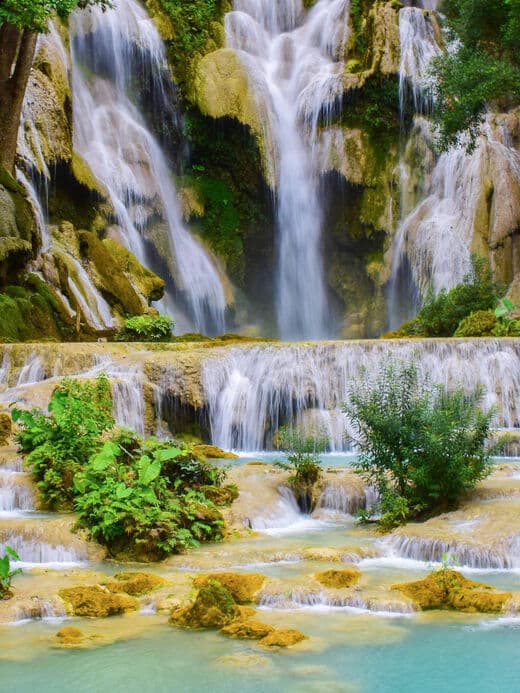
Rains come in short afternoon bursts - mornings often clear. The landscape turns impossibly green, Kuang Si Falls reaches its thundering peak, prices drop to their lowest. The bamboo bridge gets dismantled, some roads become difficult. September-October see the most rain.
Expect: Lush scenery, 30-40% lower prices, afternoon downpours, some logistics challenges.
Key Festivals
- Pi Mai (Lao New Year): April 13-16. City-wide water fights, temple ceremonies, sand stupas on the Mekong. Book early.
- Boun Ok Phansa: October. Boat racing on the Mekong, illuminated float processions at night.
- Boun That Luang: November. Candlelit processions, temple fairs. More local and intimate.
Cheapest time: Late June through September - boutique rooms at 50% of peak rates.
Luang Prabang Itinerary: 3 to 7 Days
3 Days: The Essential Luang Prabang
Day 1: Temples, Sunset, and the Night Market
6:00-7:00 AM: Witness the Morning Alms Giving Ceremony on Sakkaline Road. Watch respectfully from a distance. Breakfast at Le Banneton (opens 6:30 AM, croissants and coffee ~$4).
8:30-11:30 AM: Temple circuit. Start with Wat Xieng Thong (20,000 kip / ~$1) - the mosaic tree of life and red chapel are extraordinary. Allow 45 minutes. Walk to Haw Pha Bang Temple on the Royal Palace grounds, then visit the Royal Palace Museum next door (30,000 kip / ~$1.50; no photos inside). Allow 90 minutes for the palace complex.
12:00-4:00 PM: Lunch at Tamarind (set lunch ~$8). Rest during the heat. Browse textile shops along Sakkaline Road.
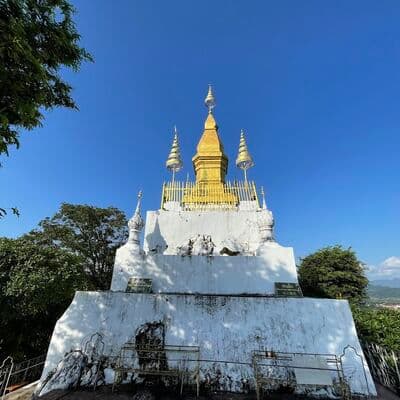
4:30-8:00 PM: Climb Mount Phousi for sunset (328 steps, 20,000 kip / ~$1). Start by 4:30 to secure a spot - the 360-degree view is unforgettable. Descend to the Night Market on Sisavangvong Road. The food stalls on Haw Kham Road are the highlight - buffet-style dishes for 15,000-25,000 kip ($0.75-1.25).
Day 2: Kuang Si Falls and Weaving Village
8:00 AM: Head to Kuang Si Falls (45 min by tuk-tuk). Shared minivans ~$2.50-3/person, private tuk-tuk $12-15. Entry 20,000 kip (~$1). Arrive by 9 AM to beat crowds. The turquoise pools are real - swim in the lower pools, hike to the top, visit the bear rescue center. Allow 2.5-3 hours.
1:00-3:30 PM: Stop at Ban Phanom weaving village on the return. Hand-woven scarves from $10-15. Late lunch at Khaiphaen ($4-7; try their fried river weed appetizer).
5:00-8:00 PM: Cross the bamboo bridge (5,000 kip, dry season only) to the north bank. Cushions and fruit shakes at Utopia Bar with sunset views. Dinner at Dyen Sabai (riverside BBQ set ~$6-8).
Day 3: Pak Ou Caves, Market, and Massage
8:00 AM-12:30 PM: Slow boat up the Mekong to Pak Ou Caves (~2 hours upstream). Stop at Ban Xang Hai whiskey village en route. Thousands of Buddha statues in limestone hollows - bring a flashlight for the upper cave. Shared boat ~$3.50-4/person, private longtail $17-20.
1:00-3:00 PM: Explore the morning market at the Mekong riverfront - herbs, fish, river weed, grilled meats. Khao piak sen (noodle soup) at a stall for $1-1.50.
3:30-5:00 PM: Red Cross Sauna and Massage - herbal sauna for 20,000 kip (~$1) plus one-hour massage for 80,000-100,000 kip ($4-5). Proceeds support nursing students.
5 Days: Going Deeper
Days 1-3: As above.
Day 4: Cooking, Culture, and Crafts
8:30 AM-1:00 PM: Lao cooking class at Tamarind Cooking School (~$35, includes market tour). Visit the morning market with your instructor, cook 5-6 dishes, eat everything for lunch. Book a day ahead in high season.
2:30-5:00 PM: TAEC (Traditional Arts and Ethnology Centre, 25,000 kip / ~$1.25) - the best museum for understanding Laos's ethnic diversity. Then wander the quiet back streets of the peninsula - hidden temples, monks' quarters, almost no tourists.
Evening: Dinner at Manda de Laos (mains $10-18, gorgeous lotus-pond garden). Try the buffalo laap or Mekong fish.
Day 5: Tad Sae, Living Land Farm, Cycling
8:30-11:30 AM: Tad Sae Falls (20 min + boat crossing). Less dramatic than Kuang Si but far less crowded. Tuk-tuk and boat combo ~$7.50-10 round trip. Best in rainy season; can be a trickle in dry months.
12:00-3:00 PM: Living Land Farm - full rice-growing process from buffalo plowing to cooking. ~$25/person, proceeds to farming families.
4:00-5:30 PM: Rent a bicycle ($2-3/day) and cycle along the Mekong past the slow boat pier. Late-afternoon light is spectacular.
Evening: Cocktails at Apsara ($5-8, colonial-era hotel bar on the Nam Khan). Dinner at Coconut Garden (Lao fusion, mains $5-10).
7 Days: The Full Experience
Days 1-5: As above.
Day 6: Nong Khiaw Day Trip
7:30 AM-6:00 PM: Minivans to Nong Khiaw depart the northern bus station at 8:00 and 9:00 AM (~$2.50-3 one way, 3 hours). Stunning riverside village with towering karst cliffs. Climb to the viewpoint (1.5 hrs round trip), explore wartime caves, lunch at a riverside restaurant. The scenery is arguably more dramatic than Luang Prabang itself. Last van back around 3:30-4:00 PM.
Day 7: Slow Morning and Farewell
6:00-8:00 AM: One last alms ceremony. Slow breakfast at Saffron Coffee (single-origin Lao beans, ~$4-6).
9:00-11:30 AM: Visit temples you missed - Wat Manorom (14th century), Wat Visoun (the watermelon stupa). Browse the morning market for souvenirs: indigo textiles, Lao coffee beans, local honey.
Afternoon: Final massage, farewell iced coffee at JoMa Bakery Cafe.
Where to Eat in Luang Prabang
The town punches far above its weight for food. French colonial influence, traditional Lao cuisine, and a growing cafe scene create a dining landscape rivaling cities ten times its size.
Street Food and Markets
The Night Market food street on Haw Kham Road is the best budget dining. From 5:30 PM, buffet-style stalls offer stir-fries, grilled meats, salads, noodles, and spring rolls. Full plate: 15,000-25,000 kip ($0.75-1.25). Grilled pork skewers and coconut pancakes are highlights.
The morning market has khao jii (baguette sandwiches, $0.50-0.75) and fruit shakes ($0.50). Phosy Market serves excellent khao piak sen and feu for $1-1.50.
Mid-Range Restaurants
Tamarind: Gold standard for approachable Lao cuisine. Tasting set (~$8-10) includes sticky rice, laap, river weed, and seasonal dishes with explanation cards. Book for dinner in high season.
Khaiphaen: Social enterprise training at-risk youth. Lao classics with modern touch. Signature fried river weed is addictive. Mains $4-7. Rooftop views.
Dyen Sabai: Across the bamboo bridge - cushions on a platform over the Nam Khan, jungle across the water. BBQ set $6-8. Perfect lazy afternoon.
Coconut Garden: Charming courtyard, Lao fusion. Coconut curry and Mekong fish standouts. Mains $5-10. Good vegetarian options.
Fine Dining
Manda de Laos: Stunning lotus-pond garden, possibly the most beautiful restaurant in Laos. Refined Lao cuisine - buffalo laap, Mekong fish in banana leaf. Mains $10-18. Book ahead.
Apsara: French-Lao fusion in a restored colonial building. Magic terrace at sunset. Mains $12-20.
L'Elephant: French-Lao since the 1990s. Elegant colonial setting, good wine list. Mains $15-25.
Cafes
Saffron Coffee: Lao-owned roastery. Single-origin Bolaven Plateau beans - would hold up in Melbourne or Portland. Americano $2-3.
Le Banneton: French bakery, opens 6:30 AM. Genuine croissants and strong coffee. $3-5 for coffee and pastry.
JoMa Bakery Cafe: Institution. Reliable coffee, sandwiches, WiFi, AC. Coffee $2-4, sandwiches $4-6.
Must-Try Food in Luang Prabang
Lao cuisine is distinct from Thai - less sweet, more herbaceous, with a focus on bitter and fermented flavors.
Khao Niao (Sticky Rice): The foundation of every Lao meal. Eaten with your hands - pinch off a ball and dip into sauces, laap, everything. Comes in a woven bamboo basket. You will eat it at every meal.
Laap: The national dish. Minced meat with toasted rice powder, fish sauce, lime, chili, mint, and fresh herbs. The Luang Prabang version uses watercress and a distinct herb profile. When it is good, it is one of the best things you will eat in Southeast Asia.
Or Lam: A rich stew specific to Luang Prabang - buffalo or pork with eggplant, mushrooms, dill, lemongrass, and sa khan (a mildly numbing vine). Deep, earthy, unlike anything else. Tamarind makes an excellent version.
Khao Piak Sen: Thick hand-rolled rice noodles in a viscous, comforting broth. Laos's answer to pho, with a distinct texture. Perfect for breakfast. Best at morning market stalls ($1-1.50).
Khaiphaen (Fried River Weed): Sounds terrible, tastes incredible. Mekong river algae dried, seasoned with sesame and tomato, deep-fried into crispy chips. Eat with jaew bong (chili-buffalo skin dip).
Khao Jii: The Lao baguette - French colonial legacy stuffed with pate, pickled veg, chili sauce, and meat. Street vendors sell them for $0.50-1.
Ping Kai (Grilled Chicken): Butterflied chickens marinated in lemongrass and fish sauce, grilled over charcoal. Half a chicken: $2-2.50 with sticky rice.
Lao-Lao (Rice Whiskey): Ranges from rough moonshine to smooth. Whiskey villages near Pak Ou sell versions infused with herbs, honey, or whole snakes. Shot at a bar: $0.50-0.75. Quality varies wildly.
Beer Lao: One of Southeast Asia's best lagers. Crisp, clean, perfect in the heat. Beer Lao Dark has a slight coffee note. Large bottle at a restaurant: $0.75-1.
Tourist traps: Skip the "happy" shakes (drug laws are severe). Avoid overpriced "fusion" spots with laminated photo menus - they serve neither good Lao nor good Western food.
Vegetarian: Fish sauce and shrimp paste are in most dishes. Tamarind, JoMa, and Khaiphaen have decent veggie options. Night market has vegetable dishes but may contain oyster sauce.
Allergies: Peanuts, sesame, shellfish appear frequently. Toasted rice powder contains gluten. Fish sauce is in almost everything. Carry a translated allergy card - English is not always understood in kitchens.
Luang Prabang Secrets: Local Tips
1. The alms ceremony is not a tourist attraction. The Morning Alms Giving is sacred. Do not buy rice from street vendors (often stale, disrespectful trade). If giving, buy fresh rice from the morning market and kneel properly. Better yet, watch quietly from 10+ meters. No flash. Monks walk at 5:30-6:00 AM depending on season.
2. Shoes off everywhere. Temples, many guesthouses, some restaurants. Wear slip-on sandals.
3. The bamboo bridge is seasonal. Dismantled June-October when the Nam Khan rises. Rebuilt each dry season. 5,000 kip per crossing. Do not skip the walk along the north bank.
4. Bargain gently. This is not Bangkok - markup is lower, aggressive haggling is rude. 10-20% reduction on crafts is fine. Food and transport prices are usually fixed and fair.
5. Cash is king. Most places run on cash. ATMs are plentiful (BCEL and JDB are most reliable). Withdraw and pay in kip for the best value. ATM fee: ~$1/transaction. Many places accept USD and Thai baht at poor rates.
6. Power outages happen. Brief cuts (15-60 min), especially during storms. Carry a power bank.
7. Mosquitoes are serious. Dengue is present. DEET repellent (~$2-3 at pharmacies), especially at dusk. Dengue mosquitoes bite daytime too. High fever with body aches = see a doctor immediately.
8. Rent a bicycle, not a motorbike. Old town is tiny - bike is perfect ($2-3/day). Motorbikes ($10-15/day) only needed for Kuang Si. Check brakes and lights; international permits technically required.
9. The town runs on sunrise time. Awake at 5 AM, asleep by 10 PM. Bars close at 11:30 PM. Embrace the early rhythm - morning light on temples is magical.
10. Kip conversion. ~20,000 kip = $1 USD. Mental trick: drop four zeros, divide by two. Prices above 500,000 kip often quoted in dollars.
11. Dress code at temples. Cover shoulders and knees, both genders. Sarongs sometimes available to borrow. Lightweight long-sleeved linen doubles as sun protection.
12. Do not drink tap water. Bottled water: $0.25 for 1.5L. Some hotels offer free filtered water. Ice in restaurants is generally safe (commercially produced).
Getting Around and Connectivity
Getting to Luang Prabang
By air: Luang Prabang International Airport (LPQ) has direct flights from Bangkok (Bangkok Airways, 2 hrs), Chiang Mai (1.5 hrs), Hanoi (1 hr), Siem Reap (seasonal), and Kunming. From the US, UK, or Australia, route through Bangkok for same-day connections.
By train: The Laos-China Railway has transformed access. Vientiane to Luang Prabang in under 2 hours ($6-10 depending on class). Also connects to Kunming, China (~10 hours total). Station is 10 km outside town; shuttle/tuk-tuk $1-2.50 to center. Comfortable, air-conditioned, vastly better than the old 10-hour bus.
By slow boat: Classic backpacker route from Huay Xai (Thailand border). Two days down the Mekong, overnight in Pak Beng ($12-17). Slow, sometimes uncomfortable, utterly memorable.
By bus: Overnight from Vientiane (10-11 hrs, $15-20) or Vang Vieng (5-6 hrs, $8-12). Winding mountain roads - motion sickness meds recommended.
Airport to City
Only 4 km. Shuttle minivan ($2.50), tuk-tuk ($3-4, negotiable), or hotel transfer ($5-15). No ride-hailing apps here.
Getting Around Town
Walking: Best for the peninsula - everything within 15 minutes. Bicycle: Perfect beyond the peninsula, $2-3/day. Motorbike: $10-15/day for day trips. Tuk-tuk: Agree price first; around town $1-1.50. Boats: Long-tails from the slow boat pier for Mekong trips.
Internet and Connectivity
SIM cards: Unitel or Lao Telecom, 10-15 GB for $2.50-4 (bring passport). Good in town, spotty rurally. eSIM: Airalo or Holafly, ~$5-8/week - easier than finding a SIM shop. WiFi: Free in most hotels and cafes. Adequate for browsing, unreliable for video calls.
Useful Apps
- Maps.me / Google Maps: Download offline maps before arriving. Maps.me better for rural trails.
- Google Translate: Download the Lao language pack. Camera mode works on signs and menus.
- XE Currency: Quick kip conversions - you will need this constantly.
- 12Go Asia: Book trains, buses, boats in advance. The Vientiane train sells out weekends and holidays.
Who Is Luang Prabang For: Summary
Ideal for: Culture enthusiasts, photographers, foodies, slow travelers, history buffs, couples seeking romance without crowds, first-time Laos visitors, anyone wanting to decompress in a genuinely beautiful small town.
Not ideal for: Party seekers (11:30 PM curfew), beach lovers (landlocked), adrenaline junkies (try Vang Vieng), anyone needing luxury resort infrastructure.
How long to stay: Minimum 3 days for the highlights. Optimal 5 days for deeper exploration and day trips. Maximum 7-10 days with Nong Khiaw, slow boat trips, cooking classes, and genuine decompression. Beyond 10 days, most feel the small size - unless working remotely, where the quiet and low cost make it an excellent base.