Museum of Islamic Art
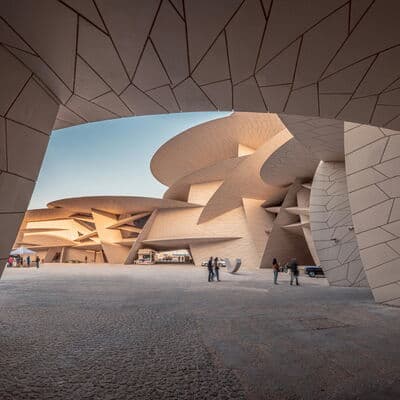
On an artificial island in Doha Bay, connected to shore by a narrow causeway, stands a building that looks like an abstract sculpture of sand-colored cubes. This is the Museum of Islamic Art, designed by I.M. Pei — the architect who created the Louvre Pyramid. He was 91 when he took on this project, and he spent months studying Islamic architecture from Spain to India. The result is a building both modern and timeless, and a collection spanning 1,400 years of Islamic civilization.
Pei's Architecture
Island and Building
Pei insisted on a separate island so the building wouldn't be lost among Doha's future development. Today the museum is the city's calling card, its silhouette recognizable from afar. The five-story building consists of geometric volumes inspired by the ablution fountain at the 9th-century Ibn Tulun Mosque in Cairo. The cladding is cream-colored limestone that shifts in hue throughout the day.
Interior
Inside is a 45-meter-high atrium with a full-facade window facing the bay. Light falls through geometric openings, creating patterns on the walls. The space is simultaneously majestic and meditative. Pei studied how light works in great mosques and transferred these principles to a museum context.
Collection: From Spain to India
Scale
The museum holds one of the world's largest collections of Islamic art: more than 10,000 objects from three continents spanning fifteen centuries. Ceramics, textiles, manuscripts, weapons, jewelry, scientific instruments. The exhibition shows how Islamic civilization absorbed and transformed influences from ancient Greece to China.
Collection Highlights
The "Blue Quran" from the 9th century — pages from Kairouan written in gold on blue parchment. A 12th-century astrolabe — a scientific instrument demonstrating the level of Arab astronomy. Safavid Persian carpets. Mughal miniatures from India. Ottoman Iznik ceramics. Each hall is a separate universe.
Exhibition
The collection is organized thematically and chronologically. It begins with early Islam and the Arab Caliphate, then regional schools: Persia, Mughal India, the Ottoman Empire, Moorish Spain. Interactive displays explain context. Descriptions are in Arabic, English, and French.
Visiting the Museum
Hours
Open daily from 9:00 AM to 7:00 PM. Friday from 1:30 PM (after prayers). Thursday and Friday evenings until 9:00 PM. Best time for exterior photos is sunset, when the building and bay are bathed in gold.
Tickets
Entry to the permanent collection is free. Temporary exhibitions may have fees. Free admission is Qatar's principled position: culture should be accessible to all.
Audio Guide
The audio guide is worth taking — it helps understand the context of exhibits. Islamic art is often functional (vessels, weapons, textiles), and without explanation you can miss the craftsmanship and symbolism.
Around the Museum
MIA Park
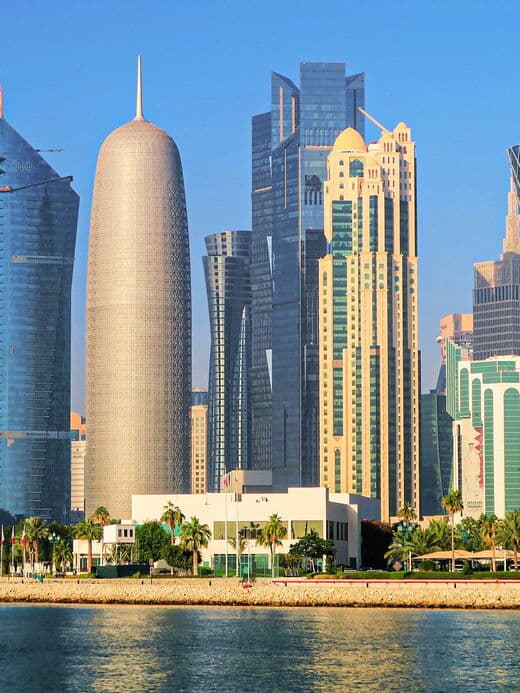
The museum is surrounded by a park with views of the bay and West Bay skyscrapers. Sculptures by contemporary artists, cafes, playgrounds. Families stroll here in the evening, and the sunset view over Doha is one of the city's best.
Corniche
Doha's waterfront is a 7-kilometer promenade from the museum to West Bay. Palms, lawns, bay views. Evening brings jogging, cycling, picnics.
Souq Waqif
Souq Waqif is a 10-minute walk. A traditional market with a labyrinth of lanes, spices, textiles, falcons. A logical continuation: from high art to living culture.
Practical Tips
Getting There
The museum is in Doha's historic center on the Corniche. Taxis are inexpensive. Metro — Museum station (Gold Line) — is a 15-minute walk.
How Much Time
For the collection — 2-3 hours. With a temporary exhibition and park walk — half a day. The museum cafe with bay views is a good spot for lunch.
Dress Code
Qatar is a conservative country, but the museum has no strict requirements. Covered shoulders and knees are appreciated — simply out of respect.
Atmosphere and Character
The Museum of Islamic Art is a place that changes stereotypes. Islamic civilization is often perceived through the lens of modern conflicts, but here you see something different: a thousand-year tradition of science, art, philosophy. Astrolabes that helped Europeans discover the world. Manuscripts preserving ancient knowledge. Beauty created by masters from Córdoba to Samarkand.
Pei's building is the ideal frame for this collection: austere, luminous, elevated. This is one of the world's best museums — not just for its collection but for its architecture and atmosphere. And it's free.