Temple d'Esna
Le Temple d'Esna est l'une des attractions les plus inhabituelles d'Égypte. Imaginez : au milieu d'une ville provinciale animée, dans une fosse de 9 mètres de profondeur, se dresse un temple antique. Autour—un bazar, des maisons d'habitation, une mosquée. Et en dessous—une salle hypostyle avec des colonnes vieilles de deux mille ans.
Le Temple dans une Fosse
Pourquoi le temple est-il si profond ? La réponse est simple : au fil des millénaires, le niveau de la ville s'est élevé. Chaque génération a construit sur la précédente, accumulant des mètres de couches culturelles. Le temple est resté là où il a été construit, tandis que la ville grandissait au-dessus.
Seule une partie du temple a été excavée—la salle hypostyle. Le reste demeure sous la ville : sous des maisons, des boutiques, des rues. Une excavation complète nécessiterait de démolir un quartier entier, donc le temple reste à moitié enterré.
Depuis le niveau de la rue, le temple est invisible—seulement une clôture et des escaliers qui descendent. La descente dans la fosse ressemble à un voyage dans le temps : le bruit du bazar reste au-dessus, et vous vous retrouvez dans un espace antique et tranquille.
Le Dieu Khnoum
Le temple est dédié à Khnoum—le dieu créateur à tête de bélier qui, selon la légende, façonna les humains sur un tour de potier. Esna était le centre de son culte, bien que Khnoum fût vénéré dans toute l'Égypte.
Khnoum était aussi le dieu du Nil et de ses crues—et donc de la fertilité et de la vie. À Esna, des sacrifices étaient faits pour assurer de bonnes récoltes. Le lien est clair : un potier crée avec l'argile, le Nil apporte le limon fertile—l'argile de la terre.
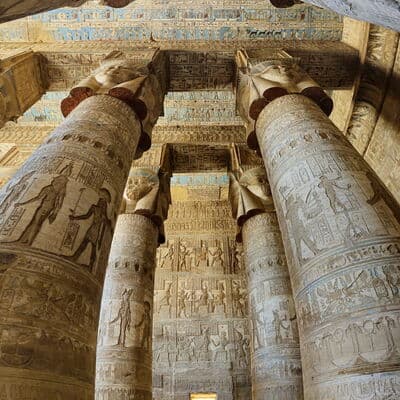
Les chapiteaux des colonnes présentent non seulement Khnoum mais d'autres divinités : Neith (déesse du tissage et de la guerre), Héka (dieu de la magie). C'était un temple de théologie complexe où différents cultes s'entremêlaient.
Colonnes et Plafonds
La salle hypostyle d'Esna contient 24 colonnes aux magnifiques chapiteaux. Chaque chapiteau est unique : palmiers, papyrus, lotus, vignes. Une telle diversité de motifs végétaux est rare dans les temples égyptiens.
Le plafond a partiellement conservé sa peinture—des scènes astronomiques dans des tons bleus et dorés. Signes du zodiaque, constellations, divinités du ciel. C'est l'un des plafonds peints les mieux conservés de l'Égypte romaine.
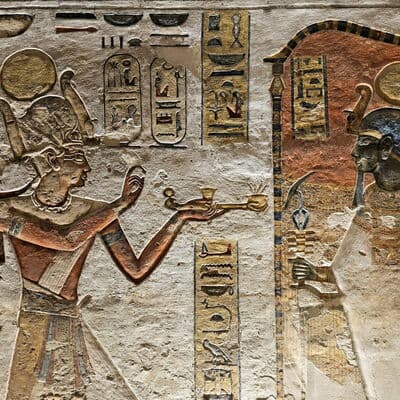
Les murs sont couverts de reliefs et de textes. Particulièrement intéressantes sont les inscriptions « cryptographiques »—des énigmes hiéroglyphiques où les signes sont utilisés de manière non conventionnelle. Les prêtres d'Esna aimaient jouer avec l'écriture.
Un Temple Romain
Le temple dans sa forme actuelle est une création de l'époque romaine. La salle hypostyle fut construite sous les empereurs de Claude à Dèce (Ier-IIIe siècles apr. J.-C.). C'est l'un des derniers temples construits pour l'ancienne religion égyptienne.
À cette époque, la tradition de construction de temples couvrait trois mille ans. Les artisans de la période romaine connaissaient parfaitement les canons—tout en se permettant des expériences. D'où les chapiteaux inhabituels et les jeux cryptographiques.
Les dernières inscriptions datées dans le temple sont de 250 apr. J.-C.—l'ère de la crise de l'Empire romain. Peu après, le temple cessa de fonctionner, fut enseveli sous le sable et oublié.
Fouilles et Restauration
Le temple fut découvert lors de l'expédition de Napoléon en 1798. Il était alors presque complètement enterré—seuls les sommets des colonnes étaient visibles. Les fouilles systématiques commencèrent au milieu du XIXe siècle.
En 2018-2020, un grand projet a nettoyé des siècles de suie et de crasse du plafond. Des couleurs ont émergé qu'on n'avait pas vues depuis des lustres. Les scènes astronomiques étonnent maintenant par leur éclat.
Les fouilles continuent : chaque année les archéologues descendent un peu plus profond. Peut-être qu'un jour tout le temple émergera—mais pour l'instant, il reste un mystère urbain.
Informations Pratiques
Esna se trouve à 55 km au sud de Louxor. Les bateaux de croisière font régulièrement escale ici. En voiture ou taxi—environ une heure depuis Louxor. Le temple est à 5 minutes à pied de l'embarcadère du Nil, à travers le bazar.
Le temple est petit—45 minutes suffisent pour l'explorer. Mais ça vaut la peine de s'attarder pour examiner les chapiteaux et plafonds. Un guide aide à comprendre le symbolisme.
Atmosphère et Conseils
Esna est un joyau méconnu. Les touristes se précipitent entre Louxor et Assouan, jetant un coup d'œil au temple pendant une demi-heure. Mais c'est un endroit unique : une ville vivante au-dessus, un sanctuaire antique en dessous. Le contraste entre le chaos du bazar et le silence du temple, c'est l'Égypte en miniature.
Après la grandiosité de Karnak, Esna semble intime. Ici vous pouvez vous tenir seul devant une colonne et contempler un lotus vieux de deux mille ans. C'est un temple pour la contemplation, pas pour les foules.