Changdeokgung Palace
If I had to choose only one palace in Seoul, I would unhesitatingly choose Changdeokgung. Not because it's the largest or oldest—there are palaces both bigger and older. But Changdeokgung possesses something elusive, a special harmony that makes you return again and again. UNESCO included it on the World Heritage List for good reason, noting an "outstanding example of Far Eastern palace architecture and garden design."
Palace History: The Secondary Residence That Became Primary
Changdeokgung—"Palace of Prospering Virtue"—was built in 1405 as a secondary royal residence. The main palace then was Gyeongbokgung, while Changdeokgung served for rest and seclusion. But history had other plans.
In 1592, the Japanese invasion destroyed both palaces. Gyeongbokgung lay in ruins for nearly 300 years, but Changdeokgung was restored by 1610—and from then on became the main royal residence. Here kings of the Joseon dynasty lived, ruled, and died for over 250 years.
The last Korean king, Sunjong, lived at Changdeokgung until 1926. After his death, the palace became a museum, but members of the royal family continued living here for a long time. The last princess—Yi Bangja—died at the palace in 1989. So Changdeokgung is not an ancient ruin but a place of living memory, where history ended literally yesterday.
Architecture: Harmony with Nature
The Principle of "Irregularity"
What distinguishes Changdeokgung from other Korean palaces? It was built "incorrectly." In Confucian tradition, palaces were strictly aligned north-south, symmetrically, following precise geometric principles. But Changdeokgung is located on a hillside, and the architects decided not to fight the terrain but to follow it.
Buildings are placed asymmetrically, paths wind between natural boulders, walls curve around trees that grew here before construction. This principle is called "pungsu" (the Korean variant of feng shui)—living in harmony with nature, not in opposition to it.
Donhwamun Gate
The palace's main gate is the oldest surviving palace gate in Seoul, dating to 1412 (with restoration after the 1609 fire). Notice the two-tiered roof—a sign of the building's highest status.
Injeongjeon Throne Hall
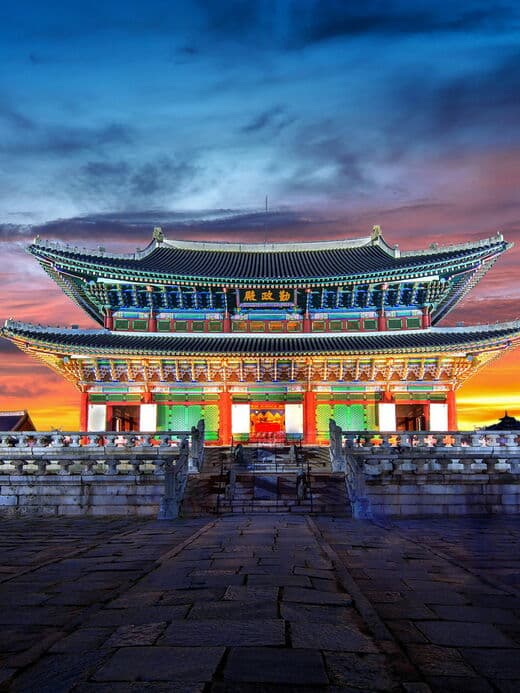
Changdeokgung's throne hall is smaller than Gyeongbokgung's but no less majestic. Here kings received officials, proclaimed edicts, conducted ceremonies. The interior is preserved virtually unchanged: wooden throne, canopy with dragons, screen with sun and moon. The courtyard floor is paved with stone, showing those same rank markers where officials lined up.
Royal Quarters: Huijeongdang and Daejojeon
These buildings are interesting for their Western elements—glass windows, electric lighting, carpets. King Sunjong modernized his residence in the early 20th century, and we see a strange mix of Korean tradition and European comfort.
The Secret Garden (Huwon): The Palace's Jewel
Why "Secret"?
The northern part of the palace complex is occupied by a huge garden of 32 hectares—nearly 45 football fields. It's called the "Secret Garden" (Huwon) or "Rear Garden" (Buwon) because it was closed to outsiders. Only the royal family and close associates could walk its paths.
The garden was created over 300 years—each king added something. But the principle remained unchanged: minimal intervention in nature. Of the 26,000 trees in the garden, most are natural in origin, many over 300 years old.
Buyongji Pond and Buyongjeong Pavilion
The garden's most famous spot is a square pond with a round island in the middle. The square symbolizes earth, the circle—heaven. On the island stands an elegant pavilion with a two-tiered roof. Around the pond—terraces where the king and courtiers admired the moon, read poetry, held picnics.
Gyujanggak Library
The garden houses the royal library—where state documents, historical chronicles, and literary works were stored. King Jeongjo (ruled 1776-1800) transformed the library into a research center where the country's best scholars worked.
Yeongyeongdang Pavilion
The "Pavilion of Eternal Youth" stands on the shore of a semicircular pond. According to legend, court ladies danced here for the king at full moon, and their reflections in the water created the illusion of dancing with celestial fairies.
What to See Nearby
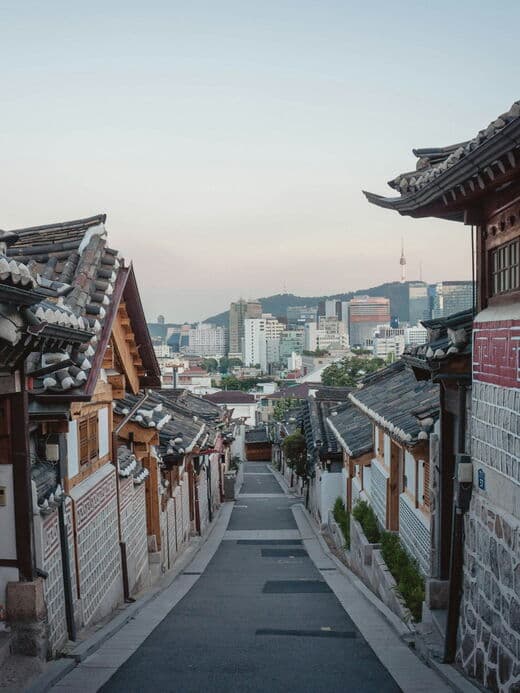
Changdeokgung is located in the heart of historic Seoul. West of the palace is Bukchon Hanok Village with its traditional Korean houses. This is an ideal continuation: after palace splendor—quiet streets with tiled roofs.
To the south—Insadong district, where you can buy antiques, traditional crafts, drink tea in an atmospheric teahouse. And a few blocks west—Gyeongbokgung Palace, Seoul's main and largest palace.
Within walking distance is Jogyesa Temple—the center of Korean Buddhism. After the Confucian strictness of palaces, here you can discover another side of Korean spirituality.
Practical Tips
Visiting the Secret Garden
Important: The Secret Garden is accessible only by guided tour! Tours are conducted several times daily in Korean, English, Japanese, and Chinese. Groups are limited (50-100 people); book tickets in advance online. The tour lasts about 90 minutes and includes significant walking—wear comfortable shoes.
When to Come
The palace is open 9:00-18:00 (winter until 17:30), closed Monday. Best time—early morning or an hour before closing, when there are fewer tourists.
Each season is good in its way: spring—cherry and azalea blossoms, summer—lush greenery and shade of old trees, autumn—golden foliage (best time!), winter—snow on tiled roofs. The Secret Garden is especially beautiful in autumn when maples and ginkgos turn red and yellow.
Hanbok and Free Entry
As at other Seoul palaces, entry is free for those wearing traditional Korean hanbok costume. Rental shops are throughout the district; prices start from 15,000 won for several hours. This is not only savings but an excellent opportunity for a photoshoot in historic interiors.
Suggested Route
I recommend this order: Donhwamun Gate → Injeongjeon Throne Hall → royal quarters → Secret Garden (guided tour). After the palace, exit through the east gate directly into Bukchon Hanok.
Atmosphere and Tips
Changdeokgung is a palace for meditation. It lacks Gyeongbokgung's majestic scale, but has something subtler—harmony between architecture and nature felt at every step.
This is especially noticeable in the Secret Garden, best visited in autumn. When sunset illuminates the pavilions and maples and ginkgos blaze with every shade of red and gold, you understand why Korean kings chose this place for seclusion.
Changdeokgung isn't just a beautiful place for photos. It's a meditation on time, nature, and humanity. The palace teaches an important principle: don't conquer nature—live in harmony with it. Come here without hurry, allow yourself to simply be—and Changdeokgung will reveal itself very differently than to those who rush through in half an hour.