Verona
Verona - City of Romeo and Juliet, Roman Amphitheaters, and Opera Festivals
Verona, situated in a bend of the Adige River at the foot of the Alps, is known worldwide thanks to Shakespeare's tragedy "Romeo and Juliet." But this Veneto city offers much more: the magnificently preserved Roman amphitheater Arena, home to famous opera festivals, medieval squares, Romanesque churches, and picturesque streets. Verona's historic center is a UNESCO World Heritage Site.
History - From Romans to the Scaligeri
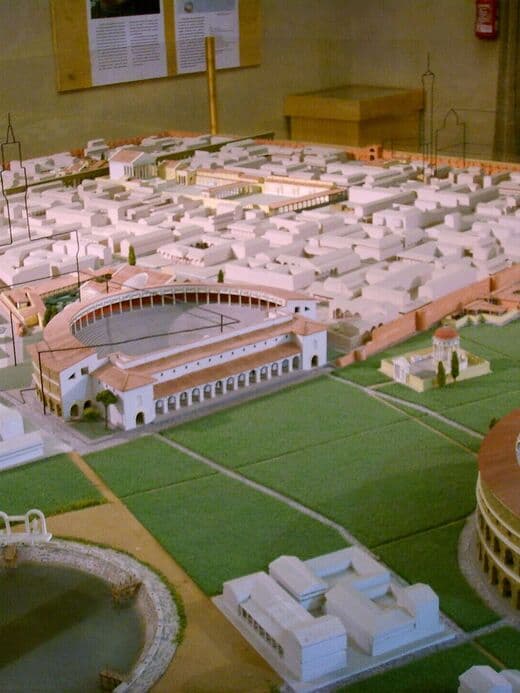
Verona was founded as a Roman colony in the 1st century BC at the intersection of important trade routes. Thanks to its strategic position, the city quickly grew wealthy. From the Roman era survive the Arena - one of the empire's largest amphitheaters, the Arco dei Gavi, the Roman Theatre on the hillside, and the Porta Borsari gates.
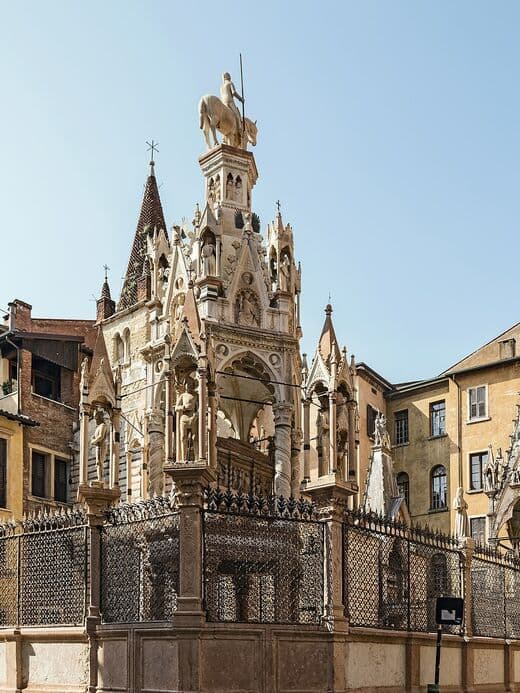
In the Middle Ages, Verona was an important Lombard city and later an independent commune. The golden age came under the della Scala dynasty (Scaligeri) in the 13th-14th centuries. Rulers Cangrande I, Mastino II, and Cansignorio transformed Verona into a powerful state and patronized the arts - the exiled Dante found refuge here. The Gothic tombs of the Scaligeri (Arche Scaligere) are a masterpiece of medieval sculpture.
From 1405, Verona became part of the Venetian Republic and remained under its rule for nearly four centuries. The Venetians adorned the city with Renaissance palaces and fortifications. In the 19th century, Verona was an important fortress of the Austrian Empire, part of the famous "Quadrilateral." After Italian unification, the city preserved its cultural significance.
Arena di Verona - Roman Amphitheater and Opera Temple
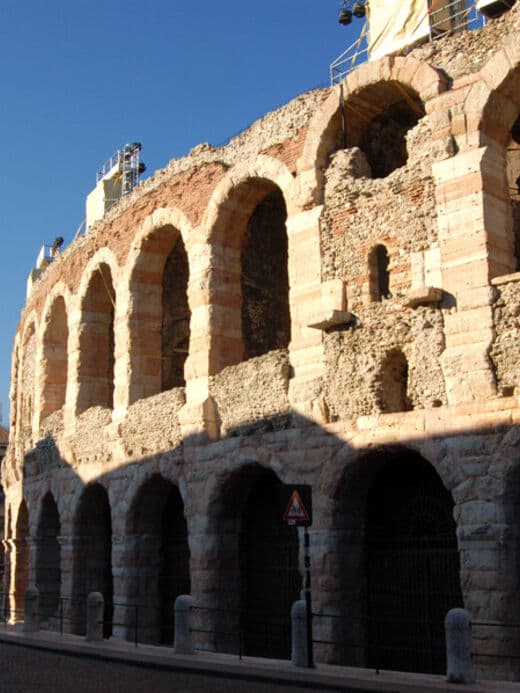
The Arena di Verona is the third-largest surviving Roman amphitheater after the Colosseum and the arena in Capua. Built in the 1st century AD, it held 30,000 spectators for gladiatorial combat. The outer ring was almost completely destroyed in the earthquake of 1117, but the internal structure remains virtually intact.
Since 1913, the Arena has hosted the famous Arena di Verona opera festival. Summer open-air performances attract up to 15,000 spectators. Verdi's "Aida" has become the festival's signature, but other classic operas are also staged: "Carmen," "Turandot," "La Traviata." The amphitheater's acoustics are remarkable - even without microphones, singers' voices reach the farthest rows.
Outside festival season, you can explore the Arena's interior, climb the stands, and imagine ancient Roman spectacles. Evening illumination creates a magical atmosphere on Piazza Bra.
Juliet's House - Literary Myth and Tourist Phenomenon
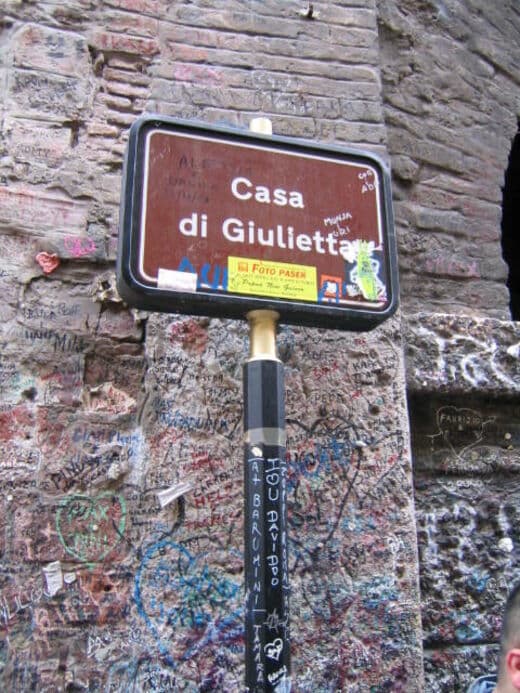
Every year, millions of tourists visit the medieval house on Via Cappello, believed to be Juliet Capulet's home. In reality, the Dal Cappello family who owned the house in the 13th century had no connection to Shakespeare's heroine - the legend was created later. The famous balcony was added in the 1930s.
Nevertheless, the place has become iconic. The entrance archway walls are covered with love notes and chewing gum (notes are now requested on special panels). The courtyard features a bronze statue of Juliet - touching her right breast supposedly brings luck in love. Inside the house is a small museum with costumes from film adaptations.
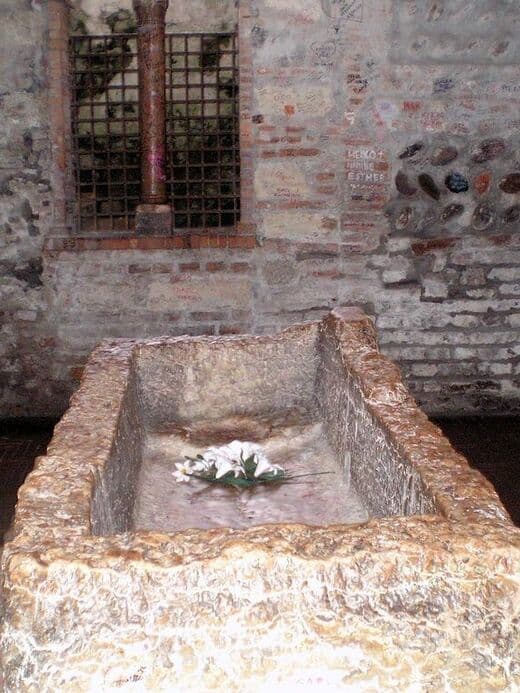
Less known is "Juliet's Tomb" in the former monastery of San Francesco - a sarcophagus in a Gothic basement, also linked to the legend. Symbolic weddings are held here.
Piazza delle Erbe - Heart of the City
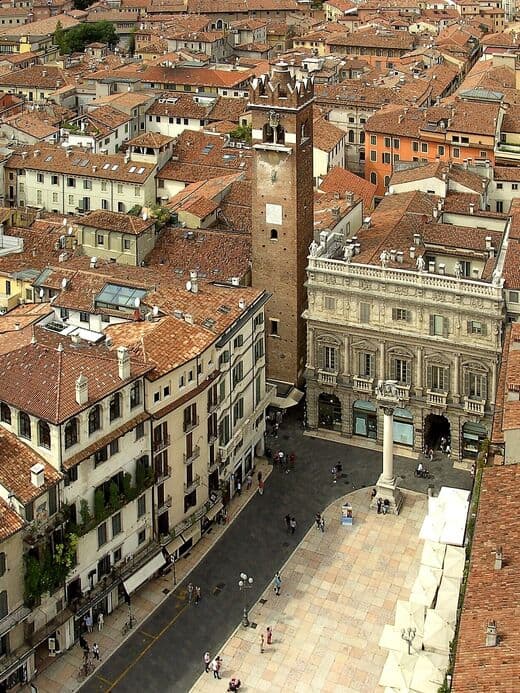
Piazza delle Erbe (Herb Square) occupies the site of the ancient Roman forum and has remained Verona's main square for centuries. A daily market operates here under white umbrellas, surrounded by historic buildings.
The square's center features the fountain with the Roman statue "Madonna Verona," the Tribuna - a 14th-century marble canopy where decrees were proclaimed, and the Column of St. Mark with the Venetian lion. The square is surrounded by: Palazzo Maffei with its Baroque facade and statues of gods, Torre del Gardello - a medieval clock tower, Casa dei Mercanti - the guild house with frescoes.
The Arco della Costa leads to neighboring Piazza dei Signori. A whale rib hangs under the arch - legend says it will fall when someone who has never lied passes beneath.
Piazza dei Signori and Arche Scaligere
Piazza dei Signori is an elegant square surrounded by medieval palaces. At its center stands a monument to Dante, who lived in Verona as a guest of the Scaligeri. The square is framed by Palazzo della Ragione with the Torre dei Lamberti (84 meters - you can climb to the viewing platform), the Loggia del Consiglio - a jewel of Veronese Renaissance, and the Palazzo del Podestà.
Nearby are the Arche Scaligere - Gothic tombs of Verona's rulers from the della Scala dynasty. Carved stone canopies with equestrian statues form a unique ensemble of medieval sculpture. Particularly impressive is the tomb of Cangrande I - his equestrian statue (original in Castelvecchio) depicts a smiling knight.
Castelvecchio and the Scaliger Bridge
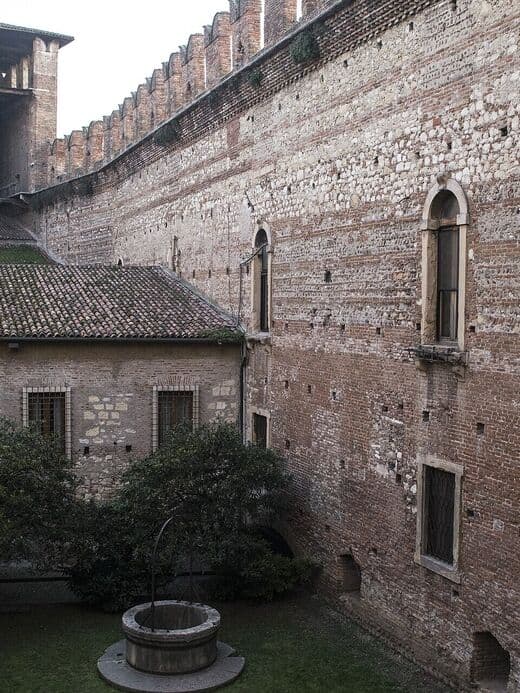
Castelvecchio (Old Castle) is a powerful 14th-century fortress built by Cangrande II della Scala. The castle served as both residence and fortification - the Scaliger rulers didn't trust their own subjects. The crenellated walls with distinctive "swallowtail" merlons are a Ghibelline symbol.
The Scaliger Bridge, attached to the castle, is an engineering marvel of the 14th century. Three red brick arches span the Adige. The bridge was blown up by retreating German troops in 1945 but was reconstructed using original stones recovered from the riverbed.
Today the castle houses the Civic Museum with a rich collection of Veronese painting and sculpture. The interiors were masterfully renovated by architect Carlo Scarpa in the 1960s - his work is considered a masterpiece of 20th-century museum design.
Romanesque Churches of Verona
Verona is renowned for outstanding examples of Romanesque architecture, characterized by the use of local pink marble.
Basilica of San Zeno Maggiore
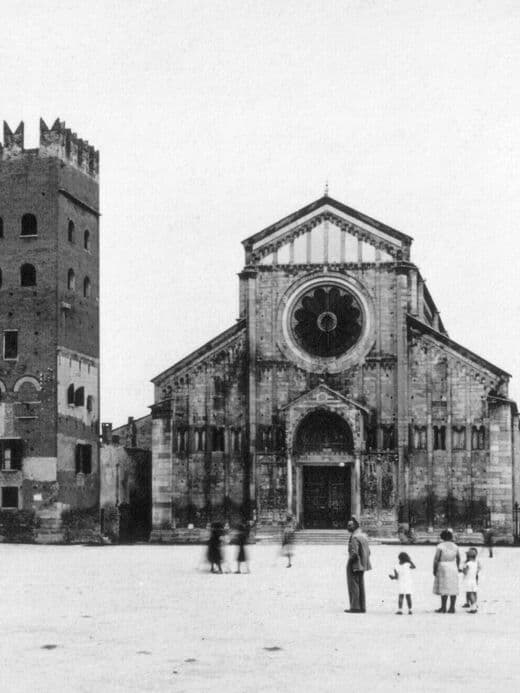
One of Italy's most beautiful Romanesque churches, built in the 10th-12th centuries over the tomb of Saint Zeno - Verona's patron. The facade is decorated with marble reliefs and famous bronze doors with 48 biblical scenes. The interior with striped columns leads to an elevated presbytery, beneath which lies the crypt with holy relics. Above the altar hangs Mantegna's triptych "Madonna and Child with Saints" (1459), an Early Renaissance masterpiece.
Cathedral (Duomo)
A 12th-century Romanesque cathedral with Gothic and Renaissance additions. The portal by Master Nicolo is decorated with reliefs of Roland and Oliver. Inside are Titian's "Assumption of the Virgin" (1535) and fragments of ancient mosaics in the archaeological complex.
Sant'Anastasia
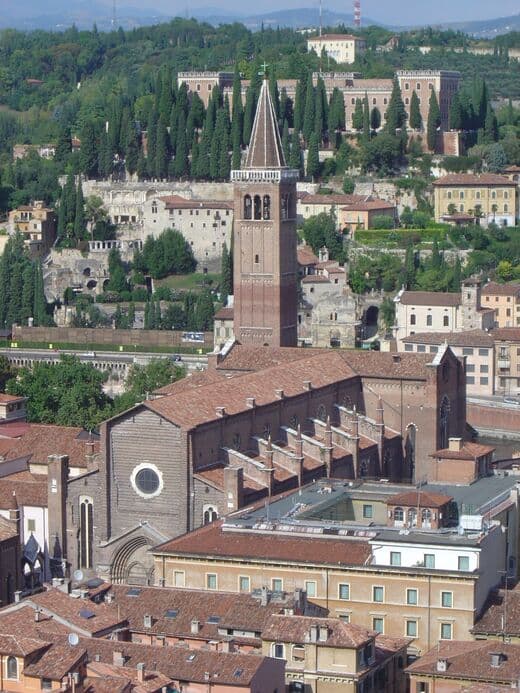
Verona's largest church, a Gothic Dominican basilica from the 13th-15th centuries. At the entrance, two marble hunchbacks support holy water basins. Inside is Pisanello's famous fresco "Saint George and the Princess" (1436-1438).
San Fermo Maggiore
An unusual two-level church: lower Romanesque (11th century) and upper Gothic (14th century). The wooden ship's-keel ceiling of the upper church is a unique example of medieval craftsmanship.
Roman Theatre and Archaeological Museum
On the left bank of the Adige, on the slope of San Pietro hill, stand the ruins of a 1st-century BC Roman Theatre. Unlike the Arena, this was not an amphitheater for combat but a classical semicircular theater for dramatic performances. A jazz festival is held here in summer.
Above the theater is the Archaeological Museum in a former monastery, with Roman mosaics, sculptures, and inscriptions. The climb up the hill is rewarded with a panorama of the old city.
Giardino Giusti and Viewpoints
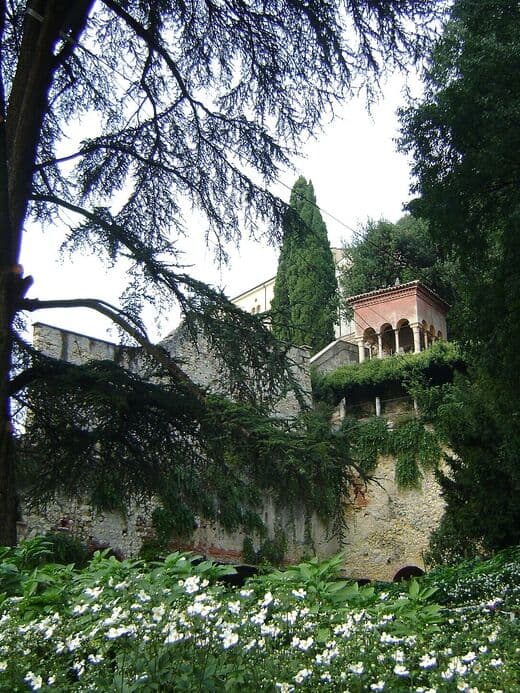
Giardino Giusti is a 16th-century Renaissance garden, one of the finest examples of Italian garden design. Geometric boxwood parterres contrast with the "wild" cypress forest on the hill. The belvedere at the summit offers beautiful views of the city. Goethe admired this garden during his Italian journey.
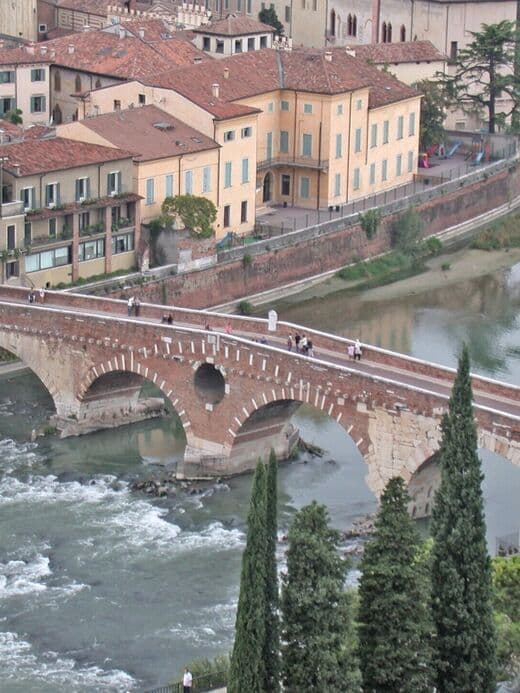
Other viewpoints: Castel San Pietro on the hill above the Roman Theatre, Torre dei Lamberti in Piazza dei Signori, and Ponte Pietra - the city's oldest bridge (Roman, reconstructed).
Veronese Cuisine and Wines
Verona's cuisine combines Veneto traditions with influences from neighboring regions.
Local Dishes
Risotto al tastasal - risotto with Veronese sausage; bigoli con le sarde - thick spaghetti with sardines and onion; pastissada de caval - horse meat stewed in red wine (a historic dish); pandoro - traditional star-shaped Christmas cake invented in Verona in 1894.
Valpolicella Wines
Verona is the gateway to the famous Valpolicella wine region. Amarone della Valpolicella - a powerful dry wine from dried grapes, one of Italy's finest reds. Ripasso - a more accessible alternative with similar character. Recioto - sweet dessert wine from the same grapes. Soave - light white wine from the neighboring region.
Lake Garda and Surroundings
Verona is an ideal base for exploring Lake Garda, Italy's largest lake, just 30 km away.
Sirmione
A town on a peninsula with a Scaliger castle and Roman ruins of the "Grotte di Catullo" - remains of the poet's villa. Thermal springs and beaches make it a popular resort.
Other Destinations
Malcesine with cable car to Monte Baldo; Limone sul Garda with lemon gardens; Gardaland - Italy's largest amusement park; Valpolicella wineries with tastings.
Practical Information
Practical tips for visiting Verona to make your trip comfortable.
Transportation
Verona Villafranca Airport (VRN) is 12 km from the center, connected by buses. Verona Porta Nuova railway station is on the Milan-Venice line. Venice is 1-1.5 hours away, Milan 1.5 hours, Bologna 1 hour. The historic center is compact and easily explored on foot.
Verona Card
The tourist card provides free admission to major museums and churches, plus city transport. Particularly worthwhile for visiting the Arena, Castelvecchio, and Torre dei Lamberti.
When to Visit
Summer is opera festival season at the Arena (June-September), but also the hottest and most crowded time. Spring and autumn are ideal for sightseeing. Winter is quieter, and Christmas markets create a festive atmosphere.
Opera Festival
Tickets for Arena performances should be booked in advance, especially for premieres and weekends. Stone seats are hard - rent a cushion. Performances begin after sunset, the atmosphere is magical.