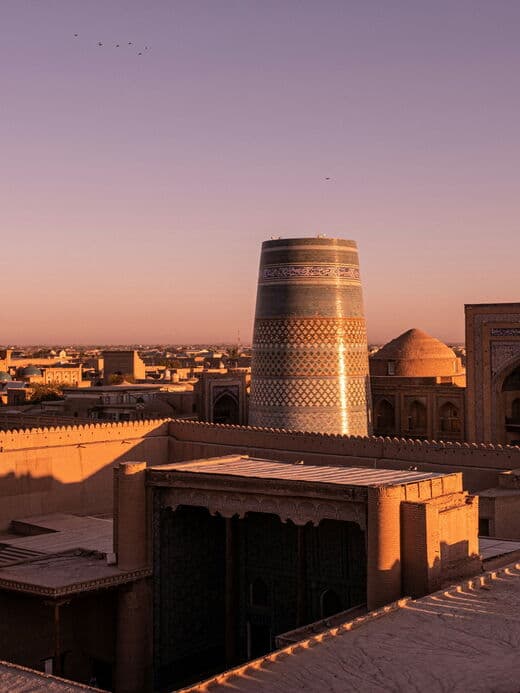
Khiva
Khiva 2026: What You Need to Know Before You Go
Khiva is a city where time stopped somewhere between the 10th and 19th centuries. While Bukhara and Samarkand keep adding modern hotels and hip coffee shops, Khiva remains the most authentic Silk Road city in Central Asia: mud-brick walls, minarets, madrasahs, and caravansaries - all original, no reconstructions. It is the only fully preserved medieval city in the region, and UNESCO confirmed that back in 1990 when it became the first site in Uzbekistan to receive World Heritage status.
In a nutshell: Khiva is a compact museum-city in western Uzbekistan, worth visiting for the Itchan Kala fortress (UNESCO World Heritage Site), the turquoise Kalta Minor Minaret, the Juma Mosque with its 213 hand-carved wooden columns, bustling bazaars, and a living sense of medieval life that you simply cannot find anywhere else on the planet. Plan for 1.5 to 2 full days at minimum.
Khiva is perfect for travelers who are tired of over-touristed capitals and want to see Uzbekistan without the polish. Even in peak season, there are no real crowds here. Prices are lower than Samarkand, and local people are genuinely happy to see every visitor - tourism has not yet become a factory line. On the downside: the city is small, there is not much to do beyond architecture and food, and getting here is an adventure in itself. But that is precisely the point - Khiva rewards those who make the effort.
Neighborhoods: Where to Stay in Khiva
Itchan Kala - Inside the Fortress Walls
This is the heart of Khiva and the reason people come here. Staying inside Itchan Kala means waking up to the sound of the call to prayer, stepping onto your guesthouse rooftop, and seeing minarets in the morning light without a single tourist in sight. In the evening, after tour groups have left, you have the entire walled city to yourself - and that experience is priceless. Imagine having a medieval city as your private backyard for a few hours every day.
Pros: unbeatable atmosphere, everything within walking distance, sunrise and sunset from rooftops, incredibly photogenic surroundings at every turn
Cons: limited accommodation options, rooms can be small (these are old buildings after all), summers are brutal without air conditioning
Prices: guesthouses from $15-20 per double room, boutique hotels from $40-60 per night
What is nearby: Kalta Minor, Muhammad Amin Khan Madrasah (now the Orient Star Hotel, but the courtyard is open to visitors), Juma Mosque
This is the best option for a first visit - you will get the most out of Khiva simply by living here. The magic happens before 8 AM and after 6 PM, when the day-trippers are gone and you have centuries of history to yourself.
Dishan Kala - The Outer City
The area between the inner and outer fortress walls. This is where ordinary Khivans live: residential houses, small shops, teahouses. The atmosphere is pure Uzbek mahalla - children playing in the streets, old men drinking tea, women carrying fresh bread from the tandoor. It feels like stepping into a neighborhood that has not changed much in decades, except for the occasional satellite dish on a rooftop.
Pros: authentic local life, quiet, cheaper than Itchan Kala, a more genuine experience of daily Uzbekistan
Cons: fewer accommodation choices, 5-10 minute walk to the main sights
Prices: guesthouses from $10-15 per night
Great for budget travelers and those who want to see everyday Khiva rather than just the postcard version. You will still be close enough to pop into the fortress whenever you want.
New Town - Beyond the Walls
Soviet and post-Soviet development to the south and east of the fortress. This is where you will find the Dekhon Bazaar, supermarkets, banks, pharmacies - everything you need for practical daily life. Tourists rarely come here, which means prices are rock-bottom and the food is honest.
Pros: infrastructure, ATMs, proper shops, cheap food, a peek at non-touristic Uzbekistan
Cons: architecturally uninteresting, 15-20 minute walk to Itchan Kala
Prices: hotels from $15-25 per night
A practical option if you are driving and need parking, or if you are staying longer and want easy access to everyday amenities without tourist markup.
Urgench Area - Do Not Make This Mistake
Khiva does not have its own major station - the nearest transport hub is Urgench, about 35 km (22 miles) away. Some travelers make the mistake of booking accommodation in Urgench to be closer to the airport or railway station. Do not do this. There is absolutely nothing to see in Urgench. Minibuses (marshrutkas) run from Urgench to Khiva every 10-15 minutes for 5,000-7,000 sum (about $0.40). The ride takes 30-40 minutes. Always base yourself in Khiva proper.
Verdict: skip Urgench entirely. Head straight to Khiva. You will thank yourself when you are sipping tea on a rooftop at sunset instead of staring at Soviet apartment blocks.
Outskirts and Suburbs
On the edges of Khiva, a new wave of family-run guesthouses has been popping up, many with gardens, small pools, and home-cooked meals. Owners often speak decent English and can help organize day trips to the Karakum Desert or the ancient Elliq-Qala fortresses. These places offer a level of peace and personal attention that the in-town options simply cannot match.
Pros: quiet setting, gardens, home-cooked food, parking, personalized service
Cons: need transport to reach the city center (usually a short taxi ride or a 20-minute walk)
Prices: from $10-20 per night with breakfast included
An excellent option for families with children, road-trippers, or anyone who values a slower pace and does not mind being a short ride from the action.
Best Time to Visit Khiva
Khiva sits at the edge of a desert, and that fact shapes everything: summers are scorching, winters are unexpectedly cold, and the ideal visiting windows are surprisingly narrow. Choose wisely, because the wrong season can make or break the experience.
April to May (the sweet spot): temperatures hover around 72-86F (22-30C), everything is green from winter rains, irrigation canals are full, and trees are in bloom. Tourist numbers are still low, and prices have not yet climbed to peak levels. The only downside is the occasional dust storm in late April - they blow in from the desert and last a few hours at most. Pack a bandana or buff just in case.
September to October (the second-best window): 68-82F (20-28C), fruit harvest season means the bazaars are overflowing with melons, grapes, and pomegranates. The light turns golden - photographers will be in heaven. By October evenings get cool, so bring a light jacket. The Dekhon Bazaar during harvest season is worth a visit in itself - mountains of produce at prices that seem impossible by Western standards.
June to August (hot, but doable): 95-113F (35-45C) in the shade, and shade is not always easy to find. The city empties out and tourists virtually disappear, which means you can bargain everything down to the bare minimum. If you can handle the heat, you will have Khiva almost entirely to yourself. Strategy: explore early morning (6-9 AM) and evening (after 5 PM), rest in the heat of the day. Non-negotiable: a hat, SPF 50 sunscreen, and 2-3 liters (half a gallon or more) of water on you at all times.
November to March (low season): 32-50F (0-10C) during the day, below freezing at night. The city has a stark beauty in winter light, and you will have it entirely to yourself, but many guesthouses and restaurants are closed for the season. Heating in old buildings is a matter of luck - some places have it, some offer you a space heater and extra blankets. On the plus side, you will experience the real rhythm of the city with only locals around.
Festivals and events worth planning around:
- Navruz (March 21) - Persian New Year, celebrated across Central Asia. The city is decorated, streets are alive with music and dancing, and you can try sumalak, a ritual wheat-sprout pudding that takes 24 hours to prepare. The most vibrant holiday of the year in Khiva.
- Asrlar Sadosi Festival (May) - international music and crafts festival held right against the walls of Itchan Kala. Folk music, traditional crafts demonstrations, performances. If you are planning to attend, book accommodation 2-3 weeks in advance as guesthouses fill up fast.
- Khiva - Cultural Capital of the Turkic World - the city received this designation, and special cultural events pop up periodically throughout the year.
When is it cheapest: November through February offers the lowest accommodation prices, though choices are limited. June through August also brings discounts because of the heat - you trade comfort for savings.
Khiva Itinerary: From 1 to 5 Days
One Day in Khiva: The Express Route (If You Are Passing Through)
7:00-8:00 AM - Breakfast at your guesthouse or at a teahouse near the Ata-Darvaza gate. Fresh tandoor bread, kaymak (thick clotted cream), and green tea. Do not rush this - it sets the tone for the day. A proper Uzbek breakfast is an experience, not just fuel.
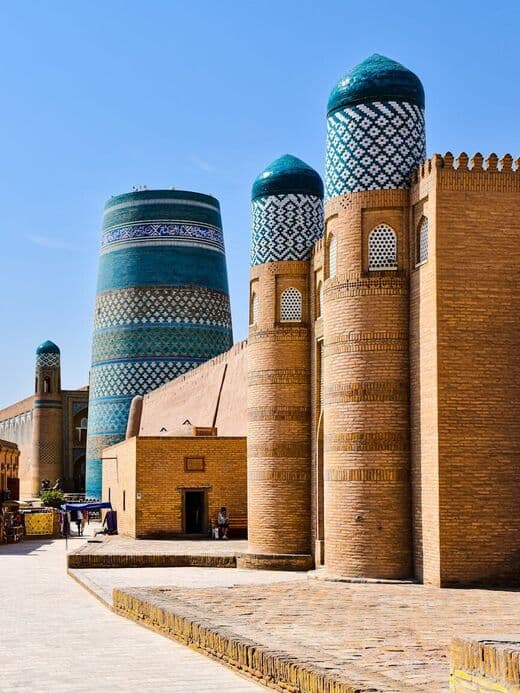
8:00-10:30 AM - Enter Itchan Kala through the western gate. Buy the combined ticket (120,000 sum, approximately $9.50) - it covers about 20 sites inside the fortress. Start with the Kalta Minor Minaret, the iconic turquoise unfinished minaret and the symbol of Khiva. The morning light on its glazed tiles is spectacular, so have your camera ready. Right next to it stands the Muhammad Amin Khan Madrasah, now operating as the Orient Star Hotel - the courtyard is open to all visitors and worth a look for its scale alone.
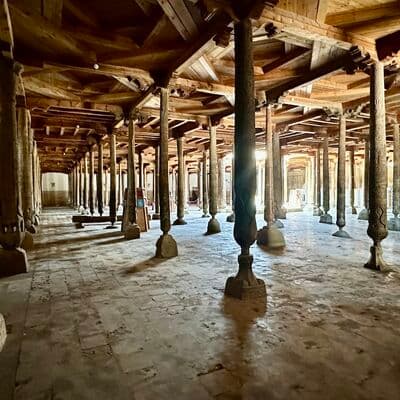
10:30 AM-12:00 PM - Head to the Juma Mosque: 213 wooden columns, each one unique, some over 1,000 years old. Light streams in through three openings in the ceiling - the best time for photographs is around 11 AM when the beams hit the ancient wood at just the right angle. Afterward, climb the Islam Khodja Minaret (the tallest in Khiva at 148 feet / 44.5 meters) for a panoramic view of the entire city and the desert beyond. The stairs are narrow and steep, but the view is worth every step.
12:00-1:30 PM - Lunch. Plov at a teahouse near the Eastern Gate, or shashlik (grilled meat skewers) in one of the courtyards inside Itchan Kala. Make sure you try shivit oshi - green dill noodles that are Khiva's signature dish. You will not find them done this way anywhere else in Uzbekistan. A full lunch will set you back about $2-4.
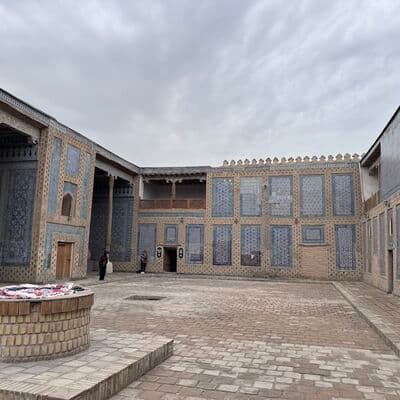
1:30-3:30 PM - Tash Hauli Palace: three courtyards (the harem, the reception hall, and the court of justice), walls covered in glazed tiles, and painted ceilings that are remarkably well preserved. The palace took 8 years to build, and legend has it the architect was executed for taking too long. Pay close attention to the majolica work - the blue and white patterns are among the finest in Central Asia.
3:30-5:00 PM - Wander the back alleys of Itchan Kala: artisan workshops (woodcarving, ceramics, carpet weaving), small museums tucked into former madrasahs. Stop by the Museum of Applied Arts in the Allakuli Khan Madrasah for a curated look at Khorezm's craft traditions. Buy directly from craftsmen if anything catches your eye - prices are 30-50% less than in the souvenir shops.
5:00-7:00 PM - Sunset from the fortress walls. Best spots: the wall near the Ata-Darvaza gate, or the rooftop of any guesthouse (ask the owners - they almost always say yes, especially if you buy a pot of tea). The golden light on the mud-brick walls is Khiva's signature moment and the image that will stay with you long after you leave.
Three Days in Khiva: The Unhurried Version
Day 1: Itchan Kala - The Major Monuments
Follow the one-day itinerary above, but at a slower pace. Add these stops:
9:00 AM - Kunya-Ark Citadel: the throne room, the mint, and the khan's harem. From the bastions, you get the best elevated view of Kalta Minor - a classic photo opportunity that appears on half the postcards from Khiva.
After lunch - Allakuli Khan Madrasah and its covered bazaar (Tim): silk fabrics, ceramics, and traditional textiles. The adjacent caravansary gives you a sense of what trade looked like on the Silk Road.
Evening - Dinner on the rooftop of Terrassa or Khiva Moon restaurant. Order shivit oshi, manti (steamed dumplings), and tandoor kabob. Watch the city lights come on as the sky turns deep blue.
Day 2: Itchan Kala - The Details and Craft Workshops
8:00-10:00 AM - Early morning walk through the empty streets. Without tourists, Itchan Kala transforms: locals carry bread from the tandoor, children walk to school, old men open their shops. If you are a photographer, this is your golden hour - literally and figuratively.
10:00 AM-12:00 PM - Take a hands-on workshop in ceramics or woodcarving. Several workshops operate inside Itchan Kala - ask at your guesthouse and they will set it up. Cost: 50,000-100,000 sum ($4-8). You will learn traditional Khivan patterns and take your creation home as a souvenir that actually means something.
12:00-2:00 PM - Dekhon Bazaar in the New Town: vegetables, fruits, spices, bread. This is a real working bazaar - not a tourist market. Try samsa straight from the tandoor while it is still crackling hot (3,000-5,000 sum, about $0.25-0.40). Wander the spice rows and pick up dried apricots or local nuts for the road.
2:00-4:00 PM - Pakhlavan Mahmud Mausoleum: the holiest site in Khiva. Carved wooden doors, a tiled dome, and a quiet courtyard where locals come to pray. Remove your shoes, keep your voice low, and take in the atmosphere. This place has a tangible sense of reverence that the larger monuments lack.
4:00-6:00 PM - Explore Dishan Kala, the outer city. Visit the Nurullabay Palace - the residence of Khiva's last khan (early 20th century), a surprising blend of European and Eastern styles with mirror-lined halls. It is a fascinating contrast to the medieval architecture inside the fortress.
Evening - Check if there is a folklore show at one of the madrasahs (these happen irregularly - ask at your guesthouse). Traditional dance, music, and costumes. Or simply have tea on a rooftop under the stars. Khiva has virtually zero light pollution, and the night sky is extraordinary - something city dwellers rarely get to experience.
Day 3: Day Trip to the Surrounding Desert
8:00 AM-3:00 PM - The ancient fortresses of Elliq-Qala ('Fifty Fortresses'). These are the ruins of Zoroastrian-era fortresses scattered across the Kyzylkum Desert, some over 2,000 years old. The most impressive: Toprak-Qala (a Kushan-period palace complex) and Ayaz-Qala (perched on a hill with sweeping desert views; you can overnight in a yurt camp here). Organize through your guesthouse or negotiate with a taxi driver: $30-50 for the car for the entire day. Bring plenty of water, sun protection, and snacks - there are no shops out there.
3:00-5:00 PM - Return via Urgench. Along the way, you will pass cotton and rice fields (if it is the right season), and roadside watermelon stands where a massive melon costs a dollar or two.
5:00-7:00 PM - One last sunset inside Itchan Kala. Farewell tea on the rooftop. By now, you will feel like you know this place.
Five Days in Khiva: The Complete Experience
Days 1-3: follow the three-day itinerary above.
Day 4: Desert Camp and Yurt Overnight
Early morning departure into the Karakum Desert. Overnight stay at a yurt camp near Ayaz-Qala fortress: stargazing without a speck of light pollution, complete silence, dinner by candlelight. Camel ride at sunset for the full Central Asian experience. Cost: $25-40 per person including dinner and breakfast. Book through your guesthouse in Khiva a day in advance. This is one of those experiences that sounds touristy on paper but is genuinely magical in person - there is nothing quite like sleeping in a yurt under a sky full of stars in the middle of a desert that has been here for millennia.
Day 5: Day Trip to Nukus
The Savitsky Museum, often called the 'Louvre of the Desert,' houses the second-largest collection of Russian avant-garde art in the world (after the Russian Museum in St. Petersburg). Banned Soviet-era artists, Karakalpak folk art, and a story of how one man smuggled forbidden paintings to the edge of the desert to save them from destruction. The drive: about 3 hours each way. Taxi: $40-60 round trip. You can combine it with Mizdakhan, an ancient necropolis along the route that is hauntingly beautiful and rarely visited. Pack a lunch, as food options between Khiva and Nukus are scarce.
Where to Eat in Khiva: Restaurants and Cafes
Street Food and Markets
Dekhon Bazaar is ground zero for street food in Khiva. It operates daily from 7 AM to 5 PM, with Sunday offering the biggest selection. Prices are fixed and laughably cheap by Western standards: samsa from the tandoor 3,000-5,000 sum ($0.25-0.40), flatbread 2,000-3,000 sum ($0.15-0.25), a glass of ayran (salted yogurt drink) 2,000 sum ($0.15). Look for the rows with prepared food - plov, shashlik, and manti are all laid out and ready to eat. Point at what looks good and dig in.
Near the gates of Itchan Kala, tandoor bread is baked fresh every morning - hot, crispy, and addictive. The best is at the western Ata-Darvaza gate, where the baker starts at 6:30 AM. Get there early; the first batch always tastes best.
Local Teahouses (Chaikhana)
A chaikhana is the Uzbek equivalent of a neighborhood cafe - simple menus, communal seating on raised wooden platforms called topchans, and a pace of life that makes you forget you were ever in a hurry. The menu is straightforward: plov, shurpa (meat soup), lagman (pulled noodles), manti (dumplings), and tea. Prices: 15,000-30,000 sum ($1.20-2.40) for a full meal that will leave you struggling to stand up.
Look for teahouses where local men are sitting on topchans - that is your quality indicator. The best chaikhanas are outside Itchan Kala, closer to the Dekhon Bazaar, where there is no tourist premium in the pricing.
Tip: do not worry about the language barrier. Point at food in the display case, or just say 'plov,' 'manti,' 'choy' (tea) - you will be understood. Smiling helps, and the staff will probably smile right back.
Tourist-Friendly Restaurants (Inside Itchan Kala)
Terrassa: rooftop restaurant with views of the minarets. Shivit oshi, kebab, salads. Average check: 50,000-80,000 sum ($4-6.50). The best spot in town for a sunset dinner, but reserve a table in advance during high season - it fills up by 6 PM.
Khiva Moon: popular with international visitors, rooftop with panoramic views. Standard Uzbek cuisine with some fusion attempts. Average check: 40,000-70,000 sum ($3.20-5.60). The views are excellent; the food is solid if not spectacular.
Bir Gumbaz: atmospheric setting in a historic building. Good plov and kebabs, reliable quality. Average check: 35,000-60,000 sum ($2.80-4.80). A dependable choice when you want traditional flavors without surprises.
Yasavul Boshi: teahouse with a terrace. Honest home-style cooking and generous portions that will challenge even the hungriest traveler. Average check: 30,000-50,000 sum ($2.40-4). One of the better value-for-money options inside the walls.
Home Cooking at Guesthouses
Here is a secret that most travel guides will not tell you: the best food in Khiva is not in restaurants. It is at guesthouses. The owners' wives (and sometimes the owners themselves) cook home-style plov, manti, and shurpa that put most restaurant versions to shame. Breakfast is typically included: kaymak (thick clotted cream so rich it borders on butter), homemade apricot or fig jam, fresh flatbread, eggs, and endless pots of green tea. If you are staying at a guesthouse, ask your hosts to prepare dinner - 10,000-20,000 sum ($0.80-1.60) will get you the best meal in the city, no contest. Sit in the courtyard, eat with the family, and let them tell you about Khiva.
Coffee and Breakfast Spots
Coffee culture in Khiva is still in its infancy. A handful of cafes have appeared inside Itchan Kala in recent years: expect to pay 15,000-20,000 sum ($1.20-1.60) for a cappuccino of varying quality. If you are a serious coffee person, adjust your expectations - this is tea country, and tea is king. Green tea ('kuk choy') is served everywhere, either free of charge or for 3,000-5,000 sum ($0.25-0.40) per pot. Embrace it. By day three, you might find yourself preferring it to coffee.
Must-Try Food: Khiva's Signature Dishes
Shivit Oshi (shivit osh) - Khiva's culinary calling card. Green noodles tinted with dill, served with a meat sauce (vajja) made from beef or lamb with vegetables, and topped with katyk (sour milk similar to yogurt). You can find it everywhere, but the best version is homemade at guesthouses. Average price: 20,000-35,000 sum ($1.60-2.80). This dish does not exist in the same form in any other Uzbek city - it is purely Khorezm, and tasting it here is a non-negotiable part of the experience.
Tukhum Barak (tukhum borak) - Khivan egg dumplings. Dough is cut into squares, filled with beaten egg mixed with butter, then boiled and served with sour cream or katyk. You will not find this in Tashkent or Samarkand - it is a purely Khorezm invention. Imagine a cross between ravioli and an omelet, but somehow better than either. Price: 15,000-25,000 sum ($1.20-2).
Khorezm Plov (osh) - different from the Samarkand and Tashkent versions. The rice is cooked separately from the zirvak (the meat and carrot base), then layered together. Less oil, more carrot, and a more delicate flavor profile. The best plov is at Dekhon Bazaar on Thursday, the traditional 'plov day' when vendors make it in enormous quantities. A generous serving: 15,000-25,000 sum ($1.20-2).
Gumma (gumma-manti) - oversized steamed dumplings filled with pumpkin and meat. A seasonal dish (fall through winter), though some restaurants serve it year-round. Served with katyk. These are enormous - one or two will fill you up for half the day. Think of them as the Central Asian answer to a Thanksgiving meal in dumpling form. Price: 10,000-20,000 sum ($0.80-1.60).
Samsa - triangular pastries made from flaky dough, baked in a tandoor oven. Fillings: meat with onion (the classic), pumpkin (seasonal), or herbs. The best are at the bazaar, straight from the tandoor while the crust is still crackling. They taste like nothing you have had before - the tandoor gives them a smoky, caramelized edge that a regular oven cannot replicate. Price: 3,000-7,000 sum ($0.25-0.55).
Tandoor Kabob - whole cuts of lamb slow-roasted inside a tandoor oven for 3-4 hours until impossibly tender. Usually ordered for a group since portions start at about a pound. Order in advance because it takes time to prepare. Price: 40,000-60,000 sum ($3.20-4.80) per portion. When done right, this is one of the most satisfying meat dishes in Central Asia.
Mastava - a thick, hearty soup with rice, vegetables, and meat. The Khorezm version uses more herbs and katyk than elsewhere. Ideal for breakfast or a light lunch - though 'light' is relative when every bowl comes with a slab of fresh bread. Price: 12,000-18,000 sum ($1-1.40).
Khalvaitar - Khorezm's liquid halva, made from flour, sugar, and oil, served hot, often with fresh flatbread for dipping. Sweet, filling, and utterly addictive - one cup replaces dessert entirely. At the bazaar: 5,000-8,000 sum ($0.40-0.65). A guilty pleasure that every visitor should try at least once.
What to avoid: any 'European menu' in Itchan Kala restaurants. The pizza and pasta here are sad imitations - stick to Uzbek food, which is what they actually know how to cook. Also skip pre-made food from shops; freshness is not guaranteed.
For vegetarians: tukhum barak (egg dumplings), pumpkin samsa, salads (achichuk - a simple but refreshing tomato and onion mix), flatbread with katyk. The selection is limited but survivable. Ask for 'bez gusht' (without meat) - they can make vegetable lagman or a salad. Vegans will have a harder time, as dairy is in almost everything, but bread, fruit, and bazaar vegetables will keep you going.
Local Secrets and Insider Tips
1. The combined ticket is not always worth it. The 120,000 sum ($9.50) ticket covers about 20 sites inside Itchan Kala. But realistically, in one day you will visit 5-7 places. Many courtyards and mosques can be admired for free from the outside. Do the math based on your plans - sometimes buying individual tickets (5,000-15,000 sum / $0.40-1.20 each) saves money. If you have two full days, the combined ticket is a no-brainer. For a quick stop, it might not be.
2. Sunrise and sunset are the magic hours. Organized tour groups arrive between 9-10 AM and leave by 4-5 PM. Before and after, Itchan Kala is virtually empty. The light on the mud-brick walls at dawn and dusk turns everything golden amber. Photographers: set your alarm for 5:30 AM. You will have the city to yourself for at least two hours, and the light is unlike anything you have seen.
3. Rooftops are the real attraction. Nearly every guesthouse and restaurant has a rooftop with views over the city. Even if you are not a guest, they will often let you up for the price of a pot of tea (3,000-5,000 sum). Just ask 'Can I go to the roof?' and someone will point you to the stairs. The panoramic views from up there make the city look like a living diorama.
4. Bargain at the bazaar, but bargain harder inside Itchan Kala. Dekhon Bazaar has honest prices, and you can negotiate 10-20% off without anyone taking offense. In the souvenir shops inside Itchan Kala, the opening price is inflated 2-3x - bargain boldly and do not feel guilty about it. Ceramics, carpets, woodcarving - buy from the actual craftsmen rather than middlemen, and you will pay significantly less while supporting the people who do the work.
5. Do not exchange money at hotels. Guesthouse and hotel exchange rates are 5-10% worse than market rate. Best rates: exchange offices in Urgench or ATMs (look for Kapitalbank or Ipoteka Bank). Khiva has very few ATMs, so withdraw cash in Urgench before heading over. Visa and Mastercard work at ATMs; keep some cash on hand because card payments are rare outside of hotels.
6. Summer heat is manageable with the right strategy. If you visit in summer: explore from 6:00-9:00 AM and after 5:00 PM. During the heat of the day, rest at your guesthouse or inside the Juma Mosque (it stays cool even at 113F/45C thanks to those thick walls and 213 columns of ancient wood). Buy water in bulk at the bazaar - it is cheaper than shops inside Itchan Kala, where everything carries a tourist premium.
7. You do not need to speak Uzbek. Locals in Khiva actually speak the Khorezm dialect of Uzbek, which even people from Tashkent sometimes struggle to understand. For tourists, a few words go a long way: 'rahmat' (thank you), 'qancha pul?' (how much?), 'choy' (tea). Younger locals understand Russian, and some speak basic English. Google Translate's camera mode works well for signs and menus.
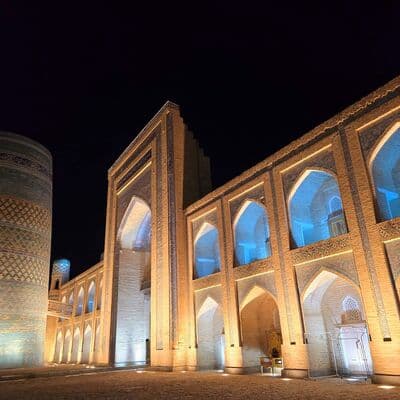
8. The evening light show is free. After dark, the minarets and madrasahs are illuminated. Itchan Kala at night is a different city entirely: dark alleys punctuated by pools of golden light, absolute silence, the smell of dust and old wood. It is completely safe - violent crime is essentially nonexistent. Take a slow walk after dinner and see a side of Khiva that day visitors miss entirely.
9. Artisans work in the open. Do not walk past the workshops: woodcarvers, ceramicists, and carpet weavers work in open courtyards where you can watch for free. Ask before photographing (they almost always say yes), and if you buy directly from the maker, prices are 30-50% lower than in shops. These are genuine craftspeople continuing traditions that are centuries old, and watching them work is mesmerizing.
10. Buy your SIM card in Urgench. Khiva has no mobile operator offices. Pick up a Beeline or Ucell SIM in Urgench near the train station. Cost: 15,000-30,000 sum ($1.20-2.40) for a SIM with 1-2 GB of data. Bring your passport - it is required. 4G coverage is stable throughout Khiva. Alternatively, buy an international eSIM (Airalo, Holafly) before you arrive - it works across Uzbekistan and saves you the hassle of finding a shop.
Transport and Connectivity in Khiva
Getting from the Airport to Khiva
The nearest airport is Urgench (UGC), about 35 km (22 miles) from Khiva. Flights operate from Tashkent (1.5 hours, from $30-50 one way), and occasionally from Bukhara. The airport is small and manageable - you will be through customs and baggage claim in under 20 minutes on most days.
- Taxi from the airport: 80,000-120,000 sum ($6.50-9.50) to Khiva, 30-40 minutes drive. Agree on the price before getting in. Ride-hailing apps like Yandex Go do not work for this route - you are dealing with individual taxi drivers. They are not aggressive or pushy by regional standards, but do negotiate firmly.
- Marshrutka (minibus): from Urgench bus station to Khiva - 5,000-7,000 sum ($0.40-0.55), departing every 10-15 minutes. From the airport to Urgench bus station requires a separate taxi (15,000-20,000 sum / $1.20-1.60). This two-step process saves money but adds 20-30 minutes to your journey.
- Guesthouse transfer: many guesthouses offer airport pickup for 100,000-150,000 sum ($8-12). Convenient if you arrive late at night or just want the simplicity of someone holding a sign with your name.
Getting Here by Train
Khiva has a relatively new train station about 20 minutes from Itchan Kala. The Afrosiab high-speed train from Tashkent takes roughly 18 hours on the overnight service, passing through Bukhara and Samarkand - a convenient way to combine multiple cities on one ticket. Cost: from 200,000 sum ($16) for a berth. The Bukhara to Khiva train takes 7-8 hours and starts at 80,000 sum ($6.50).
Alternative: shared taxi from Bukhara to Khiva, about $60-80 for the whole car (or $15-20 per person if you split with other travelers), 6-7 hours through the desert. Look for ride-share options at your hostel notice board or in Telegram groups for Central Asia backpackers. The drive through the Kyzylkum Desert is flat and monotonous, but there is a stark beauty to it - especially at sunrise or sunset.
Getting Around the City
Khiva is a walking city, period. Itchan Kala measures just 650 by 400 meters (roughly 2,100 by 1,300 feet) - you can walk across it in 20 minutes at a leisurely pace. From the New Town to Itchan Kala is a 10-15 minute stroll. You will not need a taxi within the city itself, and there is really no point in having one.
For trips to the surrounding area (Elliq-Qala fortresses, Nukus, yurt camps): negotiate with taxi drivers near the gates of Itchan Kala or arrange through your guesthouse. Prices are generally fixed by destination, but there is always room to negotiate, especially if you are booking for a full day. Expect to pay $30-50 for a day trip to the desert fortresses and $40-60 for a round trip to Nukus.
Internet and Connectivity
Wi-Fi: available at most guesthouses and restaurants inside Itchan Kala. Speeds are moderate - 5-15 Mbps is typical, which is fine for messaging and social media but may not hold up for video calls. If you need reliable video conferencing, download what you need beforehand and keep your expectations modest.
SIM card: Beeline or Ucell, buy in Urgench (no operator offices in Khiva). Passport required for purchase. Cost: 15,000-30,000 sum ($1.20-2.40) for a SIM with 1-2 GB of data. 4G coverage works throughout the city and is surprisingly reliable.
eSIM: Airalo, Holafly, and other international eSIM providers work in Uzbekistan. This is the most convenient option if you do not want to hunt for an operator office - activate it before you land and you are online from the moment you arrive.
Essential apps to download before arrival:
- Yandex Go - ride-hailing for Urgench (does not work in Khiva itself - the city is too small)
- Google Maps - download the Khorezm region map for offline use before you leave home. Cell coverage can be spotty in the desert.
- Maps.me - excellent offline alternative with good coverage of Uzbekistan, including walking paths inside Itchan Kala
- Google Translate - the camera feature is invaluable for translating Uzbek signs and menus in real time
- Booking.com / Hostelworld - useful for initial research, but the best guesthouses are often found via Google Maps reviews and word of mouth from other travelers
Final Verdict: Who Is Khiva For?
Khiva is a city for travelers who value authenticity over comfort, history over entertainment, and quiet over noise. In 1.5 to 2 days, you will see one of the best-preserved medieval cities in the world, taste dishes that exist nowhere else (shivit oshi, tukhum barak), and feel what life on the Silk Road actually looked like - not in a museum, but in a living, breathing city.
Perfect for: history and architecture enthusiasts, photographers, cultural travelers, and anyone following the classic Tashkent to Samarkand to Bukhara to Khiva route across Uzbekistan.
Not ideal for: beach vacations, nightlife, serious shopping, or travelers who are not prepared for desert heat and basic comfort levels.
How many days: minimum 1 full day (express), optimal 2-3 days (with surroundings), maximum 5 days (with desert camps and Nukus).
Information current as of 2026. Prices are given in Uzbek sum (1 USD is approximately 12,500 sum) and may fluctuate.