Chiang Rai
Chiang Rai 2026: What to Know Before You Go
Quick answer: What to see in Chiang Rai? Chiang Rai is northern Thailand's artistic and cultural frontier. The city is home to the otherworldly White Temple, the haunting Black House museum, and the shimmering Blue Temple - three landmarks that justify the trip alone. Beyond temples, you will find the Golden Triangle where three countries meet, misty tea plantations, hill tribe villages, and a food scene that rivals Chiang Mai at half the price.
Chiang Rai is for travelers who want the depth of northern Thai culture without the crowds. If Chiang Mai has become the polished, Instagram-ready version of the north, Chiang Rai is its quieter, more authentic sibling. The city itself is small - you can walk across the center in twenty minutes - but the province is enormous, stretching to the borders of Myanmar and Laos. This is a place where you rent a scooter, pick a direction, and discover something remarkable every thirty kilometers.
The honest pros: prices are genuinely low (you can eat well for $3-4 per meal), the temples are world-class, the surrounding countryside is stunning, and you will not feel like you are on a tourist conveyor belt. The honest cons: the burning season from March to April can make the air genuinely unhealthy, public transport is limited so you really need your own wheels, and nightlife is essentially nonexistent. If you want beach bars and full moon parties, this is not your city. If you want to wake up early, ride through rice paddies to a mountaintop temple, and eat the best khao soi of your life for $2, Chiang Rai will not disappoint.
Chiang Rai Neighborhoods: Where to Stay
Chiang Rai is not a big city, so "neighborhoods" is a loose term. But where you base yourself matters, especially if you are relying on walking or cycling rather than a scooter. Here is the breakdown of the main areas and who each one suits.
Clock Tower Center (Thanon Baanpa Pragarn Area)
This is the heart of Chiang Rai. The golden Clock Tower, designed by the same artist behind the White Temple, anchors a compact grid of guesthouses, restaurants, and the famous Night Bazaar. Everything you need for daily life is within a five-minute walk: 7-Elevens, ATMs, pharmacies, massage shops, and the bus station. The Saturday Walking Street runs right through here.
Who it suits: First-timers, solo travelers, anyone without a scooter. Vibe: Small-town busy - lively in the evening, quiet by 10pm. Price range: Budget guesthouses $8-15/night, mid-range hotels $25-50, boutique options $60-90. Cons: Can feel slightly touristy by Chiang Rai standards. Limited parking if you have a car.
Jet Yod (North of Center)
A residential area about 1-2 km north of the Clock Tower, centered around Wat Jet Yod temple and the road toward Mae Chan. This is where many newer hotels and serviced apartments have popped up, offering better value than the center. Several good local restaurants line the main road, and there is a Big C supermarket nearby for self-catering.
Who it suits: Couples, longer-stay visitors, digital nomads. Vibe: Quiet residential with easy access to the center. Price range: $15-35/night for comfortable rooms with pools. Cons: You will want a scooter or bicycle. Not walkable to the Night Bazaar comfortably.
Rop Wiang (East of Center)
The area east of the Kok River, across the bridge from the center. This is a more local, less-visited part of town with a few boutique guesthouses tucked along the riverbank. The Kok River views are the main draw - some properties have terraces overlooking the water. Chivit Thamma Da, one of the best cafes in town, sits on the riverbank here.
Who it suits: Couples seeking quiet, anyone who values scenery over convenience. Vibe: Peaceful, riverfront, slightly removed. Price range: $20-60/night. Cons: Limited food options within walking distance. You are a 10-minute ride from most attractions.
Wiang Chai / White Temple Road (Highway 1 South)
The stretch along Highway 1 heading south toward the White Temple (Wat Rong Khun) has seen a boom of resort-style hotels. These tend to offer more space - pools, gardens, parking - at lower prices than the center. You are about 10-15 minutes from the Clock Tower by scooter, and right on the doorstep of the White Temple.
Who it suits: Families, anyone with a rental car or scooter, temple-focused visitors. Vibe: Highway-adjacent but properties are set back. Resort feel. Price range: $20-45/night for rooms that would cost double in the center. Cons: Not walkable to anything. Highway noise at some properties. Limited restaurant choices nearby.
Singha Park Area (West)
Out toward Singha Park and Boon Rawd Farm, about 8 km west of center. A handful of eco-lodges and farm-stay properties have appeared here. The area is surrounded by tea fields and low hills. It is genuinely rural - expect roosters, not traffic.
Who it suits: Nature lovers, cyclists, anyone wanting total escape. Vibe: Rural, green, very quiet. Price range: $15-40/night. Cons: You absolutely need your own transport. Limited food options - you are cooking or riding into town.
Mae Sai Border Zone (60 km North)
If your focus is the Golden Triangle, border crossings to Myanmar, or exploring the far north, staying in Mae Sai or the Golden Triangle area itself makes sense. Mae Sai is a border town - gritty, functional, and interesting in its own way. The Golden Triangle area has a few upscale resorts with Mekong River views.
Who it suits: Border-crossing travelers, history buffs, luxury seekers (for the high-end resorts). Vibe: Mae Sai is chaotic border-town energy. Golden Triangle resorts are serene. Price range: Mae Sai $10-25, Golden Triangle resorts $80-250. Cons: Far from Chiang Rai city. Mae Sai has limited appeal beyond a day visit for most travelers.
Best Time to Visit Chiang Rai
High Season: November to February
This is when Chiang Rai is at its best. Daytime temperatures hover around 25-30C (77-86F), nights drop to 10-15C (50-59F) - cool enough that you will actually want a light jacket in the evenings, which feels surreal in Thailand. The skies are clear, the air is clean, and the rice paddies are either golden or freshly harvested. December and January are peak months: expect slightly higher hotel prices (still cheap by any standard) and more visitors at the White Temple. February is arguably the sweet spot - still cool, fewer crowds, flowers starting to bloom.
Key festivals in this window: Loy Krathong (November, floating lanterns on the Kok River - much more intimate than Chiang Mai's version), the Chiang Rai Flower Festival (late December to early January, surprisingly impressive displays in the central park), and various hill tribe New Year celebrations.
Burning Season: March to April
This is the season nobody warns you about until you are coughing. Farmers across northern Thailand and neighboring countries burn fields to clear land, and the smoke settles in the valleys. Chiang Rai's AQI regularly exceeds 200 during peak burning weeks - that is "very unhealthy" territory. You will see haze obscuring the mountains, smell smoke constantly, and may experience throat irritation or headaches. Some travelers with respiratory issues have cut trips short. If you must visit, check air quality forecasts daily (IQAir app), carry an N95 mask, and consider spending more time indoors or at higher elevations. Songkran (Thai New Year, April 13-15) falls in this window - it is a massive water fight that is genuinely fun, but you will be soaked and possibly breathing smoke simultaneously.
Rainy Season: May to October
The rains green everything up dramatically. Waterfalls run at full power, the rice paddies are neon green, and you get the countryside largely to yourself. Rain typically falls in heavy afternoon bursts - mornings are often clear. Hotel prices drop 30-50%. The downsides: some dirt roads to remote villages become impassable, river activities may be suspended during heavy rain, and the occasional full-day downpour can strand you. Leeches appear on forest trails from July onward. September and October are the wettest months. That said, many experienced Thailand travelers consider June-July the hidden gem months - warm, green, empty, with manageable rain.
Chiang Rai Itinerary: 3 to 7 Days
3 Days: The Essential Highlights
Day 1: The Three Iconic Sites
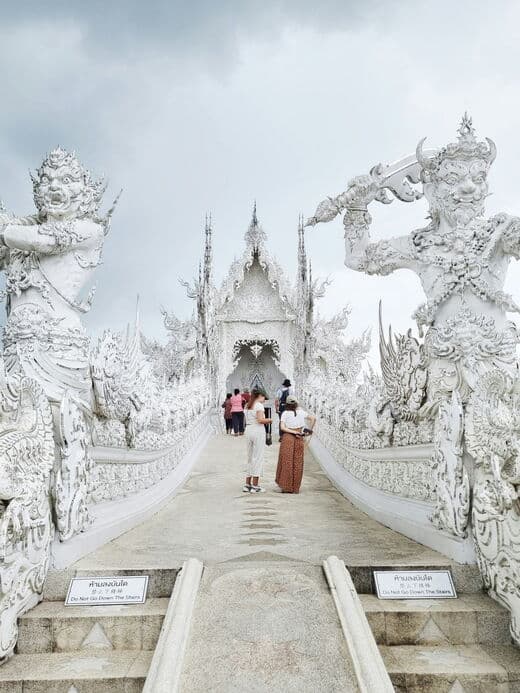
Start early. Be at the White Temple (Wat Rong Khun) by 8:00 AM when it opens. At this hour, you will have maybe 20 minutes with minimal crowds before the tour buses arrive around 9:00. The temple is 13 km south of center - a songthaew from the bus station costs 20 THB ($0.60), or a tuk-tuk runs 150-200 THB ($4-6). Spend about 90 minutes exploring the grounds and the art gallery behind the main temple.
By 10:00 AM, head to the Baan Dam Museum (Black House), 13 km north of center (opposite direction). The contrast with the White Temple is striking - where one is celestial and white, this is dark, primal, and filled with animal bones and crocodile skins. The sprawling grounds contain over 40 buildings. Allow 60-90 minutes. There are food stalls outside the entrance - grab pad thai or som tam for 40-60 THB ($1-2).
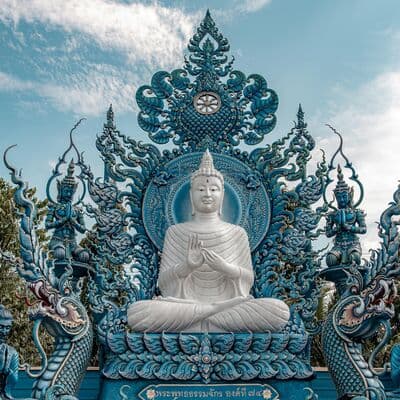
Afternoon: visit the Blue Temple (Wat Rong Suea Ten), conveniently located right in town. This is the most photogenic temple interior in Chiang Rai - the electric blue walls and massive white Buddha are breathtaking. It is free to enter and usually uncrowded. Spend 30-45 minutes. Finish the day at the Night Bazaar (opens 6:00 PM) for shopping and dinner. The food court section at the back has live music and meals for 50-80 THB ($1.50-2.50).
Day 2: Golden Triangle and the Mekong
The Golden Triangle is 70 km north, about 90 minutes by scooter or car. Leave by 8:00 AM. The viewpoint where Thailand, Myanmar, and Laos meet is free to visit. The large golden Buddha statue at the riverside is worth seeing. For $10-15 per person, you can take a longtail boat ride on the Mekong - the 30-minute trip takes you past the Laos shore and the massive Chinese casino complex that has sprung up on the Laotian bank (a surreal sight). The Hall of Opium museum nearby is genuinely excellent and takes 1-2 hours - admission is 200 THB ($6).
On the way back, stop at Mae Sai, Thailand's northernmost town. Walk to the Myanmar border bridge (you can see across into Tachileik). The market near the border sells cheap goods from Myanmar and China. Have lunch at one of the Yunnan noodle shops near the border - the area has a significant Chinese-Thai community and the food reflects it. Budget 60-100 THB ($2-3) for a hearty bowl.
Day 3: Mountain Views, Tea, and a Giant Goddess
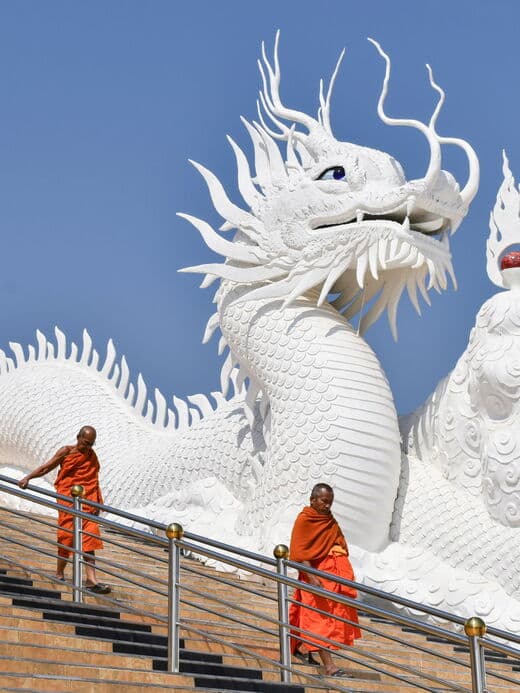
Morning: Wat Huay Pla Kang, the massive Guan Yin statue visible from across the city. It is about 8 km north of center. You can take an elevator inside the statue to the top for panoramic views - 40 THB ($1.20). The nine-tiered pagoda next to it is equally impressive. Go early (before 9:00 AM) for the best light and fewer people.
Late morning: drive south to Choui Fong Tea Plantation, about 25 km from center. This is a working tea estate with a stunning hilltop cafe. Order a pot of oolong tea (80-120 THB / $2.50-3.50) and sit on the terrace overlooking rolling green hills. The food here is decent too - Thai dishes with tea-infused twists. Spend 1-2 hours.
Afternoon: Singha Park (Boon Rawd Farm), about 8 km west of center. This sprawling estate is free to enter (you pay for activities like the zip line or farm tour). Rent a bicycle (50 THB / $1.50) and ride through the tea fields, flower gardens, and lake area. It is a relaxing way to end your three days. For dinner, head to the Saturday Walking Street if timing works, or try Barrab restaurant near the center for creative Thai food (mains 150-250 THB / $4.50-7.50).
5 Days: Add Adventure and Nature
Day 4: Hill Tribe Trek
Book a one-day trek through a guesthouse or local agency (500-1,200 THB / $15-35 per person, depending on group size). Most treks visit Akha, Lahu, or Karen villages in the mountains north or west of town. A typical day includes a 2-3 hour morning hike through forest and farmland, lunch in a village (often cooked by the host family), and an afternoon visit to a waterfall or hot spring. Some treks include a short bamboo raft ride. Choose operators carefully - ask about group sizes (smaller is better, max 6-8 people), whether they visit genuine communities or staged "tourism villages," and whether they contribute to the villages financially. Recommended agencies operate from the center and have years of reviews on TripAdvisor.
Day 5: Doi Tung and Hot Springs
Doi Tung is 45 km north of Chiang Rai. The Royal Villa (former residence of the Princess Mother) sits at the summit with beautiful gardens - entry 90 THB ($2.70). The Mae Fah Luang Garden next door is one of the best-maintained botanical gardens in Thailand. On the drive up, stop at the Doi Tung Tree Top Walk for canopy views. On the way back, detour to Huay Mae Khao hot springs for a soak (free natural pools, or 50 THB for the developed facility). These are natural, mineral-rich springs - not fancy onsen, but perfect after a morning of hiking and driving.
7 Days: Deep Exploration
Day 6: Mae Salong Chinese Village
Mae Salong (Santikhiri) is a mountain village founded by Chinese Kuomintang soldiers who fled to Thailand after the Chinese Civil War. The village retains a distinctly Yunnanese character - Chinese signage, tea shops everywhere, and a morning market selling steamed buns and Chinese pastries. The drive from Chiang Rai (35 km, but winding mountain roads so allow 90 minutes) is spectacular. Stay overnight if you can - there are simple guesthouses for $10-20, and the sunrise from the mountaintop is stunning. Try the locally grown Arabica coffee and oolong tea. The Shin Sane Guest House has been a backpacker institution here for decades.
Day 7: Kok River Boat Trip and Farewell
Take a longtail boat from Tha Ton (90 km northwest of Chiang Rai, or accessible from Chiang Mai direction) downstream on the Kok River to Chiang Rai. The trip takes 3-4 hours and passes through jungle, past Karen villages, and through small rapids. Boats depart Tha Ton at 12:30 PM and cost around 350 THB ($10) per person. This is a genuinely memorable way to arrive in (or depart from) the Chiang Rai area. Alternatively, spend the morning at the Chiang Rai Elephant Sanctuary (ethical, no-riding facility) about 20 km from town - half-day visits run $40-60 and include feeding and bathing elephants.
Where to Eat in Chiang Rai
Street Food and Markets
Chiang Rai Night Bazaar: The food court at the back of the Night Bazaar is the default evening eating spot. It operates like a hawker center - buy a card, load it with credit, order from any stall. Pad thai, grilled meats on sticks, papaya salad, fried rice - everything is 40-80 THB ($1.20-2.50). The quality is consistent and the live music creates a good atmosphere. Open nightly from about 6:00 PM.
Saturday Walking Street: Every Saturday evening, Thanon Thanalai transforms into a long market with food stalls interspersed between craft vendors. This is where you find the more interesting items - grilled river fish, northern sausage (sai ua), bamboo shoot curry, sticky rice in banana leaf packets. Prices are rock-bottom. The market runs roughly 4:00 PM to 10:00 PM.
Morning Market (Talat Sot): The central fresh market near the bus station is where locals shop. Upstairs and around the edges, food vendors sell rice porridge (jok), roti with condensed milk, grilled pork on sticks, and fresh fruit shakes. Breakfast here costs 30-50 THB ($1-1.50). It peaks between 6:00 and 9:00 AM.
Local Restaurants
Pho Chai: A local institution for khao soi (northern curry noodle soup). The shop is unassuming - plastic chairs, hand-written menu - but the khao soi is rich, coconutty, and topped with crispy noodles and pickled cabbage. A bowl costs 50-60 THB ($1.50-1.80). Located near the center, usually packed at lunch.
Lung Eed: Known for nam ngiao, the tomato-based noodle soup that is Chiang Rai's signature dish (distinct from Chiang Mai's version). Tangy, slightly spicy, with pork ribs and cherry tomatoes. About 50 THB per bowl. On the road toward the bus station.
Night Bazaar Khantoke Dinner: A few restaurants near the Night Bazaar offer khantoke - the traditional northern Thai dinner served on a raised tray with multiple small dishes, sticky rice, and often accompanied by traditional dance. It is touristy but genuinely enjoyable. Expect to pay 250-400 THB ($7.50-12) per person. Book through your hotel for a small discount.
Mid-Range and International
Chivit Thamma Da: A riverside cafe-restaurant in a beautiful colonial-style house on the east bank of the Kok River. The Western food (burgers, pasta, salads) is solid, the cakes are excellent, and the terrace with river views is the most pleasant dining spot in the city. Mains 180-350 THB ($5.50-10). Also has a good wine and cocktail list, which is unusual for Chiang Rai. Open daily, can get busy on weekends - reserve or go for lunch.
Barrab: A creative Thai restaurant that takes northern ingredients and presents them with modern flair. The menu changes seasonally but typically includes dishes like smoked pork belly with herbs, river prawn curries, and unusual vegetable preparations. Mains 150-280 THB ($4.50-8.50). The setting is casual-trendy with outdoor seating. One of the few places in Chiang Rai that feels "designed" rather than improvised.
Cat 'n' A Cup: For when you need a break from Thai food. This cat cafe near the center serves decent coffee, sandwiches, and cakes alongside a resident population of friendly cats. Coffees 60-100 THB ($1.80-3). It is exactly what it sounds like, and sometimes that is exactly what you want on day five of a Thai trip.
Coffee Culture
Doi Chaang Coffee: Chiang Rai province produces some of Thailand's best coffee, and Doi Chaang is the most famous brand. Their flagship cafe in the center serves single-origin Arabica grown in the mountains west of Chiang Rai. An Americano costs 60-80 THB ($1.80-2.50). The beans are genuinely excellent - smooth, low-acid, with chocolate notes. Buy a bag to take home (200-400 THB).
The city has developed a surprisingly good specialty coffee scene, with several small roasters and third-wave cafes. BaanChivitMai Bakery (a social enterprise supporting at-risk women) serves great coffee and baked goods, and your purchase supports a good cause. Mojo Coffee near the center is another local favorite for pour-over and cold brew.
Must-Try Food in Chiang Rai
Northern Thai food (sometimes called Lanna cuisine) is distinct from the central and southern Thai food most visitors know. It is heavier on pork, uses less coconut milk, incorporates more bitter and fermented flavors, and centers around sticky rice rather than jasmine rice. Here are the dishes you should not leave without trying.
Khao Soi (ข้าวซอย): The iconic northern Thai curry noodle soup - egg noodles in a creamy, mildly spicy coconut curry broth, topped with crispy fried noodles, pickled cabbage, shallots, and lime. Usually made with chicken or beef. Found at dedicated khao soi shops throughout the city. 50-70 THB ($1.50-2). Order it "mai pet" (not spicy) if you are sensitive to heat. This is the dish that converts people to northern Thai food.
Nam Ngiao (น้ำเงี้ยว): Chiang Rai's own contribution to the noodle soup canon. A tangy, tomato-based broth with pork ribs, cherry tomatoes, dried cotton flowers (dok ngiao, which give it the name), and rice noodles. It is lighter and more sour than khao soi. 40-60 THB ($1.20-1.80). Ask for thin noodles (sen lek) for the authentic version.
Sai Ua (ไส้อั่ว): Northern Thai sausage, packed with lemongrass, galangal, kaffir lime leaves, and chili. It is grilled until the casing is crispy and the inside is fragrant and herbal. Sold at markets by the piece (20-40 THB / $0.60-1.20) or served sliced as a side dish at restaurants. Best eaten with sticky rice and a cold beer. Quality varies - the Saturday Walking Street vendors tend to make theirs fresh.
Khantoke Dinner (ขันโตก): Not a single dish but a traditional Lanna dining experience. Food is served on a raised circular tray (the khantoke itself) with small bowls of different dishes: green curry, crispy pork rinds, laab (minced meat salad), sticky rice, and dipping sauces. A few restaurants near the Night Bazaar serve this format. 250-400 THB ($7.50-12) per person. It is a tourist-oriented presentation of real local food.
Kanom Jeen Nam Ngiao (ขนมจีนน้ำเงี้ยว): Thin fermented rice noodles served with nam ngiao broth and a spread of raw vegetables and herbs on the side. This is the Chiang Rai breakfast of choice. Locals eat it at morning market stalls between 6:00 and 9:00 AM. 30-50 THB ($0.90-1.50). The key is adding your own toppings from the vegetable tray - bean sprouts, cabbage, fresh basil, and pickled chili.
Sticky Rice (ข้าวเหนียว): In northern Thailand, sticky (glutinous) rice is the staple, not jasmine rice. It comes in a small bamboo basket and you eat it with your hands - tear off a small ball, press it flat, and use it to scoop up curries and dips. Every meal here revolves around sticky rice. It costs 5-10 THB per basket. If you order jasmine rice at a local place, the server may look slightly confused.
Nam Prik Num (น้ำพริกหนุ่ม): A roasted green chili dip served with pork rinds, steamed vegetables, and sticky rice. The chilies are fire-roasted until charred, then pounded with garlic and shallots. It is smoky, spicy, and addictive. Served as part of a set meal at local restaurants. Medium-spicy by Thai standards, which means quite spicy by most Western standards. 40-80 THB ($1.20-2.50) as part of a dip set.
Miang (เมี่ยง): Betel leaf wraps filled with tiny diced ingredients - ginger, shallots, peanuts, dried shrimp, chili, lime, and a sweet-sour sauce. You wrap everything in the leaf and eat it in one bite. It is a traditional Lanna snack and appetizer. Some upscale restaurants serve creative versions. The explosion of textures and flavors in one bite is remarkable. 60-120 THB ($1.80-3.50).
Doi Chaang Coffee: Not a food, but worth listing. The Arabica beans grown on the hills west of Chiang Rai (around the Akha village of Doi Chaang) have gained international recognition. The coffee is shade-grown at altitude and has a clean, smooth profile. A cup at one of the local cafes costs 50-80 THB ($1.50-2.50). The iced black coffee is particularly good in the afternoon heat.
Note for vegetarians: Northern Thai food is heavily pork-based. However, Buddhist temple food is always vegetarian, and the phrase "jay" (เจ) indicates vegan food. Several stalls at the morning market sell jay food with yellow flags. Khao soi can be ordered with tofu at some shops. The Saturday Walking Street usually has a few dedicated vegetarian stalls. Allergy warning: Peanuts appear frequently in northern Thai cuisine - in dips, salads, noodle toppings, and miang wraps. If you have a peanut allergy, learn the Thai phrase "phaeh thua lisong" (allergic to peanuts) and say it clearly before ordering.
Chiang Rai Insider Tips
These are the things I wish someone had told me before my first visit. Not the obvious stuff - these are the details that separate a good trip from a great one.
- Visit the White Temple at 8:00 AM sharp. The White Temple opens at 8:00 and the Chinese and Korean tour buses arrive around 9:00-9:30. That first hour is magical - you can photograph the bridge without 50 people in your frame, and the morning light on the white structure is far superior to the harsh midday glare. By 10:00 AM, the site is uncomfortably crowded.
- The Clock Tower light show happens at 7:00, 8:00, and 9:00 PM. Every evening, the golden Clock Tower in the center puts on a brief but impressive LED light show with music. The 7:00 PM show coincides with the start of the Night Bazaar, so watch it and then walk over for dinner. It only lasts about five minutes but it is worth seeing once.
- Rent a scooter, period. Chiang Rai's attractions are spread across a huge area. Tuk-tuks and songthaew exist but they are inconvenient and add up fast. A Honda Click or Scoopy rents for 200-300 THB ($6-9) per day from shops near the Clock Tower. You need a valid license (international driving permit technically required, but rarely checked at rental shops - police checkpoints are another matter). Fuel is cheap - a full tank costs about 80 THB ($2.50) and lasts 150+ km. Always wear a helmet - police checkpoints on the highway to the White Temple are common, and the fine is 500 THB ($15).
- Grab works, but barely. Unlike Bangkok or Chiang Mai, Grab (the Southeast Asian Uber equivalent) has limited drivers in Chiang Rai. You might wait 10-20 minutes for a car, and during off-peak hours, you may not find one at all. For airport transfers and longer rides, arrange transport through your hotel or flag a songthaew.
- The Night Bazaar food section is at the back. Many visitors walk through the front of the Night Bazaar (clothing, souvenirs, crafts) and miss the best part. Walk all the way to the back and you will find the covered food court with a stage for live music. This is where the locals eat. The front stalls selling "same same" t-shirts are ignorable.
- Mae Salong deserves an overnight. Most visitors skip Mae Salong or do a rushed day trip. But the village is at its best in the early morning - mist in the valleys, the morning market setting up with steamed buns and Yunnan noodles, tea farmers heading to the hills. Stay one night at a simple guesthouse and you will see a side of northern Thailand that few tourists experience.
- Be thoughtful about "long neck" village visits. Several tour operators offer visits to Kayan (Padaung) "long neck" villages near Chiang Rai. These are controversial - some are essentially human zoos where displaced Myanmar refugees are displayed for tourist photos. The women receive a small portion of the entrance fee. If you want to visit a Kayan community ethically, research operators carefully and choose those where the community controls the tourism and receives fair compensation. Better yet, visit genuine Akha or Lahu villages through a reputable trekking company where tourism supports the community directly.
- Thai massage here is incredibly cheap. A one-hour traditional Thai massage in the center costs 200-250 THB ($6-7.50). A foot massage is 150-200 THB ($4.50-6). That is about half of what you would pay in Bangkok or the islands. There are massage shops every 50 meters in the center. The ones on the side streets (not the main tourist road) tend to be better and cheaper.
- Carry cash. While Bangkok and Chiang Mai have largely gone cashless, Chiang Rai is still cash-dependent. Many local restaurants, market stalls, songthaew drivers, and even some guesthouses do not accept cards. ATMs are everywhere (7-Elevens all have them), but they charge 220 THB ($6.50) per withdrawal for foreign cards. Withdraw larger amounts less frequently to minimize fees. Some ATMs from Bangkok Bank charge slightly less.
- Download offline Google Maps. Cell signal gets patchy on the mountain roads toward Mae Salong, Doi Tung, and some trekking areas. Download the Chiang Rai province offline map before heading out on a scooter. It has saved many a lost traveler on the winding roads above Mae Chan.
- The best views cost nothing. Skip the paid viewpoints and instead ride up to the hills behind Wat Huay Pla Kang in the late afternoon. The sunset over the city with the mountains behind it is spectacular, and you will likely be the only person there. Another free viewpoint: the Kok River bridge at dawn, when mist rises off the water.
- Bargaining is expected at markets, but gently. At the Night Bazaar and Walking Street, prices on crafts and clothing are inflated 30-50% for tourists. A polite counter-offer of 70% of the asking price is normal. Food stalls, however, have fixed prices - do not try to haggle over a 40 THB pad thai. And never bargain at temples or with monks.
Getting Around Chiang Rai
Getting There
By Air: Chiang Rai's Mae Fah Luang Airport (CEI) receives daily flights from Bangkok (Don Mueang and Suvarnabhumi). AirAsia and Nok Air are the budget carriers - book 2-4 weeks ahead for fares as low as 1,000-2,000 THB ($30-60) one way. Thai Lion Air and Thai VietJet also compete on this route. Flight time is about 1 hour 20 minutes. There are occasional direct flights from Kuala Lumpur and Singapore on AirAsia.
By Bus from Chiang Mai: Green Bus operates comfortable, air-conditioned buses from Chiang Mai's Arcade Bus Station to Chiang Rai every 30-60 minutes. The journey takes about 3 hours on the new highway. First class (reclining seats, 288 THB / $8.50) is worth the small upgrade over second class (166 THB / $5). VIP buses with only three seats per row cost about 360 THB ($10.50). Buy tickets at the station or through the Green Bus app (English available). This is honestly the best way to get from Chiang Mai - cheaper than flying, scenic, and drops you right in the center of town.
By Bus from Bangkok: Overnight buses from Bangkok's Mo Chit station take 10-12 hours. VIP buses with sleeper seats cost 600-900 THB ($18-27). Nakhonchai Air is the most reputable operator. Only recommended if you genuinely enjoy bus travel or want to save on a night's accommodation.
Airport to City Center
The airport is 8 km northeast of the center. Your options: Airport taxi with a fixed price of 200 THB ($6) to anywhere in the city - buy a ticket at the counter inside the arrivals hall. Airport shuttle (shared minivan) costs 20 THB ($0.60) and drops you at the bus station in the center, but runs on a loose schedule and waits until it has enough passengers. Grab occasionally works from the airport - expect 100-150 THB if you can find a driver. Most hotels offer free airport pickup if you book directly - always ask before arranging your own transport.
Getting Around the City
Scooter Rental: The most practical option. Automatic scooters (Honda Click, Yamaha Fino, Honda Scoopy) cost 200-300 THB ($6-9) per day from rental shops near the Clock Tower. Prices drop for weekly rentals (1,000-1,500 THB / $30-45 per week). You will need to leave your passport or a deposit (usually 2,000-3,000 THB). Check the scooter for existing damage and take photos before riding off. Fuel costs roughly 35-38 THB per liter.
Songthaew (Shared Trucks): Blue songthaew (covered pickup trucks with benches) run fixed routes through the city for 15-20 THB ($0.45-0.60) per ride. There are no route maps - you flag one down and tell the driver where you are going. If they are heading that direction, they will nod. Main routes run along the highway and to the bus station. For out-of-town destinations like the White Temple, songthaew from the old bus station cost 20 THB but run infrequently.
Tuk-Tuks: Chiang Rai tuk-tuks are small covered motorcycles with a sidecar. They are more expensive than songthaew (80-150 THB / $2.50-4.50 for in-city trips) and the price is always negotiated. Useful for short hops when you cannot find a songthaew, but a scooter is cheaper if you need transport for the whole day.
Bicycle: The city center is flat and bikeable. Some guesthouses lend bicycles for free, or you can rent from shops near the Clock Tower for 50-100 THB ($1.50-3) per day. Only practical for the city itself - distances to major attractions are too far for comfortable cycling unless you are a serious cyclist.
Essential Apps and SIM Cards
SIM cards: Buy a tourist SIM at any 7-Eleven. AIS, DTAC, and True Move all offer prepaid SIMs with data. A SIM with 15-30 days of unlimited data costs 299-599 THB ($9-18). AIS tends to have the best coverage in rural and mountainous areas around Chiang Rai. You will need your passport to register the SIM - 7-Eleven staff handle this. If you arrive at the airport, there are SIM counters in the arrivals hall with slightly higher prices but instant setup.
Apps to download: Grab (ride-hailing, limited but useful for airport transfers), LINE (Thailand's universal messaging app - many hotels and tour operators communicate exclusively through LINE), Google Maps (download offline maps for the province), Google Translate (the camera feature that translates Thai signs in real-time is genuinely useful), and IQAir (air quality monitoring - essential if visiting between February and April).
Who Chiang Rai is For: Summary
Ideal for: Temple enthusiasts and architecture lovers (the White/Blue/Black trilogy alone is worth the trip). Budget travelers who want authentic Thailand at rock-bottom prices. Foodies curious about Lanna cuisine. Couples looking for quiet, scenic romance without beach resort prices. Trekkers and nature lovers who want hill tribe experiences and mountain scenery. Photographers - the light, the temples, and the landscapes are extraordinary. Anyone who has "done" Chiang Mai and wants to go deeper into the north.
Not ideal for: Beach lovers (nearest coast is a full day away). Party seekers (nightlife is virtually nonexistent). Families with very small children (the distances between sights and reliance on scooters make logistics challenging with toddlers). Travelers who rely entirely on public transport (it exists but is limited). Anyone visiting during burning season (March-April) with respiratory issues.
How long to stay: Minimum 2 full days to see the three main temples and the Night Bazaar. Optimal 4-5 days to add the Golden Triangle, a day trip to the mountains, and enough time to relax without rushing. Maximum 7-10 days if you include Mae Salong overnight, trekking, Doi Tung, and the Kok River boat trip. Beyond 10 days, you are either a very slow traveler (nothing wrong with that) or you should consider combining with Chiang Mai, Pai, or Nan province.