About
North Korea: The Most Restricted Journey on Earth -- A Complete Travel Guide
Why Visit North Korea
North Korea is not just a country. It is another planet that somehow ended up on Earth. A place where time stopped, where propaganda became an art form, and where daily life transformed into a performance directed by an invisible hand. A trip to the DPRK is not a beach holiday and not a culinary tour. It is an expedition into a parallel reality that will force you to rethink everything you thought you knew about the modern world, about freedom, about what a society can become when sealed off from the rest of humanity for seven decades.
Let me be direct with you right from the start: in the DPRK, you will not be a free traveler. Two government-appointed guides will accompany you at all times -- everywhere, from the moment you wake up until you go to sleep. Your itinerary is approved in advance, deviations are impossible, spontaneous walks are out of the question. You can photograph only with permission, you can speak to locals only through your guides. This is not an exaggeration and not a scare story -- this is the reality you need to accept before you even think about booking. If this categorically does not work for you, North Korea is not your destination, and there is nothing wrong with that. Plenty of fascinating places on this planet will welcome you with open arms and far fewer restrictions.
But if you are willing to accept the rules of the game, the DPRK will give you an experience that is genuinely impossible to obtain anywhere else on Earth. You will see Pyongyang -- a city-utopia built as an ideological showcase, with its surreal architecture, empty ten-lane boulevards, and a metro system buried 110 meters underground. You will visit the Kumsusan Palace of the Sun, where the embalmed bodies of two Kims rest in crystal sarcophagi -- a sight that sends shivers down your spine regardless of your political leanings. You will ascend the Juche Tower and see the city from above -- strange, symmetrical, almost unreal, like a diorama built by someone who read about cities but never quite lived in one.
The DPRK is a land of contrasts, but not in the cliched travel-brochure sense of that phrase. Here, the contrast is between what they show you and what they hide. Between the propaganda posters and the real life glimpsed behind fences. Between the luxury of hotels built for foreigners and the poverty you catch fleetingly from the bus window. Between the confident assertions of your guides and the questions forming in your head. This is a journey that raises far more questions than it answers. And that is precisely why it is worth taking.
North Korea is the only country in the world where tourism itself is an act. Not an act of protest, not an act of supporting the regime, but an act of witnessing. You will arrive with one set of assumptions about the DPRK -- and you will leave with an entirely different one. Not necessarily more positive or more negative, but certainly more nuanced, more layered, more human. And this shift in perception is arguably the most valuable souvenir you will bring back from the most isolated nation on the planet.
A critical note for American readers: Since September 1, 2017, a US State Department travel ban prohibits American citizens from traveling to North Korea. US passports are not valid for entry. Exceptions require special validation from the State Department and are limited to journalists, humanitarian workers, and certain other categories. This ban was prompted by the death of Otto Warmbier, a young American student who was detained in Pyongyang and returned home in a coma. If you hold a US passport, this guide serves primarily as an informational resource -- you cannot legally visit the DPRK at this time.
For British, Canadian, and Australian readers: As of early 2026, North Korea remains closed to citizens of most Western nations following the COVID-era border shutdown that began in January 2020. The country has selectively reopened to Russian and Chinese tourists, but citizens of the UK, Canada, Australia, New Zealand, and EU nations are still unable to enter as tourists. This situation could change -- it has been changing gradually -- so check with licensed tour operators for the latest updates. The information in this guide prepares you for whenever that door opens again.
Some people ask: is it ethical to visit North Korea? Does tourist money prop up the regime? These are legitimate questions without simple answers. Your tour fee does go to the state -- there is no way around that. But proponents of DPRK tourism argue that exposure to foreigners, however controlled, creates tiny cracks in the information wall. Your guides interact with you, learn about the outside world, see that Americans and Europeans are not the monsters depicted in propaganda. Whether that justifies the trip is a personal decision only you can make.
Regions of North Korea: What You Can Actually See
Before diving into regions, an important caveat: you cannot simply pick a destination and go. All itineraries are pre-approved by the government, and tourists are allowed access to only a small fraction of the country. Nevertheless, even this fraction is surprisingly diverse -- from a capital megacity to mountain ranges, coastal areas, and the most heavily militarized border on Earth.
Pyongyang -- The Showcase Capital
Pyongyang is the heart of every DPRK tour and a city you will remember for the rest of your life. Not because it is beautiful in the conventional sense (though a certain austere aesthetic is undeniably present), but because it resembles nothing else on Earth. Imagine a city of roughly 3 million people with almost no advertising, no traffic jams, no homeless people, no graffiti, no litter on the streets. Sounds like a utopia? That is exactly what it was designed to be -- a showcase of what the Workers Party claims socialism can achieve.
Pyongyang was virtually leveled during the Korean War -- American bombing campaigns destroyed an estimated 75% of the city's structures. General Curtis LeMay, who oversaw the bombing, later said the US had killed roughly 20% of North Korea's population. The city was rebuilt from scratch according to a unified plan, and you can feel it: enormously wide boulevards, monumental buildings, perfectly symmetrical squares. Architecture here is not merely construction -- it is ideology cast in concrete and granite. Every building symbolizes something. Every monument glorifies something. There is an intentionality to the urban landscape that you simply do not find in cities that grew organically.
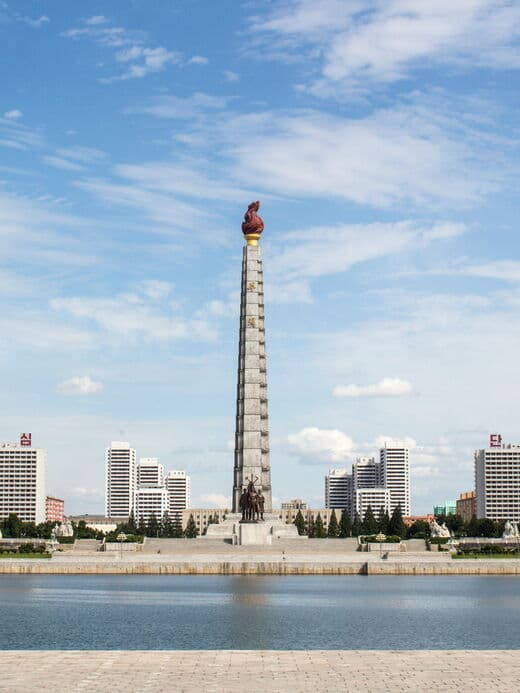
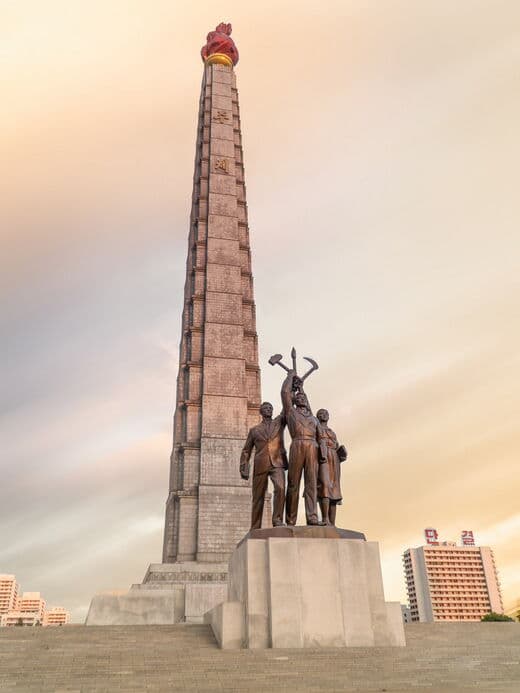
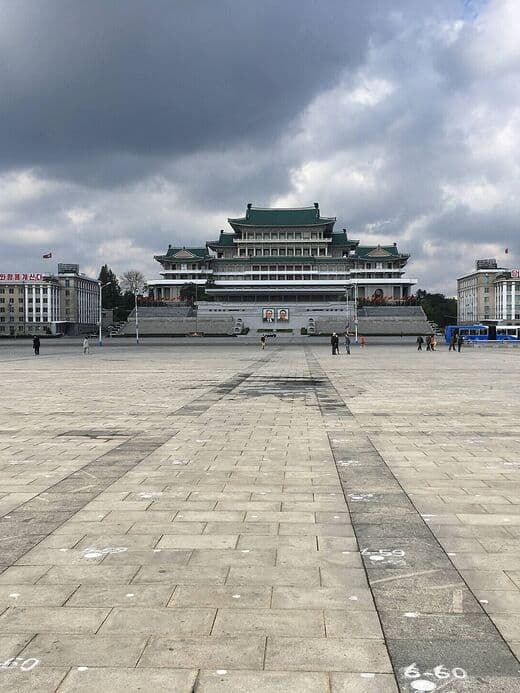
The main attraction is Kim Il-sung Square, a vast open space familiar from television broadcasts of military parades. When you stand in it without the crowds and hardware, the scale is staggering: the square can hold up to 100,000 people. On one side stands the Grand People's Study House (a massive library built in traditional Korean architectural style), and on the other -- the embankment of the Taedong River. From here you get the iconic view of the Juche Tower on the opposite bank -- a 170-meter obelisk crowned with a flame. Take the elevator to the observation platform at the top -- from there you can see all of Pyongyang, and this is one of the rare moments when panoramic photography of the city is permitted. The view is extraordinary: a geometric city stretching out in all directions, eerily quiet, with barely any cars on those wide avenues. If you have ever seen photos of SimCity models from the 1990s, Pyongyang looks like someone built one at full scale.
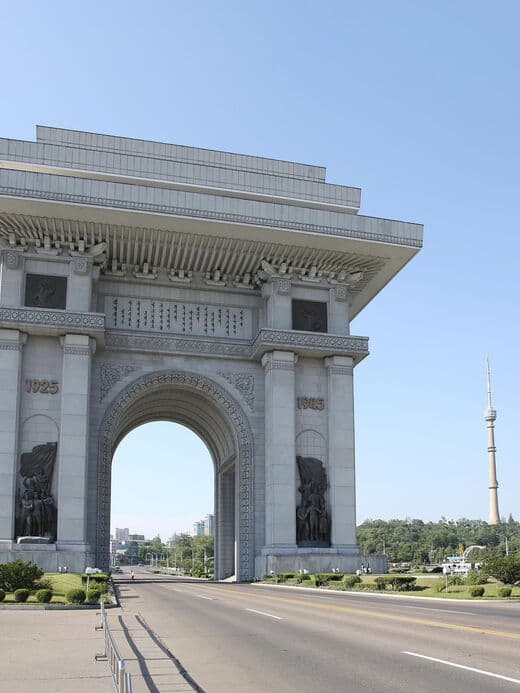
The Arch of Triumph is another symbol of Pyongyang that North Koreans are extremely proud of. It stands 60 meters tall -- 3 meters taller than the Arc de Triomphe in Paris, a comparison your guides will absolutely mention, because North Korea loves these sorts of one-upmanship statistics. The arch is built from 25,550 granite blocks, one for each day of Kim Il-sung's life up to his 70th birthday. It stands at the foot of Moran Hill, and the surrounding park is one of the few places where you might see locals in an informal setting -- families having picnics, children playing, couples walking. These glimpses of normalcy are rare and precious in a tour that is otherwise meticulously choreographed.
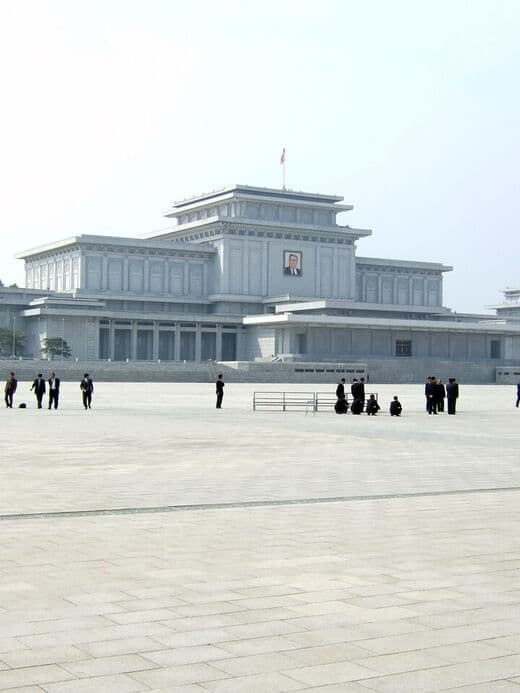
The Kumsusan Palace of the Sun is the site that provokes the strongest emotional response, regardless of your political orientation. This is the mausoleum where the embalmed bodies of Kim Il-sung and Kim Jong-il lie in state. The former presidential residence was converted into this memorial complex at a cost estimated between $100 million and $900 million -- in a country where many citizens struggle for adequate nutrition. The visit is an elaborate ritual: you pass through a series of moving walkways and air showers (to remove dust particles from your clothing) before entering the halls with crystal sarcophagi. The dress code is the strictest you will encounter anywhere in the DPRK -- absolutely no jeans, shorts, or open-toed shoes. Men must wear dress shirts and trousers, women must be fully covered. Photography is categorically forbidden. A bow is mandatory -- and yes, foreigners are expected to bow as well. Refusal will be perceived as a serious insult and could jeopardize the tour for your entire group. Think of it as a cultural obligation, similar to removing your shoes in a Japanese temple, only with significantly higher stakes.
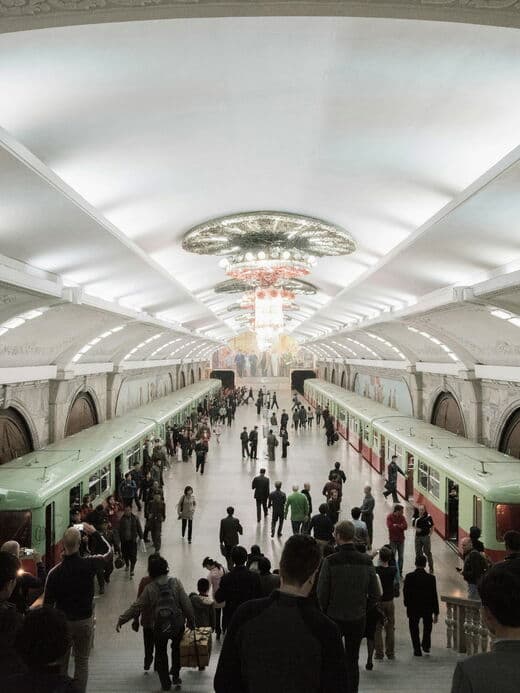
The Pyongyang Metro is one of the most extraordinary public transit experiences in the world. It is one of the deepest metro systems globally -- stations sit up to 110 meters underground (for comparison, the deepest station on the London Underground, Hampstead, is 58 meters; the deepest in Moscow is 84 meters). The official explanation is nuclear attack protection, which given the Korean War's devastation and the ongoing military tension, is plausible enough. The stations are decorated with astonishing grandeur: elaborate mosaics depicting socialist-realist scenes, bas-reliefs, crystal chandeliers, marble columns. Station names tell their own story -- 'Comrade,' 'Glory,' 'Reunification,' 'Golden Fields.' Tourists are typically shown two stations -- Puhung and Yonggwang -- but even this limited exposure is enough to impress. Pay attention to the newspaper mounted in each train car: it is the only information source for commuters, and everyone reads the same paper, Rodong Sinmun (the organ of the Workers' Party of Korea). There is something profoundly unsettling and simultaneously fascinating about watching a carful of people all reading the exact same state-approved news.
Mangyongdae is a suburb of Pyongyang where Kim Il-sung was born. This is a pilgrimage site for North Koreans and a mandatory stop on every tour. You will be shown a modest peasant house with a thatched roof where, according to the official narrative, the future 'Great Leader' spent his childhood. The house is impeccably maintained and surrounded by other humble structures that purportedly belonged to his family. Nearby is the Mangyongdae Funfair, one of the few amusement parks in the country, where you can see North Koreans at leisure: riding attractions, eating ice cream, posing for photographs. This is one of the most 'human' moments of the tour -- a reminder that behind the ideology and the marching and the monuments, there are ordinary people who enjoy a day out with their families, just like anyone else.
Beyond these key sites, Pyongyang tours typically include: the Chollima Statue (a winged horse symbolizing rapid socialist construction, similar in function to Pegasus but with ideological cargo), the Monument to the Foundation of the Workers' Party of Korea (three hands holding a hammer, sickle, and calligraphy brush -- intellectual workers getting equal billing is a nice North Korean touch), the Grand People's Study House (a library with a pneumatic tube delivery system that is genuinely impressive), the circus (surprisingly high quality -- North Korean acrobats train rigorously), a cosmetics factory, a maternity hospital, a model school, and the obligatory souvenir shop. Each visit is not merely a sightseeing stop but a carefully staged scene in the performance that the DPRK puts on for foreign visitors. Knowing this does not diminish the experience -- it adds a layer of analytical engagement that makes it more interesting, not less.
Kaesong and the Demilitarized Zone (DMZ)
Kaesong is the ancient capital of the Koryo Dynasty (918-1392), which gave the whole of Korea its name. The city sits just 10 kilometers from the border with South Korea, and it is from here that trips to the DMZ -- the Demilitarized Zone, one of the most tense places on the planet -- are organized.
The trip to the DMZ is arguably the most emotionally charged moment of the tour (alongside the mausoleum visit). You will find yourself in Panmunjom -- the 'Truce Village' where the armistice agreement was signed in 1953. Here stand the famous blue UN buildings straddling the Military Demarcation Line: half of each building is in North Korea, half in South Korea. You will be allowed to enter one of these buildings and, for a few surreal seconds, technically stand on South Korean soil. The sensation is bizarre beyond description: through the window you can see South Korean soldiers standing guard, while beside you a North Korean officer delivers his version of events -- a version in which the United States started the Korean War and South Korea is an occupied puppet state. Whether you agree, disagree, or simply marvel at the parallel narratives, it is an experience that stays with you.
If you have visited the DMZ from the South Korean side (which many travelers have), seeing it from the North offers a fascinating mirror image. The narrative is completely inverted, the propaganda completely reversed, and yet the physical space is identical. It is like reading the same novel from the antagonist's perspective.
Kaesong itself has a charming historic center with traditional Korean architecture -- low houses with tiled roofs, narrow lanes. Tour groups often stay overnight in a traditional Korean hanok house, sleeping on the floor with ondol (underfloor heating) -- a system that Koreans have used for centuries and that works remarkably well. Nearby are the Koryo-era royal tombs, a UNESCO World Heritage Site, and the Songgyungwan Confucian Academy, one of the oldest educational institutions in Korean history.
Mount Myohyang -- The Mountain Region
Mount Myohyang (meaning 'Mountain of Mysterious Fragrance') is one of the most scenic regions in the DPRK, located about 150 kilometers north of Pyongyang. This is where the stern socialist realism gives way to natural beauty: waterfalls, coniferous forests, mountain trails, and Buddhist temples. The drive from Pyongyang takes two to three hours and offers a rare window into rural North Korea -- rice paddies worked by hand, oxen pulling carts, villages that look as if they have not changed in half a century.
The main man-made attraction is the International Friendship Exhibition, an underground complex housing gifts presented to the Kims by world leaders and organizations. The complex consists of two buildings (one for Kim Il-sung, one for Kim Jong-il) carved into the mountainside. Inside are dozens of halls with thousands of exhibits: from an armored train car gifted by Stalin, to a basketball signed by Michael Jordan from Madeleine Albright, to crocodile skins from Nicaragua, to a bear pelt from Russia. The exhibits are arranged by country, and the size of each country's hall is proportional to the number of gifts. It is, without exaggeration, one of the most bizarre museums on the planet. Your guide will tell you the complex holds over 100,000 gifts -- a number that is both impressive and slightly unsettling when you consider the diplomatic implications. The heavy steel doors, the climate-controlled underground chambers, the reverential atmosphere -- it all feels less like a museum and more like a shrine to international flattery.
Also in Myohyangsan is the Pohyon Temple, an 11th-century Buddhist temple and one of the few functioning religious sites in the country. The monks you encounter there may be genuine practitioners, or they may be government employees playing the role of monks for tourist benefit. This ambiguity -- never quite knowing what is real and what is performance -- is a fundamental part of the DPRK experience and one you will grow accustomed to, though never fully comfortable with.
Wonsan and the East Coast
Wonsan is a port city on the east coast that was relatively unvisited by tourists until recently. That began to change with the opening of the Wonsan-Kalma resort in July 2025 -- the largest tourism project in DPRK history. Construction took six years instead of the planned two (a very North Korean outcome), and the resort includes a beach zone, ski slopes, a water park, and a hotel complex. As of early 2026, the resort is primarily accessible to domestic tourists and a limited number of foreign guests.
The east coast of the DPRK offers kilometers of pristine, untouched beaches, pine forests that reach right to the waterline, and fishing villages where life appears to have remained unchanged for generations. From Wonsan, tours organize trips to Lake Sijung and to hot springs in the surrounding area. The seafood on the east coast is notably fresher and more abundant than what you get in Pyongyang, and meals here are a highlight.
Mount Kumgang (Diamond Mountains)
Mount Kumgang is one of the most beautiful mountain ranges on the Korean Peninsula, featuring dramatic granite peaks, waterfalls, and Buddhist temples. Historically, this was a major tourist destination -- between 1998 and 2008, a joint project with South Korea allowed Southern tourists to visit the mountains. The project was shut down after a North Korean soldier shot and killed a South Korean tourist who had wandered into a restricted area. Inter-Korean tourism has not resumed since.
For foreign tourists, Mount Kumgang is periodically included in itineraries but is far from guaranteed. If you are lucky enough to visit, it is a stunning place: Piro Peak at 1,638 meters, Kuryong Waterfall, gorges, and temples nestled into cliff faces. Korean poetry has celebrated these mountains for centuries, and the Chinese characters for their name literally mean 'Diamond Mountains' -- a reference to the way sunlight catches the granite faces and makes them sparkle. In autumn, when the foliage turns, it is one of the most visually spectacular landscapes in all of East Asia.
Mount Paektu -- The Sacred Mountain
Mount Paektu (2,744 meters) is the highest point on the Korean Peninsula and a sacred place for all Koreans -- North and South alike. At the summit sits Heaven Lake (Chon), a crater lake that is one of the highest of its kind in the world. According to North Korean mythology, this is where Kim Jong-il was born (though Soviet records indicate he was actually born in Khabarovsk, Russia). Mount Paektu sits on the border with China, and special tours from the North Korean side are organized to reach it.
The ascent to the lake is possible by cable car or on foot. The weather is wildly unpredictable: even in summer it can be cold and foggy, and the lake is not always visible. But when the clouds part and you see the turquoise water ringed by snow-dusted rock walls -- it is one of those moments that justify all the restrictions, the scripted interactions, and the ideological performances of the tour. This is not propaganda. This is nature at its most magnificent, and no amount of regime control can diminish it.
Tours to Paektu typically include visits to the so-called 'secret camps' of Kim Il-sung's anti-Japanese guerrilla forces, and to the 'secret base' where Kim Jong-il was supposedly born. These are heavily mythologized sites -- essentially open-air temples to the Kim dynasty's origin story. Regardless of their historical accuracy, they are set in genuinely spectacular mountain wilderness.
Nampo and the West Coast
Nampo is a port city southwest of Pyongyang, known primarily for the West Sea Barrage (Nampo Dam) -- an 8-kilometer structure blocking the estuary of the Taedong River. North Koreans are extremely proud of this engineering project, and your guides will emphasize that it was built without foreign assistance. Whether or not that claim is entirely accurate, the scale of the barrage is genuinely impressive. Near Nampo is the Chongsan-ri Cooperative Farm, where tourists are shown 'model' agriculture -- a carefully curated display of collective farming that may or may not represent actual conditions in the countryside.
Sinuiju -- The Border Town
Sinuiju sits on the border with China, directly across the Yalu River from the Chinese city of Dandong. If you enter the DPRK by train from Beijing, Sinuiju is the first thing you see. The contrast is jarring: the glittering skyscrapers and LED billboards of Dandong on one side of the river, and the dark, subdued silhouette of Sinuiju on the other. This view from the train window -- the moment when the 21st-century Chinese cityscape gives way to something that looks like it belongs to the 1960s -- is one of the most powerful visual impressions of the entire trip. It tells you more about the two countries than any guidebook or documentary ever could.
Hamhung and the Industrial East
Hamhung is the DPRK's second-largest city and its industrial center. Tourists visit here rarely, but those who do note a more 'authentic' atmosphere compared to the polished showcase of Pyongyang. Here you can see chemical factories (from the outside, typically), workers' residential blocks, and the Hamhung Grand Theatre. The city is known as the birthplace of hamhung naengmyeon -- a cold noodle dish made from potato starch with a fiery red pepper sauce that is quite distinct from the more famous Pyongyang variety. If your tour includes Hamhung, count yourself fortunate: it offers a glimpse of the DPRK that most tourists never see.
Rason Special Economic Zone
Tucked away in the extreme northeast corner of the country, where Russia, China, and North Korea meet, Rason is the DPRK's experiment with capitalism -- or at least with a tightly controlled version of it. This special economic zone has foreign investment, a market where locals can trade relatively freely, and a general atmosphere that feels noticeably different from the rest of the country. Rason is rarely included in standard tours but is available on extended itineraries. Getting there requires either a domestic flight or a very long drive through regions that few outsiders have seen. The Rason market is one of the only places in the DPRK where tourists can interact somewhat freely with local traders -- though 'freely' is always a relative term in North Korea.
What Makes the DPRK Unique: Phenomena That Exist Nowhere Else
North Korea is unique not only for its isolation. There are phenomena and experiences here that simply do not exist anywhere else in the world -- or exist in such a radically different context that comparison is meaningless.
Mass Games and Artistic Performances
If you are fortunate enough to attend the Mass Games (formerly called 'Arirang,' later renamed 'The Glorious Country'), you will witness a spectacle without parallel anywhere on Earth. Tens of thousands of participants -- from schoolchildren to retirees -- perform synchronized gymnastics and dance routines at the May Day Stadium in Pyongyang, which is the largest stadium in the world by capacity at 114,000 seats. The backdrop is a 'living mosaic': approximately 20,000 schoolchildren sitting in the stands simultaneously flip colored cards to create giant images that change in coordinated waves. The technical complexity and the sheer human scale of this event is staggering regardless of the ideological content. Months of rehearsal, absolute synchronization, zero margin for individual expression -- it is simultaneously awe-inspiring and deeply uncomfortable. Nothing like it exists in the West. The closest historical parallel might be the opening ceremonies of the Beijing 2008 Olympics, but even those were a fraction of this scale.
The Mass Games are not held every year, and schedules are unpredictable. When they do happen, they typically run from September through October. If timing your visit to coincide with the Mass Games is important to you, work closely with your tour operator -- but understand that cancellations and schedule changes can happen without warning.
Ideology as Aesthetics
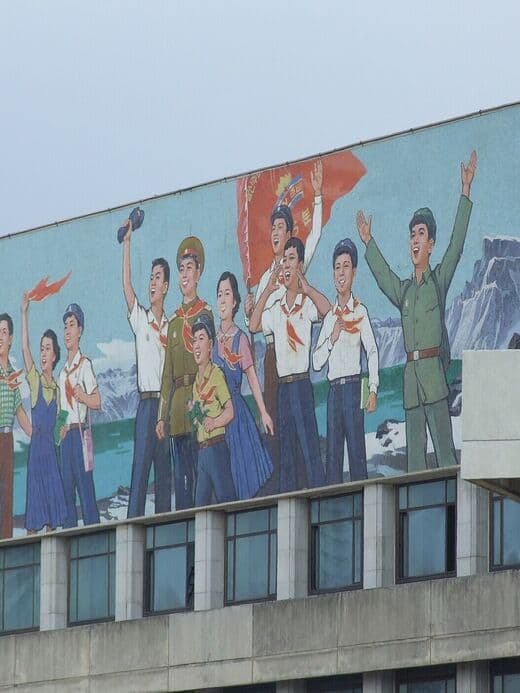
In the DPRK, propaganda is not a separate genre -- it is the only genre. Everything, from architecture to embroidery, from songs to park sculptures, carries an ideological message. But what is fascinating is that over seven decades of this experiment, a unique aesthetic has emerged: the retro-futurism of Pyongyang's skyline, the socialist-realist mosaics of extraordinary technical quality, the poster art that has become a collector's item worldwide. North Korean artists, working within rigid ideological constraints, have achieved remarkable technical mastery in certain forms. The mosaics in the metro, the murals in public buildings, the propaganda posters and postage stamps -- all display a level of craftsmanship that would be impressive in any context. There is a strange beauty in these works, even when -- perhaps especially when -- you recognize the ideology they serve.
The Personality Cult as Total Art
The cult of the Kims in the DPRK is not merely portraits on walls. It is an all-encompassing system that includes: mandatory lapel pins bearing the leaders' images that every citizen must wear; a special calendar (the Juche calendar counts from the year of Kim Il-sung's birth -- 1912 is Year 1); mandatory portraits in every home that must be kept clean with a special cloth provided by the government; an entire philosophical system called Kimilsungism-Kimjongilism as the official state ideology. The scale of this phenomenon cannot be appreciated from photographs alone -- it must be seen and felt in person. When you walk through Pyongyang and realize that every single person is wearing the same small pin on their chest, when you enter an apartment and see the portraits in the position of honor, when you bow before statues that tower above you -- the cumulative effect is overwhelming, whether it inspires reverence, horror, fascination, or some complex mixture of all three.
A City Without the Internet
The DPRK is the only country in the world where citizens have no access to the internet. None whatsoever. There exists an internal network called Kwangmyong with a limited selection of state-approved websites, but the global internet is entirely absent. Smartphones exist (the North Korean brand Arirang and some imported Chinese models), but they can only make domestic calls and access Kwangmyong. For the tourist, this means complete digital disconnection for the duration of your trip -- an experience that many travelers describe as unexpectedly liberating. No emails, no social media notifications, no news alerts. Just you, the bizarre reality around you, and your own thoughts. In an age of perpetual connectivity, there is something almost therapeutic about being forcibly unplugged -- though it is important to remember that for 25 million North Koreans, this is not a wellness retreat but an information prison they cannot escape.
The Two-Speed Economy
In the DPRK, two parallel economic systems coexist: the official planned economy (with distribution cards and state-assigned housing) and the unofficial market economy (the 'jangmadang' -- markets where everything from food to electronics is traded). From the window of your tourist bus, you may catch glimpses of these markets -- splashes of color and commerce against the gray socialist urban landscape. Your guides will typically try to redirect your attention, but an observant tourist will notice improvised trading stalls, women pushing carts loaded with goods, mobile phone sellers, and other signs of a grassroots market economy that technically should not exist but has become essential to daily survival. This shadow economy has grown dramatically since the famine of the 1990s and is now an integral part of how North Korea actually functions, even as the official narrative maintains the fiction of a fully planned system.
Pyongyang After Dark
Pyongyang after sunset is a sight that will stay with you long after you leave. In a city where electrical power is chronically scarce, darkness descends like a curtain. Only the major monuments and party buildings are illuminated, creating a surreal tableau: the bright lights of the Juche Tower and the Arch of Triumph floating in a sea of blackness. The stars above Pyongyang are visible as they are above no other capital city in the world -- there is virtually zero light pollution. It is simultaneously beautiful and deeply unsettling. You stand on your hotel balcony looking out at a city of 3 million people, and it looks almost empty, almost abandoned, punctuated only by islands of political light. Satellite photographs of the Korean Peninsula at night -- showing the blaze of South Korea and the near-total darkness of the North -- are perhaps the most powerful single image explaining the divergence of these two countries.
Time Frozen in Place
In the DPRK, there are no advertising billboards, no chain coffee shops, no branded stores, no McDonald's, no Starbucks, no TikTok, no Uber. Cars on the streets are a rarity (most of the population moves on foot or by bicycle). Architecture, clothing, music -- everything seems frozen somewhere between the 1960s and the 1980s. For a traveler weary of globalization, weary of every city looking the same with the same international brands and the same Instagram-optimized aesthetics, North Korea is a kind of time machine. But it is vital to remember: for 25 million North Koreans, this is not nostalgic retro chic. This is their everyday reality, one they did not choose and cannot leave.
When to Visit North Korea
The DPRK has a continental climate with clearly defined seasons. Your choice of timing affects not only the weather but also which events and attractions are available.
Best Time: Spring (April -- May) and Autumn (September -- October)
Spring in the DPRK means blooming cherry blossoms and azaleas, comfortable temperatures (59-72F / 15-22C), and the highlight of the year -- the Pyongyang Marathon (typically held in April). The marathon is one of the few events where tourists can run alongside North Korean athletes in front of 50,000 spectators at the May Day Stadium. It is an unforgettable experience: crossing the finish line in the world's largest stadium with thousands of North Koreans cheering is surreal in the best possible way. That said, the 2026 marathon was unexpectedly canceled without explanation, so guarantees are impossible. The Day of the Sun (April 15, Kim Il-sung's birthday) is the country's biggest holiday, accompanied by parades, fireworks, and mass dances on the streets of Pyongyang.
Autumn is the golden season: vivid foliage, dry weather, temperatures of 50-68F (10-20C). October brings the Foundation Day of the Workers' Party of Korea (October 10) with large-scale celebrations. The Mass Games, when scheduled, typically run during September and October. The mountain regions -- Myohyangsan, Kumgangsan, Paektu -- are at their most spectacular in autumn colors.
Summer (June -- August)
Hot (77-95F / 25-35C) and humid. July and August bring monsoon rains that can be torrential and cause flooding, particularly in rural areas. The upside of summer is access to longer itineraries, including the east coast and Mount Paektu (Heaven Lake is only accessible in summer months). The downside is oppressive heat and humidity, with limited air conditioning (not all venues and vehicles are equipped). If you are from the American South or Southeast Asia, the humidity will be familiar; if you are from the UK or Pacific Northwest, prepare to sweat.
Winter (November -- March)
Cold: Pyongyang sees temperatures drop to 5F / -15C or below, with mountain regions even harsher. Tourism is minimal in winter, but this is the season to visit the Masikryong Ski Resort -- one of the few in the DPRK, built at Kim Jong-un's personal insistence and featuring equipment largely purchased from Europe and China. Winter Pyongyang under snow is a striking sight: white empty boulevards, smoking chimneys, residents in identical gray coats. But heating in hotels can be unreliable, daylight hours are short, and some outdoor sites become impractical. Winter tours are significantly cheaper, and groups are smaller, which some travelers consider a worthwhile trade-off.
Key Dates and Events
Important dates that influence tourism options:
- April 15 -- Day of the Sun (Kim Il-sung's birthday). The most elaborate celebrations of the year, often including military displays, mass dances, and fireworks.
- Mid-April -- Pyongyang Marathon (if held). Registration through tour operators only.
- February 16 -- Day of the Shining Star (Kim Jong-il's birthday). Significant celebrations, though smaller in scale than April 15.
- July 27 -- Victory Day (end of the Korean War, which North Korea calls the 'Fatherland Liberation War'). Major events, including veterans' gatherings.
- September 9 -- DPRK Foundation Day. National holiday with celebrations throughout the country.
- October 10 -- Foundation Day of the Workers' Party of Korea. One of the biggest holidays on the calendar.
- September -- October -- Mass Games (if scheduled for that year).
Time your visit to coincide with these dates if you want to see the DPRK in 'celebration mode' -- with parades, mass dances, and fireworks. But be aware that holiday periods bring larger tour groups and potential itinerary changes as the government prioritizes certain venues for official events.
How to Get to North Korea
Getting into the DPRK independently is impossible. You must go through a licensed tour operator. All visas are processed through them, all tickets are booked through them, everything is controlled. There is no backpacker route, no independent visa application, no showing up at the border. This is the single most organized (or controlled, depending on your perspective) form of tourism on Earth.
From China (The Primary Route)
The vast majority of tours begin and end in Beijing. There are two options:
By air: Air Koryo is the DPRK's national carrier and the only airline operating international routes to Pyongyang. Regular flights run from Beijing to Pyongyang (approximately 2 hours). Air Koryo was long considered the worst airline in the world (the only carrier with a 1-star rating from Skytrax), but it has modernized part of its fleet in recent years. In-flight, you will be offered a burger (reportedly surprisingly decent), a selection of beverages, and the airline's in-flight magazine -- one of the few North Korean print publications available to foreigners and a collector's item in itself. As of March 2026, Air China has also resumed a weekly Beijing-Pyongyang service, offering an alternative for those who prefer a more conventional flying experience.
By train: In March 2026, after a six-year hiatus, rail service between Beijing and Pyongyang via Dandong was restored. The journey takes approximately 24 hours. This is an unforgettable experience: you cross the Friendship Bridge over the Yalu River, and within minutes the world outside your window changes fundamentally. The Chinese side is all neon and construction cranes; the Korean side is still, dark, and quiet. The train is an excellent way to gradually acclimate to the DPRK reality rather than being dropped into it suddenly from a plane. The pace forces contemplation. Fellow passengers in the international compartment tend to be a fascinating mix -- aid workers, diplomats, experienced DPRK tourists, and the occasional journalist. Pro tip: bring snacks and a bottle of something to share. The dining car on the Chinese side of the journey is adequate; on the Korean side, it is an experience in itself.
From Russia
Russia is one of the few countries whose citizens can currently visit the DPRK (as of early 2026). Direct flights operate from Vladivostok to Pyongyang via Air Koryo. There is also a rail route through Khasan-Tumangan (the border crossing on the Russia-North Korea frontier). Trains run irregularly, but the route through the Russian Far East is extraordinarily scenic. For Westerners, this option is currently irrelevant since Western nationalities cannot enter, but it is worth knowing about for when restrictions ease.
From the United States
Not possible. Since September 1, 2017, a US State Department travel ban makes it illegal for American citizens to use their passports to travel to, through, or within North Korea. This restriction was imposed after the tragic case of Otto Warmbier and remains in effect with no sign of being lifted. Violating the ban can result in passport revocation and criminal penalties. Special validation passports can be issued for journalists, humanitarian workers, and certain professional categories, but these are rare and require a lengthy application process through the State Department. If you are an American citizen, you cannot legally visit North Korea. Period.
From South Korea
Impossible. Citizens of South Korea are prohibited from visiting the DPRK, and vice versa. This is one of the lasting tragedies of the Korean division -- families separated by the border have, in most cases, had no contact for over 70 years.
Who Can Currently Visit? (As of Early 2026)
- Russian citizens -- can visit as tourists. Russian tour operators offer group and individual tours with Russian-speaking guides.
- Chinese citizens -- resumption of tourism expected in mid-2026 (not officially confirmed).
- Citizens of Western countries (Europe, Canada, Australia, NZ) -- entry currently closed to tourists. Some diplomatic and humanitarian access remains.
- Citizens of the US, South Korea, Japan -- entry prohibited.
This situation can change at any moment. Check with licensed tour operators for the latest information: Koryo Tours (the most established Western operator, based in Beijing), Young Pioneer Tours, Uri Tours, KTG Tours. These operators maintain direct contacts with the DPRK's Korea International Travel Company (KITC) and will have the most current access information.
A note for Americans planning ahead: Even when/if the DPRK reopens to Western tourists, the US travel ban is a separate legal restriction imposed by the US government. Unless the ban is explicitly lifted, American citizens will remain unable to visit regardless of North Korea's own entry policies. Follow updates from the State Department's Bureau of Consular Affairs.
Transportation Inside North Korea
The short answer: you will not be independently using any transportation. Your entire itinerary is covered by a bus or minibus with a driver assigned to your group. But understanding the DPRK's transport system helps you understand the country itself -- and gives you context for the extraordinary things you will see from your bus window.
Tourist Transport
Your group moves by air-conditioned bus (quality ranges from new Chinese-made coaches to well-worn vehicles of uncertain vintage). Between cities, you travel on roads of varying quality. The Pyongyang-Kaesong highway (approximately 170 kilometers) is arguably the best road in the country: wide, smooth, and empty. Literally empty -- you can drive for tens of kilometers without encountering another vehicle. This is one of those surreal DPRK experiences: a highway built to international standards with virtually no traffic. Your bus, a few military trucks, occasionally a lone cyclist -- and miles of pristine, deserted asphalt. Roads beyond the main arteries deteriorate quickly: potholes, no lane markings, sometimes unpaved surfaces. Average intercity speed is 25-40 mph (40-60 km/h), which means transfers between cities take longer than the distance would suggest.
Railways
The DPRK's railway network is one of the oldest in Asia (originally built by the Japanese during the colonial period). Trains are slow (average speed 25-30 mph / 40-50 km/h) and unpunctual by several hours. For tourists, train rides are sometimes included in itineraries -- this is a unique opportunity to see rural North Korea from a train window, something the bus routes typically avoid. Uniformed conductors, clean compartments, thermoses of hot water, propaganda speakers in each car -- it all has a distinctly Soviet feel that older travelers may find nostalgic and younger ones will find alien.
Pyongyang Metro
The Pyongyang Metro is not only a tourist attraction but a genuinely functioning transit system with two lines (Chollima and Hyoksin) and 16 stations. Tourists are usually allowed to ride one or two stops. The train cars are modernized German vehicles -- former Berlin U-Bahn stock, donated by East Germany and subsequently refurbished. Passengers ride in calm silence, ostensibly ignoring the foreign visitors (or doing a very convincing job of pretending to). Watch how people board, how they read the newspaper on the wall, how children behave, how everyone exits in orderly fashion. These micro-observations of daily life are among the most valuable moments of the trip.
Aviation
Air Koryo operates a limited number of domestic routes, but these are generally not available to tourists. Domestic flights are used primarily by the party elite and military officials. An exception is the flight to Samjiyon, the nearest airport to Mount Paektu, which is sometimes included in extended tours.
Public Transportation in Pyongyang
Pyongyang has trolleybuses and trams -- old but functioning. Buses also operate, though they are frequently overcrowded. Taxis have appeared in recent years (recognizable blue and green vehicles), but tourists do not use them. Bicycles have become increasingly popular -- the streets now feature growing numbers of cyclists, particularly women. The famous traffic ladies of Pyongyang -- female traffic officers who direct vehicles with precise, almost robotic movements at major intersections -- are a genuine sight, though their numbers have decreased as traffic lights have been installed.
Car Rental
Not possible for foreigners. And even if it were, driving in the DPRK without local knowledge would be extremely problematic: minimal road signs, no GPS navigation, military checkpoints, and the very real risk of accidentally entering a restricted area. This is one country where being driven is not a luxury but a necessity.
The Cultural Code of North Korea
Understanding the DPRK's cultural code is not about deepening your cultural appreciation -- it is about your safety. Violating the unwritten (and written) rules can lead to serious consequences, up to and including detention and imprisonment. This is not a place where 'ignorance of the law' serves as an excuse.
Rules That Must Not Be Broken
Respect for the leaders is absolute. No jokes, no parodies, no critical remarks about Kim Il-sung, Kim Jong-il, or Kim Jong-un. Never. Not even jokingly. Not even in a whisper in your hotel room (rooms may be monitored). This is not paranoia -- this is documented reality. When photographing statues and portraits of the leaders, capture the entire figure without cropping. Do not point at images of the leaders. Newspapers bearing leaders' portraits must not be folded or crumpled. If you are from a culture where irreverent humor is second nature -- and if you are American, British, or Australian, that almost certainly means you -- you need to consciously suppress that instinct for the duration of your visit. A joke that would get laughs at a dinner party back home could get you detained in Pyongyang.
Photography. Always ask your guides for permission before shooting. You cannot photograph: military personnel, construction sites, people in unflattering situations, the 'unscripted' side of life. Guides may ask you to delete photos -- comply without argument. At the border upon departure, your phone and camera may be inspected. Some travelers report that this inspection is thorough; others say it was cursory or skipped entirely. Do not gamble on the latter. If you have photos you want to keep but that might be borderline, consider uploading them to cloud storage (before entering the DPRK, since there is no internet inside) and keeping them off your device during the exit inspection.
Interaction with locals. Speaking to North Korean citizens without your guides' permission is prohibited. It can be construed as espionage. Even if a Korean speaks to you first (which is unlikely), your guides must be present. This rule is frustrating but non-negotiable. The people you see on the street, in the metro, in the parks -- they inhabit the same physical space as you but exist in an entirely different reality, and the barrier between you is not merely linguistic.
Religious materials. Importing Bibles, Qurans, or any religious literature is strictly forbidden. South Korean books, films, and music are also banned. Pornography, political literature, and critical journalism about the DPRK -- all confiscated at the border. The penalties for smuggling in prohibited materials can be severe. Do not test this.
Behavior at the Mausoleum and Monuments
When visiting the Kumsusan Palace of the Sun and the Mansudae Grand Monument (the giant bronze statues of the Kims), you are expected to bow. This is not a request -- it is a requirement. Refusal will be seen as a serious insult and can sour the experience for your entire group. Dress strictly: long trousers, closed shoes, long-sleeved shirts. No shorts, tank tops, or sandals. If you arrive inappropriately dressed, you may be denied entry entirely -- and given that the mausoleum only opens on certain days, you will not get a second chance.
Tipping
Officially, tipping does not exist in the DPRK. In practice, your guides and driver expect 'gifts' at the end of the tour. The standard is EUR 20-50 / USD 22-55 per guide and EUR 10-20 / USD 11-22 for the driver for a week-long tour. You can also give items: quality liquor, cosmetics, cigarettes. Your guides will spend every waking minute with you -- if they do their job well, generosity is appropriate and appreciated. Some travelers report that a good tip noticeably improves the flexibility and openness of their guides on the second half of the tour.
Alcohol and Evening Entertainment
North Koreans are a drinking culture, and alcohol is one of the few 'bridges' between tourists and guides. In the evening at your hotel, you can drink Taedonggang beer (a decent brew -- more on that in the food section) or soju (Korean rice spirit) with your guides. These evening sessions are arguably the most genuine human interactions of the entire trip -- the one time when the atmosphere relaxes slightly and your guides become marginally more candid. They might share personal stories, ask questions about your country, even crack the occasional joke. Do not overindulge: drunken behavior by a foreigner creates problems for your guides, who are responsible for you. And never, under any circumstances, use a loosened atmosphere as an excuse to ask provocative political questions. The relaxation has limits, and your guides know where those limits are even if you do not.
Korean Politeness
Korean culture -- both North and South -- is built on Confucian principles: respect for elders, hierarchy, saving face. Do not argue with your guides publicly. If you want to discuss something sensitive, do so gently and in private. Do not put your guides in an awkward position with provocative questions in front of the group. Remember: your guides are not merely tour guides. They are people living within a system they did not choose, and they bear responsibility for every word they say. Treat them with the respect and empathy you would want if the roles were reversed.
Safety in North Korea
Paradoxically, the DPRK is one of the safest countries in the world for tourists in terms of street crime. You will not be mugged, pickpocketed, or scammed by street hustlers. There are no aggressive touts, no taxi scams, no petty thieves targeting tourists. The risks here are of a fundamentally different nature.
The Biggest Risk: Yourself
The greatest danger in the DPRK is your own behavior. The story of Otto Warmbier -- an American student detained in January 2016 for allegedly attempting to steal a propaganda poster from his hotel and sentenced to 15 years of hard labor -- is not a cautionary tale. It is a tragedy. Warmbier was returned to the United States in June 2017 in a comatose state and died shortly after. His family believes he was tortured. The North Korean government claims he contracted botulism and took a sleeping pill. Whatever the truth, the outcome was fatal. Do not attempt to 'test the system.' Do not take 'souvenirs' without permission. Do not try to evade your guides. Do not photograph covertly. Do not venture outside your hotel at night (some hotels are on islands or in compounds specifically to prevent this). The rules exist, and the consequences of breaking them are real and severe -- up to and including years of imprisonment in conditions that defy description.
Detention
If you are detained, your government will most likely be unable to help you -- most Western countries do not have embassies in the DPRK. Sweden represents the interests of several nations (including the United States, Canada, and Australia) through its embassy in Pyongyang, but its practical capabilities are extremely limited. Negotiations for the release of detained foreigners have historically taken months or years and have involved high-level diplomatic or political intervention. Do not put yourself in a position where this becomes relevant.
Road Safety
Roads between cities are in poor condition. There is no street lighting outside of Pyongyang. Local drivers sometimes drive without headlights at night to conserve energy (or because they lack functioning headlights). Accidents are possible, and emergency medical services may take hours to arrive -- or may not come at all. Fortunately, tourist drivers are typically experienced and cautious, and drive during daylight hours whenever possible.
Natural Disasters
The DPRK is prone to flooding (especially during the monsoon season, July-August) and droughts. Earthquakes are possible but rare. The country's disaster response infrastructure is minimal. If you are traveling during monsoon season, be prepared for itinerary disruptions and, in extreme cases, delayed departures.
Emergency Contacts
Forget 911, 999, or 112. There are no emergency numbers accessible to tourists in the DPRK. Your guide is your only connection to external assistance. Make sure you have the contact information of your tour operator outside the DPRK and that someone at home knows your itinerary. Consider leaving a detailed copy of your travel plans, passport information, and emergency contacts with a trusted person before departure.
Health and Medicine
Medical preparation for a trip to the DPRK should be more thorough than for most other countries. This is not a destination where you can rely on local healthcare -- it barely exists in a form recognizable to Westerners.
Vaccinations
There are no mandatory vaccinations for entry, but the following are recommended: Hepatitis A and B, typhoid, tetanus, diphtheria, Japanese encephalitis (if traveling to rural areas in summer). Malaria risk is minimal but exists in southern areas of the country during warm months. Consult your travel medicine clinic at least 6-8 weeks before departure for the most current advice.
First Aid Kit
Bring everything you might need: painkillers (ibuprofen, acetaminophen/paracetamol), anti-diarrheal medication (loperamide), antihistamines, antiseptic wipes and cream, band-aids, insect repellent, sunscreen, rehydration salts, any prescription medications you take regularly (bring more than you need, in original packaging with the prescription label). There are no pharmacies accessible to foreigners in the DPRK. Your guide can try to help obtain medications, but the selection is extremely limited and the quality unpredictable. If you need something specific, you will not find it.
Water and Food
Do not drink tap water under any circumstances. Use only bottled water (provided in hotels and during excursions). Food in tourist restaurants and hotels is safe and generally good quality. However, if you have a sensitive stomach, exercise caution with unfamiliar dishes. Street food is unlikely to be offered to you, but if it is, use judgment. Hand sanitizer is your friend.
Medical Facilities
DPRK hospitals suffer from chronic shortages of everything: equipment, medications, trained staff. For foreigners, there is the Pyongyang Friendship Hospital, but its capabilities are limited by Western standards. Any serious medical emergency -- a broken bone, appendicitis, heart attack, allergic reaction requiring epinephrine -- will require evacuation to China (Beijing or Shenyang), and this can take time to arrange, especially if you are outside Pyongyang.
Insurance
Medical insurance with evacuation coverage is not optional -- it is essential. Make sure your policy explicitly covers the DPRK (many standard travel insurance policies exclude this country). The cost of medical evacuation from Pyongyang to Beijing can run to tens of thousands of dollars. Companies like World Nomads, Battleface, and IMG Global offer policies that cover the DPRK, but read the fine print carefully. If your existing insurance does not cover North Korea, purchase supplementary coverage.
Money and Budget
The monetary system of the DPRK is one of the most unusual in the world, and for tourists it operates completely differently than for locals.
Currency
The official currency is the North Korean won (KPW). But you will most likely never see it, let alone use it. Foreigners are prohibited from using local currency. All purchases in foreigner-designated shops, hotels, and on excursions are conducted in foreign currency: euros, Chinese yuan, US dollars. The euro is the most preferred currency (due to American sanctions, dollars are accepted reluctantly if at all). You can obtain some North Korean won as a souvenir -- your guides can help you exchange a small amount on the unofficial market (technically gray-market but universally practiced). The won notes, with their depictions of the leaders, make unique keepsakes.
Cash Is the Only Option
There are no ATMs for foreigners in the DPRK, no card terminals, no credit card acceptance. None. Not Visa, not Mastercard, not Amex, not UnionPay. Bring all the cash you need in euros (small denominations -- EUR 5, 10, 20 notes are most practical) and Chinese yuan (if transiting through Beijing). Some establishments also accept US dollars, but do not count on it. This is an entirely cash economy for foreigners. Make sure your bills are clean, relatively new, and undamaged -- torn or heavily worn notes may be refused.
Tour Costs
A tour to the DPRK is an all-inclusive package: international transport (flight or train), visa processing, accommodation, meals (three per day), in-country transport, guides, entrance fees. Typical prices from established tour operators:
- Short tour (4-5 days): EUR 800-1,200 / USD 880-1,320
- Standard tour (7-8 days): EUR 1,500-2,500 / USD 1,650-2,750
- Extended tour (10-14 days): EUR 2,500-4,000 / USD 2,750-4,400
- Private/individual tour: Significantly more expensive -- from EUR 2,000 / USD 2,200 for just 4 days
Prices depend on: season, group size (larger groups mean lower per-person costs), itinerary, and hotel grade. Budget travelers should aim for the larger group departures during peak season; those wanting a more intimate experience should consider the pricier individual tours, where you have your own guides and can sometimes negotiate minor itinerary adjustments.
What to Spend Money on Once There
Your main expense will be souvenirs from the foreigner-designated shops: stamps (from EUR 1), postcards, propaganda posters, North Korean paintings (EUR 10 to EUR 500+), embroidery, ginseng products, books and pamphlets in various languages. Taedonggang beer costs EUR 1-2 per bottle at the hotel bar. Additional activities like bowling, swimming at the hotel pool, or table tennis run EUR 5-10. Some hotels have karaoke bars where you can sing North Korean and international songs -- a surreal and highly recommended evening activity that typically costs a few euros.
Pocket Money Budget
For a one-week tour, plan to bring EUR 200-400 / USD 220-440 above your tour cost: EUR 50-100 for souvenirs, EUR 50-100 for drinks and extra food, EUR 50-100 for tips to guides and driver, and the rest as a reserve. It is always better to bring too much cash than too little -- you cannot access more once you are inside the country, and any leftover foreign currency comes back with you. Running out of cash on day three of a seven-day tour would be thoroughly unpleasant.
Itineraries for North Korea
An important thing to understand: you do not design your own itinerary. You choose a tour from an operator, and the route has already been approved by the DPRK authorities. But knowing what itineraries exist helps you select the tour that best matches your interests. Below are the typical routes offered by the major tour operators, expanded with practical tips from those who have traveled them.
7 Days -- 'Classic Pyongyang and Beyond'
The standard format for a first visit to the DPRK. Long enough to get a genuine feel for the country, short enough to maintain the novelty without the experience becoming grinding.
Day 1: Arrival in Pyongyang (from Beijing by air or train, or from Vladivostok). Check into the Yanggakdo International Hotel, located on an island in the Taedong River -- isolated from the city, which is intentional. The Yanggakdo is the most commonly used tourist hotel: 47 floors, revolving restaurant on top, bowling alley, swimming pool, karaoke bar, billiard room. The rooms are clean but dated, with a certain Soviet-era charm. Your first evening includes an orientation drive through central Pyongyang: Kim Il-sung Square, the Taedong River embankment, and your first glimpse of the illuminated monuments against the dark city skyline. Dinner at the hotel restaurant. Many travelers find the first evening overwhelming -- the sheer strangeness of the environment takes time to process. Use the hotel's bar or rooftop restaurant to decompress and compare notes with fellow travelers.
Day 2: Morning visit to the Kumsusan Palace of the Sun (open on specific days -- typically Thursday, Saturday, Sunday, and holidays). Strict dress code is mandatory. This is the most emotionally intense part of the tour for many visitors. After lunch, the Mansudae Grand Monument (mandatory bow at the bronze statues of the leaders), the Juche Tower (ascend to the observation deck for the best panoramic view of Pyongyang), and the Monument to the Foundation of the Workers' Party of Korea. Evening: the Taedonggang Brewery Bar, the DPRK's only microbrewery, offering seven varieties of beer. The atmosphere here is surprisingly relaxed, and it is one of the rare venues where you might see North Korean locals enjoying a night out. The dark lager (No. 3) and wheat beer (No. 6) are widely considered the best.
Day 3: Full day excursion to Kaesong and the DMZ (Panmunjom). Early departure (3-4 hours by road). The drive south on the empty highway is an experience in itself. At the DMZ: the Military Demarcation Line, the armistice negotiation room, the blue UN buildings, and the North Korean military officers' perspective on the Korean War. Lunch in Kaesong at a traditional Korean house -- a multi-dish spread called pansang featuring 12-15 small plates of different foods. On the return journey, a stop at the Reunification Monument (an arch formed by two female figures representing the two Koreas, leaning toward each other). Evening in Pyongyang.
Day 4: Transfer to Mount Myohyangsan (2-3 hours). Stop en route at a cooperative farm for a guided look at North Korean agriculture. Check into the Hyangsan Hotel (a mountain hotel with decent facilities and good views). The International Friendship Exhibition -- the underground museum of gifts presented to the Kims. This is one of the strangest museums you will ever visit, and you could easily spend two hours here without exhausting the bizarreness. Evening: a walk in the mountain surroundings near the hotel, fresh air after the intensity of Pyongyang.
Day 5: Morning trekking in the Myohyangsan mountains (trails of varying difficulty -- your guides will advise based on your fitness level). Visit to Pohyon Temple, the 11th-century Buddhist temple. Waterfalls and forest trails. Lunch in a local restaurant or picnic-style in the mountains. Return drive to Pyongyang in the afternoon.
Day 6: Pyongyang Metro (ride through the ornate underground stations), the Arch of Triumph, and Mangyongdae (Kim Il-sung's birthplace and the adjacent funfair). Afternoon options may include: the Pyongyang Circus (genuinely impressive acrobatic performances), the embroidery factory, or Department Store No. 1 (a fascinating window into the consumer goods available to Pyongyang's elite). Farewell dinner with your guides -- this is the traditional occasion for gift-giving and tipping. Many travelers report this final dinner as one of the most genuine moments of the trip, as guides relax knowing the tour has gone smoothly.
Day 7: Morning departure by flight or train to Beijing.
10 Days -- 'The Deep Dive'
For those who want to see more than the standard package, adding the east coast and the DPRK's second city to the Pyongyang-DMZ-Myohyangsan core.
Days 1-5: Pyongyang + DMZ + Myohyangsan (as in the 7-day itinerary).
Day 6: Transfer to the east coast -- Wonsan (5-6 hours via a scenic mountain pass). The drive itself is a highlight: you pass through rural North Korea that is absent from the capital-centered itineraries. Rice paddies, ox carts, roadside villages, children waving. The mountain pass offers dramatic views. Check into a coastal hotel. Evening on the beach -- one of the most unexpected and peaceful moments of a DPRK tour.
Day 7: Wonsan: the seaport, a fish market (one of the livelier places you will see), the resort area. Trip to Lake Sijung. A boat ride if weather permits. Meals here feature fresh seafood -- clams, fish, sea cucumber, and more -- that surpass what you get in Pyongyang. This is one of the days where the DPRK feels least like a controlled tour and most like an actual vacation.
Day 8: Transfer to Hamhung (the DPRK's second-largest city). An industrial center that is notably less polished than Pyongyang, which makes it more interesting in many ways. The Hamhung Grand Theatre, views of chemical factories (from outside), a local market if your guides allow it. The signature dish: hamhung naengmyeon -- fiery cold noodles with a potato starch base. If you enjoy spicy food, this is a revelation. If you do not, approach with caution.
Day 9: Return to Pyongyang. Free time (under guide supervision): hotel amenities, final souvenir shopping. A farewell dinner featuring Korean barbecue -- arguably the best meal of the trip, with high-quality meats grilled at the table and an array of banchan (side dishes).
Day 10: Departure.
14 Days -- 'The Extended Expedition'
A comprehensive tour that adds Mount Paektu and more off-the-beaten-path destinations to the standard route. Not always available and not offered by all operators.
Days 1-8: The core route (Pyongyang + DMZ + Myohyangsan + East Coast + Hamhung).
Days 9-10: Internal flight to Samjiyon (the nearest airport to Mount Paektu). Ascent to Heaven Lake (Chon) -- the crater lake at the summit of Paektu. Kim Il-sung's guerrilla camps. The 'secret base' of Paektu -- the location where Kim Jong-il was allegedly born. Overnight in a mountain hotel. The Paektu region is genuinely remote and spectacularly beautiful. The weather can be brutal even in summer, so pack warm layers regardless of the calendar month. When the lake is visible -- and it is not always, due to fog and cloud cover -- the sight is breathtaking. A deep blue lake cradled by volcanic rock and snow at 2,744 meters above sea level. This is the spiritual heart of Korean identity, claimed by both North and South, and the power of the landscape transcends politics.
Days 11-12: Return to Pyongyang. Additional sites: the Central Zoo (surprisingly large, with an aquarium section), the Korean Film Studio (North Korea's version of Hollywood, where propaganda films are produced on elaborate sets), a boat ride on the Taedong River, and the Victorious Fatherland Liberation War Museum (the country's largest museum, devoted to the Korean War and featuring captured American military equipment including the USS Pueblo). The museum tour includes an enormous 360-degree cyclorama painting depicting a battle scene that is genuinely impressive as a piece of art, whatever you think of the political narrative.
Days 13-14: Final purchases, any sites not previously covered, and departure. Some extended tours also include Nampo and the West Sea Barrage on these final days.
21 Days -- 'The Ultimate DPRK Experience'
The maximum format, for those who want to see as much of the accessible DPRK as possible. Rare, expensive, and unforgettable.
Days 1-14: The extended route as above.
Days 15-21: Can include: Nampo and the West Sea Barrage, Sariwon (a provincial city with a folk village), Mount Kumgang (the Diamond Mountains -- if currently accessible), Chongjin (the third-largest city, industrial northeast, rarely visited and fascinatingly raw), and the Rason Special Economic Zone (where the borders of Russia, China, and North Korea converge, and where a limited form of market economy is permitted). Each of these destinations is a different world from showcase Pyongyang. Sariwon offers a glimpse of small-town North Korea. Chongjin reveals the industrial reality that the regime prefers tourists not to see. Rason, with its cross-border trade and slightly looser atmosphere, hints at what the DPRK might become if it ever follows China's path of economic opening. A three-week tour is an extraordinary commitment of time and money, but those who have done it describe it as one of the most profound travel experiences of their lives.
Communication and Internet
Prepare for a digital detox -- it is unavoidable, and according to many tourists, unexpectedly pleasant.
Mobile Phone Service
Foreign SIM cards do not work in the DPRK. At all. Your phone becomes a camera and an alarm clock. Since 2013, tourists can purchase a local SIM card for foreigners (operator Koryolink), but it only allows international calls (not domestic calls within the DPRK) and is expensive: approximately EUR 50 / USD 55 for the SIM card plus about EUR 0.60 / USD 0.66 per minute for international calls. eSIM is naturally not supported. Data services are not available on tourist SIMs. Most tourists simply go without phone service for the duration of the trip. If you need to make an emergency call home, your hotel can usually arrange an international call for a fee.
Internet
There is no internet. No Wi-Fi, no mobile data, no internet cafes. The internal Kwangmyong network is accessible only to DPRK citizens. If you critically need connectivity, you could theoretically bring a satellite phone (formally permitted, though confiscation at the border is possible). In practice, almost no tourist does this. Some hotels in Pyongyang offer access to international telephone lines at additional cost, but this is voice only, not data. You will not be checking email, posting to Instagram, or scrolling through news for the entire duration of your stay.
Postal Service
The only way to communicate with the outside world (besides telephone) is to send a postcard. North Korean postal service is slow but functional -- postcards from Pyongyang reach recipients around the world in 2-6 weeks. The postmark reading 'Pyongyang, DPR Korea' on a postcard is an excellent souvenir in itself, and sending cards to friends and family has become something of a tradition among DPRK tourists. Stamps are available at the hotels and at the philatelic shop in central Pyongyang.
What to Do Without Internet
Download all necessary maps, guidebooks, and translation tools before your trip (see the Apps section below). Bring an e-reader loaded with books. A physical notebook and pen are essential for recording observations -- keeping a detailed journal is one of the best ways to process the DPRK experience. If you are accustomed to sharing your travels on social media in real time, you will need to adjust your expectations: everything gets posted after you return. Many travelers find that this forced delay actually improves the quality of their reflections and their writing about the trip. Without the pressure to curate a live feed, you are freed to simply observe, think, and experience.
What to Eat: North Korean Cuisine
North Korean cuisine is one of the most pleasant surprises of the trip. Despite stereotypes about a starving country, tourist restaurants serve food that is genuinely good, often excellent, and impressively varied. The important caveat is that the food served to tourists and the food available to ordinary citizens are two entirely different realities -- but what you eat on your tour is nonetheless an authentic expression of Korean culinary tradition.
Essential Dishes
Pyongyang naengmyeon (cold noodles): The signature dish of North Korean cuisine and arguably the single best thing you will eat in the DPRK. Buckwheat noodles served in an ice-cold broth (meat-based or radish-based) with thin slices of beef, a hard-boiled egg, pickled cucumbers, and Asian pear. Served with mustard and vinegar on the side. You eat it with scissors (the noodles are literally cut in the bowl -- a practice that surprises first-timers) and a long-handled spoon for the broth. The best place is the Okryu Restaurant in Pyongyang, which has specialized in this dish for over 50 years and is considered the gold standard. Even in South Korea, many food critics acknowledge that the Northern version of naengmyeon is the superior original. The dish is served year-round but is particularly refreshing in summer. If you eat only one thing in North Korea, make it this.
Hamhung naengmyeon: The version from the city of Hamhung is an entirely different dish: noodles made from potato starch (chewier and more 'bouncy' than the buckwheat version), served without broth, with a fiery red pepper sauce and raw fish. Significantly spicier than the Pyongyang variety. If you enjoy Korean or Thai levels of heat, you will love it. If you do not, approach with caution and keep water nearby.
Korean barbecue: Meat (pork, beef, duck) grilled on a tabletop barbecue right in front of you. Served with lettuce and perilla leaves for wrapping, garlic, gochujang paste, and kimchi. This is a dish shared by both Koreas, and the DPRK version is excellent -- the quality of the meat in tourist restaurants is high, and the communal experience of grilling and eating together creates a convivial atmosphere. Pair it with Taedonggang beer for the full experience.
Kimchi: No Korean meal is complete without kimchi. In the DPRK, kimchi tends to be less spicy and less sweet than its South Korean counterpart -- closer to the traditional ancestral recipe. Dozens of varieties exist: napa cabbage (the classic), radish, cucumber, green onion, and more. You will eat kimchi at every meal, and by the end of the trip, you may find yourself craving it back home.
Insam (ginseng): Korean ginseng is considered among the finest in the world, and in the DPRK it appears everywhere: in soups, teas, tinctures, candy, and alcohol. Ginseng tea is a standard part of any tourist meal, served hot and slightly bitter. The health claims are numerous and ancient. Whether or not you believe in ginseng's medicinal properties, the flavor is distinctive and the cultural significance is real.
Sinseollo (royal hotpot): An elaborate dish of meat, fish, eggs, mushrooms, and vegetables cooked in a special pot with a charcoal insert. Beautiful presentation and complex flavors -- this is Korean haute cuisine. It is not served at every meal but appears on special occasion dinners and at higher-end restaurants. If your tour includes a sinseollo dinner, you are in for a treat.
Dog meat (dangogi): Yes, it is served. No, you will not be forced to try it. But if offered, know that it is a traditional dish, typically served in a soup or stir-fried, and many Koreans (both North and South) consider it a delicacy, especially in summer months when it is believed to help endure the heat. If this bothers you, simply tell your guide and it will not appear on your plate. No one will be offended.
Clam barbecue: Available primarily on the east coast around Wonsan, this is a memorable experience -- large clams grilled over open flame, served with a dipping sauce. Fresh, simple, and delicious. If your itinerary includes the east coast, this is a culinary highlight.
Drinks
Taedonggang beer: The crown jewel of DPRK beverages. The backstory alone is worth knowing: in 2000, North Korea purchased an entire brewery -- the Ushers of Trowbridge facility in Wiltshire, England -- disassembled it, shipped it to Pyongyang, and reassembled it on the banks of the Taedong River. The beer is brewed to German purity standards and comes in seven varieties. Reviews from beer enthusiasts are consistently positive -- this is not some exotic novelty but a genuinely well-made lager. The dark variety (No. 3) has notes of chocolate and coffee; the wheat beer (No. 6) is light and citrusy. At EUR 1-2 per bottle in your hotel bar, it is excellent value and one of the more enjoyable ways to end a day of monument-visiting and ideological performance.
Soju: Korean rice spirit, typically 20-25% ABV. Served cold, in small glasses. The taste is milder than vodka, with a slight sweetness. North Korean soju is less commercialized than the South Korean version (think small-batch artisan versus mass-market) and many travelers find it superior. Drinking soju with your guides in the hotel bar is one of the few bonding experiences that transcend the tourist-guide barrier.
Ginseng liquor: A local specialty -- spirit infused with ginseng root. The taste is distinctive (bitter, herbal, with a medicinal quality) and it is an excellent souvenir. A bottle costs EUR 5-15 depending on quality and age.
Tea: Green tea, corn tea, barley tea, and ginseng tea are widely available and served frequently. Coffee is rare in the DPRK, and its quality is inconsistent at best. If you are caffeine-dependent, bring instant coffee sachets or caffeine pills as a backup.
Meal Format
Hotel breakfast is a buffet-style mix of Western and Korean items: eggs, toast, rice, kimchi, soup, fruit. Lunch and dinner are served at restaurants tied to the itinerary. A typical meal includes rice, soup, a meat or fish dish, and 4-6 types of banchan (side dishes), with fruit for dessert. Portions are generous. Vegetarians will find things more challenging -- notify your tour operator well in advance so that menus can be adjusted. Vegan options are very limited and require significant advance coordination. Food allergies should also be communicated clearly before departure, as ingredient information at restaurants may be unreliable.
What to Bring Home: Shopping in North Korea
Shopping in the DPRK is not about fashion brands or electronics. It is about acquiring unique objects that are impossible to buy anywhere else in the world -- artifacts from a parallel reality.
The Best Souvenirs
Postage stamps: North Korean stamps are collected worldwide. Vividly colored, ideologically charged, with extraordinary detail and printing quality. The philatelic shop in central Pyongyang offers an enormous selection, from EUR 1 per stamp to complete sets for EUR 50+. Some series (space exploration, military hardware, sports) are genuine works of graphic art. Even if you have never collected stamps, the DPRK's output might convert you. These are not just postage -- they are miniature propaganda posters, and they are beautiful.
Propaganda posters: Original lithographs cost EUR 10-100. These are not reproductions -- they are genuine products of North Korea's propaganda apparatus, executed with remarkable technical skill. Bold red and blue colors, muscular workers, smiling children, menacing rockets, triumphant soldiers -- the entire visual vocabulary of Juche ideology is available for the price of a restaurant meal back home. They make striking wall decorations and never fail to spark conversation.
Paintings: North Korean artists work in the socialist realist tradition and have achieved genuine mastery within it. Landscapes, portraits, historical scenes -- from EUR 20 to EUR 500+. The technical execution often impresses art professionals. Paintings are sold at the Mansudae Art Studio in Pyongyang, where you can sometimes watch artists at work. Higher-end works can cost significantly more but may appreciate in value over time -- North Korean art has a growing collector's market internationally.
Ginseng products: Korean ginseng is a world standard. In the DPRK, it is cheaper than in South Korea: tinctures, teas, capsules, dried roots. Quality is high, though certification is a matter of trust rather than verifiable documentation. Ginseng products make practical gifts that people will actually use.
Embroidery: Hand embroidery is a traditional Korean craft, and the Pyongyang Embroidery Factory produces works of astonishing quality: landscapes, animals, and portraits executed in silk thread with photographic precision. Prices range from modest (a small piece for EUR 20) to significant (large works for EUR 200+). The technical skill on display is genuinely remarkable.
Books and pamphlets: Foreign-language bookshops sell works in English, Russian, Chinese, and other languages: collected works of the Kims, Korean language textbooks, photography books, tourist guides, and ideological treatises. Prices are nominal (EUR 1-5). These publications offer a window into the regime's self-presentation and are fascinating historical documents regardless of their propaganda content. A copy of 'On the Juche Idea' or 'Kim Il-sung: Condensed Biography' makes a unique addition to any bookshelf.
Alcohol: Ginseng liquor, soju, Taedonggang beer -- excellent gifts. The packaging with North Korean symbols and Korean script is a bonus. Note that bottled beer is heavy, so plan your luggage allowance accordingly.
Where to Buy
Foreigner-designated shops at hotels, the philatelic shop in central Pyongyang, the Mansudae Art Studio, the embroidery factory, and jewelry stores. All of these locations are part of the standard tourist itinerary, so you will have opportunities to browse without seeking them out. Prices in these shops are fixed -- bargaining is not part of the culture in state-run stores.
Customs Restrictions
You cannot export: large quantities of North Korean won, or items with state symbols without authorization (though in practice, souvenirs with state imagery are sold openly). An important note for travelers returning to Western countries: some nations impose sanctions that technically prohibit the import of North Korean goods. In the EU and the US, importing goods from the DPRK falls under sanctions regulations -- legally, you may not be permitted to bring even souvenirs. In practice, personal items of small value typically do not attract customs attention, but the technical possibility of legal complications exists. If you are an American who somehow obtained a special validation passport to visit, be especially careful: US customs may scrutinize DPRK-origin items more closely. South Korea prohibits the import of any North Korean goods entirely.
TSA and customs note for Americans (relevant if traveling via China): If returning to the US through Chinese airports, standard TSA rules apply to your carry-on. Unusual items purchased in East Asia may attract secondary screening. Declare any items of significant value on your customs form. Propaganda materials are not prohibited for import into the US (First Amendment protections apply to your own possessions), but items that could be considered 'goods' rather than personal effects might technically fall under the North Korea sanctions regime. When in doubt, declare and explain.
Useful Apps and Digital Preparation
This list is shorter than for any other country on Earth -- because there is no internet in the DPRK. But preparing your devices before departure is essential.
Download Before You Go
- Maps.me or OsmAnd -- download the offline map of North Korea. Detail is minimal (maps are compiled from satellite imagery rather than user contributions, for obvious reasons), but they provide a general geographic framework and can help you orient yourself. Do not expect street-level accuracy.
- Google Translate -- download the Korean language pack for offline translation. Note: Korean in the DPRK differs from the South Korean variant, and Google is optimized for Southern Korean. Still, it is better than nothing for reading signs or attempting basic phrases.
- Naver Papago -- a Korean translation app that handles the language better than Google Translate in many cases. Download the offline pack.
- XE Currency -- a currency converter with offline mode. Useful for quick EUR/CNY/USD conversions when shopping.
- A good e-reader app -- loaded with books about North Korea and general reading material. Recommended titles: 'Nothing to Envy' by Barbara Demick, 'The Real North Korea' by Andrei Lankov, 'Escape from Camp 14' by Blaine Harden, and 'Without You, There Is No Us' by Suki Kim.
On the Ground
Your phone is a camera. That is essentially it. Bring a quality charging cable, a power bank (essential -- outlets in your hotel room may be limited), and a travel adapter. North Korean outlets use European-type C/F plugs, 220V. If you are coming from the US, Canada, or the UK, you need an adapter. Bring a spare -- losing your only adapter in a country without electronics shops would be inconvenient.
Instead of a Conclusion
North Korea is not a vacation. It is an expedition. An expedition to a place that simultaneously fascinates and repels, inspires awe and provokes unease, generates empathy and defies understanding. You will not leave the DPRK with a tan and a collection of fridge magnets (though they do sell fridge magnets). You will leave with a set of impressions that will simmer in your mind for weeks and months after you return -- impressions that resist easy categorization and simple moral judgments.
Was the tour a performance? Yes, about 90% of it. Did you see the 'real' DPRK? Both yes and no -- you saw what they chose to show you, but even in a meticulously directed performance, moments of truth slip through. The gaze of a girl in the metro, unguarded for half a second before she remembers to look away. The laughter of construction workers sharing a cigarette break. The stillness of Pyongyang evenings, so quiet you can hear your own breathing. The genuine delight of your guide receiving a bottle of whisky as a farewell gift. These moments are real. They are human. And they are what you will remember long after the monuments and the ideology have blurred together.
The DPRK forces you to think about things you normally take for granted: freedom of movement, access to information, the right to disagree, the way ideology shapes reality. Many travelers report that after North Korea, they developed a deeper appreciation for the simple liberties they had previously ignored: the ability to open any website, to say what they think, to go wherever they want, to read whatever they choose. If the trip achieves nothing else, this recalibration of gratitude is worth the price of admission.
Is it worth going? If you can accept the rules, if the restriction of freedom does not terrify you, if you are capable of observing and thinking critically, if you are interested in the world beyond your comfort zone -- yes. It will be one of the most unusual and memorable journeys of your life. Just do not expect from it what it cannot give -- and be prepared for what you did not expect.
And one last thing: be kind to your guides. They live in a system they did not choose, and they do their work within boundaries they did not set. Most of them are educated, intelligent, curious people who know more about the outside world than they let on. Your respect, your humanity, and your genuine interest in them as people -- not as curiosities, not as objects of pity, but as fellow human beings navigating an impossible situation -- is the best thing you can offer. It costs nothing, and it may mean more to them than you will ever know.
When the border reopens to your nationality -- and it will, eventually -- you will be glad you read this guide. And when you finally stand in Kim Il-sung Square at dusk, watching the lights flicker on at the Juche Tower across the dark river, you will understand why some experiences cannot be conveyed in words, photographs, or documentaries. Some things have to be witnessed. North Korea is one of them.