Blue Mosque (Sultan Ahmed Mosque)
The Blue Mosque is the symbol of Ottoman Istanbul, the creation of Sultan Ahmed I, who dared to challenge Hagia Sophia itself. Six minarets, cascading domes, an interior clad in blue Iznik tiles—this isn't just a mosque, but a manifesto of imperial ambition frozen in stone and ceramic.
Construction History
Sultan Ahmed I ascended the throne in 1603 at age 13. The young ruler wanted to leave his mark on history—and chose architecture. In 1609, construction began on a mosque intended to eclipse all predecessors.
Architect Sedefkar Mehmed Aga was a student of the great Sinan, who built the Süleymaniye Mosque. He worked on the project until his death, and construction was completed in 1616—one year before the sultan himself died.
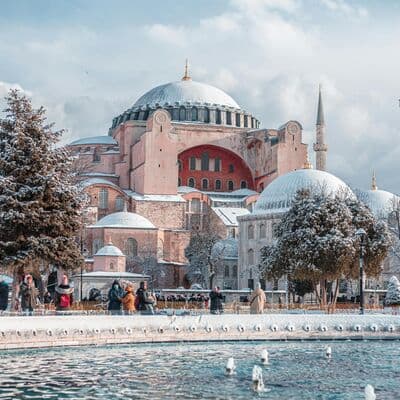
The mosque was built directly opposite Hagia Sophia—a direct challenge to the Byzantine masterpiece. Ahmed wanted to prove that the Ottomans could create something equal to or surpassing Christian heritage.
Six Minarets
The Blue Mosque is the only one in Istanbul with six minarets. Legend says the sultan told his architect "altın" (golden), and he heard "altı" (six). A lovely story, but most likely apocryphal.
In reality, six minarets were a deliberate status display. The same number existed at the al-Haram Mosque in Mecca, which caused scandal in the Islamic world. Ahmed had to finance construction of a seventh minaret in Mecca so Islam's holiest mosque would remain "ahead."
Interior and Tiles
"Blue Mosque" is a tourist name—Turks don't call it that. But it's accurate: the interior is adorned with more than 20,000 Iznik tiles with predominantly blue and azure tones.
The tiles were made in Iznik—the center of Ottoman ceramics. Tulips, carnations, roses, cypresses—traditional motifs of Islamic art. By the 17th century, Iznik ceramic quality was already declining, but Ahmed's mosque features the finest examples of late production.
200 stained glass windows fill the interior with light. The original glass hasn't survived, but modern replicas convey the idea: the mosque should be bright, unlike the dimness of Hagia Sophia.
Architecture
The main dome measures 23 meters in diameter and 43 meters in height. It rests on four "elephant legs"—massive columns 5 meters in diameter. A cascade of semi-domes transfers the load downward—the classic Ottoman scheme.
The mosque courtyard is surrounded by an arcade with 26 columns. At the center stands a hexagonal ablution fountain (no longer used—ablutions are performed in a separate building). The courtyard matches the mosque in size—symmetry was crucial to Ottoman architects.
Building Complex
The mosque is just part of a larger complex (külliye). This included: a medrese (school), hospital, caravanserai, market, bathhouse, and kitchens for the poor. Most buildings survive, though used differently now.
Sultan Ahmed's mausoleum stands in the northeast corner of the complex. The sultan himself, his wife, and three sons are buried here. Admission is free.
Visiting the Mosque
The Blue Mosque is active—prayers are held five times daily. Tourists aren't admitted during prayers (usually 90 minutes, check the schedule).
Admission is free, but dress code applies: covered shoulders and knees, headscarves for women. Coverings and scarves are provided at the entrance, but it's better to bring your own.
You remove your shoes and carry them in a bag. Inside, there's a designated tourist area separated from the prayer space.
Getting There
The mosque is located on Sultanahmet Square, opposite Hagia Sophia. Take tram T1 to Sultanahmet stop. From the Grand Bazaar—10 minutes on foot.
Practical Information
The mosque is open to tourists from 8:30 until sunset, except during prayer times. Friday prayers (around 13:00-14:30) create the longest break.
The best time is early morning, right after opening. Crowds gather by noon, especially in summer.
A visit takes 20-30 minutes (the tourist area is limited). But linger to absorb the atmosphere.
Atmosphere and Character
The Blue Mosque is where imperial ambition meets spirituality. Ahmed I wanted to build a monument to himself—and created a prayer space that has functioned for 400 years.
Comparison with Hagia Sophia is inevitable—they stand facing each other. Hagia Sophia is older, more mysterious, with a more complex history. The Blue Mosque is younger, brighter, "cleaner" in style. Both are masterpieces, just different ones.
In the evening, when the minarets are illuminated and the muezzin calls for prayer, Sultanahmet Square becomes a theater. The Blue Mosque is the lead actor on this stage.