About
Kyrgyzstan Travel Guide 2026: The Ultimate Resource for First-Time and Returning Visitors
There is a country in Central Asia where you can ride a horse across a mountain pass at 4,000 meters, sleep in a felt yurt under a sky so full of stars it looks fake, eat food cooked over dried dung fuel (it tastes better than it sounds), and do all of this for less than you would spend on a long weekend in Denver. That country is Kyrgyzstan, and it is one of the last genuinely under-visited destinations on Earth that actually deserves visitors.
Let me be honest from the start: Kyrgyzstan is not a polished tourism product. There are no five-star resort chains lining the lakeshores. The roads will rattle your fillings loose. You will encounter language barriers that no amount of Google Translate can fully bridge. The infrastructure outside of Bishkek ranges from basic to nonexistent. And none of that matters, because what Kyrgyzstan offers in return is something increasingly rare in modern travel -- genuine, unrehearsed, jaw-dropping experiences that you did not find on someone else's Instagram feed first.
I have spent considerable time exploring this country, from the chaotic energy of Osh Bazaar to the eerie silence of a frozen Issyk-Kul Lake shoreline in December. This guide is everything I wish someone had told me before my first trip, and everything I have learned since. It is not a marketing brochure. It is not a dry Wikipedia summary. It is a practical, honest, sometimes opinionated guide written for English-speaking travelers -- Americans, Brits, Australians, Canadians -- who want to actually go to Kyrgyzstan and not just dream about it.
One more thing before we dive in: 2026 is a particularly excellent year to visit. The World Nomad Games are happening from August 31 to September 6, 2026, which means the country will be buzzing with energy, cultural performances, and events you literally cannot see anywhere else on the planet. More on that later. Let us get into it.
1. Why Kyrgyzstan? Fifteen Reasons That Actually Matter
Every travel guide starts with a "why visit" section, and most of them recycle the same vague platitudes about "hidden gems" and "off the beaten path." Let me skip the cliches and give you specific, concrete reasons why Kyrgyzstan deserves a spot on your travel list in 2026.
The Mountains Are World-Class, and Nobody Is On Them
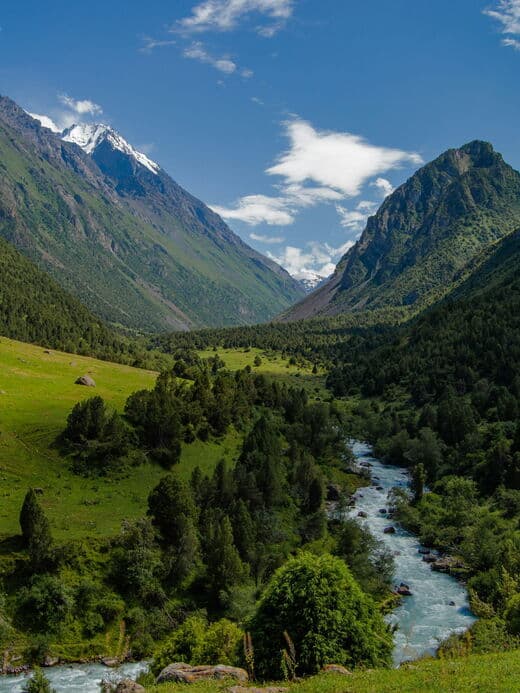
Kyrgyzstan is roughly 94% mountains. Not gentle rolling hills -- actual, serious, glaciated peaks reaching over 7,000 meters. The Tien Shan range (which translates to "Celestial Mountains," and yes, they earn the name) dominates the country. Peak Pobedy, at 7,439 meters, is the highest point, though you do not need to be a mountaineer to appreciate the scenery. Even a day hike in Ala Archa National Park, just 40 minutes from downtown Bishkek, puts you in alpine landscapes that rival anything in the Swiss Alps or the Canadian Rockies. The difference? In Switzerland, you are sharing the trail with hundreds of other hikers. In Ala Archa on a weekday, you might see ten people total. On some of the more remote treks -- Song-Kol Lake, the Alay Valley, the Inylchek Glacier approach -- you can walk for entire days without seeing another human being.
It Is Absurdly Affordable
Your money goes far here. A solid meal at a local restaurant costs $3-5. A private room in a guesthouse runs $15-25. A full day of horseback riding with a guide might set you back $30-40. Even in Bishkek, which is the most expensive city in the country, you can live well on $40-50 per day including accommodation, food, and transport. Budget travelers who are willing to stay in homestays and eat where locals eat can get by on $20-25 per day outside the capital. Compare that to neighboring Kazakhstan, where Almaty hotel prices have crept up to European levels, or to any comparable mountain destination in Europe or North America. Kyrgyzstan is not cheap because it is low quality -- it is cheap because the Kyrgyz som (KGS) is weak against the dollar, and the cost of living is genuinely low.
The Visa Situation Is Excellent
Citizens of the United States, United Kingdom, Canada, Australia, and most EU countries can enter Kyrgyzstan visa-free for up to 60 days. No visa application, no invitation letter, no registration hassle. You show up at Manas International Airport, get your passport stamped, and walk through. This is a significant advantage over neighboring countries. Uzbekistan and Kazakhstan have also liberalized their visa regimes, but Kyrgyzstan was ahead of the curve and remains one of the easiest Central Asian countries to enter. If you want to stay longer than 60 days, you can apply for an extension at the State Registration Service in Bishkek, though the process involves some bureaucracy.
Nomadic Culture Is Not a Museum Exhibit -- It Is Still Alive
In many countries, "traditional culture" means a staged performance at a tourist restaurant. In Kyrgyzstan, nomadic traditions are part of daily life, especially outside the cities. Families still migrate to high-altitude summer pastures (jailoos) with their livestock every year. Yurts are not decorative -- they are functional homes used for months at a time. Kumys (fermented mare's milk) is not a novelty drink for tourists -- it is a staple that people genuinely consume daily. When you stay at a yurt camp near Song-Kol Lake and your host family invites you to watch them milk mares at dawn, that is not a performance. That is their morning routine, and you are simply being included in it. This authenticity is becoming harder to find globally, and Kyrgyzstan still has it in abundance.
The Trekking Is Among the Best in the World
I am not being hyperbolic. Kyrgyzstan's trekking infrastructure -- built largely through the Community-Based Tourism (CBT) network -- offers multi-day routes through landscapes that would be headline attractions in any other country. The trek from Karakol to Jyrgalan passes through alpine meadows, over 3,800-meter passes, past glacial lakes, and through valleys where the only other beings are marmots and golden eagles. The four-day trek to Song-Kol Lake takes you to one of the highest alpine lakes in Central Asia, where you sleep in yurts at 3,000 meters surrounded by nothing but grass and sky. And unlike the Inca Trail or the Tour du Mont Blanc, you do not need to book months in advance or pay hundreds of dollars in permit fees. You show up, arrange a guide and horses through a local CBT office, and go.
Issyk-Kul Is Central Asia's Unexpected Beach Destination
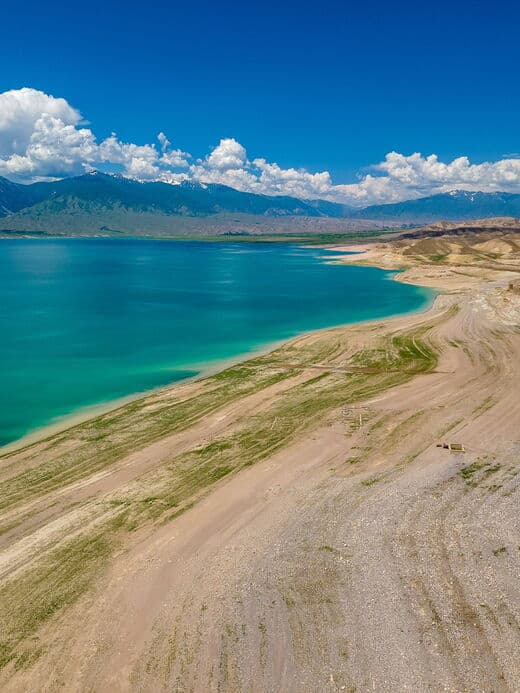
Issyk-Kul Lake is the second-largest alpine lake in the world (after Titicaca), and it never freezes despite being at 1,607 meters elevation -- hence its name, which means "warm lake." The northern shore has developed sandy beaches, resorts, and a summer holiday atmosphere that feels bizarrely like a landlocked Mediterranean. The southern shore is wilder, less developed, and backed by snow-capped peaks that rise directly from the waterline. The water is slightly saline, crystal clear, and cold enough to wake you up but warm enough to actually swim in during July and August. For travelers who associate Central Asia exclusively with deserts and steppes, Issyk-Kul is a genuine surprise.
The People Are Genuinely Welcoming
This is something every travel guide says about every country, so let me be specific. Kyrgyz hospitality is rooted in nomadic tradition, where refusing to help a traveler was considered deeply shameful. In practice, this means that if you break down on a mountain road, someone will stop to help. If you are lost in a village, someone will walk you to where you need to go. If you are invited into a home (which will happen), you will be fed tea, bread, jam, and possibly an entire meal before you can politely decline. This is not performative tourism hospitality -- it is cultural DNA. The flip side is that you are expected to reciprocate: accept the tea, eat the bread, show genuine interest, and bring a small gift if you are staying overnight.
Adventure Sports Without the Price Tag
Paragliding over the Suusamyr Valley. Skiing at Karakol or the new Ala-Too Resort complex being built in the Issyk-Kul region. Rafting on the Chon-Kemin River. Mountain biking through the Chuy Valley. Horseback riding across high-altitude pastures that extend to the horizon. Rock climbing on the granite walls above Karakol. Ice climbing in winter. All of these activities exist in Kyrgyzstan at a fraction of what they cost in Western countries. A full-day paragliding experience that would run $200+ in the Alps costs $50-80 here. The safety standards are not always up to Western levels (more on that in the safety section), but for experienced adventure travelers who can assess risk, the value proposition is extraordinary.
It Is a Gateway to the Rest of Central Asia
Kyrgyzstan's borders with Kazakhstan, Uzbekistan, Tajikistan, and China make it an excellent hub for a broader Central Asian trip. The overland crossing from Bishkek to Almaty takes about five hours. The border with Uzbekistan connects to the Fergana Valley and eventually to Samarkand and Bukhara. The Irkeshtam or Torugart passes lead into China's Xinjiang region (though these require more planning). And the recently settled border with Tajikistan (finalized in 2025 after decades of disputes) has opened up new overland routes to the Pamir Highway, one of the world's great road trips. With the China-Kyrgyzstan-Uzbekistan railway under construction (groundbreaking in 2025, with full completion expected in the late 2020s), future connectivity will only improve.
The Food Scene Is Better Than You Expect
Central Asian food does not get the international recognition it deserves. Kyrgyz cuisine is hearty, meat-heavy, and deeply satisfying -- especially after a day of trekking. Beshbarmak (boiled meat and pasta sheets), lagman (hand-pulled noodle soup), manti (steamed dumplings), plov (rice pilaf), and samsa (baked pastry with meat) are all excellent. Bishkek has also developed a surprisingly cosmopolitan food scene, with Korean, Uighur, Dungan, Turkish, and even decent Italian restaurants. And everywhere you go, there is bread -- fresh, round, slightly sweet flatbread (lepyoshka/nan) that is baked in tandoor ovens and served with every meal. It is simple and perfect.
The Stargazing Is Extraordinary
Light pollution is virtually nonexistent outside of Bishkek and Osh. At altitude, the air is thin and dry, creating conditions for stargazing that rival the Atacama Desert or rural Namibia. If you camp at Song-Kol Lake, on the south shore of Issyk-Kul, or in any of the remote valleys, you will see the Milky Way with a clarity that is genuinely startling if you have spent your life in or near cities. No special equipment needed -- just look up.
It Is Changing Fast
Kyrgyzstan in 2026 is not what it was in 2016. Tourism infrastructure is improving rapidly. New guesthouses and yurt camps open every season. The road network is being upgraded (the new Bishkek-Osh highway is expected to be completed in 2026, cutting travel time dramatically). International flights are increasing. A new cable car is being built in Ala Archa National Park, which will make alpine scenery accessible to non-hikers. The Ala-Too Resort ski cluster is under construction in the Issyk-Kul region, which will eventually position Kyrgyzstan as a legitimate ski destination. All of this means that the window for experiencing Kyrgyzstan as a genuinely under-touristed destination is closing. It is not gone yet -- not by a long shot -- but in ten years, the experience will be different. Going now means catching it at a sweet spot: enough infrastructure to be comfortable, not enough to feel commodified.
The World Nomad Games 2026
From August 31 to September 6, 2026, Kyrgyzstan will host the World Nomad Games, an international festival of traditional nomadic sports. Think of it as an Olympics for activities that most people have never heard of: kok-boru (a polo-like game played with a goat carcass), er enish (horseback wrestling), alysh (belt wrestling), ordo (a complex bone-throwing game), and eagle hunting demonstrations. The games attract teams from across Central Asia, Turkey, Mongolia, and beyond, and the atmosphere combines genuine athletic competition with cultural performances, music, and a general sense of national celebration. The 2026 edition is expected to be the largest yet, and if you can time your visit to coincide with it, you absolutely should. Events are primarily held at the Hippodrome near Cholpon-Ata on the north shore of Issyk-Kul, though Bishkek will also host opening ceremonies and related events.
Photography Opportunities Are Endless
The combination of dramatic landscapes, photogenic nomadic culture, intense light, and minimal visual clutter (no billboards, no power line forests, no strip malls) makes Kyrgyzstan one of the most photogenic countries in Asia. Golden hour on the south shore of Issyk-Kul, when the snow peaks turn pink and the lake goes mirror-flat, is worth the entire trip. A line of horses and yurts against a green jailoo with thunderclouds building over the mountains behind them is the kind of image that wins photography competitions. And unlike in some countries, people are generally happy to be photographed -- just ask first, especially with older women and in more conservative southern regions.
It Will Change How You Think About Travel
This is the intangible one, and it is the most important. Kyrgyzstan is not an easy country. It requires patience, flexibility, physical effort, and a willingness to be uncomfortable. In return, it offers experiences that are profound in a way that comfortable, well-organized tourism rarely achieves. Sleeping in a yurt during a thunderstorm while your host family calmly serves you tea. Cresting a mountain pass on horseback and seeing an entire valley open up below you with no sign of human habitation. Sitting in a shared taxi with five other passengers and a live chicken, communicating entirely through gestures and laughter. These are the moments that stay with you. Kyrgyzstan does not just give you a vacation -- it gives you stories.
2. Regions of Kyrgyzstan: Where to Go and What to Expect
Kyrgyzstan is roughly the size of South Dakota or slightly smaller than the United Kingdom, but the mountainous terrain means that distances between regions involve significantly more time than the map suggests. A straight-line distance of 100 kilometers might require four hours of driving on mountain roads. Understanding the country's regions is essential for planning a realistic itinerary.
Bishkek and the Chuy Valley
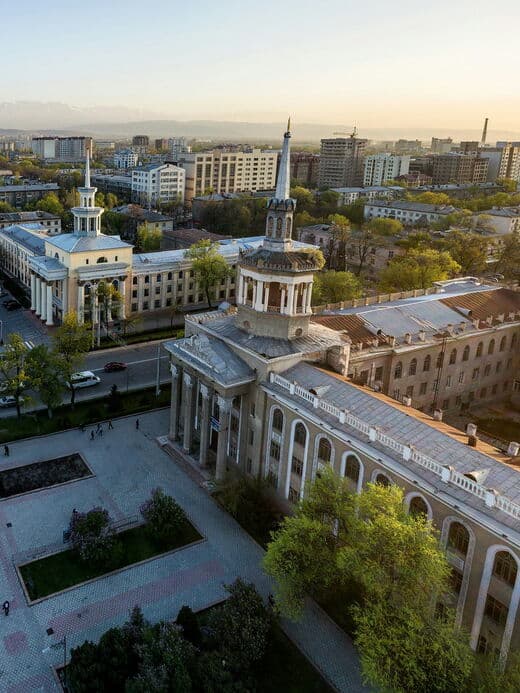
Bishkek, the capital, sits at the northern edge of the country in the broad, flat Chuy Valley, backed by the snow-capped Kyrgyz Ala-Too range. With a population of about 1.1 million, it is by far the largest city and the primary gateway for international travelers. Most people spend one to three days here, using it as a base for day trips to the mountains and as a place to organize onward travel.
The city itself has a post-Soviet charm that grows on you. Wide, tree-lined boulevards. Enormous Soviet-era apartment blocks alongside gleaming new construction. Parks that fill with families on weekends. A cafe and restaurant scene that has exploded in recent years, with everything from traditional Kyrgyz food to excellent Korean and Uighur cuisine.
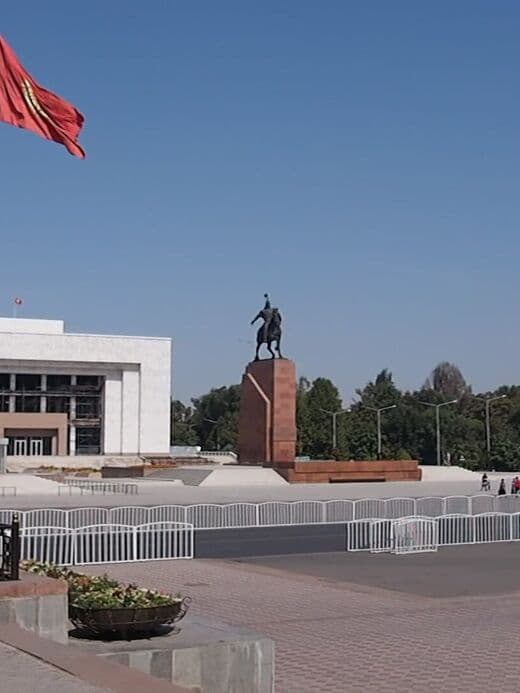
Ala-Too Square is the political and symbolic center of the city, a vast open plaza dominated by a flagpole flying an enormous Kyrgyz flag. The changing of the guard ceremony happens here, and the square has been the site of the country's various political upheavals (Kyrgyzstan has had three revolutions since independence in 1991, a fact that locals discuss with a mixture of pride and exasperation). The State Historical Museum sits at one end of the square, and while the collection is somewhat dated, it provides useful context for understanding Kyrgyz history and culture.
Osh Bazaar is the other must-visit in Bishkek, and it is exactly the kind of sensory overload that makes Central Asian markets so compelling. This is not a tourist market -- it is where Bishkek residents actually shop, and the range of goods is staggering. Entire sections dedicated to dried fruits and nuts. Mountains of spices measured in kilograms. Clothing, electronics, household goods, livestock feed, car parts, and traditional felt crafts all crammed into a labyrinthine complex of covered stalls and open-air areas. The meat section is not for the squeamish. The cheese section is fascinating (look for kurut, the dried yogurt balls that nomadic herders carry as trail food). And the people-watching is endless. Budget an hour minimum, more if you enjoy markets.
Ala Archa National Park is the day trip that every visitor to Bishkek should make. Located just 40 kilometers south of the city, the park climbs from a valley floor at about 2,000 meters to glaciated peaks above 4,000 meters. The most popular hike is the trail to the Ak-Sai Waterfall and glacier viewpoint, which takes about four to five hours round trip and gains roughly 700 meters of elevation. The trail is well-marked, the scenery is spectacular (especially in early summer when the alpine meadows are blooming), and on clear days the views of the surrounding peaks are genuinely breathtaking. A new cable car is currently being built in the park, which will eventually allow visitors to access alpine elevations without the steep hike. For now, though, you walk. The park entrance fee is about $2, and shared taxis from Bishkek cost $3-5 per person.
Beyond these highlights, Bishkek is a good place to arrange logistics. Most tour companies have offices here. You can buy SIM cards, exchange money, stock up on supplies, and book shared taxis or marshrutkas (minibuses) to other destinations. The city also has the country's best nightlife, such as it is -- a handful of bars and clubs along Chuy Avenue and Erkindik Boulevard that get lively on weekends.
The broader Chuy Valley offers a few additional attractions. The Burana Tower, about 80 kilometers east of Bishkek, is an 11th-century Karakhanid minaret that is one of the oldest surviving structures in Kyrgyzstan. The surrounding field of balbals (Turkic stone grave markers) is atmospheric and usually uncrowded. The Belogorka Valley and Kegety Gorge offer additional hiking options within easy reach of the capital.
Issyk-Kul Region
The Issyk-Kul region is the most visited area of Kyrgyzstan after Bishkek, and for good reason. Issyk-Kul Lake dominates the geography -- 182 kilometers long, 60 kilometers wide, and surrounded on all sides by mountains that rise to over 5,000 meters. The lake's microclimate keeps the region warmer than the rest of the country, and its beaches, hot springs, and dramatic scenery attract both domestic and international visitors.
The north shore is the more developed side. Cholpon-Ata is the main resort town, with beaches, hotels, the Petroglyphs Museum (an open-air site with Bronze Age rock carvings), and the hippodrome that will host the World Nomad Games in 2026. The stretch from Balykchy to Karakol along the north shore is well-paved and serviced by regular transport. In July and August, the north shore beaches fill with Kyrgyz and Kazakh vacationers, and the atmosphere is lively and social.
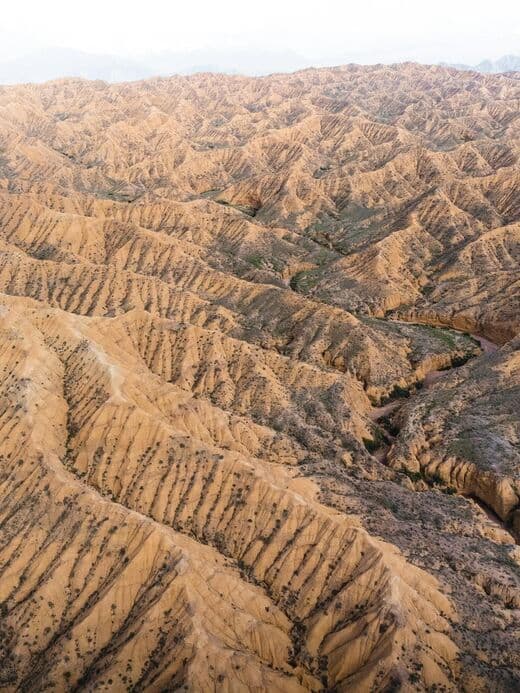
The south shore is the opposite -- quieter, wilder, and backed by more dramatic mountain scenery. The road is rougher, the villages are smaller, and the tourism infrastructure is more basic. This is where you go if you want solitude with your scenery. The canyons and valleys that cut into the mountains on the south side -- Barskoon, Tamga, Skazka Canyon (with its eroded sandstone formations that look like something from Utah's canyon country) -- are spectacular and often empty of other visitors.
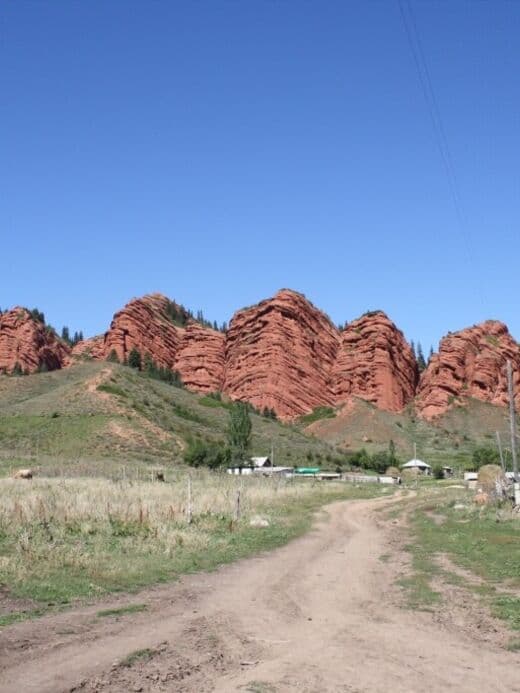
Jeti-Oguz, meaning "Seven Bulls," is one of the most iconic landscapes in the country. These are massive red sandstone formations that rise from a green valley floor, backed by snow-covered peaks. The resemblance to bulls is debatable (I see it from certain angles), but the visual impact is not. The valley behind the formations offers excellent hiking, and there is a small resort with hot springs at the base. In spring, the surrounding hills are covered in poppies, creating a red-on-red-on-green color combination that is almost aggressively photogenic.
Karakol, the fourth-largest city in Kyrgyzstan (population around 80,000), sits at the eastern end of the lake and serves as the base for most trekking and adventure activities in the region. The Karakol Ski Base is the country's most developed ski area (more on that in the activities section). The Dungan Mosque, built entirely of wood without a single nail, is architecturally fascinating. The animal market on Sundays is a chaotic, muddy, noisy, wonderful window into rural Kyrgyz life. And the town has an unexpectedly good food scene, thanks to its diverse population of Kyrgyz, Russians, Uighurs, and Dungans (Chinese Muslims).
The Ala-Too Resort ski cluster currently under construction in the Issyk-Kul region is worth mentioning for future visitors. This ambitious project aims to create a modern ski resort complex with multiple lifts, hotels, and year-round recreation facilities. While it is still in the construction phase, it signals Kyrgyzstan's intentions to position itself as an international winter sports destination. When completed, it will significantly expand the country's skiing capacity beyond the existing Karakol and ZiL bases.
Naryn Region
Naryn is the heart of Kyrgyzstan -- geographically, culturally, and spiritually. This is the most mountainous, most remote, and most traditionally Kyrgyz part of the country. The regional capital, also called Naryn, is a small, dusty city at 2,000 meters elevation that serves mainly as a supply point and transit stop. The real attractions are in the surrounding countryside.
Song-Kol Lake is the crown jewel. Sitting at 3,016 meters in a high-altitude basin surrounded by rolling grasslands, Song-Kol is where Kyrgyz nomadic culture is most visible and most accessible to visitors. From June to September, the shores of the lake are dotted with yurt camps -- some operated as tourist accommodation, others belonging to herding families who have brought their livestock up from lower pastures for the summer grazing season. Staying at a yurt camp on Song-Kol is the quintessential Kyrgyz experience: horseback riding across endless green pastures, watching shepherds work their flocks, eating fresh-cooked food in a yurt, and experiencing the absolute silence of a high-altitude lake at night. The water is too cold for comfortable swimming (even in August, it rarely exceeds 10-12 degrees Celsius), but the scenery more than compensates. Getting to Song-Kol requires either a significant drive on rough roads or a two-to-three-day trek from Kyzyl-Oi or Kochkor, both of which are excellent in their own right.
Tash Rabat is another Naryn highlight -- a remarkably well-preserved 15th-century stone caravanserai located at 3,500 meters in a remote valley near the Chinese border. The building is atmospheric and mysterious, set against a backdrop of treeless brown mountains that look like they belong on another planet. The drive to Tash Rabat from Naryn is an adventure in itself, crossing the 3,200-meter Moldo-Ashuu pass and traversing increasingly wild countryside.
The Torugart Pass, the border crossing into China, is located in Naryn region. It requires advance arrangement and is not a casual crossing -- you typically need a prearranged guide and vehicle on the Chinese side. But for travelers heading into or coming from Kashgar, it is a dramatic and memorable route.
Osh and the Southern Regions
Osh, the second-largest city (population around 300,000), is the capital of the south and claims to be 3,000 years old, which makes it one of the oldest continuously inhabited cities in Central Asia. It has a distinctly different feel from Bishkek -- more Uzbek cultural influence, more conservative, more traditional, and significantly warmer in summer. Sulaiman-Too, a rocky hill in the center of the city, is a UNESCO World Heritage Site and has been a place of pilgrimage and worship for millennia. The Osh Bazaar (confusingly, also called Osh Bazaar, like the one in Bishkek) is the largest market in southern Kyrgyzstan and one of the most atmospheric in all of Central Asia.
The Alay Valley, south of Osh, is one of the most spectacular landscapes in the country. A high-altitude valley running east-west, it is bounded on the south by the Trans-Alay Range, which includes Peak Lenin (7,134 meters). The Base Camp for Peak Lenin is accessible from the Alay Valley and is a destination in itself, even for non-climbers -- the views of the north face of Lenin from Achik-Tash are extraordinary. The Alay region is also home to the ethnic Kyrgyz communities with the strongest traditions of eagle hunting, and it is possible to arrange demonstrations and even multi-day eagle hunting experiences.
The new Bishkek-Osh highway, expected to be completed in 2026, will dramatically improve connectivity between the north and south of the country. Currently, the drive takes 12-14 hours on the old road (which crosses two mountain passes above 3,000 meters and is frequently closed by snow, landslides, or construction). The new highway will cut travel time significantly and make the south far more accessible for travelers with limited time.
Jalal-Abad Region
Jalal-Abad is the transition zone between the northern mountains and the southern lowlands. The city of Jalal-Abad itself is not a major tourist draw, but the region contains several worthwhile attractions. Arslanbob is the most notable -- a Uzbek village nestled in what is claimed to be the world's largest natural walnut forest. The village is a center for Community-Based Tourism, offering homestays, guided hikes through the walnut forests, and access to waterfalls and mountain viewpoints. The cultural experience in Arslanbob is distinctly different from Kyrgyz areas -- the population is predominantly Uzbek, the food has more Uzbek influences, and the atmosphere in the village is more conservative.
Sary-Chelek Lake, located in a biosphere reserve in the western part of Jalal-Abad region, is one of the most beautiful lakes in the country -- turquoise water surrounded by dense forest and backed by mountains. It is also one of the more difficult to reach, requiring a permit and a long drive on rough roads from the town of Arkyt. The isolation is part of the appeal.
The Fergana Valley portion of Jalal-Abad, including the towns of Kara-Suu and Uzgen, is a fascinating window into Central Asia's complex ethnic geography. Uzgen has an 11th-century Karakhanid minaret and mausoleum complex that is one of the most important historical sites in the country, though it receives far fewer visitors than it deserves.
Talas Region
Talas is the most isolated and least-visited region of Kyrgyzstan, tucked into the northwestern corner of the country and accessible only by crossing a mountain pass from the Chuy Valley (there is no direct road connection from the rest of Kyrgyzstan). This isolation has preserved a distinctive local culture and dialect. The main attraction is the Manas Ordo complex, a mausoleum and memorial dedicated to the epic hero Manas, the central figure of Kyrgyz national identity. The Epic of Manas is one of the longest epic poems in the world (roughly 20 times longer than the Iliad), and it remains a living tradition -- professional Manas reciters (manaschi) can perform sections from memory for hours. Whether or not the historical Manas existed is debated, but the cultural significance is not. The Manas Ordo site is set in a pleasant valley and includes a small museum with exhibits about the epic and Kyrgyz nomadic history.
Besh-Tash National Park, near the city of Talas, offers excellent hiking through juniper forests to alpine lakes. The trails are less trafficked than in Issyk-Kul or the Bishkek area, and the scenery is rewarding. Talas is not a region you visit for convenience, but if you have three weeks or more in the country and want to see a side of Kyrgyzstan that few foreigners encounter, it is worth the detour.
Batken Region
Batken, in the far southwest, is the most geopolitically complex region of Kyrgyzstan. It contains two Uzbek enclaves (Sokh and Shakhimardan) and one Tajik enclave (Vorukh), remnants of the Soviet-era border-drawing process that created some of the most convoluted international boundaries on Earth. The 2025 border settlement with Tajikistan has improved the security situation significantly -- prior to the agreement, the Batken region experienced periodic tensions and even armed clashes along disputed border sections.
For travelers, Batken is notable primarily for rock climbing. The Karavshin Valley, sometimes called the "Patagonia of Central Asia," contains sheer granite walls that have attracted international climbing expeditions since the Soviet era. Peaks like Asan (4,230 meters) and Usan (4,378 meters) offer big-wall routes that are considered among the finest in Central Asia. Access requires permits and is complicated by the proximity to the Tajik border, but for serious climbers, it is a world-class destination.
The broader Batken region is not a typical tourist destination, but the landscape -- dry, rocky, canyon-cut mountains with oasis villages -- is strikingly different from the rest of Kyrgyzstan and reminiscent of the American Southwest or parts of Morocco.
3. Natural Wonders: What Makes Kyrgyzstan's Landscape Extraordinary
Kyrgyzstan's natural environment is its primary attraction, and it deserves a dedicated section because the variety is genuinely surprising for a country this size. Many visitors arrive expecting "just mountains" and discover an ecological and geological diversity that spans from semi-desert to permanent ice.
The Tien Shan Range
The Tien Shan ("Celestial Mountains" in Chinese, "Tengri-Too" in Kyrgyz) is one of the great mountain ranges of the world, stretching roughly 2,500 kilometers from Uzbekistan through Kyrgyzstan, Kazakhstan, and into China. Kyrgyzstan sits at the heart of the range, and its mountains include some of the highest and most dramatic peaks. Jengish Chokusu (Peak Pobedy) at 7,439 meters is the highest point in Kyrgyzstan and the second-highest in the former Soviet Union after Peak Ismoil Somoni in Tajikistan. Khan Tengri, at 7,010 meters, is one of the most beautiful mountains in the world -- a perfect marble pyramid that glows pink at sunset. Neither peak is a casual climb (both are serious mountaineering objectives requiring weeks of expedition planning), but the mere fact that these giants exist within Kyrgyzstan's borders gives you an idea of the scale involved.
For most visitors, the Tien Shan is experienced through trekking in the more accessible valleys and passes. The range's front ridges, which are what you see from Bishkek and the Chuy Valley, rise to 4,000-4,500 meters and offer excellent hiking and mountaineering at a more approachable level. The glaciers that feed the rivers draining these peaks are visible from many trails, and the sensation of walking through a valley with glaciated peaks on both sides is one of the defining experiences of travel in Kyrgyzstan.
Lakes
Kyrgyzstan has an extraordinary number of mountain lakes, ranging from the enormous (Issyk-Kul) to tiny glacial tarns barely bigger than a swimming pool. Each has its own character.
Issyk-Kul Lake has already been discussed, but its sheer scale deserves emphasis. It is the tenth-largest lake in the world by volume and the second-largest saline lake after the Caspian Sea (though its salinity is very low). The lake is deep -- up to 668 meters -- and its waters are remarkably clear. The color shifts from deep blue to turquoise depending on the light and depth, and on calm days the reflections of the surrounding mountains create mirror-image panoramas that are almost too perfect to look real.
Song-Kol Lake, at 3,016 meters, is the largest high-altitude lake entirely within Kyrgyzstan. Its shallow, grassy shores and the vast, treeless pastures surrounding it create a landscape of almost Mongolian openness. The lake freezes solid from November to April, and the transition seasons (when ice is forming or melting at the edges) create otherworldly visual effects.
Sary-Chelek Lake, in Jalal-Abad region, is surrounded by dense coniferous forest and has a more intimate, enclosed feeling than the big open lakes. Its color -- an intense turquoise-green -- comes from glacial minerals suspended in the water.
Kel-Suu Lake, near the Chinese border in Naryn region, is one of the most dramatic landscapes in the country. A deep, narrow lake in a steep-walled canyon, it has the feel of a Norwegian fjord transplanted to Central Asia. Access requires a permit (it is in a border zone) and involves a significant off-road drive and a hike, but those who make the effort are rewarded with scenery that is genuinely unlike anything else in Kyrgyzstan.
Ala-Kol Lake, at 3,532 meters in the mountains above Karakol, is the destination of one of the country's most popular multi-day treks. The lake sits in a cirque of rock and ice, its water a deep, cold blue. The trek to Ala-Kol typically takes two to three days and crosses a 3,860-meter pass, making it one of the more physically demanding popular routes.
Glaciers
Kyrgyzstan has roughly 8,000 glaciers covering about 4% of the country's surface. The Inylchek Glacier, at roughly 60 kilometers long, is the largest in the Tien Shan and one of the largest in the world outside of the polar regions. The South Inylchek Glacier is the route to Khan Tengri and Peak Pobedy base camps, and even reaching the glacier's snout is a significant undertaking that involves helicopter flights or multi-day treks from Karakol. For most visitors, the glaciers are visible from afar -- the white rivers of ice clinging to the high peaks above almost every valley -- rather than destinations in themselves. But for mountaineers and glacier trekkers, Kyrgyzstan offers some of the most accessible glacier experiences in the world.
Climate change is visibly affecting Kyrgyzstan's glaciers. Many have retreated significantly in recent decades, and this has both environmental and practical implications. The glaciers feed the rivers that irrigate the lowlands, and their reduction threatens water security across Central Asia. For travelers, this adds a sense of urgency -- the landscapes you see today will look different in twenty years.
Gorges and Canyons
The combination of soft sedimentary rock and powerful erosion has created dramatic canyon landscapes throughout the country. Skazka Canyon ("Fairy Tale Canyon") on the south shore of Issyk-Kul is the most visited -- its wind-eroded sandstone formations in shades of red, orange, and ochre look like they were airlifted from Utah. The canyon is small enough to explore in an hour or two but photogenic enough to justify spending half a day.
Konorchek Canyon, accessible from the main Bishkek-Issyk-Kul highway, is larger and more dramatic than Skazka but less visited because it requires a longer hike to reach the most impressive formations. The red rock pillars and hoodoos here are genuinely reminiscent of Bryce Canyon National Park, and the isolation adds to the impact.
Boom Gorge, through which the main highway passes between Bishkek and Issyk-Kul, is impressive in its own right -- steep, rocky walls rising hundreds of meters on both sides of the road, with the Chu River churning through the bottom. If you are arriving at Issyk-Kul from Bishkek, the moment the highway enters Boom Gorge is a dramatic transition from agricultural valley to mountain landscape.
The Jeti-Oguz valley combines canyon scenery with alpine meadows in a way that is uniquely compelling. The red sandstone "bulls" at the valley entrance give way to a broad green valley that climbs toward glaciated peaks. In spring, the entire valley floor erupts in wildflowers, and the contrast between the red rock, green grass, white snow, and blue sky is the kind of thing that makes you understand why painters and photographers become obsessed with Central Asia.
Flora and Fauna
Kyrgyzstan's ecological diversity is underappreciated. The country spans multiple biomes, from semi-arid steppe to alpine tundra, and supports a range of wildlife that includes some genuine rarities.
The snow leopard is the marquee species. Kyrgyzstan is home to an estimated 300-400 snow leopards, making it one of the most important countries for the species' conservation. Seeing a snow leopard in the wild is extraordinarily difficult (they are solitary, territorial, and perfectly camouflaged), but the knowledge that they are out there, somewhere in the peaks above your campsite, adds a layer of wildness to the mountain experience. Several conservation organizations offer snow leopard tracking experiences in the Sarychat-Ertash Reserve and other protected areas, though these require significant time, expense, and tolerance for disappointment.
More commonly seen wildlife includes ibex (large mountain goats with spectacular curved horns, often visible on rocky slopes), marmots (fat, whistling rodents that are ubiquitous in alpine meadows and whose alarm calls will become the soundtrack of your trek), golden eagles (which are also used by traditional hunters -- more on that later), and various raptors including lammergeiers (bearded vultures) with their enormous wingspans. In the forests of Jalal-Abad and the juniper woodlands of the Tien Shan foothills, wild boar, lynx, and brown bears are present but rarely seen.
The walnut forests of Arslanbob deserve special mention. These are the largest natural walnut forests in the world, covering roughly 600,000 hectares, and they are believed to be the genetic origin of the domestic walnut. Walking through them in autumn, when the leaves are turning gold and the ground is carpeted with fallen nuts, is a uniquely beautiful experience. The forests also support a rich understorey of wild fruit trees (apple, pear, plum, cherry) that are thought to be the ancestors of domesticated varieties.
National Parks and Protected Areas
Kyrgyzstan has a growing network of protected areas, though enforcement and management vary considerably. Ala Archa National Park is the most accessible and best-managed, with clear trails, ranger stations, and basic facilities. Sarychat-Ertash State Reserve, in the remote eastern Issyk-Kul region, is one of the best-protected wilderness areas in Central Asia and a critical snow leopard habitat -- but access is restricted and requires special permits. Padysha-Ata State Reserve in Jalal-Abad protects juniper forests and is important for botanical conservation.
The Community-Based Tourism (CBT) network, which is not a protected area system per se but functions as a conservation mechanism, has been instrumental in linking tourism revenue to environmental protection in rural areas. When you stay at a CBT-affiliated yurt camp or guesthouse, a portion of your payment goes to community conservation projects. This model has been internationally recognized as one of the most effective approaches to sustainable tourism in developing countries.
4. When to Visit: Seasons, Weather, and Timing Your Trip
Kyrgyzstan is a year-round destination, but the experience varies enormously by season. Choosing when to go depends entirely on what you want to do.
Summer (June to August)
This is peak season for good reason. Mountain passes are open, trekking routes are accessible, yurt camps on Song-Kol and other high-altitude pastures are operating, and the weather is generally warm and dry at lower elevations. Temperatures in Bishkek can hit 35-40 degrees Celsius in July and August, which makes the city uncomfortable but makes the mountains (where temperatures are 15-25 degrees cooler) extremely appealing. The Issyk-Kul beaches are swimmable from mid-June through early September, with water temperatures reaching a pleasant 20-22 degrees on the north shore.
July and August are the best months for high-altitude trekking. Snow has melted from most passes below 4,000 meters, wildflowers are at their peak, and the days are long (sunset is around 8:30 PM). The downside is that this is also when domestic tourism peaks. The north shore of Issyk-Kul can feel crowded by Kyrgyz and Kazakh standards (though it would still feel empty by Mediterranean standards), and popular trekking routes like the Ala-Kol circuit will have other hikers.
Late August and early September offer an excellent sweet spot: still warm enough for trekking and swimming, but the crowds thin out as the Kyrgyz and Kazakh school year begins. And in 2026, this period coincides with the World Nomad Games (August 31 to September 6), making it an ideal time for visitors who want both natural beauty and cultural spectacle.
Autumn (September to November)
September is arguably the best month to visit Kyrgyzstan. The summer heat has broken, the sky is clear, the mountains have their first dusting of new snow on the highest peaks (creating dramatic contrasts), and the walnut forests of Arslanbob are turning gold. The light takes on a warm, low-angled quality that makes everything look cinematic. Most trekking routes remain accessible through mid-October at lower elevations, though high passes start closing with snow by late September.
October is beautiful but risky. Weather becomes unpredictable, and early snowfall can close mountain roads and passes with little warning. If you are planning to trek, stick to lower-elevation routes and have contingency plans. The compensation is that you will have the mountains almost entirely to yourself.
November is the transition to winter. Gray skies, cold temperatures, and limited tourism infrastructure. Not recommended for most visitors unless you are specifically interested in early-season skiing or have a particular reason to be in Bishkek or Osh.
Winter (December to February)
Kyrgyzstan in winter is cold, dramatic, and surprisingly rewarding for the right traveler. Bishkek gets regular snowfall and temperatures drop to -10 to -20 degrees Celsius. Issyk-Kul, thanks to its thermal properties, remains unfrozen but the shoreline and surroundings are snow-covered, creating striking scenery. The mountains are obviously spectacular in snow, though most are inaccessible except to experienced winter mountaineers.
The main winter activity is skiing. Karakol Ski Base, about 25 kilometers from the town of Karakol, offers surprisingly good skiing with a vertical drop of about 800 meters and a mix of groomed runs and excellent off-piste terrain. Lift tickets are laughably cheap by Western standards (under $20 per day), and the lack of crowds means no lift lines. The snow quality is generally excellent -- dry, cold powder that Central Asian skiers compare to Japanese snow. The facilities are basic (do not expect Whistler-level lodges), but the skiing itself is genuinely good.
Winter is also the season for eagle hunting festivals, typically held in February or March. These events bring together traditional Kyrgyz and Kazakh hunters who work with trained golden eagles, and they offer spectacular photography opportunities.
Spring (March to May)
Spring is the least-visited season and, depending on what you are looking for, either the best or worst time to come. March and April are mud season -- snowmelt turns dirt roads into rivers, mountain passes are still closed, and the lowlands can be gray and soggy. But by late April and May, the transformation is dramatic. Wildflowers explode across the hillsides. The foothills and valleys turn a shade of green so vivid it looks artificial. Waterfalls from snowmelt are at their most powerful. And you have the entire country essentially to yourself.
May is particularly good for visitors interested in the Chuy Valley, the lower Issyk-Kul shores, and the southern regions. The mountains are still white with snow (great for photography), the valleys are green and blooming, and the weather is comfortable -- warm days, cool nights, occasional rain. High-altitude trekking is not yet possible, but lower-elevation hikes and cultural visits are excellent.
Festivals and Events
Beyond the World Nomad Games (August 31 to September 6, 2026), Kyrgyzstan hosts several notable festivals. Nooruz (Persian New Year) is celebrated on March 21-22 with public festivities, traditional games, and the preparation of sumalak (a sweet wheat pudding that takes 24 hours to cook). Independence Day on August 31 features celebrations in Bishkek, including concerts and fireworks at Ala-Too Square. Various regional festivals celebrate the beginning of the jailoo season (when herders move to summer pastures), the eagle hunting season, and specific local traditions. These are often not well-publicized to international visitors, but if you learn about one through your guesthouse host or a local contact, attending is always worthwhile.
5. Getting There: Flights, Airports, and Border Crossings
By Air
Manas International Airport (FRU), about 25 kilometers northwest of Bishkek, is the primary gateway. Despite the "international" designation, direct connections to Western countries are limited. There are no nonstop flights from North America, the UK, or Australia. Most English-speaking travelers route through one of the following hubs:
- Istanbul (IST): Turkish Airlines operates daily flights to Bishkek. This is the most convenient connection for travelers from the US, UK, and Europe. Istanbul Airport is well-organized, and the connection times are usually reasonable.
- Dubai (DXB) or Abu Dhabi (AUH): FlyDubai and Air Arabia operate flights to Bishkek, and Emirates and Etihad connect to the Bishkek flights via their respective hubs. Good option for travelers from the US East Coast, UK, or Australia.
- Moscow (SVO/DME): Multiple daily flights on Aeroflot, S7, Ural Airlines, and Kyrgyz carriers. The cheapest option in many cases, but requires a Russian transit visa for many passport holders unless you are connecting without leaving the international transit zone. Check current requirements before booking.
- Almaty (ALA): Short flights connect Bishkek with Almaty, and then you can use Almaty's broader international connections. Air Astana has a growing international network.
Osh Airport (OSS) in the south receives international flights from Moscow, Istanbul, and several other cities. If your itinerary starts in the south, flying into Osh can save you the long overland journey from Bishkek.
Domestic flights between Bishkek and Osh operate several times daily and cost $40-80 one way. The flight takes about an hour compared to 12-14 hours by road (soon to be less with the new highway). There are also occasional flights to Tamchy Airport near Issyk-Kul, though service is irregular.
By Land
Kyrgyzstan has land borders with four countries, and several crossings are accessible to international travelers.
From Kazakhstan: The Korday border crossing on the Bishkek-Almaty highway is the busiest and most straightforward. The drive from Almaty to Bishkek takes about five hours including the border crossing, which can take anywhere from 20 minutes to two hours depending on traffic. Shared taxis (usually comfortable sedans) run this route constantly and cost about $15-20 per person. There is also a crossing near Karakol on the eastern side, which is useful if you are coming from or going to Kazakhstan's Almaty region via the Charyn Canyon area.
From Uzbekistan: Several crossings connect the Fergana Valley portions of both countries. The Dostyk crossing south of Osh is the most commonly used. Relations between Kyrgyzstan and Uzbekistan have improved dramatically in recent years, and the border crossings have become much faster and less bureaucratic. This opens up excellent overland routes combining Kyrgyzstan with Uzbekistan's Silk Road cities (Samarkand, Bukhara, Khiva).
From Tajikistan: The 2025 border settlement has resolved long-standing disputes and improved the situation at several crossings. The Kyzyl-Art pass connects the Alay Valley with the Pamir region of Tajikistan and is the primary crossing for travelers on the Pamir Highway. This is a high-altitude crossing (3,720 meters) that requires some paperwork and is best arranged through a tour company. The rewards -- connecting Kyrgyzstan's mountains with the Pamir Highway, one of the world's great road trips -- are immense.
From China: The Torugart Pass (3,752 meters) and Irkeshtam Pass (2,850 meters) connect Kyrgyzstan with China's Xinjiang region. Both require advance arrangements, including a Chinese visa and pre-arranged transport on the Chinese side. The Torugart is more dramatic and more complex logistically; the Irkeshtam is lower and somewhat easier. Both routes eventually connect to Kashgar, the historic Silk Road oasis city. With the China-Kyrgyzstan-Uzbekistan railway under construction (groundbreaking in 2025), this overland connection will eventually become much easier, though the railway is a long-term project and will not be operational for your 2026 trip.
Getting from the Airport to Bishkek
Manas Airport is 25 kilometers from central Bishkek. Your options:
- Official taxi: About $15-20 to the city center. Arrange at the taxi desk inside the terminal to avoid being overcharged by freelancers outside.
- Yandex Go: If you have already set up the app (more on that later), you can order a ride directly. Typically $8-12 to the city center.
- Marshrutka (minibus): The cheapest option at about $1, but service is irregular and not ideal if you arrive at night or with heavy luggage.
- Pre-arranged transfer: If you have booked a tour or hotel, most can arrange airport pickup for $15-25.
6. Getting Around: Transport Within Kyrgyzstan
Transport in Kyrgyzstan is the aspect that requires the most patience and flexibility. The country's mountainous terrain makes road travel slow, and outside the main highways, road conditions range from mediocre to genuinely hazardous. That said, the system works -- millions of Kyrgyz people travel around their country every day using these networks, and as a visitor, you can too.
Shared Taxis
This is the most common form of intercity transport for both locals and savvy travelers. Shared taxis (usually Chevrolet sedans or Toyota Corolla wagons) depart from designated points in each city when they have four passengers. You pay for your seat, and the driver covers the route. The system is informal but efficient. In Bishkek, the Western Bus Station (Zapadny Avtovokzal) handles traffic to Issyk-Kul, while the Southern Bus Station handles Osh-bound traffic.
Prices are standardized and known by locals, so you are unlikely to be badly overcharged (though a small foreigner premium is common). Bishkek to Karakol costs about $8-10 per person; Bishkek to Osh is $15-20. You can also buy multiple seats if you want more space or do not want to wait for the car to fill up.
The downside: shared taxis operate on a "when full" basis. During peak hours, you might wait five minutes; at quieter times, you might wait an hour or more. Taxis also stop for bathroom breaks, food breaks, and to pick up and drop off additional passengers along the route. A journey that Google Maps says should take three hours might take four or five. Accept this as part of the experience.
Marshrutkas (Minibuses)
Marshrutkas are the budget option for longer routes. These are typically Mercedes Sprinter vans or similar vehicles that seat 12-15 passengers (in theory -- in practice, they may squeeze in more). They follow fixed routes, depart on a schedule (more or less), and cost less than shared taxis. The trade-off is less comfort, more stops, and a slower overall journey. Within Bishkek, marshrutkas are the primary public transport, covering the city on dozens of routes. The fare is about 15 KGS (roughly $0.15). Learning to use the Bishkek marshrutka system is a rite of passage -- there are no maps or apps (2GIS helps somewhat), stops are unmarked, and you signal the driver to stop by shouting. It sounds chaotic, and it is, but it works.
Yandex Go and Taxis
Yandex Go (the Russian-developed ride-hailing app) works in Bishkek and, to a lesser extent, in Osh and Karakol. In Bishkek, it is excellent -- rides around the city cost $1-3, cars arrive within a few minutes, and the app eliminates the language barrier for giving directions. You will need a local SIM card (or eSIM with a phone number) to register, so set this up shortly after arriving. Outside of Bishkek, Yandex Go coverage is patchy. In smaller cities, you either negotiate with taxi drivers directly or ask your guesthouse to arrange transport.
Car Rental
Renting a car gives you the most freedom but comes with significant caveats. Roads outside major highways are often unpaved, poorly maintained, and can be genuinely dangerous -- narrow mountain passes with no guardrails, livestock on the road, sudden rockfalls, and local drivers with aggressive overtaking habits. A 4WD vehicle is essential if you plan to go beyond the main highways. Rental prices start at about $50-60 per day for a basic sedan and $80-120 for a 4WD SUV. Some rental companies offer driver packages, which is worth considering if you are not comfortable with mountain driving.
International driving permits are theoretically required but inconsistently enforced. Your home country license plus an IDP is the safest combination. Fuel stations are plentiful on main routes but can be scarce in remote areas -- fill up whenever you see a station in the Naryn, Talas, or Batken regions.
Domestic Flights
The Bishkek-Osh route is the only reliable domestic air connection. Several airlines operate multiple daily flights, and tickets cost $40-80 one way. The flight takes about an hour, compared to the 12-14 hour road journey. For travelers who want to see both north and south Kyrgyzstan but have limited time, flying one direction and driving the other is a popular strategy. Occasional flights to Tamchy (for Issyk-Kul) and other domestic airports exist but should not be relied upon -- check schedules close to your travel dates.
Railways
Kyrgyzstan's rail network is minimal -- a short line connects Bishkek with Balykchy (at the western tip of Issyk-Kul), and that is essentially it. The train is slow but scenic and costs almost nothing. It is more of a curiosity than a practical transport option. However, this is going to change. The China-Kyrgyzstan-Uzbekistan railway, one of the most ambitious infrastructure projects in Central Asia, broke ground in 2025. When completed (projected for the late 2020s or early 2030s), it will create a rail link from Kashgar in China through Kyrgyzstan to the Uzbek rail network and beyond, transforming regional connectivity. For your 2026 visit, the railway will not yet be operational, but you may see construction activity along the planned route.
Horses
This is not a joke. In rural Kyrgyzstan, horses remain a practical mode of transport, and for visitors, horseback travel is one of the most memorable ways to experience the country. Multi-day horse treks are offered throughout the mountain regions, typically organized through CBT offices or local tour companies. The horses are sturdy, sure-footed mountain animals that handle steep terrain with impressive calm. You do not need to be an experienced rider, though some basic comfort in the saddle is helpful. A typical arrangement includes a horse, a guide (who brings additional pack horses for gear and supplies), meals, and camping or yurt accommodation. Prices vary but expect $30-50 per person per day for a fully-supported horse trek.
The classic horse trek routes include the approach to Song-Kol Lake (two to three days from Kochkor or Kyzyl-Oi), the Suusamyr Valley traverse, and various circuits in the mountains above Karakol. For the full nomadic experience, there is nothing quite like arriving at a high-altitude lake on horseback after two days of riding through mountain passes. It is slow, physically demanding, and absolutely worth it.
7. Cultural Code: Understanding Kyrgyz Traditions and Customs
Kyrgyzstan is a secular, moderate Muslim country with deep nomadic traditions, Soviet-era influences, and a growing cosmopolitan streak (at least in Bishkek). Understanding the cultural context will make your trip smoother and more meaningful.
Nomadic Heritage
The Kyrgyz people were nomadic herders for most of their history, and this heritage permeates daily life in ways that are not always immediately obvious. The emphasis on hospitality, the importance of horses, the structure of social relationships around family and clan networks, the preference for meat-heavy cuisine, and the relationship with the natural landscape all trace back to nomadic traditions. Even in urban Bishkek, where life looks thoroughly modern on the surface, nomadic values shape social interactions. Understanding this context helps you make sense of things that might otherwise seem puzzling -- like why a Kyrgyz family living in a Bishkek apartment might erect a yurt in their courtyard for a celebration, or why horse meat appears on restaurant menus alongside pizza and sushi.
The Yurt
The boz-uy (Kyrgyz yurt) is the central symbol of Kyrgyz identity -- it appears on the national flag, which depicts the wooden crown (tunduk) of a yurt viewed from below. Yurts are circular, portable structures made of a wooden lattice frame covered with felt. They are ingeniously designed: easy to assemble and disassemble (a skilled team can put one up in about an hour), insulated enough for cold nights at altitude, ventilated through the crown for smoke and airflow, and surprisingly spacious inside. When you stay in a tourist yurt camp, the yurt is typically furnished with colorful shyrdak (felt carpets), thin mattresses, blankets, and a low table. The arrangement of space inside a yurt follows traditional rules: the place of honor (tor) is at the back, opposite the door; the left side is traditionally the men's area, the right the women's. As a guest, you will likely be seated at the tor. Accept graciously.
Hospitality Rituals
If you are invited into a Kyrgyz home (and you will be, if you spend any time outside the cities), there is a fairly standard sequence of events. You will be invited to sit on the floor on cushions or a korpe (thin mattress) around a low table called a dastorkon. Tea will be served -- always. The tea ritual is important: your host will pour tea into small bowls (piyala) and serve you first. The tea is often poured only to about one-third of the bowl, which might seem stingy but is actually a sign of respect -- it means the host will refill your bowl frequently, which creates an ongoing interaction and ensures your tea is always hot. A full bowl, paradoxically, suggests the host wants you to drink up and leave.
With the tea comes bread (lepyoshka or nan). Bread is considered sacred in Kyrgyz culture. Never place bread upside down on the table, never throw bread away, and never cut bread with a knife -- tear it with your hands. If bread falls on the floor, pick it up and touch it to your forehead before putting it aside. These are deeply ingrained customs that locals observe automatically, and following them shows respect.
After tea and bread, the meal may progress through various courses -- typically starting with light items (fruit, nuts, salads) and building to heavier dishes (meat, plov, beshbarmak). The most honored guest is often served the best cuts of meat, and in very traditional settings, a whole sheep may be slaughtered for an important gathering. As a foreign guest, you have a high status, and people will go out of their way to feed you well. Eat generously, compliment the food, and accept second helpings -- politely refusing is fine after the first serving, but accepting at least some food is essential.
Religion
Kyrgyzstan is roughly 80% Muslim (Sunni, Hanafi school), with a Russian Orthodox minority and small numbers of other religions. However, Kyrgyz Islam is notably moderate and heavily influenced by pre-Islamic shamanistic and animistic traditions. Most Kyrgyz people do not pray five times daily, many drink alcohol, and women generally do not wear hijab (though headscarves have become more common in the south in recent years). Mosques are present in every town but are not dominant in the way they are in more conservative Muslim countries.
For visitors, the practical implications are limited. You do not need to dress particularly conservatively in most situations (though covering shoulders and knees is appropriate when visiting mosques or very traditional homes). Alcohol is widely available. Pork is generally not served (except in Russian restaurants), but dietary restrictions are not strictly enforced. During Ramadan, some restaurants in smaller towns may close during daylight hours, but in Bishkek and tourist areas, this has little practical impact.
The south of the country (Osh, Jalal-Abad, Batken) is more conservative than the north. In these areas, slightly more modest dress and behavior is appreciated, especially for women travelers.
Language
Kyrgyz (a Turkic language) is the state language, and Russian is the official language. In practice, most urban Kyrgyz speak both fluently, and Russian is the default language of business, government, and inter-ethnic communication. In rural areas, especially in the south, Kyrgyz is dominant and Russian may be limited.
English is not widely spoken. In Bishkek, younger people in tourism, business, and education may speak some English, and you can get by in tourist-oriented restaurants and hotels. Outside the capital, English is rare. This is one of the biggest practical challenges for English-speaking travelers. Mitigation strategies include:
- Learning basic Russian phrases (hello = zdravstvuyte, thank you = spasibo, how much = skolko, yes = da, no = nyet). Even minimal Russian goes a long way.
- Learning basic Kyrgyz greetings (hello = salam, thank you = rakhmat). Using Kyrgyz, even a few words, delights people and opens doors.
- Google Translate with the offline Russian and Kyrgyz language packs downloaded. The camera translation feature (point your phone at signs and menus) is genuinely useful.
- Having your destination written in Cyrillic script to show to taxi drivers and locals.
Tipping
Tipping is not a strong tradition in Kyrgyzstan. In restaurants, a 10% tip is appreciated but not expected (and many locals do not tip). For tour guides, trekking guides, and drivers, tipping is more common and more expected -- $5-10 per day for a guide, $3-5 per day for a driver, is reasonable. At yurt camps and homestays, leaving a small cash gift ($5-10) for your hosts is a kind gesture, especially if they have been particularly welcoming. Hotel bellhops, taxi drivers, and similar service providers do not expect tips.
Photography Etiquette
Kyrgyz people are generally relaxed about being photographed, but asking permission first is always the right move. Most people, especially younger people, are happy to pose. Older women in rural areas may be more reluctant, and you should respect a refusal. Children are often eager subjects (and may perform enthusiastically for the camera), but consider getting a parent's nod of approval first. At markets and in public spaces, general-scene photography is fine. At mosques and cemeteries, be discreet and ask if unsure.
Photographing military installations, border checkpoints, and police buildings is prohibited and can lead to trouble. Given that some of the most scenic areas are near borders (particularly the Chinese and Tajik borders), be aware of your surroundings and avoid pointing your camera at anything that looks military.
8. Safety: Honest Advice About Risks and How to Manage Them
Kyrgyzstan is generally safe for travelers. Violent crime against tourists is rare, and the overall security situation is stable. That said, there are specific risks worth understanding.
Petty Crime
Pickpocketing occurs in crowded places, particularly Osh Bazaar in Bishkek and busy marshrutka routes. Use common sense: keep valuables in front pockets or a money belt, leave unnecessary items at your accommodation, and be extra alert in crowded markets and public transport. Bag snatching is occasionally reported in Bishkek, usually by motorcycle-riding thieves targeting pedestrians with exposed bags or phones. Keep bags closed and held close to your body, and avoid walking with your phone in your hand on busy streets.
Taxi Scams
Unofficial taxis at airports and bus stations may quote inflated prices to foreigners. Use Yandex Go when possible, or agree on a price before getting in. In Bishkek, regular taxis should cost $1-3 for most intra-city trips. If a driver quotes more than double the Yandex Go rate, walk away and find another option. A specific scam to watch for: a driver agrees on a price, then at the destination claims the price was per person, not for the whole car. Clarify in advance.
Currency Exchange
Exchange money only at banks or licensed exchange offices (obmen valyut). Street money changers near Osh Bazaar occasionally run shortchange scams. Count your money carefully before leaving the window. The exchange rate is publicly posted and should be consistent across licensed outlets within the same city.
Mountain Safety
This is the most serious safety consideration. The mountains that make Kyrgyzstan spectacular also make it dangerous if you are unprepared. Key risks include:
- Altitude sickness: Any trek above 3,000 meters carries a risk. Song-Kol (3,016m), Ala-Kol (3,532m), and many popular passes are high enough to cause problems. Ascend gradually, stay hydrated, know the symptoms (headache, nausea, dizziness), and descend immediately if symptoms worsen.
- Weather changes: Mountain weather in Kyrgyzstan can shift from sunshine to snowstorm in an hour, even in summer. Carry warm layers, rain gear, and sun protection regardless of the forecast.
- Trail conditions: Many trails are unmarked, unmaintained, and cross terrain that requires basic route-finding skills. Hiring a local guide is strongly recommended for any multi-day trek and essential for remote areas.
- River crossings: Glacial rivers are cold, fast, and can rise dramatically in the afternoon as glacial melt increases. Never underestimate a river crossing, and never cross alone.
- Rescue: Mountain rescue services exist but are slow and limited. Helicopter evacuation is theoretically possible but expensive and not always available. Having comprehensive travel insurance with evacuation coverage is essential.
Road Safety
Kyrgyz roads are among the most dangerous in Central Asia. The statistics are grim, and the causes are predictable: aggressive driving, excessive speed on mountain roads, poor vehicle maintenance, overloaded vehicles, livestock on the road, and inadequate road infrastructure (missing guardrails, no lighting, crumbling surfaces). As a passenger in a shared taxi, you have limited control, but you can choose not to ride with a driver who is clearly reckless. As a self-driving visitor, drive defensively, reduce speed on mountain roads, avoid night driving entirely, and be alert for livestock, pedestrians, and oncoming vehicles on the wrong side of the road.
Dogs
Stray and semi-feral dogs are common throughout Kyrgyzstan, and many homes have large guard dogs. Shepherding dogs (tobet) that protect livestock can be aggressive toward hikers who approach flocks. If you encounter aggressive dogs while trekking, stand still, avoid eye contact, do not run, and back away slowly. Carrying a walking stick provides some deterrence. In villages, dogs are usually more bark than bite, but give them space. Rabies exists in Kyrgyzstan, so any dog bite should be treated as a medical emergency requiring immediate post-exposure prophylaxis.
Border Areas
Some border areas require permits, particularly near the Chinese border (the entire eastern strip of the country is technically a border zone). The areas around the Kyrgyz-Tajik and Kyrgyz-Uzbek borders in the Fergana Valley have historically seen tensions, though the 2025 Kyrgyz-Tajik border settlement has significantly improved the situation. Check current conditions before traveling to Batken region or the Alay Valley border areas. Your tour company or guesthouse can usually provide up-to-date information.
Political Stability
Kyrgyzstan has experienced political upheavals in 2005, 2010, and 2020, all of which involved unrest primarily in Bishkek and Osh. While these events were significant, they were generally concentrated in specific locations and resolved relatively quickly. The current political situation is stable, but it is wise to monitor news before and during your trip, register with your country's embassy, and avoid large political demonstrations. In practice, the vast majority of travelers experience nothing more threatening than a honking traffic jam.
9. Health: Medical Considerations and Preparedness
Vaccinations
No specific vaccinations are required for entry to Kyrgyzstan, but the following are recommended by the CDC and WHO:
- Routine vaccinations: Make sure your tetanus, diphtheria, hepatitis A, and hepatitis B vaccinations are current.
- Typhoid: Recommended if you will be eating in rural areas or from street vendors.
- Rabies: Consider pre-exposure vaccination if you will be trekking in remote areas far from medical facilities. Rabies post-exposure treatment is available in Bishkek but may be difficult to access in rural areas.
Travel Insurance
This is non-negotiable. Get comprehensive travel insurance that specifically covers:
- Medical evacuation (including helicopter evacuation from remote mountain areas)
- High-altitude trekking (many standard policies exclude activities above a certain elevation -- check the fine print)
- Adventure sports if you plan to ski, paraglide, rock climb, or horseback ride
- Trip cancellation and interruption
World Nomads and IMG are popular choices among adventure travelers and generally cover the activities you are likely to do in Kyrgyzstan. Costs range from $50-150 for a two-week trip depending on your coverage level and home country.
Altitude Sickness
This deserves additional emphasis because many travelers underestimate it. Bishkek sits at about 800 meters, which is fine. But you can be at 3,000+ meters within a few hours by car or one day of trekking, and that rapid ascent is exactly what triggers Acute Mountain Sickness (AMS). Symptoms typically appear 6-24 hours after reaching altitude and include headache, nausea, loss of appetite, fatigue, and difficulty sleeping. Mild AMS is unpleasant but not dangerous -- rest, hydrate, and give your body time to acclimatize. Severe AMS, characterized by confusion, loss of coordination, severe headache unresponsive to painkillers, and fluid in the lungs (coughing, breathlessness), is a medical emergency requiring immediate descent.
Practical prevention: spend at least one night at an intermediate elevation (2,000-2,500m) before going higher. Ascend no more than 500 meters per day above 3,000 meters. Stay well hydrated. Avoid alcohol at altitude. Consider carrying acetazolamide (Diamox) after consulting your doctor -- it can help prevent and treat mild AMS. Know the symptoms and be honest with yourself and your companions about how you feel.
Water
Tap water in Bishkek is technically safe but tastes heavily chlorinated. In other cities and towns, treat tap water as non-potable. Bottled water is cheap and widely available. For trekking, carry purification tablets or a filter -- mountain stream water is usually clean above settlements but can carry giardia and other waterborne pathogens. Boiled water (kipyatok) is always available at guesthouses and yurt camps and is safe to drink.
Medical Facilities
Bishkek has several hospitals and private clinics with English-speaking doctors. The quality of care is adequate for most routine medical issues. Outside Bishkek, medical facilities are basic to very basic. In remote trekking areas, there may be no medical facilities at all within several hours' travel. Carry a well-stocked first aid kit (including altitude medication, antibiotics for gastrointestinal issues, wound care supplies, and any prescription medications you need). If you have a serious medical condition, consider whether the remoteness of some Kyrgyz destinations is appropriate for your risk tolerance.
Sun Protection
The UV index at altitude in Kyrgyzstan is extreme. You are closer to the sun, the atmosphere is thinner, and reflection off snow and water intensifies exposure. Sunburn can occur in under 30 minutes at 3,000+ meters. Use SPF 50+ sunscreen, reapply frequently, wear a hat and sunglasses (polarized lenses are helpful), and cover exposed skin. Lip balm with SPF is essential -- cracked, sunburned lips are one of the most common trekking complaints.
10. Money: Currency, Cards, ATMs, and Budget Planning
The Kyrgyz Som (KGS)
The currency is the Kyrgyz som, abbreviated KGS. As of early 2026, the exchange rate is approximately 87-90 KGS to 1 USD. The som has been relatively stable against the dollar in recent years, though it fluctuates against other currencies. Coins exist but are rarely used -- most transactions are in paper bills, which come in denominations of 20, 50, 100, 200, 500, 1000, 2000, and 5000 KGS.
Exchanging Money
US dollars are the most widely accepted foreign currency for exchange, followed by euros, Russian rubles, and Kazakh tenge. Bring clean, undamaged bills -- exchangers may reject torn, stained, or marked bills, and older-series US bills (pre-2009) are sometimes refused. Exchange offices (obmen valyut) are common in Bishkek, Osh, Karakol, and other cities, and rates are competitive with minimal spread. Banks also exchange currency but may require more paperwork. At the airport, rates are slightly worse than in the city.
Cards and ATMs
Visa and Mastercard are accepted at larger hotels, restaurants, and shops in Bishkek and, to a lesser extent, Osh and Karakol. Outside these cities, Kyrgyzstan is essentially a cash economy. Even in Bishkek, many smaller shops, cafes, and all bazaars are cash-only.
ATMs are available in Bishkek (many of them), Osh, Karakol, Cholpon-Ata, and most regional capitals. International cards (Visa, Mastercard) usually work, though occasional failures happen -- try another ATM or another bank. Common ATM banks include Optima Bank, Demir Bank, and Kompanion. ATM withdrawal limits are typically 20,000-40,000 KGS per transaction (roughly $225-450). Fees vary -- some ATMs charge a flat fee of 100-200 KGS, others are fee-free for international cards.
In rural areas, on treks, and at yurt camps, cash is the only option. Withdraw enough cash in Bishkek or the last major town before heading to remote areas. Running out of cash in a village that is two days' ride from the nearest ATM is not a theoretical problem -- it happens to travelers regularly.
Budget Categories
Here is what Kyrgyzstan costs in US dollars for a solo traveler in 2026:
Budget ($20-35/day):
- Accommodation: Dorm bed in hostel ($5-8) or basic homestay ($10-15 with meals)
- Food: Local restaurants and bazaar food ($5-8/day)
- Transport: Marshrutkas and shared taxis ($2-5 per trip)
- Activities: Self-guided hiking, markets, city walking (free to minimal cost)
Mid-range ($50-80/day):
- Accommodation: Private room in guesthouse ($15-30) or yurt camp ($25-40 with meals)
- Food: Mix of local and tourist-oriented restaurants ($10-15/day)
- Transport: Shared taxis plus occasional Yandex Go ($5-10/day)
- Activities: Guided day hikes, horse riding, entrance fees ($10-20/day)
Comfort ($100-150/day):
- Accommodation: Hotel ($40-80) or upscale yurt camp ($50-80 with meals)
- Food: Best restaurants, including international cuisine ($20-30/day)
- Transport: Private car and driver ($40-60/day)
- Activities: Guided tours, adventure sports ($20-40/day)
Organized tour ($150-250/day):
- All-inclusive with transport, accommodation, guide, meals, and activities
- Small group tours typically cost $150-180/day
- Private guided tours run $200-250/day
Two people traveling together will spend less per person, as accommodation and transport costs are shared. A couple on a mid-range budget can expect to spend $80-120/day total, not per person.
11. Itineraries: Realistic Route Plans for 7, 10, 14, and 21 Days
Planning a Kyrgyzstan itinerary requires being honest about travel times. Distances look short on the map, but mountain roads are slow, and rushing defeats the purpose of being here. These itineraries are tested, realistic, and account for the actual speed of Kyrgyz transport.
7 Days: Bishkek and Issyk-Kul Highlights
This is the minimum viable trip. It gives you a taste of the capital, the mountains, and the lake, but you will leave wanting more.
Day 1: Arrive in Bishkek
Arrive at Manas Airport. Transfer to your hotel or guesthouse. If you arrive in the morning, spend the afternoon exploring Ala-Too Square, walking along Chuy Avenue, and visiting Osh Bazaar. Buy a SIM card (Beeline or MegaCom, available at the airport or in the city). Set up Yandex Go. Have dinner at a Kyrgyz restaurant -- try Navat or Faiza for a good introduction to the cuisine. Get to bed early; the next few days are active.
Day 2: Ala Archa National Park
Day trip to Ala Archa National Park. Take a shared taxi or arrange a Yandex Go to the park entrance (about 40 minutes from central Bishkek). Hike to the Ak-Sai Waterfall viewpoint (4-5 hours round trip, moderate difficulty, stunning alpine scenery). Pack lunch, water, sunscreen, and warm layers -- the temperature drops significantly with elevation. Return to Bishkek in the afternoon. Evening: explore the cafe scene on Toktogul Street or Erkindik Boulevard.
Day 3: Bishkek to Karakol via the North Shore
Take a shared taxi from the Western Bus Station to Karakol (5-6 hours, about $10). The route follows the north shore of Issyk-Kul Lake, passing through Balykchy, Cholpon-Ata, and various small lakeside towns. If you are driving or have arranged a private car, stop at the Cholpon-Ata petroglyphs (Bronze Age rock carvings in an open-air field). Arrive in Karakol in the afternoon. Check into a guesthouse, walk around the town, visit the Dungan Mosque and the Holy Trinity Cathedral. Evening: eat at Karakol's excellent Uighur or Dungan restaurants -- ashlan-fu (a cold noodle soup) is a local specialty.
Day 4: Jeti-Oguz and Karakol Valley
Day trip to Jeti-Oguz (about 30 minutes from Karakol by taxi). Explore the red rock formations, then hike into the valley behind them. The trail to the Kok-Jayik valley (also called the "Flower Valley") climbs gently through meadows that are spectacular in summer. Budget 4-6 hours for a satisfying day hike. If you have energy, stop at the Jeti-Oguz hot springs on the way back for a soak. Return to Karakol for dinner. If it is Sunday, the Karakol animal market operates in the early morning and is worth waking up for.
Day 5: South Shore of Issyk-Kul
Arrange a private car (about $50-60 for the day) to drive the south shore of Issyk-Kul from Karakol toward Tamga and beyond. Stops: Barskoon Valley (where a beautiful waterfall drops from the mountains into the valley floor), Skazka Canyon (surreal sandstone formations -- bring your camera), and Tamga village (with Soviet-era rock carvings and a relaxed atmosphere). The south shore road is rougher than the north but the scenery is more dramatic. End the day in Tamga or continue west toward Bokonbaevo, where eagle hunting demonstrations can be arranged. Stay overnight on the south shore.
Day 6: Return to Bishkek via the South Shore
Continue west along the south shore to Balykchy, then take the main highway back to Bishkek through Boom Gorge. Alternatively, stop at Bokonbaevo for an eagle hunting demonstration (arrange in advance through CBT) before continuing. Arrive in Bishkek in the afternoon. Use the evening for souvenir shopping (TsUM department store, Tumar Art Salon for felt crafts, or the Osh Bazaar for everything else), a nice dinner, and packing.
Day 7: Departure
Transfer to the airport. If you have a late flight, use the morning for any last Bishkek exploration -- the Frunze Museum (the former home of Mikhail Frunze, a Soviet-era military leader), the oak park, or simply a final walk along the tree-lined streets.
10 Days: Adding Song-Kol or the Suusamyr Valley
With ten days, you can add the quintessential Kyrgyz experience: a visit to Song-Kol Lake or a trek through the Suusamyr Valley.
Days 1-4: Follow the 7-day itinerary through Bishkek, Ala Archa, and Karakol/Jeti-Oguz.
Day 5: Karakol to Kochkor
Travel from Karakol to Kochkor (about 4 hours by shared taxi). Kochkor is a small town that serves as the gateway to Song-Kol Lake and a center for traditional felt-making. Visit a felt workshop to see how shyrdak carpets are made -- the process is fascinating and the products make excellent souvenirs. Arrange your Song-Kol trip through the CBT office in Kochkor: transport to the lake, yurt accommodation, meals, and optional horse riding. Stay overnight in Kochkor.
Day 6: Kochkor to Song-Kol Lake
The drive to Song-Kol takes about 3-4 hours on a rough mountain road that crosses a 3,200-meter pass. The road is adventurous (4WD essential, significant mud after rain), and the scenery on the approach is spectacular -- you climb through progressively wilder terrain until you crest the pass and the lake opens up below you, surrounded by green jailoos dotted with yurts and livestock. Arrive at your yurt camp. Spend the afternoon horseback riding, walking the lakeshore, or simply sitting and absorbing the scenery. Watch the sunset over the lake. Have dinner in the yurt (typically plov, bread, salads, and tea). Experience the silence of a high-altitude lake at night.
Day 7: Song-Kol Lake
Full day at Song-Kol. Go on a longer horseback ride (half-day rides can cover substantial ground around the lake). Watch the herders work. Try kumys (fermented mare's milk) -- it is an acquired taste, somewhere between sour yogurt and sparkling wine, but it grows on you. Visit a family yurt where felt is being processed. Hike to a viewpoint above the lake. Second night in the yurt camp. If the sky is clear, the stargazing will be some of the best of your life.
Day 8: Song-Kol to Bishkek
Depart Song-Kol in the morning and drive back to Kochkor, then continue to Bishkek (total journey about 6-7 hours). Alternatively, take a different route from Song-Kol through Kyzyl-Oi and the Suusamyr Valley, which adds time but shows you different scenery. Arrive in Bishkek in the late afternoon. Dinner and rest.
Day 9: Bishkek South Shore or Free Day
If you did not do the Issyk-Kul south shore on the 7-day plan, do it as a long day trip. Otherwise, use this day for Bishkek activities: visit the State Museum of Fine Arts, explore the Dordoi Bazaar (one of the largest wholesale markets in Central Asia -- overwhelming but fascinating), take a cooking class, or simply relax in Panfilov Park. Evening: farewell dinner at one of Bishkek's best restaurants.
Day 10: Departure
14 Days: The Comprehensive Tour
Two weeks allows you to see both the north and south of the country, including a visit to Osh.
Days 1-8: Follow the 10-day itinerary through Bishkek, Ala Archa, Karakol/Jeti-Oguz, and Song-Kol.
Day 9: Fly Bishkek to Osh
Take a morning flight from Bishkek to Osh (1 hour, $40-80). Spend the afternoon exploring Osh: climb Sulaiman-Too for panoramic views of the city and the Fergana Valley, visit the Osh Bazaar (larger and more chaotic than its Bishkek namesake), and walk through the old mahalla neighborhoods. Osh has a different energy from Bishkek -- more Uzbek, more traditional, more intense. Stay in a guesthouse in the old town if possible.
Day 10: Osh to Arslanbob
Take a shared taxi from Osh to Jalal-Abad (about 2 hours), then another to Arslanbob (about 1 hour). Arslanbob is a predominantly Uzbek village surrounded by the world's largest natural walnut forest. Check into a CBT homestay. In the afternoon, hike to the smaller waterfall (about 1 hour each way) and explore the village. The cultural atmosphere here is noticeably different from Kyrgyz areas -- more conservative, more community-focused, and with distinctly Uzbek cuisine. Evening: enjoy a homestay dinner of plov and salads.
Day 11: Arslanbob
Full day in Arslanbob. Hike to the larger waterfall (a more demanding trek of about 3-4 hours round trip with significant elevation gain). Walk through the walnut forests. If it is autumn, the forests are a blaze of gold. Visit the local holy lake. Arrange a horse ride through the forest if time permits. Second night at the homestay.
Day 12: Arslanbob to Osh
Return to Osh via Jalal-Abad. If time permits, stop in Uzgen to see the 11th-century minaret and mausoleum complex -- it is a short detour and one of the most important historical sites in the country. Arrive in Osh in the afternoon. Spend the evening at the bazaar or exploring the Silk Road-era streets of the old town.
Day 13: Osh (or Alay Valley Day Trip)
Option A: Relax in Osh, visit the Silk Road Museum, and enjoy the city at a slower pace. Option B (for the adventurous): arrange a day trip to the Alay Valley, about 3 hours south of Osh. The drive crosses the 3,615-meter Taldyk Pass and descends into the broad Alay Valley with Peak Lenin (7,134m) dominating the southern horizon. The views are extraordinary, and if you time it right, you can visit the Peak Lenin Base Camp area at Achik-Tash. This is a long day (8-10 hours round trip including stops) but deeply rewarding. Return to Osh for a final night.
Day 14: Fly Osh to Bishkek, Departure
Morning flight from Osh to Bishkek. Connect to your international flight, or spend a few hours in Bishkek if your schedule allows.
21 Days: The Deep Dive
Three weeks lets you go deep. This itinerary includes remote areas that most visitors never reach.
Days 1-4: Bishkek and Northern Highlights
Follow the 7-day itinerary through Bishkek, Ala Archa, and the journey to Karakol.
Days 5-7: Karakol Area Trekking
Three-day Ala-Kol trek from Karakol. Day 5: Hike from Karakol to the Ak-Suu Valley camp (about 5 hours). Day 6: Climb to Ala-Kol Lake (3,532m) via the pass (3,860m) -- the most physically demanding day but visually overwhelming. Descend to the Keldike Valley camp. Day 7: Hike out through the Jeti-Oguz valley, emerging at the Jeti-Oguz resort area. This trek requires good fitness, warm clothing, and ideally a guide. The views of Ala-Kol Lake, a deep blue tarn surrounded by rock and ice, are worth every drop of sweat.
Days 8-10: Song-Kol Lake
Travel from Karakol to Kochkor. Two nights at Song-Kol with horseback riding and cultural immersion, as described in the 10-day itinerary.
Day 11: Kochkor to Naryn
Drive from Kochkor to Naryn (about 3 hours). Naryn is a frontier town -- small, dusty, and not particularly charming, but it is the gateway to some of the most remote landscapes in the country. Spend the afternoon exploring the town and arranging transport to Tash Rabat.
Day 12: Tash Rabat
Day trip to Tash Rabat caravanserai (about 2 hours from Naryn on a rough road). The 15th-century stone building sits at 3,500 meters in a treeless valley near the Chinese border, and its isolation and atmosphere make it one of the most memorable sites in the country. Explore the building (bring a flashlight for the dark interior rooms), hike in the surrounding valley, and have a picnic lunch with the mountains as your backdrop. Return to Naryn or, if arranged, stay overnight in a yurt near Tash Rabat.
Day 13: Naryn to Jalal-Abad
Long driving day from Naryn through the mountains to Jalal-Abad (about 7-8 hours). The road crosses several passes and traverses some of the most dramatic mountain scenery in the country. This is an endurance day, but the views compensate. Arrive in Jalal-Abad in the evening.
Days 14-15: Arslanbob
Two days in the walnut forests, as described in the 14-day itinerary.
Day 16: Jalal-Abad to Osh
Travel to Osh with a stop in Uzgen.
Days 17-18: Osh and Alay Valley
Day 17: Explore Osh. Day 18: Day trip to the Alay Valley and Peak Lenin Base Camp area.
Day 19: Osh to Bishkek (fly)
Morning flight to Bishkek. Alternatively, if the new Bishkek-Osh highway is open, consider driving (expected to be significantly faster than the old road). Afternoon in Bishkek.
Day 20: Bishkek Day Trip -- Burana Tower or Chon-Kemin Valley
Option A: Visit the Burana Tower and Balbal field (half-day trip, about 80km from Bishkek). Option B: Day hike in the Chon-Kemin Valley, a scenic national park north of the Issyk-Kul highway. Evening: farewell dinner in Bishkek.
Day 21: Departure
12. Connectivity: SIM Cards, Internet, and Staying in Touch
SIM Cards
Getting a local SIM card is one of the first things you should do after arriving. The process is simple: bring your passport to a mobile operator office or kiosk (available at the airport and throughout Bishkek), choose a data plan, and you are set up in minutes. The three main operators are:
- Beeline: Generally considered the best coverage nationwide. Tourist SIM packages with generous data (10-20 GB) cost about $5-8.
- MegaCom: Good coverage in urban areas and along main highways. Slightly cheaper than Beeline. Competitive data packages.
- O! (Nur Telecom): Smallest network but adequate for most tourist routes. Often the cheapest option.
All three offer 4G coverage in cities and along major routes. In rural and mountain areas, coverage drops to 3G, 2G, or nothing. On multi-day treks, do not expect any cell coverage. At Song-Kol Lake, reception is spotty at best. In the eastern mountains around Inylchek, it is nonexistent. Plan accordingly -- download offline maps, tell someone your itinerary, and carry a power bank.
eSIM
If your phone supports eSIM, services like Airalo, Holafly, and Nomad offer Kyrgyzstan data plans that you can purchase and activate before arriving. This is convenient for having connectivity immediately upon landing, though local SIM cards are usually cheaper for larger data allowances. An eSIM is a good backup option if you arrive late at night when SIM card shops might be closed.
WiFi
WiFi is available in virtually all hotels and guesthouses in Bishkek, Osh, Karakol, and other cities. Quality varies -- expect usable but not fast connections in most cases. Streaming video is usually feasible. Video calls are hit-or-miss. In rural guesthouses and yurt camps, WiFi is rare to nonexistent. Some cafes and restaurants in Bishkek offer free WiFi, and the trend is growing. Coworking spaces in Bishkek (yes, they exist) offer more reliable high-speed connections.
Communication Apps
WhatsApp is the dominant messaging app in Kyrgyzstan. Tour companies, guesthouse owners, taxi drivers, and local contacts will communicate primarily through WhatsApp. Make sure it is installed and connected before you arrive. Telegram is also widely used and gaining ground. Regular SMS works with a local SIM. For international calls, WhatsApp voice calls or Telegram calls are the most reliable option.
13. Food and Drink: What to Eat, Where to Eat, and What to Expect
Kyrgyz cuisine is the food of nomads: hearty, meat-centric, calorie-dense, and designed to sustain people through cold winters and hard physical labor. It is not subtle or delicate. It is satisfying in the most fundamental way. You will not find molecular gastronomy or Instagram-ready plating, but you will find food that fills you up, warms you through, and tastes like it was made by someone who actually cares about feeding you properly.
The Essential Dishes
Beshbarmak: The national dish. The name means "five fingers" because it is traditionally eaten with the hands. Boiled meat (usually lamb or horse, occasionally beef) served over flat, wide noodles (like rough-cut pasta sheets) in a broth flavored with onions. It is simple, rich, and deeply comforting. The meat quality matters enormously -- the best beshbarmak uses pasture-raised lamb from high-altitude jailoos, and the flavor is noticeably better than commercial meat. At a traditional feast, the host carves and distributes the meat according to a specific protocol based on the guests' age and status. As a foreign guest, you will likely receive a choice cut. Accept it graciously.
Plov (Pilaf): Rice cooked with carrots, onions, and meat (usually lamb) in a large kazan (cast-iron pot) over open fire. Every Central Asian country claims to make the best plov, and the debate is fierce and unresolvable. Kyrgyz plov tends to be less oily than Uzbek plov and uses larger chunks of meat. It is served as a centerpiece dish at gatherings and celebrations, and making a good plov is a matter of pride. In cities, look for plov-khana (plov houses) that specialize in this dish -- the best ones cook it in enormous kazans over wood fire, and the result is smoky, rich, and addictive.
Lagman: Hand-pulled noodle soup, a dish of Uighur origin that has been thoroughly adopted by Kyrgyz cuisine. The noodles are thick, chewy, and made fresh for each serving. The broth is typically beef or lamb-based with tomatoes, peppers, onions, and various vegetables. There is also a fried version (fried lagman or zharkop) where the noodles are stir-fried rather than served in soup. Karakol, with its Uighur and Dungan population, is the best place to eat lagman, though it is available everywhere. In Bishkek, Uighur restaurants serve versions that compete with anything you would find in Kashgar.
Manti: Large steamed dumplings filled with seasoned meat (lamb, beef, or horse) and onions. Similar to Chinese jiaozi or Turkish manti but much larger -- typically you eat three to five pieces for a meal. The best manti have a thin, slightly translucent wrapper and a filling that is moist and flavorful. They are steamed in tiered bamboo or metal steamers and served with sour cream or a tomato-based sauce. Manti is comfort food at its finest, and every household, restaurant, and bazaar stall makes them slightly differently.
Samsa: Baked pastry filled with meat, onions, and sometimes potato. The dough is flaky and buttery (the best versions use significant amounts of sheep fat), and the filling is juicy and well-seasoned. Samsa are baked in tandoor ovens (the same clay ovens used for bread) and are best eaten hot, straight from the oven. They are a ubiquitous street food and snack, available at bazaars, bus stations, and roadside stalls. Prices range from $0.30-0.50 each, making them one of the best-value snacks in the country.
Ashlan-fu: A cold soup/noodle dish that is a specialty of Karakol's Dungan community. Starch noodles and strips of a cold, savory jelly are served in a vinegary, spicy broth. It is refreshing, unusual, and genuinely delicious once you get past the initial unfamiliarity. In Karakol, ashlan-fu vendors are on almost every corner in summer. It costs about $1 and is a perfect lunch on a hot day.
Kuurdak: Fried meat (usually organ meats -- liver, kidneys, heart, lungs -- along with regular meat) with onions and potatoes. It is a simple, rustic dish that you will encounter at homestays and traditional meals. The quality of kuurdak depends heavily on the freshness of the ingredients and the skill of the cook. At its best, it is rich and satisfying. At its worst, it is chewy and heavy. If you are squeamish about organ meats, you can usually ask for kuurdak made with only regular meat, though you will miss the traditional version.
Shorpo: A simple meat and vegetable soup that is a staple of everyday Kyrgyz cooking. Chunks of bone-in meat (lamb or beef) simmered with potatoes, carrots, onions, and sometimes turnips in a clear broth. It is the kind of food that is perfect after a cold day in the mountains -- warming, nourishing, and uncomplicated. The broth is the star -- rich, savory, and restorative.
Drinks
Kumys: Fermented mare's milk, the iconic drink of Central Asian nomads. It is mildly alcoholic (1-3%), slightly fizzy, sour, and has a thin, watery consistency. The flavor is unlike anything you have tried -- imagine a cross between sour yogurt, champagne, and something you cannot quite identify. Most Westerners need a few servings before they acquire the taste, but many do eventually enjoy it. Kumys is available from June to September (the milking season) and is freshest at jailoos and yurt camps. It is rich in vitamins and probiotics, and Kyrgyz people attribute various health benefits to it. At bazaars and roadside stalls, a glass costs about $0.50.
Maksym and Chalap: Non-alcoholic fermented grain drinks. Maksym is made from toasted barley flour and has a slightly sour, earthy flavor. Chalap is a diluted, salted yogurt drink. Both are traditional summer refreshments and are sold from large barrels at bazaars and roadside stands. They are an acquired taste but worth trying.
Tea: Tea is the social lubricant of Kyrgyzstan. Green tea (kok chai) is the default in most of the country, served in small bowls without sugar. Black tea (kara chai) is also common, especially in Bishkek and the north. Tea is served with every meal and at every social gathering, and refusing tea is one of the few things that might genuinely offend a Kyrgyz host. Drink it. Even if you do not like tea, drink it. It is the price of admission to Kyrgyz hospitality, and it is a very low price to pay.
Beer and Alcohol: Kyrgyzstan produces several local beers, the best-known being Arpa (a decent lager). Russian, Kazakh, and imported European beers are also widely available. Vodka remains culturally significant (a Soviet legacy) and appears at celebrations and gatherings. Wine is available but generally not good -- if you want wine, go to a restaurant that imports. Spirits are cheap. There is no social stigma around alcohol consumption in most settings, though drinking is less visible in the more conservative south.
Where to Eat
Bazaars: The best-value food in the country. Stalls at Osh Bazaar in Bishkek and other major bazaars offer samsa, lagman, plov, and other dishes for $1-3. The food is fresh (high turnover ensures this) and authentically prepared. Hygiene standards are variable -- choose stalls that are busy (high turnover = fresher food) and where the cooking area is visible.
Stolovayas: Soviet-style cafeterias where you point at dishes behind a glass counter and pay by the plate. They are ubiquitous, cheap ($2-4 for a full meal), and serve a rotating menu of Russian-Kyrgyz comfort food. Quality varies from excellent to institutional, but they are always affordable and filling.
Local restaurants: Small, family-run restaurants are found in every town and city. The menu typically covers Kyrgyz, Russian, and Uighur/Dungan dishes. Prices are $3-8 per meal. English menus are rare outside tourist-oriented establishments in Bishkek and Karakol -- use Google Translate camera mode on your phone to read menus in Russian or Kyrgyz.
Tourist restaurants in Bishkek: Bishkek has a growing number of restaurants catering to international visitors and the local expatriate community. Cuisine ranges from Kyrgyz to Korean, Japanese, Italian, Georgian, and beyond. A meal at a mid-range restaurant in Bishkek costs $8-15. High-end dining (by Kyrgyz standards) runs $15-25 per person. The quality has improved markedly in recent years, and it is entirely possible to eat very well in Bishkek.
Homestays and yurt camps: Meals at homestays and yurt camps are included in the price and are home-cooked. Expect simple, hearty food: bread, jam, tea for breakfast; soup and bread for lunch; meat, rice or noodles, salads, and bread for dinner. The quality depends on the host, but it is generally good -- these are people who take pride in feeding their guests well. Vegetarians should notify their hosts in advance, as the default menu is heavily meat-based. Vegetarian options exist (potatoes, eggs, vegetables, bread, dairy) but require advance planning in rural areas.
Dietary Restrictions
Vegetarians: Kyrgyzstan is challenging but not impossible for vegetarians. In Bishkek, vegetarian and vegan options exist at international restaurants and a few dedicated vegetarian cafes. Outside Bishkek, you will need to be proactive -- inform your hosts and guides in advance, and be specific about what you do and do not eat (many Kyrgyz consider chicken broth-based dishes to be "vegetarian"). Reliable vegetarian staples include eggs, bread, potatoes, dairy products (fresh and fermented), salads, and rice dishes without meat. At bazaars, non-meat samsa (filled with potato and onion) and various salads are available.
Vegans: Significantly harder. Dairy is ubiquitous, and many dishes that appear vegan contain butter or sour cream. In Bishkek, you can manage. In rural areas, it requires significant advance planning and possibly bringing your own food for some meals.
Gluten-free: Difficult, as bread and noodles are dietary staples. Rice-based dishes (plov, kuurdak) are naturally gluten-free, and meat and vegetable soups are usually safe. Communicate your needs clearly.
Halal: Essentially all meat in Kyrgyzstan is halal by default, as the population is predominantly Muslim. Pork is almost never served (except at specifically Russian restaurants). Halal-conscious travelers will have no issues.
14. Shopping: What to Buy and Where to Find It
Kyrgyzstan produces several traditional crafts and products that make excellent souvenirs and gifts. The quality of traditional craftsmanship is generally high, and prices are reasonable compared to what similar items would cost in a Western country.
Felt Products (Shyrdak and Ala-Kiyiz)
Felt-making is the signature craft of Kyrgyz nomadic culture, and felt products are the most distinctive souvenirs you can buy. Shyrdak are patterned felt carpets made by stitching together pieces of dyed felt in traditional geometric and floral designs. They are durable, beautiful, and unmistakably Kyrgyz. A small shyrdak (suitable for a wall hanging or small floor rug) costs $30-80; larger pieces run $100-300 depending on quality and complexity. Ala-kiyiz are pressed felt carpets with patterns created by rolling dyed wool into the felt during the manufacturing process. They tend to be softer and less durable than shyrdak but equally beautiful.
The best places to buy felt products: the CBT felt workshop in Kochkor (where you can watch the process and buy directly from the makers), Tumar Art Salon in Bishkek (curated selection, higher prices, reliable quality), and Osh Bazaar in Bishkek (lower prices, more variety, quality varies). Smaller felt items -- coasters, phone cases, slippers, bags, Christmas ornaments -- are available at souvenir shops throughout the country and make easy-to-pack gifts.
Ak-Kalpak (Traditional White Felt Hat)
The ak-kalpak is the traditional Kyrgyz men's hat -- a tall, white felt hat with black embroidered patterns. It is a symbol of national identity and is worn by older men in rural areas as daily headwear. Souvenir versions are available in various sizes and qualities. A basic ak-kalpak costs $5-10; a high-quality handmade version with detailed embroidery runs $20-40. They are distinctive, lightweight, and packable. Even if you never wear it at home, it makes a striking decorative piece.
Honey
Kyrgyz honey is exceptional, particularly honey from the mountain jailoos where bees feed on wildflowers at altitude. The flavor is more complex and intense than most commercial honey, and varieties include standard wildflower honey, white honey (a creamy, almost-solid honey with a mild flavor), and dark mountain honey (rich and complex). Honey is sold at bazaars, roadside stalls, and specialty shops. Prices range from $3-10 per kilogram depending on variety and quality. White honey from the Issyk-Kul region is particularly prized. Just be aware of customs regulations in your home country -- most allow honey import but check in advance.
Komuz (Traditional Three-String Instrument)
The komuz is the national musical instrument of Kyrgyzstan -- a three-stringed fretless lute carved from a single piece of wood (traditionally apricot wood). It produces a distinctive, resonant sound and is central to Kyrgyz musical tradition. Souvenir komuz instruments cost $20-50; performance-quality instruments from skilled makers cost $100-300. They are beautiful objects even if you never learn to play them. For a more portable musical souvenir, look for temir komuz (jaw harps), which are small, inexpensive ($3-5), and produce a surprisingly complex sound.
Textiles and Embroidery
Kyrgyz women traditionally produce detailed embroidery (tushu kiyiz, wall hangings, and clothing embroidery) using silk thread on felt or fabric. These pieces range from small decorative items ($10-20) to large, elaborate wall hangings that take months to produce ($100-500). The patterns are traditional and often carry symbolic meaning (ram's horns for prosperity, birds for freedom, etc.). Suzani embroidery, which is more associated with Uzbek culture but available in southern Kyrgyzstan, features colorful floral designs on cotton or silk.
Other Souvenirs
- Kurut: Dried yogurt balls, a traditional nomadic trail food. They are rock-hard, intensely salty and sour, and an acquired taste. They last indefinitely and make an unusual (and conversation-starting) gift. Available at any bazaar for about $1-2 per bag.
- Spices: The spice sections of Osh Bazaar in Bishkek and the Osh Bazaar in Osh offer an excellent selection of Central Asian spices, including cumin, coriander, dried barberries, saffron (or, more commonly, safflower sold as saffron -- know the difference), and various blends for plov and lagman.
- Cognac and Spirits: The Kyrgyz Cognac Company produces decent brandy at very low prices. A bottle of five-star Kyrgyz cognac costs about $5-8 and makes an unusual gift. Not quite Hennessy, but surprisingly drinkable.
15. Essential Apps for Traveling in Kyrgyzstan
Your smartphone is your most important travel tool in Kyrgyzstan, especially given the language barrier. Here are the apps that will make your trip significantly easier.
Yandex Go: The ride-hailing app that works in Bishkek and, to a lesser extent, Osh and Karakol. Essential for getting around the capital without negotiating with taxi drivers. You need a phone number (local SIM) to register. The interface is available in English. Also offers food delivery in Bishkek.
2GIS: A mapping app that is far more useful than Google Maps for navigating Kyrgyz cities. It has detailed listings of businesses, restaurants, shops, and services, with addresses and phone numbers. The offline maps are excellent. Navigation works well in cities. For rural areas, it is less useful, but for Bishkek, it is indispensable.
Maps.me: The best offline mapping app for rural Kyrgyzstan. Download the Kyrgyzstan map before your trip. Maps.me includes hiking trails, rural roads, guesthouses, and points of interest that Google Maps often lacks. Essential for trekking and driving in remote areas.
Namba Food / Glovo / Wolt: Food delivery apps that work in Bishkek. Namba Food is the local option, while Glovo and Wolt are international services that have entered the Kyrgyz market. Useful for lazy evenings at your accommodation or when you want to try a restaurant that is too far to walk to.
WhatsApp: The primary communication app in Kyrgyzstan. Tour companies, guesthouse owners, and local contacts will use it. Have it installed and working.
Google Translate: Download the Russian and Kyrgyz offline language packs before your trip. The camera translation feature (point your phone at Cyrillic text) is genuinely useful for reading menus, signs, and schedules. The voice translation feature works for basic communication, though it struggles with complex sentences and Kyrgyz-accented Russian.
16. Practical Tips: The Little Things That Make a Big Difference
Electricity
Kyrgyzstan uses European-style Type C and Type F plugs (the round, two-pin variety). Voltage is 220V, 50Hz -- same as Europe. American and British travelers need an adapter. In rural areas and yurt camps, electricity may be limited or unavailable -- bring a power bank (ideally 20,000 mAh or more) for charging phones and cameras.
Toilets
Let us talk about this honestly, because it affects your daily comfort. In cities, Western-style flush toilets are standard in hotels, restaurants, and modern buildings. In rural areas, guesthouses, and yurt camps, expect squat toilets (outhouses). These range from reasonably clean to genuinely challenging. On treks, the "toilet" is wherever you can find privacy behind a rock. Carry your own toilet paper at all times -- it is not always provided. Bring hand sanitizer. If you are camping, bring a small trowel for burying waste. For women, a pee funnel (Shewee or similar) can be a game-changer on treks and during long drives through areas with no facilities.
Packing Essentials
Beyond the obvious (clothes, toiletries, documents), the following items are especially valuable in Kyrgyzstan:
- Headlamp: Essential for trekking, yurt camps (no bedside lamps), and nighttime trips to the outhouse.
- Water bottle with filter: A LifeStraw or Grayl bottle eliminates the need to buy plastic bottles and allows you to drink from mountain streams.
- Layers: The temperature difference between a sunny valley floor and a shaded mountain pass can be 20+ degrees. A merino base layer, fleece mid-layer, and wind/rain shell will cover most situations.
- Down jacket: Even in July, evenings at altitude are cold. A packable down jacket is the single most useful garment you can bring.
- Sunscreen and sunglasses: UV at altitude is serious. SPF 50+ sunscreen and quality sunglasses (polarized, side-shield if possible) are essential.
- Earplugs: For shared taxis with loud music, yurt camps with snoring neighbors, and guesthouses with thin walls and early-rising roosters.
- Small gifts: If you are staying in homestays, bring small gifts from your home country. Pins, postcards, chocolates, or small toys for children are always appreciated. Avoid culturally insensitive gifts (alcohol for conservative families, politically themed items).
- Cash in small denominations: Carry a mix of 100, 200, 500, and 1000 KGS notes. Smaller shops and vendors often cannot break a 5000 KGS note.
Photography Gear
If you are serious about photography, Kyrgyzstan is a dream destination. Bring the widest lens you have for landscapes (14-24mm equivalent), a versatile zoom for general use (24-70mm or 24-105mm), and a telephoto if you want wildlife or compressed mountain perspectives (70-200mm minimum). A polarizing filter is essential for managing the intense high-altitude light and deepening sky colors. A lightweight tripod or GorillaPod is useful for sunrise/sunset shots and long exposures. Extra batteries are important -- cold temperatures drain batteries faster, and charging opportunities may be limited in remote areas. An underwater/action camera is useful for Issyk-Kul swimming and river activities.
Registration
Foreign visitors staying in Kyrgyzstan for more than a few days should technically register with local authorities. In practice, if you are staying in hotels and registered guesthouses, they handle the registration for you. If you are staying in private homes or camping, the requirement is loosely enforced. To be safe, keep a record of your accommodations and have your hotel registration slips available if asked.
Insurance
Already discussed in the health section, but worth emphasizing: do not skip travel insurance. A medical evacuation from a remote mountain area can cost $10,000-50,000 or more, and your regular health insurance almost certainly does not cover it. Spend the $50-150 on a good policy and forget about it.
Bargaining
Bargaining is expected at bazaars and markets, especially for non-food items. Start at about 60-70% of the quoted price and negotiate from there. Be friendly, not aggressive -- Kyrgyz vendors generally quote reasonable initial prices (nothing like the 10x markups you see in some tourist markets), and a respectful negotiation is expected. For food, transport, and services with posted prices, bargaining is not appropriate. For guesthouses, tour services, and horse rentals booked through CBT offices, prices are standardized and non-negotiable.
Time Zone
Kyrgyzstan is UTC+6, which does not observe daylight saving time. This is the same time zone as Almaty, Kazakhstan, and Dhaka, Bangladesh. When it is noon in Bishkek, it is midnight in New York (EST), 5 AM in London (GMT), and 4 PM in Sydney (AEDT).
17. Beyond the Highlights: Underrated Experiences Most Guides Skip
Most travel guides cover the same core attractions. Here are some experiences that are less commonly mentioned but equally rewarding.
Jyrgalan Valley
This former coal-mining village about 60 kilometers east of Karakol has reinvented itself as an adventure tourism destination, and it deserves more attention than it gets. The valley offers excellent trekking, mountain biking, ski touring (in winter), and horseback riding in a spectacular alpine setting. The community-based tourism model here is well-developed, and the guesthouses are among the best in the country. What makes Jyrgalan special is the combination of accessibility (it is an easy day trip from Karakol) and remoteness (the valley dead-ends at the mountains, with no through-traffic). The multi-day trek from Jyrgalan over the passes to Ala-Kol or Altyn-Arashan is one of the best in Kyrgyzstan and far less crowded than the standard Karakol-based routes.
Altyn-Arashan Hot Springs
A three-to-four-hour hike from Karakol (or a rough 4WD drive) brings you to the Altyn-Arashan valley, where natural hot springs feed into stone pools surrounded by spruce forest and snow-capped peaks. Soaking in the hot springs after a long day of hiking, with cold mountain air on your face and stars appearing overhead, is one of those experiences that no photograph can adequately capture. Basic yurt and guesthouse accommodation is available, and most trekkers stay one or two nights. The hot springs are a popular stop on multi-day treks combining Altyn-Arashan with Ala-Kol Lake.
The Suusamyr Valley
A vast, flat valley at about 2,200 meters elevation, sandwiched between two mountain ranges. The Suusamyr is not a destination so much as a landscape -- miles of grassland, herds of horses, distant snow peaks, and an overwhelming sense of space. The main highway between Bishkek and Osh passes through the Suusamyr, and most travelers see it through a car window. But stopping for a day or two, staying at a yurt camp, and exploring on horseback reveals a pace and quality of life that feels like stepping back several centuries. The kumys from Suusamyr-area mares is considered among the finest in the country.
Dungan Villages
The Dungans are ethnic Chinese Muslims who fled China in the 1870s and settled in the Chuy Valley and Issyk-Kul region. Their villages, particularly Yrdyk and Aleksandrovka near Karakol, are fascinating cultural crossroads where Chinese architecture, Central Asian Islam, and Soviet-era planning coexist. The food in Dungan homes and restaurants is outstanding -- a fusion of Chinese and Central Asian flavors that includes hand-pulled noodles, dumplings, and stir-fried dishes that you will not find anywhere else. Visiting a Dungan village with a local guide provides a window into one of Central Asia's most unique and least-known ethnic communities.
Eagle Hunting
Kyrgyz eagle hunting (berkutchi) is not just a tourist show -- it is a living tradition passed down through generations. Hunters capture young golden eagles, train them over several years to hunt foxes, hares, and even wolves, and then release them back into the wild when the eagle reaches maturity (about seven years). The bond between hunter and eagle is intense, and watching a trained eagle launch from a hunter's arm, circle above a valley, and return to the glove is genuinely thrilling. Eagle hunting demonstrations can be arranged through CBT offices in Bokonbaevo, Karakol, and other locations. More immersive experiences -- spending a day or more with a berkutchi, learning about the training process, and watching an actual hunt -- can be arranged through specialist tour operators. These experiences are more meaningful outside the tourist-show context, and the best operators pair you with real hunters, not performers.
Cooking with Local Families
Several guesthouses and tour companies offer cooking experiences where you prepare traditional dishes with a Kyrgyz family. Making beshbarmak from scratch (including the noodle-making, which is an art form), learning to fold manti, or helping prepare a plov in an outdoor kazan over a wood fire are engaging, educational, and result in an excellent meal. These experiences also provide extended time with a Kyrgyz family, which almost always leads to conversations, stories, and connections that are among the most memorable parts of a trip. CBT offices in Kochkor, Karakol, and Bishkek can arrange cooking experiences.
Soviet Heritage
Kyrgyzstan was a Soviet republic for 70 years, and the Soviet legacy is visible everywhere -- in architecture, infrastructure, attitudes, and cultural references. For travelers interested in Soviet history, Kyrgyzstan offers a more accessible window into this legacy than Russia itself. Bishkek's Soviet-era urban planning (wide boulevards, grand public buildings, monumental apartment blocks), the enormous Lenin statues still standing in several cities, the Soviet-era mountain lodges and sanatoria around Issyk-Kul, and the abandoned uranium mines in Mailuu-Suu (which are a sobering reminder of the less glamorous side of Soviet industrialization) all tell parts of the story. The State Historical Museum in Bishkek has a collection of Soviet-era art and propaganda that is both fascinating and disturbing.
Night Markets in Osh
During the warm months, Osh's riverside area comes alive in the evening with food vendors, tea houses, and social activity. This is not a formal "night market" in the Southeast Asian sense, but an organic gathering of locals eating, socializing, and enjoying the cooler evening air after a hot day. The food -- especially the grilled meats, fresh bread, and cold drinks -- is excellent. Joining the crowd on a warm evening, eating shashlik (grilled meat skewers) by the river, is a wonderful way to experience the social life of Kyrgyzstan's oldest city.
18. Responsible Travel: How to Visit Without Causing Harm
Tourism is an increasingly important part of Kyrgyzstan's economy, and how you spend your money, behave, and interact with communities has real consequences.
Support Community-Based Tourism
The CBT model in Kyrgyzstan is one of the most successful in the world, and choosing CBT-affiliated guesthouses, guides, and yurt camps directly supports rural communities. Money spent at CBT establishments stays in the community -- it pays for local people's livelihoods, funds community projects (schools, water systems, conservation), and creates economic incentives for communities to protect their natural environment rather than exploit it. The CBT offices in Bishkek, Kochkor, Karakol, and other towns can arrange homestays, guided treks, horse riding, and cultural experiences throughout the country. Prices are standardized and transparent.
Environmental Responsibility
Kyrgyzstan's natural environment is its greatest asset and its most fragile one. Key principles:
- Pack out all trash: Litter is a growing problem at popular trekking sites and lakeshores. Carry a trash bag and bring everything out with you. If you can pick up other people's litter too, even better.
- Respect water sources: Do not wash dishes, clothes, or yourself directly in rivers and lakes. Use a basin and dispose of water at least 50 meters from water sources.
- Stick to established trails: Alpine meadows are fragile, and erosion from off-trail walking can take decades to recover.
- Do not pick flowers: Many alpine wildflowers are rare and slow-growing. Photograph them instead.
- Camp responsibly: Use established campsites where possible. If wild camping, leave no trace.
Cultural Sensitivity
Beyond the specific etiquette points discussed earlier, general cultural sensitivity includes:
- Avoid poverty tourism: Do not photograph people's homes or belongings in a way that emphasizes poverty. If you are visiting rural communities, do so with genuine interest and respect, not as a safari through other people's lives.
- Ask before entering: Yurts and homes may look open and inviting, but they are private spaces. Do not enter without an invitation.
- Be patient: Things move at a different pace in Kyrgyzstan. Transport runs late. Food takes time to prepare. People prioritize conversation over efficiency. Embrace this rather than fighting it.
- Learn about the history: Understanding Kyrgyzstan's complex history -- nomadic traditions, Russian colonization, Soviet era, independence struggles, multiple revolutions -- helps you interact more meaningfully with people and places.
Economic Impact
Where you spend your money matters. Eating at locally-owned restaurants rather than international chains (few as they are), buying handicrafts from artisans rather than souvenir shops, and booking guides and transport through local providers maximizes the economic benefit to Kyrgyz communities. Avoid the temptation to bargain aggressively -- the few dollars you save by pushing a vendor down from $5 to $3 mean much more to them than to you.
19. Common Mistakes: What First-Time Visitors Get Wrong
After spending time in Kyrgyzstan and talking to dozens of other travelers, here are the most common mistakes I see first-time visitors make.
Trying to See Too Much
The single biggest mistake. Kyrgyzstan's map is misleading -- a country that looks like it should take three days to cross actually requires weeks to explore properly because of the mountain terrain. A common rookie plan involves Bishkek, Issyk-Kul, Song-Kol, Osh, Arslanbob, and Tash Rabat in seven days. This is physically possible but miserable -- you will spend all your time in vehicles and arrive at each destination too exhausted to enjoy it. Pick a region, slow down, and go deep rather than wide.
Underestimating Altitude
Many visitors arrive from sea level, drive to Song-Kol (3,016m) on day two, and spend the night with a splitting headache wondering what went wrong. Altitude affects everyone differently, but rapid ascent from low elevation is asking for trouble. Build in acclimatization time, especially if you are heading above 3,000 meters.
Not Carrying Enough Cash
The ATM network exists in cities but evaporates in rural areas. Visitors who run low on cash in Karakol and assume they can find an ATM on the way to Song-Kol learn an expensive lesson. Withdraw more than you think you need in the last major city before heading to remote areas.
Ignoring the Weather
Mountain weather in Kyrgyzstan can change from sunshine to snowstorm in less than an hour, even in July. Visitors who start a day hike in shorts and a t-shirt can find themselves in dangerous conditions by afternoon. Carry layers, rain gear, and emergency supplies on every mountain activity, regardless of the morning forecast.
Not Learning Any Russian
Even ten words of Russian -- hello, thank you, how much, yes, no, please, water, bread, left, right -- makes your trip dramatically smoother and more enjoyable. Showing up with zero Russian and expecting everyone to speak English will lead to frustration for both you and the people trying to help you. Spend an hour with a Russian phrasebook or app before your trip.
Expecting Western Infrastructure
Kyrgyzstan is a developing country. Roads have potholes. Internet drops out. Hot water is not guaranteed. Toilets are sometimes holes in the ground. Menus are in Cyrillic. Schedules are approximate. If these things stress you out, you will have a bad time. If you can accept them as part of the experience, you will have an amazing time. Your attitude determines your experience more than any other single factor.
Skipping Travel Insurance
Already mentioned multiple times, but it bears repeating because visitors keep making this mistake. A helicopter evacuation from a mountain pass costs more than your entire trip. Get insurance.
Traveling During Peak Heat Without Preparation
Bishkek in July and August can hit 40 degrees Celsius. The cities in the south are even hotter. If you are arriving from a cooler climate, the heat can be debilitating, especially combined with jet lag. Drink water constantly, stay in shade during the hottest hours (noon to 4 PM), and schedule your city sightseeing for mornings and evenings. Better yet, head for the mountains, where temperatures are 15-20 degrees cooler.
20. Conclusion: Why Kyrgyzstan Stays With You
I have tried to be honest throughout this guide. Kyrgyzstan is not an easy destination. The infrastructure is developing. The language barrier is real. The toilets will challenge you. The roads will test your patience and your spine. The altitude will remind you that you are human.
But here is what I keep coming back to: in a world of increasingly homogenized travel experiences, where a hotel room in Bangkok looks like a hotel room in Barcelona, and a "local experience" means a pre-packaged tour with twenty other tourists, Kyrgyzstan offers something genuinely different. It offers landscapes that have not been tamed by development. Communities where hospitality is not a service industry but a cultural imperative. Mountains that do not care about your comfort or your schedule. And moments of beauty so unexpected and overwhelming that they recalibrate your understanding of what travel can be.
I remember sitting on a rock above Song-Kol Lake at sunset, watching the light turn the water gold while a herd of horses grazed on the shore below. A Kyrgyz herder rode up, dismounted, sat beside me, and shared his thermos of tea without a word. We sat together for twenty minutes, watching the light change, drinking tea, saying nothing because we shared no language. Then he remounted, nodded, and rode away. It was one of the most perfect travel moments of my life, and it could not have been planned, purchased, or replicated.
That is what Kyrgyzstan gives you. Not luxury, not convenience, not Instagram perfection. Something better: genuine human connection, awe-inspiring nature, and the quiet satisfaction of traveling in a place that is still, fundamentally, itself.
The World Nomad Games in August-September 2026 offer a perfect excuse to make the trip -- a once-in-several-years event that showcases the best of Kyrgyz culture and nomadic traditions. But honestly, any time between June and October is a good time to go. The mountains will be there. The yurts will be there. The hospitality will be there. The tea will be there.
Go. You will not regret it.
Quick Reference: Key Facts at a Glance
- Capital: Bishkek
- Population: ~7 million
- Area: 199,951 sq km (about the size of South Dakota or slightly smaller than the UK)
- Currency: Kyrgyz som (KGS); ~87-90 KGS = 1 USD
- Language: Kyrgyz (state language), Russian (official language)
- Religion: ~80% Muslim (Sunni), ~15% Russian Orthodox
- Visa: Visa-free for 60 days for US, UK, Canada, Australia, and most EU citizens
- Time zone: UTC+6 (no daylight saving)
- Electricity: 220V, 50Hz, Type C/F plugs (European style)
- Emergency number: 112 (general), 103 (ambulance), 101 (fire), 102 (police)
- Country code: +996
- Internet domain: .kg
- Driving: Right-hand side
- Best time to visit: June-September (trekking), January-March (skiing)
- Key event 2026: World Nomad Games, August 31 - September 6
Useful Phrases
In Russian (most widely understood):
- Hello: Zdravstvuyte (ZDRAHST-vuy-tyeh)
- Thank you: Spasibo (spah-SEE-bah)
- Please / You are welcome: Pozhaluysta (pah-ZHAHL-stah)
- Yes: Da (dah)
- No: Nyet (nyet)
- How much?: Skolko? (SKOL-kah)
- Where is...?: Gdye...? (gdyeh)
- Water: Voda (vah-DAH)
- Food: Yeda (yeh-DAH)
- Help: Pomogite (pah-mah-GEE-tyeh)
- I do not understand: Ya ne ponimayu (yah nyeh pah-nee-MAH-yoo)
- Do you speak English?: Vy govorite po-angliyski? (vy gah-vah-REE-tyeh pah ahn-GLEE-skee)
In Kyrgyz (appreciated, especially in rural areas):
- Hello: Salam (sah-LAHM)
- Thank you: Rakhmat (rahk-MAHT)
- How are you?: Kandaysyz? (kahn-DYE-syz)
- Good: Jakshy (jahk-SHEE)
- Goodbye: Kosh bolunuz (kosh boh-loo-NOOZ)
- Beautiful: Suluu (soo-LOO) / Koozduu (kooz-DOO)
- Delicious: Daamduu (dahm-DOO)
- Water: Suu (soo)
- Bread: Nan (nahn)
- Horse: At (aht)
This guide was written for English-speaking travelers planning a trip to Kyrgyzstan in 2026. Information is current as of March 2026, but conditions in Kyrgyzstan can change -- verify visa requirements, transport schedules, and border crossing status before your trip. For the latest updates, check the Kyrgyzstan section of your government's travel advisory website and connect with recent travelers through online communities.
Safe travels. And drink the kumys. You will learn to like it.