Old Arbat Street
Old Arbat is a pedestrian street in the heart of Moscow, symbol of bohemian life, a place of poets and artists. Pushkin lived here, Okudzhava visited, street musicians still play here today. Touristy, occasionally kitschy—but still charming.
Street History
Arbat has been known since the 15th century. The name probably comes from Arabic "rabad" (suburb)—via Tatar. The street lay on the route from the Kremlin to Smolensk; craftsmen and merchants settled here.
In the 19th century, Arbat became noble and intellectual. Tolstoy, Rachmaninoff, Scriabin lived here. In the 20th—Bulgakov, Rybakov (novel "Children of the Arbat"), Okudzhava ("Ah, Arbat, my Arbat, you are my religion").
The street became pedestrian in 1986—one of the first in the USSR. Since then—street vendors, artists, musicians, strolling crowds.
What to See
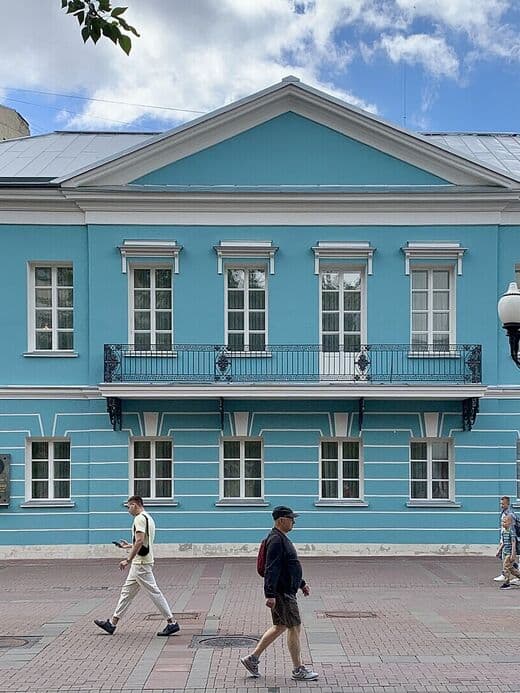
Pushkin House-Museum—the memorial apartment where the poet lived after his wedding. The only Moscow location connected to his family life.
Okudzhava Monument—the bronze bard stands in a building archway. Nearby, street musicians usually play his songs.
Tsoi Wall—a spontaneous memorial to the "Kino" leader in Krivoarbatsky lane. Graffiti, inscriptions, candles—the cult has continued since 1990.
Vakhtangov Theatre—one of Moscow's main theaters. The façade faces Arbat; in front—the "Princess Turandot" fountain.
Prague Restaurant—at the street's beginning, near Arbat Gates. 1872 building, Stalinist Empire interiors. The Prague cake was invented here.
Street Life
Artists sell paintings—from banal to interesting. Commissioned portraits, caricatures, cityscapes. Quality varies; bargaining is appropriate.
Musicians play everything from classical to rock. Levels vary, but real talent occasionally appears. The hat for money is part of tradition.
Souvenir shops—matryoshkas, ushankas, "Soviet kitsch." Tourist prices, quality to match.
Food
Restaurants and cafés abound. Tourist format dominates: high prices, average cuisine. But exceptions exist—read reviews.
Side streets are better and cheaper. Krivoarbatsky, Starokonyushenny—local residents there, real Moscow there.
New Arbat
Parallel to the old runs New Arbat—a wide 1960s avenue with "book" high-rises. The contrast is striking: intimate 19th century versus Soviet modernism. Together they give a dimensional picture of the city.
Practical Information
Arbat is a pedestrian zone from Arbat Gates square to Smolenskaya square (about 1.2 km). Metro: Arbatskaya (at start), Smolenskaya (at end).
Best time is evening: lanterns light up, musicians activate, atmosphere becomes more romantic. Daytime is more businesslike.
Atmosphere and Tips
Arbat is a contradictory street. For some—kitsch and tourist trap. For others—the soul of old Moscow, nostalgia for the 1960s. Truth is somewhere in between: come without expectations, and the street will reveal itself.