Mausoleum at Halicarnassus
The Mausoleum at Halicarnassus was one of the Seven Wonders of the Ancient World, of which almost nothing remains. The tomb of the Carian king Mausolus gave its name to all mausoleums in the world, but itself became a pile of stones and memories. A story of grandeur and destruction in one place.
King Mausolus
Mausolus ruled Caria (southwestern Asia Minor) in the 4th century BC as a satrap of the Persian Empire, but was effectively an independent king. His capital Halicarnassus (modern Bodrum) flourished.
Mausolus died in 353 BC before his tomb was completed. His widow and sister Artemisia II continued the work. She survived her husband by only two years but managed to complete the monument.
The word "mausoleum" derives from Mausolus's name—his tomb became the standard for monumental burial structures.
What the Mausoleum Looked Like
Ancient authors describe a building about 45 meters tall. Three tiers: a high podium, a colonnade of 36 Ionic columns, and a pyramidal roof of 24 steps. At the summit stood a quadriga (four-horse chariot) bearing statues of Mausolus and Artemisia.
The finest Greek sculptors—Scopas, Bryaxis, Leochares, Timotheus—decorated the building with reliefs and statues. Subjects: battles with Amazons, centauromachy, chariot races.
The Mausoleum combined Greek, Egyptian, and Lycian architectural traditions. It was groundbreaking in funerary art—nothing like it had been built before.
Destruction
The Mausoleum stood for over 1,500 years. Earthquakes from the 12th to 15th centuries gradually destroyed the building. By the 15th century, it was in ruins.
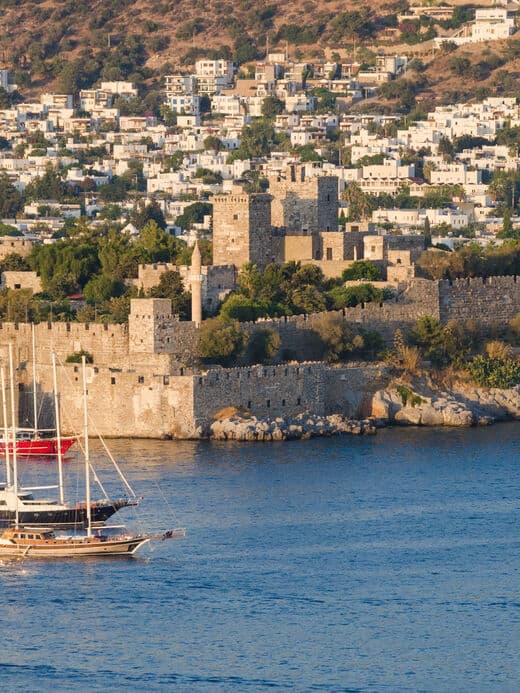
The final blow came from the Knights Hospitaller. Building Bodrum Castle from 1494 to 1522, they used the Mausoleum as a quarry. Marble blocks, reliefs, and statues went into the fortress walls.
The knights even found the burial chamber—and plundered it, leaving only a few fragments. Stories of finding Mausolus's sarcophagus remain unconfirmed.
What Remains
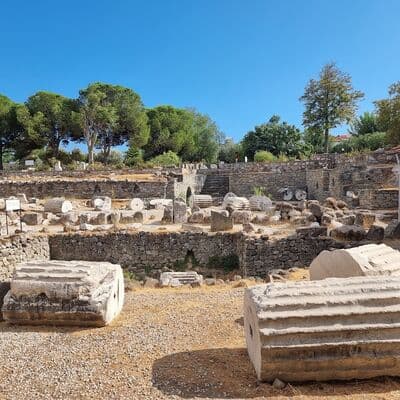
At the Mausoleum site—a pit with foundation fragments, a few columns, and stones. A small museum shows reconstructions and the monument's history.
The best fragments are in the British Museum in London. In the 1850s, Charles Newton removed statues of Mausolus and Artemisia, Amazonomachy reliefs, and parts of the quadriga. Turkey demands their return; Britain refuses.
In the walls of Bodrum Castle, you can see embedded reliefs and blocks—literal evidence of the Wonder's destruction.
Is It Worth Visiting?
Honest answer: if you're not passionate about antiquity, it may be boring. Ruins are minimal, the museum modest. This is a place for imagination, not eyes.
But if you understand the context, the visit is moving. Standing where one of the Seven Wonders stood, imagining the 45-meter colossus, thinking about Mausolus and Artemisia—that's a different experience.
Combine with Bodrum Castle—there you'll see where the Mausoleum's stones ended up.
Practical Information
The Mausoleum is open 8:30 AM to 7 PM (summer) or 5 PM (winter). Tickets are inexpensive. Visit takes 30-45 minutes if you read the information panels.
Location: central Bodrum, 10 minutes' walk from the castle. Street signs point to Mausoleum.
Atmosphere and Character
The Mausoleum at Halicarnassus is a reminder of fame's fragility. A king built himself an eternal monument, gave his name to an entire type of structure—and his creation became a pit and a few stones.
This place works on contrast. Imagine: a Wonder of the World stood here, travelers came from across the Mediterranean, Greece's finest sculptors worked here. Now—souvenir shops around the perimeter and tourists trying to figure out what to look at.
Maybe that's the lesson. Mausolus wanted to be remembered forever—and he is. Not because of surviving stones, but because of a word that lives in every language on Earth.