Magellan's Cross
Magellan's Cross: Where Philippine History Began
In the center of Cebu City, steps away from bustling shopping streets, stands a small octagonal pavilion of coral stone. Inside is a wooden cross, surrounded by the scent of candles and quiet prayers. This is Magellan's Cross — the place where, five hundred years ago, the history of the Philippines as we know it began.
On April 14, 1521, Portuguese navigator Ferdinand Magellan, sailing under the Spanish crown, landed on the shores of Cebu. He came not as a conqueror but as a guest of the local ruler — Rajah Humabon. And he brought not just goods for trade, but a new faith.
History of the Cross
The First Baptism
Magellan convinced Rajah Humabon and his wife Juana to accept Christianity. On April 14, 1521, a mass baptism took place: about 800 locals embraced the new faith. To commemorate this event, Magellan planted a large wooden cross on the shore — symbolizing the arrival of Christianity to the Philippine islands.
This event changed the archipelago's history forever. Today over 80% of Filipinos are Catholic, and the country remains the only predominantly Christian nation in Asia (apart from East Timor). And it all started here, at this cross.
Fate of the Original
What happened to Magellan's original cross remains uncertain. According to one account, locals began chipping away pieces, believing in their miraculous powers. To preserve the relic, in 1835 the remains of the original cross were encased inside a new one made of tindalo wood.
Skeptics believe the original was lost long ago and the current cross is entirely new. Believers insist ancient wood remains inside. Either way, the symbolic significance of the place remains unchanged.
The Pavilion
The current octagonal pavilion was built in 1834 from coral stone. The ceiling features a painting depicting the baptism of Rajah Humabon and Queen Juana — vivid colors, historical costumes, a momentous scene.
In 2021, for the 500th anniversary of the first baptism, the cross was officially named the '2021 Jubilee Cross.' The pavilion, along with the adjacent Basilica of Santo Niño, was declared a National Cultural Treasure of the Philippines.
What You'll See
The pavilion is small — literally a few steps from entrance to cross. But the atmosphere is special. Locals come to pray, light candles, ask for blessings. Tourists mix with worshippers, clicking cameras but speaking more softly.
At the entrance sit women selling candles of different colors. Each color has its meaning: red for love, yellow for money, white for health. For a small fee they'll perform a short ritual, dancing around with lit candles. This isn't an ancient tradition — more tourist attraction — but many enjoy it.
The cross stands in the center of the pavilion, protected by a barrier. You can't touch it — precisely because of those who for centuries tried to take pieces as souvenirs. But you can stand nearby, think about how much has changed in 500 years, and how much remains the same.
Practical Information
Opening Hours
The pavilion is open daily from 8:00 AM to 6:00 PM. Entry is free.
How to Get There
Magellan's Cross is in the heart of Cebu City, on Plaza Sugbo, opposite City Hall. Adjacent to the Basilica of Santo Niño and the cathedral.
- From Mactan Airport: Taxi or Grab (30-40 minutes, 300-400 pesos) or MyBus to SM Cebu City, then jeepney 10M or 12I
- From other Cebu areas: Any jeepney heading downtown, tell the driver 'Santo Niño' or 'Magellan's Cross'
- Walking: If you're already downtown, everything is within walking distance
Tips for Visiting
- Dress modestly. This is a religious site — cover shoulders and knees.
- Come morning or late afternoon. Midday is hot and crowded.
- Combine with the Basilica. It's literally steps away, logical to visit both together.
- Fridays and Sundays — More worshippers, lively atmosphere, but also larger crowds.
Nearby Attractions
Basilica of Santo Niño
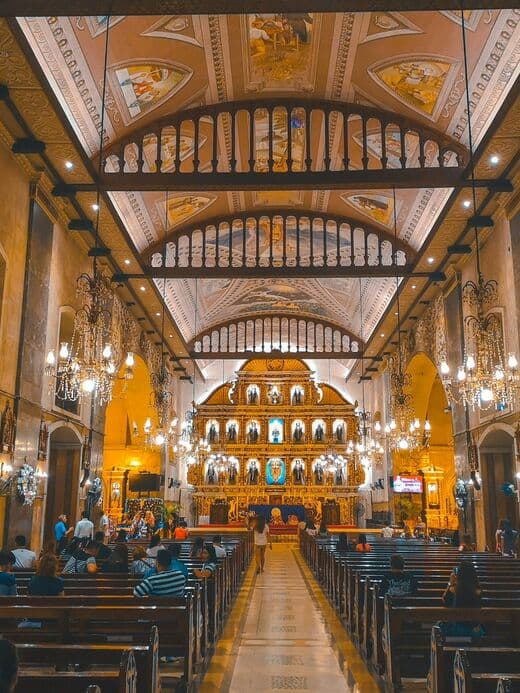
The oldest church in the Philippines (founded 1565), literally 50 meters from the cross. Houses the statue of the Holy Child Jesus — the same one Magellan gave to Queen Juana at her baptism. More details in a separate article.
Fort San Pedro
A 16th-century Spanish fortress 10 minutes' walk away. The oldest and smallest fort in the Philippines. Now a museum and pleasant park.
Heritage of Cebu Monument
An impressive sculptural complex telling Cebu's story from pre-colonial times to the present. Great photo spot.
Colon Street
The oldest street in the Philippines, named after Columbus. Busy, chaotic, authentic — feel the pulse of a Filipino city.
Historical Context
Understanding Magellan's Cross requires context. 1521 was the Age of Discovery. Magellan led a Spanish expedition seeking a western route to the Spice Islands (modern Indonesia).
Cebu wasn't the final destination, just a stop along the way. But a fateful one. Weeks after planting the cross, Magellan died in battle on nearby Mactan Island, fighting against local chief Lapu-Lapu. The irony of history: Lapu-Lapu is now considered the first Filipino hero who resisted colonizers. Yet the cross planted by his enemy is a national shrine.
The Spanish returned to Cebu in 1565 under Miguel López de Legazpi. They found a burned village, but among the ruins a soldier discovered a wooden box containing the Holy Child statue — Magellan's gift. This was seen as a divine sign, and on this spot they founded the first Spanish settlement in the Philippines.
Best Time to Visit
For a quiet visit: Weekday mornings (right after opening) or late afternoons. Fewer tourists, peaceful exploration.
For atmosphere: Friday or Sunday when local worshippers come. Street masses, processions, living religious life.
Special dates:
- Third Sunday of January — Sinulog Festival, Cebu's biggest celebration. Millions of people, dancing, processions. If you want to see it — book accommodation months ahead.
- April 14 — Anniversary of the first baptism. Solemn services.
- April 28 — Kaplag feast, anniversary of finding the Santo Niño statue.
Reflections
Magellan's Cross isn't just a tourist attraction. It's where history and faith intersect, past and present, colonialism and national identity.
You can view it different ways. For devout Filipinos, it's a sacred site marking the beginning of their Christian history. For historians — a monument to the Age of Discovery and colonial beginnings. For tourists — an essential stop in Cebu.
But standing beneath the painted dome of the pavilion, looking at the simple wooden cross, you feel something more than the sum of these interpretations. Five hundred years ago an event occurred here that changed millions of lives. And the echo of that day still resonates within these walls.