Moscow Kremlin
The Moscow Kremlin is the heart of Russia, a fortress that has witnessed everything: Tatar raids and tsars' coronations, revolutions and Victory Day parades. Behind red walls lie cathedrals with golden domes, the Armoury Chamber with royal regalia, and the presidential residence. A place where the country's history is concentrated on 28 hectares.
Fortress History
The first fortification on Borovitsky Hill appeared in 1147—Moscow's history begins from this date. Wooden walls burned, were rebuilt, expanded. The white-stone Kremlin of Dmitry Donskoy stood for a hundred years.
The present walls date from the late 15th century, work of Italian architects. Ivan III invited masters from Milan, and they built a fortress using state-of-the-art fortification: red brick, "swallowtail" merlons (like Ghibelline castles), 20 towers.
The Kremlin was the residence of grand princes and tsars until Peter I moved the capital to St. Petersburg. Power returned in 1918—now Bolsheviks occupied it. Since then, the Kremlin has symbolized Russian statehood.
Cathedrals
Cathedral Square is the Kremlin's spiritual center. Three main cathedrals stand together, creating an ensemble of unparalleled beauty.
Assumption Cathedral—the state's main church, where all Russian tsars were crowned and emperors inaugurated. Also the burial place of metropolitans and patriarchs. Interior features 16th-century frescoes, iconostasis with ancient icons.
Archangel Cathedral—burial place of grand princes and tsars. 54 tombs, including Ivan Kalita, Ivan the Terrible, Michael Romanov. Sarcophagi arranged in rows, names reading like a history textbook.
Annunciation Cathedral—the tsars' private church. Iconostasis by Theophanes the Greek and Andrei Rublev. Jasper and agate floor—a gift from the Persian Shah.
Ivan the Great Bell Tower
At 81 meters, it was Moscow's tallest building for centuries (building higher was forbidden). Bell tower with 21 bells. From the observation platform—panoramic views of the entire center, though access isn't always available.
Nearby—the Tsar Bell (200 tons, cracked in a fire, never rang) and Tsar Cannon (40 tons, never fired). Monuments to Russian gigantism—beautiful but useless.
Armoury Chamber and Diamond Fund
The Armoury Chamber is a treasure museum: royal regalia, thrones, carriages, Fabergé egg collection. The Diamond Fund is even more impressive: the Imperial Crown, the Orlov Diamond, gold nuggets. Tickets sell out fast—book ahead.
Practical Information
The Kremlin is open daily except Thursday, 10:00 AM to 6:00 PM. Tickets sold at Kutafya Tower ticket offices and online (recommended). Territory plus cathedrals—one ticket; Armoury Chamber and Diamond Fund—separate.
Airport-style security screening at entrance. Large bags and backpacks go to storage. Photography allowed everywhere except museums.
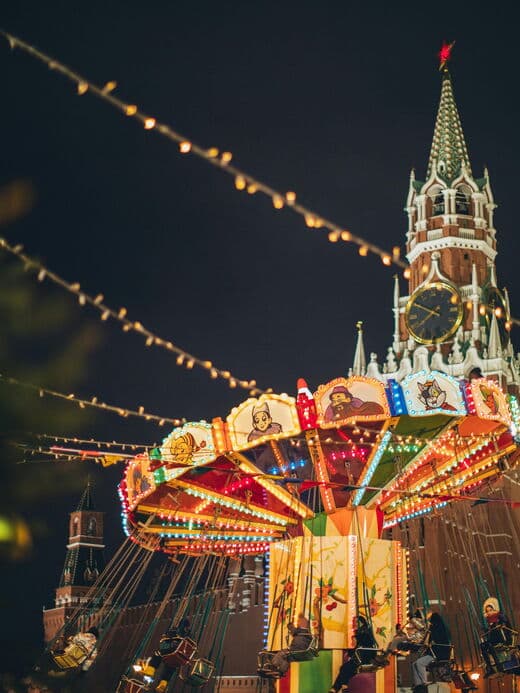
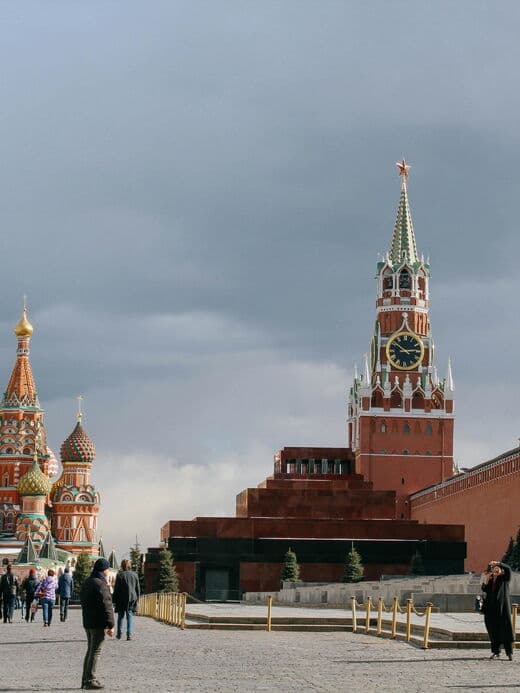
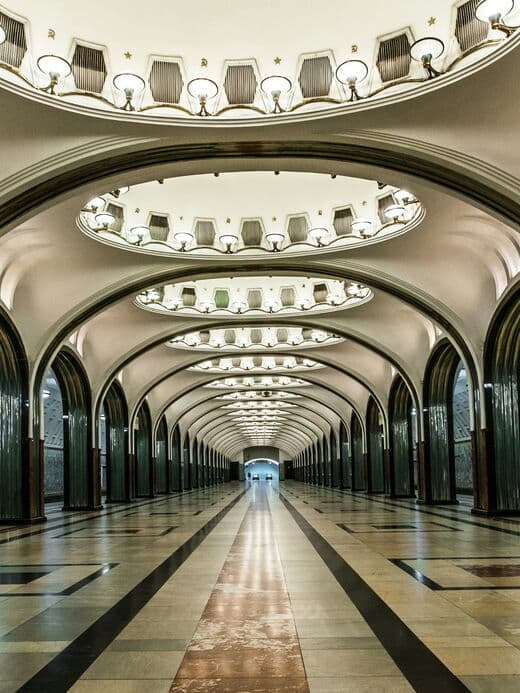
Enter through Kutafya Tower (from Alexandrovsky Sad metro). Exit through Spasskaya to Red Square or back through Kutafya.
Atmosphere and Character
The Kremlin is a place where history weighs physically. These walls remember Ivan the Terrible, Napoleon, Stalin. These cathedrals witnessed coronations and funerals. Decisions affecting millions of lives were made here.
Tourists abound, especially in summer. But the Kremlin's scale allows finding relatively quiet corners. Cathedral Square at sunset, when golden domes glow in the last rays—one of Moscow's finest views.
This isn't a museum—it's an active seat of power. The Senate Palace is closed, security watches, helicopters sometimes land right behind the walls. History continues.