Sukhothai 2026: What to Know Before You Go
Sukhothai is where Thailand began - literally. This was the first capital of the Thai kingdom, founded in 1238, and walking through its ruins feels less like visiting a museum and more like stepping into the origin story of an entire civilization. Yet somehow, while millions flock to Ayutthaya or Chiang Mai, Sukhothai remains gloriously under-visited. Think of it as Thailand's Angkor Wat - ancient, sprawling, breathtaking - but without the crowds, the $37 entry fee, or the guy trying to sell you a selfie stick every forty seconds.
The Sukhothai Historical Park is a UNESCO World Heritage Site covering roughly 70 square kilometers of temple ruins, Buddha statues, lotus ponds, and centuries-old walls. But Sukhothai is more than its ruins. It is a quiet Thai town where the best noodles in the country cost less than a dollar, and where you can cycle past 800-year-old temples without another tourist in sight.
What makes Sukhothai special:
- UNESCO World Heritage ruins with a fraction of Ayutthaya's crowds
- Birthplace of the Thai alphabet, Thai art, and Theravada Buddhism as state religion
- Some of the most photogenic temple ruins in Southeast Asia
- Genuinely affordable - eat, sleep, and explore on $25-35 per day
- The Loy Krathong festival here is the most beautiful in Thailand
The honest downsides:
- Getting here takes effort - no direct trains, limited airport flights
- Nightlife is essentially nonexistent
- The March-to-May heat is punishing among open ruins
- New Sukhothai town itself is not charming
- English is less widely spoken than in major tourist hubs
Sukhothai Neighborhoods: Where to Stay
There are two Sukhothais. New Sukhothai is the modern town where buses arrive. Old Sukhothai is the historical park area, 12 kilometers west. Where you stay shapes your entire experience.
Old Town (Near the Historical Park)
This is where you want to be if temples are your priority. Staying here means you can be among the ruins at sunrise before tour groups arrive. A handful of guesthouses and small resorts line the road to the park entrance.
The vibe: Quiet, rural, village-like. After dark - a few restaurants, some fireflies, and not much else.
Prices: Budget guesthouses 400-600 THB ($11-17). Mid-range 1,200-2,500 THB ($34-71). Boutique options 3,000-4,500 THB ($85-128).
Pros: Walking distance to ruins. Sunrise access without a commute. Peaceful atmosphere. Some properties include bicycle rental.
Cons: Limited dining after 8 PM. Few convenience stores nearby. Need transport to New Sukhothai for anything beyond basics.
Best for: History enthusiasts, photographers, couples seeking tranquility.
New Sukhothai Town Center
Where the practical stuff lives - bus station, banks, ATMs, morning market, pharmacies, widest selection of restaurants. A functional Thai town rather than a tourist destination, but comfortable and convenient.
Prices: Budget rooms 300-500 THB ($8-14). Mid-range with AC and hot water 700-1,500 THB ($20-43). Modern hotels with pools 2,000-3,500 THB ($57-100).
Pros: Best restaurant selection. Bus station access. Night market. Social atmosphere. Cheapest rooms in the area.
Cons: Need transport to the historical park daily - the 12 km ride adds up without your own wheels.
Best for: Budget travelers, those with early/late bus connections, anyone wanting evening dining options.
Along the Yom River
A sweet spot between the two areas. River scenery and a sense of place without total isolation. Some of the most charming mid-range accommodation sits along this corridor.
Prices: Mid-range 1,000-2,500 THB ($28-71). Upscale with pools 3,000-5,000 THB ($85-143).
Best for: Mid-range travelers, couples, anyone who values setting in their accommodation.
Si Satchanalai Area
About 55 km north, this sister park is even quieter. A tiny handful of homestays operate nearby - basic rooms 300-800 THB ($8-23). Better as a one-night side trip than your only base.
Best Time to Visit Sukhothai
Sukhothai sits in Thailand's central plain - inland, flat, and sun-exposed. Your timing matters more here than in coastal destinations because you will spend hours outdoors with limited shade.
November to February (Cool Season) - Best time. Daytime 25-32C (77-90F), mornings can dip to 15-18C (59-64F) in December-January. Rain is rare. The light is spectacular for photography.
The Loy Krathong factor: If you can time your visit for November's full moon, do it. Sukhothai is widely considered the most beautiful place in Thailand to celebrate Loy Krathong. The historical park comes alive with thousands of floating candles on the ponds surrounding the ruins, traditional dance performances, fireworks, and a light-and-sound show that transforms Wat Mahathat into something otherworldly. The festival runs about five days - book accommodation weeks in advance.
March to May (Hot Season) - Challenging but possible. Temperatures hit 38-42C (100-108F). Start at sunrise (park opens 6:00 AM), retreat to AC by 11 AM, return after 4 PM. Carry two liters of water minimum. Upside: ruins to yourself, and hotel prices drop. Songkran in mid-April brings water fights and parades.
June to October (Rainy Season) - Underrated. Rarely rains all day. Typical pattern: clear morning, afternoon downpour for 1-3 hours, clearing by evening. Ruins look stunning after rain - wet laterite glows deep red, greenery is lush. Lowest prices, fewest tourists. Bring waterproof bags for camera gear.
Sukhothai Itinerary: 2 to 5 Days
Most travelers allocate one day, which is a mistake. You can hit the highlights, but you will be rushing - and rushing is antithetical to this place.
2-Day Express: The Essentials
Day 1: Central and Western Zones
Be at the Sukhothai Historical Park entrance by 6:30 AM. Rent a bicycle at the gate for 30 THB ($0.85).
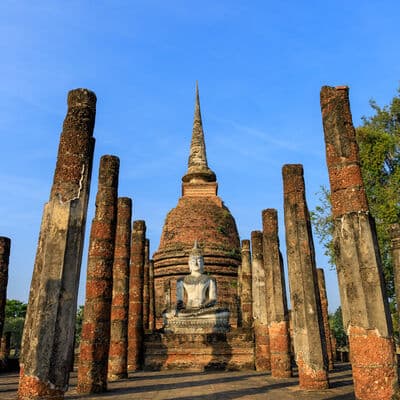
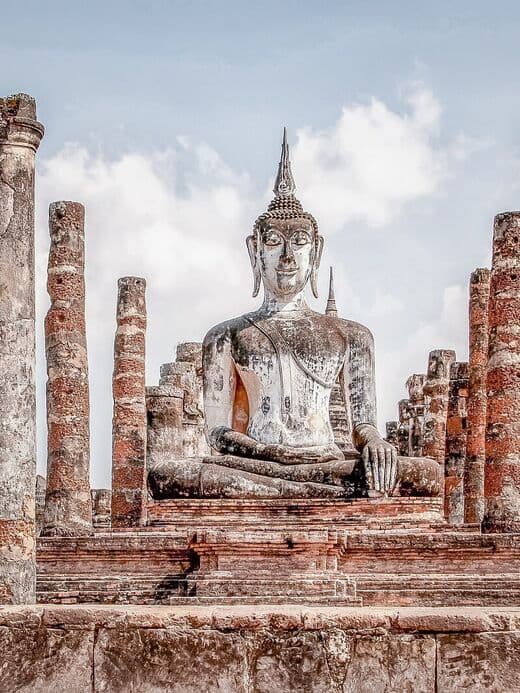
Begin with the central zone (100 THB / $2.85 admission). Head straight for Wat Mahathat, the largest temple complex - nearly 200 chedis, numerous Buddha images, and a reflecting pond creating mirror-perfect reflections at dawn. Spend at least 45 minutes here.
Cycle to Wat Sa Si, set on an island in a lotus pond - arguably the single most photogenic spot in the park. A graceful walking Buddha framed by a slender chedi and water lilies. Then visit Wat Trapang Thong, an active temple on a small island where monks still practice.
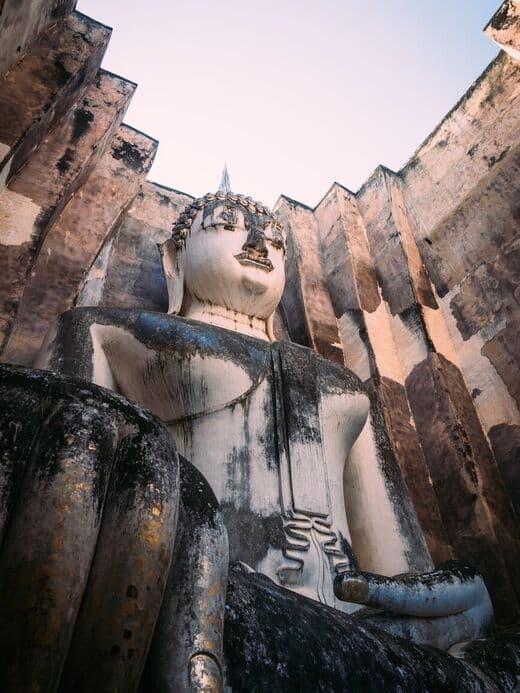
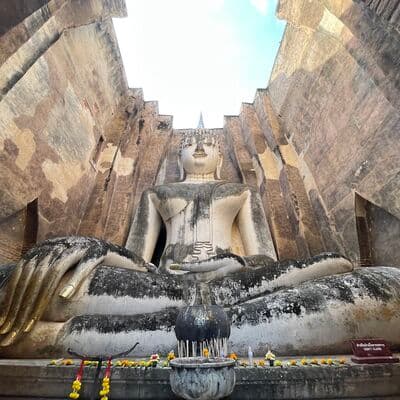
Move to the western zone (100 THB / $2.85 separate ticket). Here you will find Wat Si Chum - inside a massive mondop with walls over three meters thick sits an enormous seated Buddha. The Buddha's face is framed perfectly by the narrow doorway slit, and the effect is genuinely awe-inspiring. Late morning light is ideal.
Afternoon: Return to your hotel by noon. Around 4 PM, revisit the central zone (ticket valid all day). Watch sunset near Wat Mahathat - chedis silhouetted against orange sky.
Evening: Night market in New Sukhothai for dinner. Try the Sukhothai noodles - this is literally where they were invented.
Day 2: Northern Zone and Museum
Visit the Ramkhamhaeng National Museum near the park entrance (150 THB / $4.28). An hour here provides context that transforms the ruins from old stones into a narrative - the history of the kingdom, finest Thai sculpture, and a replica of the famous Ramkhamhaeng inscription, the oldest known Thai script.
Explore the northern zone (100 THB / $2.85). Wat Phra Phai Luang is the highlight - a Khmer-era complex predating the Thai kingdom, hinting at the Hindu-Buddhist transition. The zone feels wilder than the manicured central area.
Afternoon: Depart, or visit the Sangkhalok Ceramic Museum - pottery was Sukhothai's primary export, traded across Southeast Asia and as far as Japan.
3-Day Relaxed: Adding Si Satchanalai
Day 3: Si Satchanalai Historical Park
This sister site 55 km north was the kingdom's second city, and many repeat visitors prefer it. Set on a hillside above the Yom River, the ruins are more overgrown, less restored, and far emptier - you might encounter more deer than tourists.
Getting there: Motorbike from New Sukhothai (200-300 THB / $5.70-8.55 per day rental), about 1 hour through rice paddies. Or bus from the terminal, 40-60 THB ($1.14-1.71), about 1.5 hours.
Highlights: Wat Chang Lom (chedi ringed by 39 elephant statues), Wat Chedi Jet Thaew (rows of stupas in photogenic decay), Wat Nang Phaya (rare stucco reliefs). Admission 100 THB ($2.85). Nearby, visit the old kilns at Ban Ko Noi - original ceramic workshops with kilns intact after 700 years.
5-Day Deep Dive: The Complete Kingdom
Day 4: Kamphaeng Phet - 75 km south, the kingdom's military outpost and the third corner of the UNESCO designation. The least visited of the three parks, with a forested setting and haunting laterite Buddha statues among trees at Wat Phra Si Iriyabot. Bus from New Sukhothai, 1.5 hours, 60-80 THB ($1.71-2.28).
Day 5: Countryside and Culture - Explore east of the historical park by bicycle. Visit Wat Traphang Thong Lang for the finest stone relief carvings in the Sukhothai style. Browse the morning market (not the tourist night market) where locals buy produce. Seek out workshops producing Sangkhalok-style ceramics - artisans continuing a 700-year tradition.
Where to Eat in Sukhothai
Sukhothai is not a dining destination like Chiang Mai or Bangkok. No rooftop cocktail bars or fusion restaurants. What you will find is honest, inexpensive Thai food - much of it excellent, some unique to this region, almost all shockingly cheap.
Street Food and Night Markets
The New Sukhothai Night Market operates most evenings near the bridge. A full meal - noodle soup, grilled skewer, sticky rice, and a drink - costs 60-100 THB ($1.71-2.85). Look for the Sukhothai noodle stalls with the biggest queues. Fresh fruit smoothies 25-35 THB ($0.71-1.00).
Near the historical park, food stalls at the entrance serve rice and noodle dishes for local workers and tourists alike, 40-60 THB ($1.14-1.71). The Saturday Walking Street Market near the Ramkhamhaeng monument has more variety and live music - worth planning around.
Local Restaurants
Tan Puy Noodle - The place for Sukhothai noodles. A no-frills shop serving its version for decades. Slightly sweet broth with peanut undertone, exactly as it should be. 40-50 THB ($1.14-1.43). Locals debate whether this or the stall near the bus station is better - at these prices, try both.
Chan Thong - Family-run, broader menu. Good curries, stir-fries, excellent som tam. Most dishes 50-80 THB ($1.43-2.28). They can adjust spice levels, though they respect you more if you order Thai-spicy.
Poo Restaurant - Slightly more upscale by Sukhothai standards (still casual). Popular with locals and tourists. Wide menu, some Western options. Mains 80-150 THB ($2.28-4.28). Pleasant riverside setting with cold beer.
Cafes and Breakfast
Chopper Bar and Cafe near the park serves good espresso (60-90 THB / $1.71-2.57). Small cafes between New and Old Sukhothai serve Thai iced coffee for 25-35 THB ($0.71-1.00). For breakfast, the morning market has jok (rice congee), fried dough sticks, and hot soy milk - a proper Thai breakfast under 40 THB ($1.14).
Must-Try Food in Sukhothai
Sukhothai Noodles (Kuay Tiew Sukhothai) - The dish. Slightly sweet broth with ground peanuts, sliced green beans, and thin pork over rice vermicelli. What makes it distinct from Bangkok noodle soup is the balance - lighter, sweeter, more complex. The dry version (broth on the side) is equally popular and arguably better. 35-50 THB ($1.00-1.43). You will eat this multiple times, comparing versions like a noodle sommelier.
Som Tam (Green Papaya Salad) - The central plains version is milder than the Isan version. Shredded papaya, tomatoes, chili, lime, fish sauce, peanuts. Specify your chili count - start with two. 35-50 THB ($1.00-1.43).
Sai Krok Isan (Fermented Sausage) - Tangy pork-and-rice sausages, grilled over charcoal, served with ginger and peanuts. Sounds strange, tastes addictive. Night market staple, 20-40 THB ($0.57-1.14).
Khao Lam (Bamboo Sticky Rice) - Sticky rice with coconut milk and black beans, roasted inside bamboo tubes. Subtle woody flavor. Roadside vendors between New and Old Sukhothai, 20-30 THB ($0.57-0.85). Perfect cycling snack.
Tropical Fruits - The morning market has mangoes (Nam Dok Mai variety), dragon fruit, rambutan, longan. Mango kilo: 40-80 THB ($1.14-2.28). Mangosteen (May-September) is transcendent. Durian in season April-June for the brave.
Thai Iced Coffee and Tea - Kafae yen and cha yen served everywhere. Sweet by default - say "mai waan" (not sweet) or "waan nit noi" (a little sweet). 25-40 THB ($0.71-1.14).
For vegetarians: Manageable with effort. Most dishes can be made meatless ("mai sai neua sat"). During Buddhist festivals, look for yellow "jay" flags at stalls indicating vegan food - no meat, eggs, dairy, or strong aromatics.
Sukhothai Insider Tips
1. Sunrise beats sunset. The park opens at 6:00 AM. The first hour - mist over lotus ponds, empty ruins - is the most atmospheric. You can photograph Wat Mahathat without another person in frame. Sunset is beautiful too, but busier.
2. Rent an e-bike, not a regular bicycle. The park is much larger than it looks on maps. By noon, pedaling in 33-degree heat becomes deeply unpleasant. E-bikes available near the entrance for 200-300 THB ($5.70-8.55) per day versus 30-50 THB for a regular bike. The extra cost pays for itself.
3. Three zones means three tickets. Central, western, and northern zones each charge 100 THB ($2.85) for foreigners. Eastern and southern zones are free. The combined ticket at 350 THB ($10.00) covers all three paid zones plus museums - best value for multi-day visits.
4. Wat Sorasak is a hidden gem. In the central zone, a chedi base surrounded by 24 elephant statues - striking and far less photographed. Slightly off the main path, which is why most miss it.
5. Visit the museum before the ruins. Counterintuitive, but an hour in the Ramkhamhaeng Museum transforms old stones into a narrative. You will notice details - the walking Buddha, the flame-shaped ushnisha - that you would otherwise miss.
6. Water is non-negotiable. Carry at least 1.5 liters. Freeze a bottle overnight - it melts slowly and gives you cold water for hours. Dehydration sneaks up when you are focused on temples.
7. Download Google Maps offline. Coverage is fine but data speeds can lag. Download the area covering both New and Old Sukhothai before arriving.
8. This is not a day trip from Bangkok. 430 km away - you would spend 12+ hours in transit for 3-4 hours at the ruins. Sukhothai deserves at least two nights.
9. Bring a flashlight for dusk. If you stay until closing for sunset, paths back to the entrance get dark, especially in outer zones. The park is not lit at night except during festivals.
10. Temple fatigue is real. There are over 190 ruins in the park. Pick 8-10 key sites per day, spend real time at each. The temples you stumble upon accidentally - overgrown, unsigned, tucked behind a tree - are often the most memorable.
Getting Around Sukhothai
Getting to Sukhothai
From Bangkok by bus: Buses from Mo Chit Northern Terminal, 6-7 hours. First-class 320-400 THB ($9-11), VIP with reclining seats 450-550 THB ($13-16). Night buses depart 9-10 PM, arrive at dawn. Book through the 12Go.asia app.
From Bangkok by air: Bangkok Airways flies to Sukhothai Airport (charming open-air terminal). About 1h20m, 2,500-5,000 THB ($71-143) one way. Airport sits between New and Old Sukhothai. Budget alternative: fly into Phitsanulok (more airlines, cheaper), then bus 60 km to Sukhothai.
From Chiang Mai by bus: Several daily, 5-6 hours, 230-350 THB ($6.55-10.00). Natural pairing - Chiang Mai first, then Sukhothai on the way south.
From Phitsanulok: Frequent buses and minivans, 60-80 THB ($1.71-2.28), about 1 hour. Phitsanulok has a train station on the Bangkok-Chiang Mai line - good for rail lovers.
Getting Around Town
Bicycle: Best for the historical park. Flat terrain, enjoyable cycling. Rental 30-50 THB ($0.85-1.43) per day near the entrance. Check brakes and tires before accepting.
Motorbike: 200-300 THB ($5.70-8.55) per day for automatic scooter. Technically need international driving permit. Gives freedom for Si Satchanalai, countryside, and commuting between towns. Full tank about 80-100 THB ($2.28-2.85).
Songthaew: Shared pickup truck between New Sukhothai and the park, 30 THB ($0.85). Roughly every 20-30 minutes. Last one back around 5:30 PM - do not get stranded.
Tuk-tuk: Private hire, 150-200 THB ($4.28-5.70) between New and Old Sukhothai. Negotiate before boarding.
Connectivity
SIM cards: Any 7-Eleven in New Sukhothai. AIS, True Corp, or DTAC tourist packages with data: 200-300 THB ($5.70-8.55) for 7 days. Bring your passport. AIS has the best rural coverage.
ATMs: Throughout New Sukhothai. Expect 220 THB ($6.28) foreign card fee per withdrawal - Thailand-wide standard. Withdraw larger amounts to minimize fees. ATMs scarce near the historical park. This is primarily a cash economy.
Apps: Google Maps (offline), Grab (limited here but worth having), LINE (messaging - useful with guesthouses), Google Translate with Thai offline pack, 12Go.asia for transport bookings.
Is Sukhothai Right for You?
Sukhothai is for people who find beauty in old stones and silence. It rewards patience, curiosity, and willingness to travel off the beaten path. If you love history, photography, or simply the feeling of having an ancient place to yourself, Sukhothai may be the highlight of your Thailand trip.
It is not for those seeking beaches, nightlife, or the social buzz of a backpacker hub. No full moon parties. The fanciest restaurant would be casual anywhere else. The nearest beach is hundreds of kilometers away.
Two to three nights is the sweet spot. Arrive, slow down, explore the ruins in golden morning and evening light, eat noodles that cost less than a dollar, and cycle through landscapes that have not changed much in centuries. You will leave carrying something Sukhothai gives better than almost anywhere in Thailand - a sense of where this remarkable country came from.
 26°
26° 34°25°
 33°26°