Strasbourg
Strasbourg 2025: Complete Guide to Europe's Capital of Unity
Strasbourg is a city where France and Germany intertwine into a unique cultural blend. The capital of Alsace and one of the capitals of the European Union, this city on the banks of the Ill River amazes visitors with its architecture, from medieval half-timbered houses to the futuristic European Parliament building. Strasbourg is where a Gothic cathedral stands alongside modern institutions, and Alsatian cuisine combines French refinement with German heartiness.
In 2025, Strasbourg continues to play a key role in European politics, hosting sessions of the European Parliament, the Council of Europe, and the European Court of Human Rights. Yet the city remains vibrant and cozy: a population of about 290,000 within the city proper and over 500,000 in the metropolitan area creates the atmosphere of a large village where all attractions can be explored on foot. The historic center on Grande Île, listed as a UNESCO World Heritage Site, is considered one of the most beautiful in Europe.
City History: Between Two Worlds
Argentoratum - that's what the Romans called the military camp established here in 12 BC. The strategic position at the crossroads of routes from Italy to northern Europe determined the city's fate. After the fall of Rome, the Alemanni settled here, and the name Strateburgum - "fortress on the road" - first appeared in the 6th century.
The Middle Ages transformed Strasbourg into one of the wealthiest cities of the Holy Roman Empire. A Free Imperial City from 1262, it prospered through Rhine trade. It was then that construction began on the famous cathedral, which remained the world's tallest building for two centuries. Gutenberg lived and worked in Strasbourg, where printing was born.
In 1681, Louis XIV annexed Strasbourg to France. The city kept its privileges and German language but became part of the French kingdom. The next two centuries passed relatively peacefully until the Franco-Prussian War of 1870-1871 returned the city to Germany. After World War I, it became French again, was occupied by the Nazis from 1940-1944, and finally returned to France after liberation.
After World War II, Strasbourg became a symbol of Franco-German reconciliation and European unity. In 1949, the Council of Europe was established here, followed later by the European Parliament. Today the city rightfully bears the title of European capital.
Strasbourg Cathedral: Gothic Masterpiece
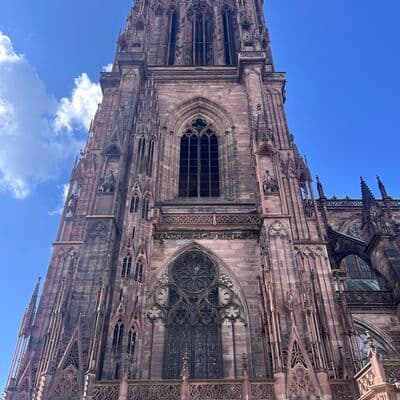
The Cathedral of Our Lady of Strasbourg is the undisputed landmark of the city and one of the greatest Gothic cathedrals in the world. Its single spire, 142 meters high, is visible from dozens of kilometers away and until 1874 made the cathedral the tallest building on the planet. Victor Hugo called it a "gigantic and delicate wonder."
Construction began in 1015 on the site of a Roman temple, but that Romanesque cathedral burned down. The current building was erected from 1176 to 1439, combining Romanesque elements (crypt, choir) with the Gothic splendor of the nave and western façade. The pink Vosges sandstone gives the cathedral a unique warm hue, especially striking at sunset.
The western façade is an encyclopedia of medieval sculpture. Hundreds of statues depict biblical scenes, allegories of virtues and vices, prophets and saints. Particularly famous are the figures of the Church and Synagogue - allegorical female figures on either side of the portal. The central rose window, 15 meters in diameter, is one of the most beautiful in Gothic architecture.
Inside, the cathedral impresses with its height (32 meters) and the exquisite stained glass windows from the 12th-14th centuries. The Romanesque crypt, the 16th-century astronomical clock with moving figures, the 15th-century organ, the medieval baptismal font - each element deserves separate study. The climb to the viewing platform (330 steps) rewards visitors with panoramas of the city, the Vosges, and the Black Forest.
Grande Île: The Treasure Island
Place Kléber
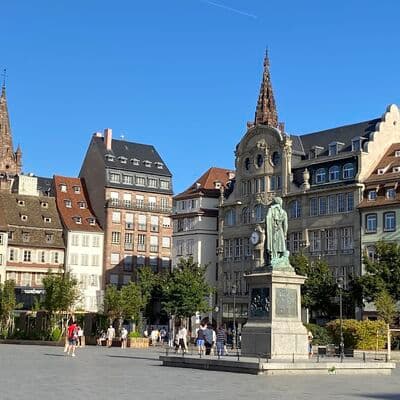
Place Kléber is Strasbourg's main square, named after General Jean-Baptiste Kléber, a native of the city and hero of the Napoleonic Wars. In the center stands a statue of the general above his grave (his remains were transferred here in 1838). Around it are magnificent 18th-19th century buildings, shops, and cafés.
The square is especially magical during the Christmas market, when a giant tree is erected here along with hundreds of stalls selling gifts, decorations, and mulled wine. Strasbourg's Christmas market is the oldest in France (since 1570) and one of the most beautiful in Europe.
Place Gutenberg
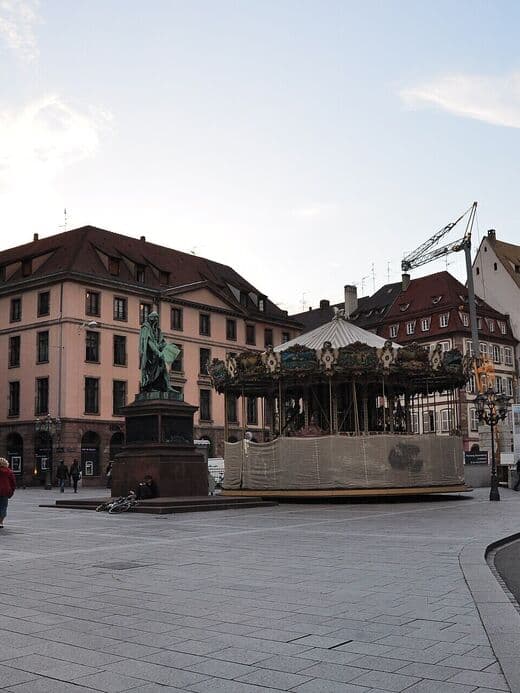
Place Gutenberg is located in the heart of Grande Île, at the southern entrance to the cathedral. Here in the 15th century, Johannes Gutenberg perfected his invention - printing. The monument to the inventor, created by David d'Angers in 1840, depicts Gutenberg with a page from the Bible - the first printed book.
The square features the Chamber of Commerce building - a magnificent example of 16th-century Alsatian Renaissance with rich carvings. Bookshops and antique stores around the square continue the city's tradition as a center of book culture.
Petite France
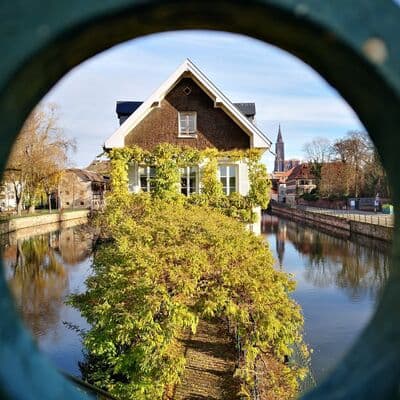
Petite France is Strasbourg's most picturesque quarter and perhaps all of France. The former quarter of millers, tanners, and fishermen has preserved the atmosphere of the 16th-17th centuries: half-timbered houses with wooden balconies lean over canals, covered bridges connect small islands, and old mill wheels still turn in the streams of the Ill.
The quarter's name has nothing to do with patriotism: a hospital for patients with the "French disease" (syphilis) was located here - hence the ironic name. Today it's one of the most romantic spots in Europe, especially in the evening when house windows reflect in the calm canal waters.
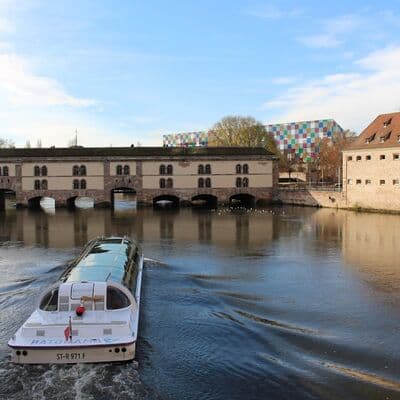
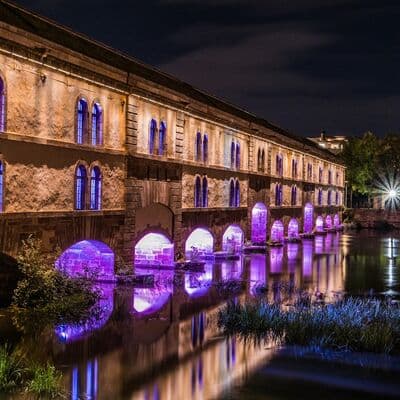
The Covered Bridges (Ponts Couverts) - three medieval bridges with four 14th-century defensive towers - are the symbol of Petite France. Despite their name, the bridge roofs were lost long ago, but the towers remain. The best view of the ensemble opens from the panoramic terrace of the Vauban Dam.
Vauban Dam
The Vauban Dam (Barrage Vauban) is a 17th-century military engineering structure built according to the famous marshal's design. The dam allowed flooding of the southern approaches to the city in case of siege. Today it's a viewing platform with stunning views of Petite France, the Covered Bridges, and the cathedral.
Inside the dam is a gallery with sculptures - fragments of the cathedral's original décor replaced with copies during restoration. This is a little-known but impressive open-air museum of medieval art.
European Quarter
European Parliament
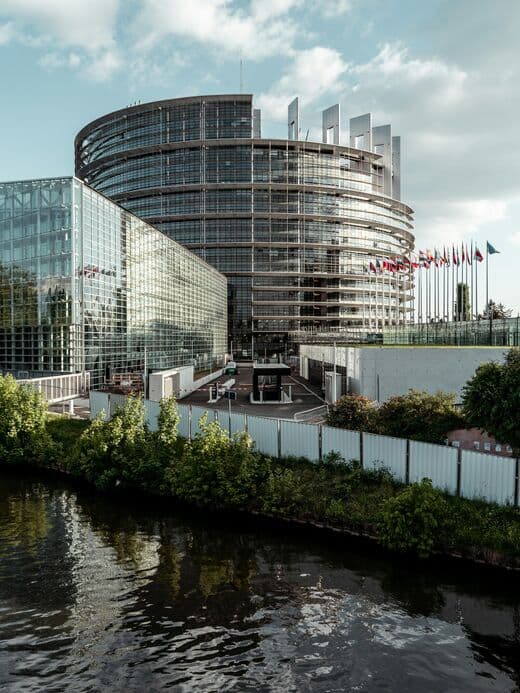
The European Parliament building is an architectural symbol of united Europe. The 60-meter-high glass tower and semicircular assembly hall were designed to symbolize the openness and incompleteness of the European project (the tower is deliberately "unfinished"). The building can be visited with a tour when plenary sessions are not in progress.
Nearby are other European institutions: the Council of Europe (1949), the European Court of Human Rights (distinctive round building), and the Palace of Europe. The quarter embodies Strasbourg's role as a capital of European unity.
Parc de l'Orangerie
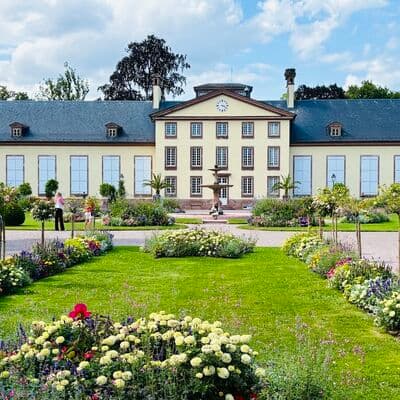
Parc de l'Orangerie is Strasbourg's oldest park, laid out in 1692 to house 138 orange trees brought from Hanau-Lichtenberg Castle. Today it's a favorite recreation spot for Strasbourgers: a lake with boats, a zoo with storks (symbol of Alsace), playgrounds, and the Josephine Pavilion with exhibitions.
The park is located near the European institutions, making it a popular walking spot for diplomats and officials. In spring, it's especially beautiful during the blooming of magnolias and rhododendrons.
Strasbourg Museums
Alsatian Museum
The Alsatian Museum occupies three traditional 16th-17th century houses connected by galleries and courtyards. The exhibition recreates Alsatian village life: peasant interiors with painted furniture, ceramics, costumes, and religious art. The building itself, with its labyrinth of rooms and staircases, is the main exhibit.
Museum of Modern and Contemporary Art
MAMCS (Musée d'Art Moderne et Contemporain de Strasbourg) is one of the largest modern art museums in France. The collection spans from 1870 to the present: Impressionists, Fauvists, Surrealists, Abstract artists. Monet, Sisley, Kandinsky, Picasso, Basquiat - top-tier names.
The museum building (1998, architect Adrien Fainsilber) is itself an architectural landmark: the glass façade reflects the waters of the Ill, and the spacious halls are filled with light.
Museum of Fine Arts
The Museum of Fine Arts in the Rohan Palace presents European painting from the 14th-19th centuries. Italian primitives, Flemish masters (Memling, Rubens), Spanish artists (El Greco, Goya), French painters from Watteau to Corot - the collection is small but of exceptional quality.
Rohan Palace
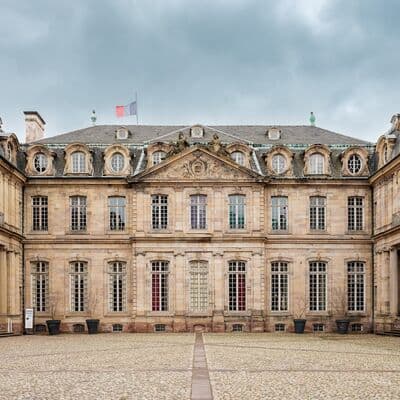
The Rohan Palace was the residence of Strasbourg's prince-bishops from the Rohan family, built between 1732-1742. It's one of the most beautiful 18th-century palaces in France: grand halls, royal apartments (Louis XV, Marie Antoinette, and Napoleon stayed here), and exquisite Rococo interiors.
Today the palace houses three museums: the Museum of Fine Arts, the Museum of Decorative Arts (furniture, ceramics, silver), and the Archaeological Museum (from the Paleolithic to the early Middle Ages).
Alsatian Cuisine
Choucroute - King of the Table
Choucroute is the quintessence of Alsatian cuisine. Sauerkraut braised with juniper and white wine is served with various meat products: sausages, smoked pork, bacon, sometimes fish. Portions are enormous and require a good appetite.
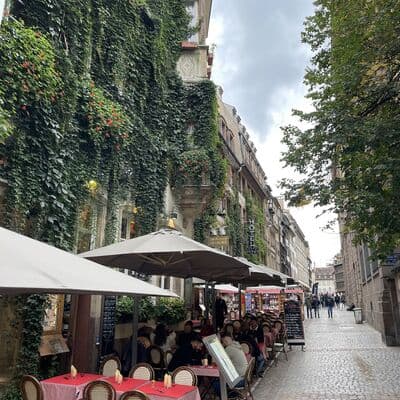
The best choucroute is prepared in traditional winstubs - Alsatian taverns with wooden panels and checkered tablecloths. Maison Kammerzell opposite the cathedral is the most famous, but Au Pont Saint-Martin in Petite France is equally authentic.
Other Signature Dishes
Tarte Flambée (or Flammkuchen) - the Alsatian pizza: thin dough with crème fraîche, onions, and bacon, baked in a wood-fired oven. Traditionally served whole on a wooden board and cut with scissors.
Baeckeoffe - a slow-cooked casserole of three meats (pork, beef, lamb) with potatoes and onions, marinated in white wine. Prepared in a clay pot sealed with dough.
Bretzel - the Alsatian pretzel with coarse salt, an essential companion to beer in any bar. Kougelhopf - a sweet yeast cake with raisins and almonds in a characteristic fluted mold.
Alsatian Wines
Alsace is the only French wine region where wines are labeled by grape variety rather than terroir. Riesling is the king of Alsatian wines, dry and elegant. Gewürztraminer is aromatic and spicy. Pinot Gris is rich and powerful. All pair wonderfully with local cuisine.
The Alsace Wine Route (Route des Vins d'Alsace) passes through picturesque villages with half-timbered houses and vineyards on the slopes of the Vosges. Colmar, Riquewihr, and Eguisheim are the most beautiful stops on the route.
Practical Information for 2025
Getting There
Strasbourg is well connected to Europe. TGV will take you from Paris in 1 hour 46 minutes - one of the fastest lines in France. Frankfurt is 2 hours away, Basel is 1 hour 20 minutes. Regional trains connect Strasbourg with Colmar (30 minutes) and wine route towns.
Strasbourg Airport receives flights from major European cities. The TGV station at the airport allows you to reach the center in 9 minutes. From Basel-Mulhouse-Freiburg Airport (the second largest in the region), Strasbourg is about 1.5 hours by bus or train.
Getting Around
The historic center (Grande Île) is compact and perfect for walking. The tram network (6 lines) covers the entire city and suburbs, including the European quarter. Bicycles are popular transport: the Vélhop system offers rentals at stations throughout the city.
River cruises along the canals are an excellent way to see Petite France and the European institutions from the water. Batorama offers one-hour tours with audio guides in several languages.
Best Time to Visit
Strasbourg is beautiful year-round, but each season has its advantages. Spring (April-May) - ideal weather for walks, blooming parks. Summer (June-August) - warm, many tourists, but also many festivals. Autumn (September-October) - wine season, harvest time, fewer crowds.
Winter is special thanks to the Christmas markets (late November to late December). "Capitale de Noël" - that's what Strasbourg is called, and deservedly so: the city transforms into a fairytale of lights, mulled wine aromas, and gingerbread.
Where to Stay
Grande Île is the best choice for a first visit. Hotels here are more expensive, but you're within walking distance of all attractions. The station district (Gare) offers a good balance of price and location. The European quarter suits business travelers.
Around Strasbourg
Colmar
Colmar is the jewel of the Alsace Wine Route, 30 minutes from Strasbourg. "Little Venice" - the canal quarter with colorful half-timbered houses - is one of the most photographed places in France. The Unterlinden Museum with the Isenheim Altarpiece - a masterpiece of the German Renaissance - is a must-see.
Wine Route
The Alsace Wine Route (170 km) is one of the oldest wine routes in France. The villages of Riquewihr, Eguisheim, and Kaysersberg have preserved their medieval appearance and are surrounded by vineyards. Tastings in cellars, castles on hills, storks on roofs - all create an unforgettable atmosphere.
Haut-Koenigsbourg Castle
Haut-Koenigsbourg Castle is the largest castle in Alsace, restored in the early 20th century by order of Kaiser Wilhelm II. From a height of 750 meters, panoramas open over the Alsatian plain, the Vosges, and the Black Forest. The interiors recreate life in a medieval fortress.
Strasbourg for Different Travelers
For History Lovers
The cathedral, Grande Île, museums in the Rohan Palace - Strasbourg offers a rich historical program. Two to three days will allow you to see the main attractions. Add a day for Colmar and Haut-Koenigsbourg Castle.
For Foodies
Choucroute, tarte flambée, Alsatian wines - the gastronomic program is extensive. Don't miss the covered market (Marché Couvert) and winstubs in the old town. Gourmets will appreciate the Michelin-starred restaurants: Strasbourg has several.
For Architecture Enthusiasts
From Romanesque to modern - Strasbourg features all eras of European architecture. The cathedral, half-timbered houses, Rohan Palace, European Parliament building - the contrasts are impressive.
For Families
River cruises, Parc de l'Orangerie with its zoo, climbing the cathedral, interactive museum exhibitions - children won't be bored. Christmas markets are a special pleasure for the whole family.
Conclusion: Why Visit Strasbourg
Strasbourg is a city where Europe becomes tangible. Here French elegance meets German solidity, Gothic spires stand alongside glass façades of European institutions, and Alsatian cuisine reconciles the culinary traditions of two great nations.
This is a city that surprises. Around every corner is a discovery: a hidden courtyard, a picturesque canal, a cozy winstub with centuries of history. Strasbourg is smaller and more intimate than Paris or Lyon, but that's its charm. Here you can feel the pulse of real Europe - not touristic, but living and authentic.
Plan your trip to Strasbourg in 2025. The capital of Europe awaits those ready to discover one of the most beautiful and significant cities on the continent.