Nakhon Ratchasima
Nakhon Ratchasima (Korat) 2026: What to Know Before You Go
Nakhon Ratchasima, universally known as Korat by locals and expats alike, is the gateway to Isan - Thailand's vast northeastern plateau, where tourist trails end and real life begins. There are no crowds wielding selfie sticks, no inflated 'farang prices,' and no sense that the entire city exists to service a tourism machine. Korat is Thailand's third-largest city, a major transport hub, and most importantly, a launchpad for two of the region's greatest treasures: Khao Yai National Park (a UNESCO World Heritage Site) and the ancient Khmer ruins of Phimai.
In short: Korat is worth visiting for Khao Yai National Park with its waterfalls and wild elephants, the Phimai Historical Park - often called the 'little brother' of Angkor Wat - authentic Isan cuisine, and wineries nestled in the foothills. This is not a resort town. It is a living, breathing Thai city that works perfectly as a base for a 3-to-5-day itinerary across the northeast. Three to four days for Korat and its surroundings is the sweet spot.
Who is this city for? For travelers who are done with tourist-heavy Bangkok, Phuket, and Chiang Mai and want to see 'the other Thailand.' For nature lovers - Khao Yai is one of the finest national parks in all of Southeast Asia. For foodies - Isan cuisine is widely regarded as the boldest and most flavorful in the country. For anyone who values authenticity and low prices.
Pros: prices 30-40% lower than Bangkok; zero tourist scams; stunning nature within an hour's drive; a genuinely Thai atmosphere. Cons: very few people speak English; public transport is limited - getting around without a car or motorbike is tough; the city itself is not particularly photogenic - the real value lies in the surrounding area.
Neighborhoods: Where to Stay
Old City - History and Atmosphere
The historic core of Korat, ringed by remnants of ancient walls and moats. The famous Thao Suranaree Monument stands here - honoring the heroine who saved the city from a Laotian invasion in 1826. The surrounding square is Korat's social heart: evening night market, local crowds, real energy. Narrow lanes with shophouses, Chinese temples, old wooden buildings - all walkable.
Pros: walkable access to the city's main sights, the night market right at the monument, old-Thailand atmosphere, tons of cheap street food.
Cons: noisy in the evenings, parking is a nightmare, hotels tend to be dated and no-frills.
Prices: $ (guesthouses from $8.50/300 THB, hotels from $17/600 THB per night)
Best for: backpackers, history buffs, anyone who wants to be in the thick of it.
The Mall / Central Plaza Area - Modern Comfort
This is Korat's commercial center, where shopping malls (The Mall Korat, Central Plaza), cinemas, chain restaurants, and modern hotels cluster together. Here, Korat looks like any other Thai metropolis - clean streets, air-conditioned spaces, Starbucks, and MK Restaurant. The area is well-connected, making it easy to get anywhere by car or Grab.
Pros: modern hotels with strong reviews, malls for shopping and entertainment, wide restaurant selection, air conditioning everywhere.
Cons: no local atmosphere - the view from your window could be Bangkok or Udon Thani; pricier than the rest of Korat.
Prices: $$ (hotels from $23-43/800-1,500 THB, quality options from $57/2,000 THB)
Best for: families with kids, comfort-seekers, business travelers.
Railway Station Area - Transit and Budget
Surrounding the main Nakhon Ratchasima Railway Station, you will find a cluster of budget guesthouses and hostels. The neighborhood is lively and slightly chaotic, with markets and street food stalls on every corner. From here, it is easy to catch a train to Bangkok or deeper into the northeast. The old Bus Terminal 1, serving local routes, is also nearby.
Pros: the lowest prices in town, convenient for transit connections, a market right on your doorstep.
Cons: noisy, not the cleanest area, can feel deserted at night.
Prices: $ (hostels from $5.70/200 THB, guesthouses from $11.40/400 THB)
Best for: transit travelers, backpackers on a tight budget.
Khao Yai Area (Pak Chong) - Nature and Wineries
Technically a separate district (Amphoe Pak Chong), 50 miles (80 km) southwest of central Korat, but this is where most travelers spend the bulk of their time. The Khao Yai foothills are a different world: cooler air, vineyards, farms, boutique hotels styled after Tuscan villas, and the entrance to Khao Yai National Park. Thanarat Road is the main artery, lined with hotels, restaurants, and quirky theme parks.
Pros: proximity to the national park, 5-10 degrees Fahrenheit cooler than the city, beautiful mountain views, a romantic vibe.
Cons: absolutely no public transport - you need your own wheels; prices are higher than in the city; Thanarat Road gets jammed on weekends.
Prices: $$-$$$ (hostels from $14/500 THB, boutique hotels $57-143/2,000-5,000 THB, luxury resorts from $228/8,000 THB)
Best for: nature lovers, couples on a romantic getaway, photographers, families with a rental car.
Suranaree (SUT) Area - The University Quarter
Clustered around Suranaree University of Technology (SUT), this youthful neighborhood is packed with cheap eateries, coworking spaces, and bars. You will find a student vibe, a growing number of vegetarian spots (Thai students are increasingly going meat-free), trendy coffee shops, and clothing boutiques. It is about 6-9 miles (10-15 km) from downtown, but with a rented motorbike it makes a solid base.
Pros: youthful energy, cheap food, modern cafes, reliable Wi-Fi everywhere.
Cons: far from downtown and major attractions, need your own transport.
Prices: $ (rooms from $7/250 THB, apartments from $14/500 THB)
Best for: digital nomads, younger travelers, anyone planning a longer stay.
Best Time to Visit
Korat sits on the Khorat Plateau (the Isan Highlands) at roughly 650 feet (200 m) elevation, which makes the climate slightly more moderate than coastal Thailand - but the heat is still no joke. Timing your visit matters a lot, especially if you plan to hike in Khao Yai.
Best season: November through February (cool season)
Temperatures range from 68 to 86 degrees Fahrenheit (20-30 C), with minimal rain. Up in the Khao Yai mountains, nights can drop to 50-59 F (10-15 C) - bring a jacket. This is ideal for trekking, wildlife spotting, and visiting the wineries during harvest season. The downside: this is high season, and Khao Yai gets packed with Thai families on weekends in December and January.
Hot season: March through May
Temperatures climb to 100-108 F (38-42 C). April is the hottest month - walking around during the day is genuinely punishing. On the upside, this is festival season: Songkran (Thai New Year, April 13-15) is celebrated with particular gusto in Korat - the city turns into a week-long water fight. Hotel prices drop 30-50%, except during Songkran itself.
Rainy season: June through October
Rain typically falls in intense 1-2 hour bursts in the afternoon, followed by sunshine. Khao Yai is at its greenest during this period, and the waterfalls are at their most powerful - Haew Narok and Haew Suwat are thundering spectacles. But trails get slippery, some routes close, and leeches are very active. The trade-off: minimal crowds and the lowest prices of the year.
Festivals and events
- Thao Suranaree Festival (March 23 - April 3) - Korat's biggest celebration. Ten days of parades, fairs, and cultural performances honoring the city's heroine. The city comes alive.
- Songkran (April 13-15) - Thai New Year with epic water battles in every street.
- Phimai Boat Racing Festival (November) - longtail boat races at the Phimai ruins.
- Harvest Wine Festival, Khao Yai (February) - harvest celebrations at the local wineries.
When to book ahead
Book 2-3 weeks in advance for December-January (high season plus Thai long weekends). Book a full month ahead for Songkran and the Thao Suranaree Festival. The rest of the year, hotels in Korat are half-empty - you can book the day before without any trouble.
Itinerary: 3 to 7 Days
Korat in 3 Days: The Essentials
Day 1: Korat City
9:00-10:30 - Start at the Thao Suranaree Monument and the surrounding square. Mornings are quiet here. Pop into Wat Phra Narai Maharat next door - one of the oldest temples in town.
10:30-12:00 - Walk through the Old City: ancient walls and gates, Chinese temples, narrow shopping lanes. Compact enough to cover on foot in 90 minutes.
12:00-13:30 - Lunch at Manat Market. Try pad mee Korat (the city's signature noodle dish) and som tam (green papaya salad - the Isan version is fiercer than anywhere else).
14:00-16:00 - Maha Virawong National Museum: Khmer artifacts from Phimai. Small but high-quality. Admission: $4.30 (150 THB).
16:30-18:00 - Stroll around Bung Ta Lua Park, a city lake popular with joggers and cyclists. Great sunset spot.
18:30-21:00 - Night market at the Thao Suranaree Monument. Dozens of food stalls. Must-tries: kai yang (Isan grilled chicken) and khao niam (herbed rice balls).
Day 2: Khao Yai National Park
7:00 - Leave Korat for Khao Yai (50 miles/80 km, ~1.5 hours). Without a car, book a tour or hire a full-day taxi for $43-57 (1,500-2,000 THB).
8:30-9:00 - Stop at the Khao Yai Visitor Center. Grab a trail map. Park entry for foreigners: $11.40 (400 THB).
9:30-12:00 - Hike to Haew Suwat Waterfall - the waterfall Leonardo DiCaprio jumped off in 'The Beach' (2000). Moderate trail, about 1.2-1.8 miles (2-3 km) one way. Expect macaques, hornbills, and possibly deer and gibbons along the way.
12:00-13:00 - Lunch at the visitor center cafeteria, or bring food from Korat (recommended - park food options are limited).
13:30-15:30 - Drive to Haew Narok Waterfall, the park's tallest at 490 feet (150 m). The name means 'Abyss of Hell,' and it lives up to the billing.
16:00-17:30 - Pha Diao Dai Viewpoint for sunset. Panoramic views across endless jungle canopy - one of the finest vistas in Thailand.
18:00-20:00 - Khao Yai Night Safari. A truck with spotlights heads into the darkness hunting for wild elephants, sambar deer, and porcupines. Cost: $14-29 (500-1,000 THB). Book ahead.
Day 3: Phimai and Return
8:00-9:00 - Drive to Phimai (37 miles/60 km northeast, about 1 hour).
9:00-11:30 - Phimai Historical Park, an 11th-century Khmer temple complex often called 'mini Angkor Wat.' The main sanctuary, Prasat Hin Phimai, is built from white sandstone with intricate carvings. Admission: $2.85 (100 THB). Hire a guide ($8.50-14/300-500 THB) - without context you will miss a lot.
11:30-12:30 - Lunch in Phimai town. The noodle shops on the main street serve legendary Phimai noodles with a distinctive broth found nowhere else.
13:00-14:00 - Phimai National Museum, adjacent to the ruins. Khmer sculptures and carved lintels. Admission: $4.30 (150 THB).
14:00-15:00 - Sai Ngam, a 350-year-old banyan tree whose canopy covers over an acre. One tree that looks like an entire forest. Free.
15:30 - Return to Korat.
Korat in 5 Days: Taking It Slow
Days 1-3 as above, plus:
Day 4: Wineries and Theme Parks of Khao Yai
9:00-11:30 - PB Valley Winery, Thailand's largest, set in a valley at the foot of Khao Yai. Vineyard tour plus four-wine tasting: $8.50-14 (300-500 THB). The Shiraz and Chenin Blanc are standouts. The on-site restaurant is one of the best in the region.
12:00-13:30 - Lunch at GranMonte Vineyard, another winery with excellent food and a more intimate vibe.
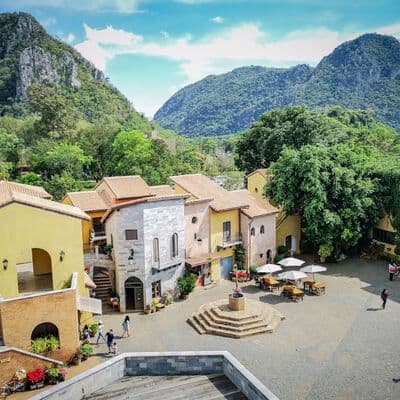
14:30-17:00 - Primo Piazza, an Italian-themed village. Kitschy but photogenic, with real mountain views. Adjacent farm with alpacas and sheep - perfect for families. Admission: $5.70 (200 THB).
17:30-19:00 - Dinner along Thanarat Road. The Thai-European fusion scene here is surprisingly strong for a rural area.
Day 5: Deep Isan
8:00-10:00 - Drive to Dan Khun Thot (25 miles/40 km), a small town with a vibrant morning market. Sample real Isan food far from tourists: fried insects, fermented fish (pla ra), blood sausage.
10:30-12:30 - Wat Ban Rai, shaped like a giant elephant and covered in mosaics of broken porcelain. Inside: a museum for the revered monk Luang Phor Khoon. Free.
13:00-14:00 - Lunch at a roadside eatery near the temple. Try the larb (minced meat salad with herbs).
15:00-17:00 - An ethical elephant sanctuary on the way back. The Khao Yai area has several where elephants are observed and fed, not ridden. Research beforehand - not all 'sanctuaries' are equal.
18:00 - Return to Korat for shopping at The Mall or Central Plaza.
Korat in 7 Days: With Day Trips
Days 1-5 as above, plus:
Day 6: A Full Day Deep in Khao Yai
Full day in Khao Yai National Park: the longer Nong Phak Chi trail (5-6 hours, 5 miles/8 km), dawn birdwatching for hornbills, natural pools at the smaller waterfalls. Pack lunch. Hire a ranger-guide at the visitor center ($23-43/800-1,500 THB for the day) - they know where the elephants are.
Day 7: Buriram or Rest
Option A: Day trip to Buriram (93 miles/150 km, 2 hours). The Khmer temple of Phanom Rung atop an extinct volcano - many consider it even more beautiful than Phimai. Bonus if it coincides with MotoGP or Buriram Marathon.
Option B: Rest day in Korat. Thai massage ($5.70-8.50/200-300 THB per hour), silk shopping in Pak Thong Chai (prices 2-3x lower than Bangkok), farewell dinner.
Where to Eat: Restaurants and Cafes
Street food and markets
Korat is a street food paradise. The night market at the Thao Suranaree Monument operates every evening from 5:00 PM to 10:00 PM. Dozens of stalls, average price per dish: $1.15-2.30 (40-80 THB). Do not miss kai yang (Isan grilled chicken), som tam (papaya salad), khao niam (herbed rice balls), and stuffed rolled pancakes.
Manat Market is a daytime market with the best selection of Isan dishes in town. This is where the locals eat. In the morning (6:00-10:00 AM), come for breakfast: jok (rice congee), pa tong ko (Thai doughnuts), and Thai-style iced coffee.
Save One Night Market is a massive market on the south side of the city with hundreds of stalls selling food, clothing, and vintage goods. The scale is impressive. Open Friday through Sunday.
Local hole-in-the-wall joints
The best food in Korat hides in unassuming places. Look for plastic chairs on the sidewalk, a Thai-only menu, and a lunchtime queue of locals. The area around Manat Market and Chomphon Road is dense with these gems. Average meal: $1.40-2.85 (50-100 THB).
Pro tip: a sign reading 'khao tom' means a 24-hour rice soup joint - perfect for late-night eating. Rice porridge with meat and sides for $1.70-2.30 (60-80 THB).
Mid-range restaurants
For a proper sit-down dinner with air conditioning and an English menu, head to the area around The Mall and Central Plaza. Thai restaurants here cook just as well as the street vendors, but with creature comforts. Average bill: $4.30-11.40 (150-400 THB) per person.
Rabiang Pa, on the edge of the city heading toward Khao Yai, is a terrace restaurant overlooking rice paddies. High-quality Thai cuisine. No reservation needed on weekdays.
In the Khao Yai area, Thanarat Road is lined with dozens of restaurants spanning Thai to Italian. Prices are higher ($5.70-17/200-600 THB), but the quality and atmosphere justify it. Many offer mountain views with your meal.
Top-tier dining
Midwinter Green (Khao Yai area) serves European cuisine from a chef with Michelin-starred experience. Book a week ahead for weekends. Average bill: $23-43 (800-1,500 THB).
The PB Valley Winery Restaurant pairs steaks and pastas with estate wines, vineyard views included. Average bill: $17-34 (600-1,200 THB).
GranMonte Restaurant offers Thai-European cuisine with a tasting menu - one of the finest gastronomic experiences in Isan.
Cafes and breakfast spots
Korat's coffee scene is surprisingly developed, with dozens of specialty shops serving northern Thai beans. In the city: District Korat (Old City area) is a loft-style cafe with great coffee and breakfast. Cafe de Museum is quieter. Cup Fine Day is a popular chain with good desserts. In Khao Yai: Palio village has dozens of cafes, and Birder's Lodge Coffee caters to birdwatchers. Cappuccino: $2.30-3.40 (80-120 THB).
Must-Try Food
Isan cuisine is the spiciest, the most aromatic, and the most 'real' food in Thailand. Many dishes that the world thinks of as 'Thai' actually originated right here. Here is what you absolutely must eat in Korat:
Som tam - green papaya salad with chili, lime, fish sauce, and dried shrimp. The Isan version uses pla ra (fermented fish) - hotter and funkier than Bangkok's edition. Order 'som tam Thai' for mild or 'som tam Isan' for the full experience. Price: $1.15-1.70 (40-60 THB).
Kai yang - chicken marinated in garlic, coriander, pepper, and fish sauce, charcoal-grilled. Korat is the kai yang capital of Thailand. Served with sticky rice and nam jim (spicy dipping sauce). Follow the smoke to the best grills. Price: $1.15-2.30 (40-80 THB).
Larb - a salad of minced meat (pork, chicken, or fish) tossed with mint, lemongrass, chili, lime, and toasted rice powder. Comes in two versions: 'larb suk' (cooked) and 'larb dib' (raw - for the adventurous). A cornerstone of Isan cuisine. Price: $1.70-2.85 (60-100 THB).
Pad mee Korat - the city's signature dish. Do NOT call it pad Thai. Thin rice noodles with a unique sweet-salty sauce found nowhere else. Locals take enormous pride in it. Look for specialized market stalls. Price: $1.15-1.70 (40-60 THB).
Khao piak sen - a Lao-influenced soup with thick rice noodles in a rich, starchy broth. A popular breakfast across Isan. Served with fresh herbs and crispy croutons. Warming and filling. Price: $1.15-1.70 (40-60 THB).
Nam tok - literally 'waterfall' salad, named for the juices that drip from the beef as it grills. Sliced grilled beef tossed with herbs, toasted rice powder, and chili. One of the best options for meat lovers. Price: $2.30-3.40 (80-120 THB).
Sai krok Isan - fermented sausage made from pork and rice. The tangy, slightly sour flavor is unusual at first but quickly becomes addictive. Sold on every corner, grilled on charcoal. The best versions come from street vendors. Price: $0.57-1.15 (20-40 THB).
Khao lam - sticky rice cooked with coconut milk and beans inside a bamboo tube. A sweet snack-dessert sold along the roads near Khao Yai. Price: $0.57-1.15 (20-40 THB).
What NOT to order: skip the 'Western breakfast' at Thai street stalls - the eggs will be questionable at best. Eat jok (rice congee) or khao tom (rice soup) like a local instead. Also avoid ordering seafood - Korat is 186 miles (300 km) from the coast, and freshness is not guaranteed.
For vegetarians: vegetarianism is rare in Isan. Fish sauce and shrimp paste find their way into almost everything. Look for the signs 'jay' (strict vegetarian) or 'mangsa wirat' (vegetarian). The area around SUT university has more plant-based options than anywhere else in town.
Allergies: peanuts are used extensively - in sauces, garnishes, and desserts. Sesame, fish sauce, and shrimp paste appear in roughly 90% of dishes. Learn the phrase 'phae tua' (allergic to nuts) - it could be a lifesaver.
Local Secrets and Tips
1. Korat is not Bangkok - slow down. Everyone here moves at a more relaxed pace, smiles more often, and does not understand why you are in such a hurry. Embrace the Isan rhythm: breakfast by 10 AM, siesta during peak heat (noon to 3 PM), activity picks up again in the evening. Trying to power through everything at a sprint will earn you heatstroke and disappointment.
2. Without a car or motorbike, you are stuck. The fundamental truth about Korat. City transport is songthaew (converted pickup minibuses), but routes are unpredictable and schedules nonexistent. Khao Yai and Phimai without your own wheels means tours or taxis. Car: from $23/day. Motorbike: from $5.70/day. Grab works in town but not outside it.
3. Pad mee Korat is NOT pad Thai. Do not confuse them - locals will be offended. It is an entirely different dish and a point of fierce civic pride. Ask for 'pad mee Korat' at any market, and watch the vendor light up with a smile.
4. Visit Khao Yai on weekdays. On weekends - especially Saturdays - the park is overrun with Thai families. Traffic jams at the entrance, queues on the trails, no parking. On a weekday, you might have an entire trail to yourself. Your chances of spotting wildlife also go way up.
5. Learn a few Thai phrases. English is genuinely rare in Korat. 'Sawadee khrap/kha' (hello), 'Aroi mak' (very delicious), 'Pet nit noi' (just a little spicy), 'Check bin' (the bill) - and you are the most popular farang in the restaurant. Google Translate's camera mode for Thai menus is a lifesaver.
6. Do not skip Phimai. Many visitors come only for Khao Yai and ignore Phimai. That is a mistake. It is one of the most significant Khmer monuments outside Cambodia. Unlike Angkor Wat, you may have this thousand-year-old temple complex to yourself.
7. Shop for silk in Pak Thong Chai. About 18 miles (30 km) from Korat lies a town famous for handwoven silk. Prices are 2-3 times lower than Bangkok, and the quality is superior. If you want to bring home authentic Thai silk, this is the only place to buy it.
8. Beware the monkeys in Khao Yai. Macaques at parking areas steal everything: food, sunglasses, phones. Do not show food, do not bare your teeth (they see it as a threat), never touch babies. If one grabs your stuff, do not grab back - it will bite.
9. Eat sticky rice with your hands. Khao niao (sticky rice) arrives in a woven basket. Pinch off a clump, roll it into a ball, dip in sauce. Fork and spoon for sticky rice marks you as someone who does not know the customs.
10. Do not drink tap water. Basic advice, but especially important in Isan. Buy bottled water ($0.20 for 1.5 liters at 7-Eleven) or take ice in restaurants - it is always made from purified water.
11. 7-Eleven is your best friend. On every corner. ATM, SIM cards, quick meals, bill payments, bus tickets. Open 24/7.
Transport and Connectivity
Getting to Korat
From Bangkok by bus: Most popular option. Buses from Mo Chit (Northern Terminal) every 30 minutes. Travel time: 3-4 hours. Price: $5.70-10 (200-350 THB). Take the VIP class with AC, Wi-Fi, and reclining seats. Arrives at Bus Terminal 2.
From Bangkok by train: From Hua Lamphong or Bang Sue Grand Station. Travel time: 4-5 hours. Price: $2.85-7.15 (100-250 THB). Slower but more scenic. Third class without AC ($2.85/100 THB) is an authentic experience - open windows and vendors selling snacks.
By car: Mitraphap Highway (Route 2), 162 miles (260 km), 3-3.5 hours. Well-maintained road with regular gas stations.
By air: Nakhon Ratchasima Airport (NAK) has Bangkok flights (Nok Air, Thai Lion Air), but factoring in airport transfers, the bus is often faster.
Getting around the city
Songthaew: Blue converted pickups - the main public transport. Routes are fixed but incomprehensible to visitors. Price: $0.29-0.43 (10-15 THB). Wave, hop in, press the buzzer to stop.
Grab: Works in the city for motorbike or car rides. A cross-town trip: $1.15-2.85 (40-100 THB). Outside the city, drivers are scarce.
Tuk-tuk: Negotiate BEFORE boarding. City rides: $1.40-2.85 (50-100 THB). To Khao Yai: $43-57 (1,500-2,000 THB) one way - rent a car instead.
Vehicle rental: Motorbike ($5.70-8.50/day, 200-300 THB) is best for the city. International license technically required but rarely checked. Car ($23-43/day, 800-1,500 THB) essential for Khao Yai and Phimai. Book through Thai Rent A Car or Budget.
Internet and connectivity
SIM card: Buy at Bangkok airport or any 7-Eleven. AIS, DTAC, TrueMove. Tourist SIM: ~$8.50 (299 THB) for 15 GB/7 days. 4G in the city is excellent; signal drops on deeper Khao Yai trails.
eSIM: AIS and TrueMove support eSIM activation before arrival. Airalo and Holafly also offer Thailand eSIMs you can set up from home.
Wi-Fi: All hotels and cafes. Most mid-range restaurants. Not at markets or street stalls.
Essential apps
- Grab - ride-hailing and food delivery. Works reliably within the city.
- Google Maps - solid for navigation, but for hiking trails inside Khao Yai, download maps.me or AllTrails with offline maps before you go.
- Google Translate - the camera translation feature (point your phone at a Thai menu) will save you daily. Download the Thai language pack for offline use.
- LINE - Thailand's dominant messaging app. Hotels and tour operators often take bookings through LINE rather than email.
- Klook / KKday - book Khao Yai tours, night safaris, and winery experiences at discounted prices.
Final Verdict
Nakhon Ratchasima is not the kind of city people fly to Thailand for. It is the kind of city people discover when they want to see the real Thailand beyond the tourist trail. Korat is a base camp, a launching pad for some of the most rewarding experiences in the country: the jungles of Khao Yai with wild elephants, the ancient Khmer temples of Phimai, vineyards in the mountains, and the spiciest cuisine in the kingdom.
Great for: nature and trekking enthusiasts; foodies ready for bold flavors; couples seeking romance in the Khao Yai hills; travelers who have 'already done Bangkok and the beaches'; photographers looking for something different.
Not ideal for: anyone seeking a beach vacation; those unwilling to navigate a language barrier; travelers relying exclusively on public transport; visitors looking for a pumping nightlife scene.
How many days: minimum 3 (city + Khao Yai + Phimai), optimal 5 (add wineries and the Isan countryside), maximum 7 (add Buriram and a second full day in the national park).
Information current as of 2026. Prices listed in USD with Thai baht equivalents (1 USD is approximately 35 THB).