Lille
Lille: The Cultural Capital of French Flanders
Lille is France's fourth-largest city and the capital of the Hauts-de-France region, situated near the Belgian border. This dynamic metropolis combines a rich Flemish heritage, impressive 17th-century architecture, and contemporary urban culture. The old town, with its magnificent Grand'Place, world-class Palace of Fine Arts, and picturesque cobblestone streets, attracts travelers from around the globe. The annual Braderie de Lille - Europe's largest flea market - transforms the city into a massive celebration every first weekend of September.
History of Lille: From Flemish Trading Town to French Metropolis
Lille's history begins in 640 AD when a small settlement was founded on an island in the Deûle River - hence the city's name (L'Isle means "the island"). By the 10th century, Lille had become the capital of the County of Flanders and quickly developed into an important trading center thanks to its strategic location at the crossroads of routes between France, the Netherlands, and England.
Over the centuries, the city changed hands multiple times: it belonged to the Dukes of Burgundy, then the Habsburgs, and was part of the Spanish Netherlands. In 1667, after a brief siege, Lille was captured by the forces of Louis XIV and definitively annexed to France by the Treaty of Aix-la-Chapelle in 1668. It was then that the great military engineer Vauban constructed one of his most impressive fortresses here - the Citadel, which he called "the queen of citadels."
The Industrial Revolution and Prosperity
The 19th century brought an industrial boom to Lille. The city became one of France's largest textile centers, producing cotton, linen, and wool. Factories and mills mushroomed, and the population grew rapidly. This industrial wealth was reflected in architecture: many of the magnificent mansions and public buildings that still adorn the city today were constructed during this period.
20th Century Trials and Renaissance
Both World Wars dealt serious blows to Lille. During World War I, the city was occupied by German forces from 1914 to 1918. World War II also brought destruction and occupation. The post-war period was a time of reconstruction, and the city's true renaissance began in the 1990s when the Channel Tunnel opened and high-speed rail connected Lille with Paris, London, and Brussels. In 2004, Lille was named European Capital of Culture, giving a powerful boost to the city's development.
Grand'Place: The Heart of Old Lille
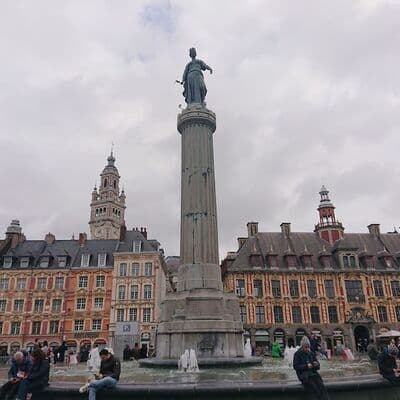
Grand'Place, officially named Place du Général de Gaulle, is the center of Lille's public life. This majestic square is surrounded by impressive Flemish Baroque buildings from the 17th and 18th centuries. In the center stands the Column of the Goddess - a monument to the 1792 siege of Lille by Austrian forces, when citizens successfully repelled the attack.
The Old Stock Exchange - A Flemish Renaissance Gem
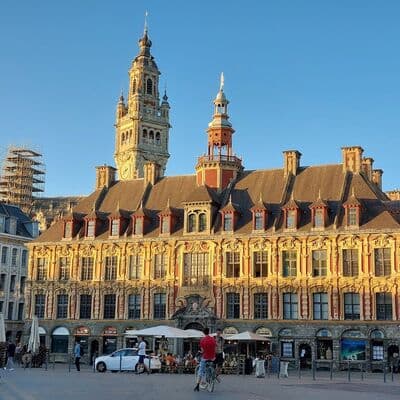
The Old Stock Exchange (Vieille Bourse) is undoubtedly Lille's most beautiful building and one of the finest examples of Flemish Renaissance architecture in France. Built in 1652-1653 by architect Julien Destrée, the exchange consists of 24 identical houses surrounding an inner courtyard. The facades are decorated with sculptures, pilasters, garlands, and cartouches depicting fruits and flowers.
The inner courtyard of the Old Stock Exchange is one of Lille's most atmospheric spots. A second-hand book market operates here daily, where you can find rare books and engravings. In the evenings and on weekends, the courtyard transforms into a tango venue - local dancers gather here under the open sky, creating an incomparable romantic atmosphere.
Grand'Garde and Théâtre du Nord
On the opposite side of Grand'Place stands the Grand'Garde building - a former royal guard barracks built in 1717. Today it houses a branch of the Théâtre du Nord. The building is executed in Flemish classical style with a characteristic stepped gable. Nearby is the imposing La Voix du Nord newspaper building with its famous clock and neon sign.
The Palace of Fine Arts: France's Second Museum
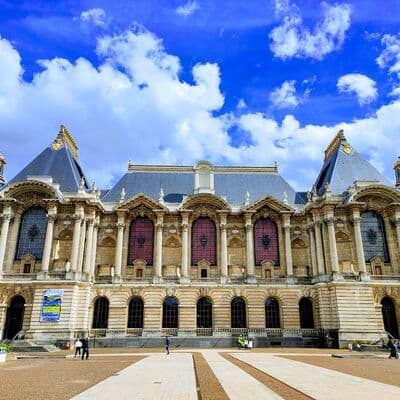
The Palais des Beaux-Arts de Lille is France's second-largest art museum after the Louvre. Located in a monumental 19th-century building on Place de la République, the museum houses an impressive collection of painting, sculpture, and decorative arts from the Middle Ages to the 20th century.
Painting Collection
The museum's painting collection includes masterpieces by European masters: Rubens, Van Dyck, Goya, El Greco, David, Delacroix, Courbet, Monet, Renoir, and many others. The Flemish and Dutch painting of the 17th century is particularly well represented - unsurprising for a city with such a history. Don't miss Rubens' famous "Descent from the Cross" and works by Northern Renaissance masters.
Relief Plans
A unique part of the collection is the relief plans of fortified cities (Plans-Reliefs), created in the 17th and 18th centuries for military purposes. These scale models of cities and fortresses, executed with remarkable precision, allow you to see what French and Belgian cities looked like three to four centuries ago. The collection includes plans of Lille, Calais, Dunkirk, Ypres, and other regional cities.
Vieux Lille: A Walk Through History
Vieux Lille (Old Lille) is a labyrinth of narrow cobblestone streets surrounded by magnificent 17th and 18th-century mansions built of red and yellow brick. This district, carefully restored in recent decades, is now one of the city's most fashionable and expensive neighborhoods, home to boutiques, antique shops, restaurants, and cafés.
Rue de la Monnaie and Its Treasures
Rue de la Monnaie is one of the most beautiful streets in Vieux Lille. Here you'll find the Maison Gilles de Bois, also known as the "Witch's House" thanks to its unusual 17th-century wooden bay window. Nearby is the luxurious Rang du Beauregard mansion - one of the finest examples of Flemish architecture in the city.
Place Louise de Bettignies
This cozy square, named after a French Resistance heroine, represents a typical example of Flemish urban architecture. Buildings with characteristic stepped gables, red brick, and white stone create a unique atmosphere. It's pleasant to sit at one of the cafés here, watching the unhurried life of Old Lille pass by.
Notre-Dame de la Treille Cathedral
The Notre-Dame de la Treille Basilica is Lille's main Catholic church, dedicated to the city's patron saint. Construction of the cathedral began in 1854 in neo-Gothic style but was only completed in 1999 - after long interruptions and project changes. The modern western facade of translucent marble and stainless steel, designed by architect Pierre-Louis Carlier, strikingly contrasts with the neo-Gothic interior.
Vauban's Citadel: A Military Architecture Masterpiece
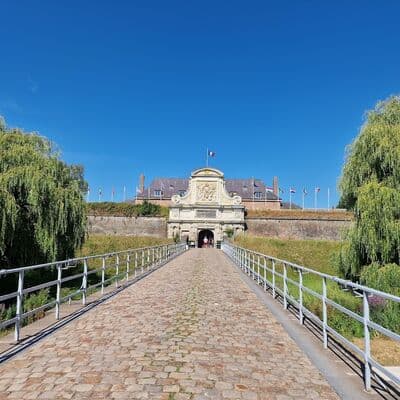
The Citadel of Lille, built from 1667 to 1670 to plans by Marshal Vauban, is one of the best-preserved examples of 17th-century military architecture. Vauban called it "the queen of citadels," and today it remains an active military installation - home to the NATO Rapid Deployable Corps headquarters.
Citadel Park
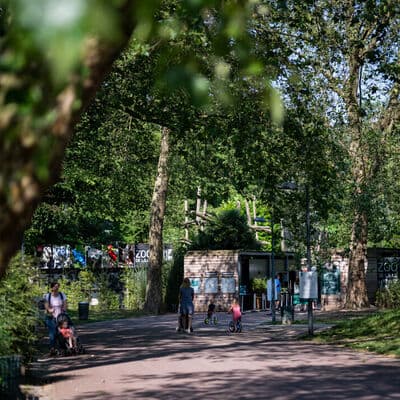
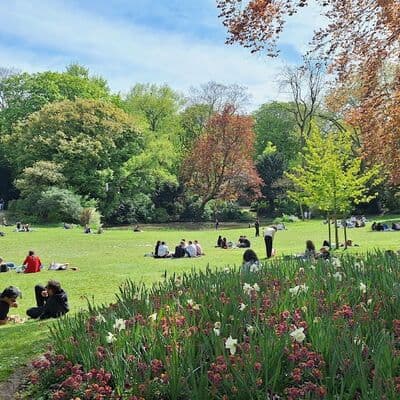
While the fortress itself is closed to visitors (except for rare tours), the surrounding 60-hectare park is open to the public. The Bois de Boulogne of Lille, as it's sometimes called, is a favorite recreation spot for locals. You can stroll along shaded pathways, take a boat ride on the canals, visit the zoo, or simply have a picnic on the lawn.
Modern Lille: Euralille and the European Quarter
Beyond its historic center, Lille boasts world-class contemporary architectural projects. The Euralille district, built in the 1990s around the Lille-Europe station, embodies the city's new face.
Euralille Architecture
International architecture stars worked on the Euralille project: Rem Koolhaas, Jean Nouvel, Christian de Portzamparc. The Euralille shopping center, the Lille Europe towers, the futuristic Credit Lyonnais building - all create a striking contrast with the Flemish architecture of the Old Town. The TGV Lille-Europe station building, connecting the city with Paris, London, and Brussels, is particularly impressive.
Lille Grand Palais
Lille Grand Palais is the largest congress and exhibition center in northern France. Concerts, exhibitions, conferences, and sporting events are held here. The building, designed by architect Rem Koolhaas, is an important part of the city's contemporary image.
Lille Gastronomy: Flemish Traditions
Lille's cuisine consists of hearty Flemish dishes that warm you on cold winter days. Here, beer culture reigns (rather than wine, as in southern France), and many dishes are prepared with it. The city is also famous for its cheeses, sausages, and, of course, legendary waffles.
Carbonnade Flamande
Carbonnade flamande is the region's signature dish. This beef stew is made with dark beer, onions, mustard, and spices. The meat becomes incredibly tender after several hours of slow cooking. It's traditionally served with French fries or mashed potatoes.
Potjevleesch
Potjevleesch is a cold meat dish consisting of several types of meat (chicken, rabbit, veal, pork) covered in jelly. It's prepared in clay pots and served cold with French fries. The name translates from Flemish as "little pot of meat."
Welsh
Welsh is a toasted sandwich with cheddar cheese melted in beer, usually with ham added. This hearty dish came from Wales but has become an integral part of local cuisine. It's served with French fries and salad.
Maroilles and Mimolette
Northern France is famous for its strong-smelling cheeses. Maroilles is one of France's smelliest cheeses, with a red-orange rind and soft interior. Mimolette is a distinctive orange cheese, often aged until very hard, with an earthy, nutty flavor.
Lille Waffles
Gaufre de Lille, or merveilleux, are famous Lille waffles. Unlike Belgian Liège waffles, they're thinner and crispier, often with vanilla sugar or covered in chocolate. Also popular is the merveilleux - a dessert of two meringue pieces joined by whipped cream.
Beer
Lille is the capital of French brewing. Dozens of beer varieties are brewed here, from light pale ales to strong dark beers. Bière de garde - aged beer in the regional style - is especially popular, along with numerous craft varieties from local breweries. Try local beer in one of the traditional estaminets - Flemish pubs.
Braderie de Lille: Europe's Largest Market
The Braderie de Lille is Europe's largest flea market, held annually on the first weekend of September. The market's history spans over 800 years: in the Middle Ages, servants were allowed once a year to sell their masters' old belongings.
Scale and Atmosphere
For two days and two nights, Lille transforms into a massive market. More than 10,000 vendors line up along 100 kilometers of streets, and around 2-3 million visitors come to haggle for antiques, vintage items, books, and all manner of goods. Traditionally, people eat mussels with French fries at the Braderie - at the market's end, restaurants compete to see who has the tallest pile of empty shells.
Practical Information for Travelers
Getting There
Lille is one of Europe's best transport hubs. From Paris by TGV takes just one hour. From London by Eurostar - 1 hour 20 minutes; from Brussels - about 35 minutes. Lille has two railway stations: Lille-Flandres for regional trains and Lille-Europe for high-speed services. The nearest major airport is Paris-Charles de Gaulle, from where you can reach Lille by TGV.
City Transport
Central Lille is compact and perfect for walking. Lille's metro was the world's first fully automated system (driverless), opened in 1983. Two metro lines, two tram lines, and a bus network cover the entire city and suburbs. The Pass Lille is convenient for tourists, offering unlimited travel and museum discounts.
When to Visit
Lille is good at any time of year. Spring (April-May) and autumn (September-October) are optimal times to visit: mild weather and fewer tourists. The first weekend of September is when the famous Braderie takes place, but note that the city is overcrowded and hotels are booked months in advance. The Christmas market in December creates a magical atmosphere. In summer (July-August), the weather is pleasant but many locals leave on vacation.
Where to Stay
Vieux Lille is the most atmospheric area to stay but also the most expensive. The area around Lille-Flandres station is convenient for those planning lots of travel. Euralille offers modern business-class hotels. For budget travelers, hotels and hostels around the Republique-Beaux Arts metro station are a good option.
Around Lille
Roubaix and Tourcoing
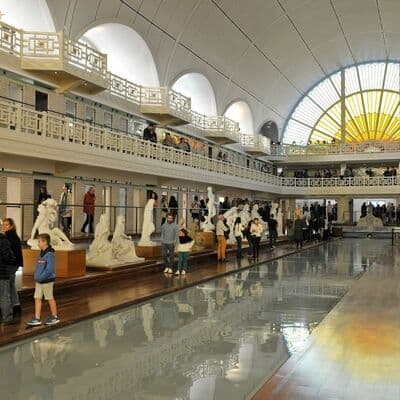
The satellite cities of Roubaix and Tourcoing, connected to Lille by metro, are interesting for their industrial heritage. In Roubaix, be sure to visit La Piscine - an art museum housed in a former Art Deco swimming pool. In Tourcoing, the Museum of Fine Arts and 19th-century architecture are worth exploring.
Bruges and Ghent
Thanks to proximity to the Belgian border, day trips to Belgian cities from Lille are easy. Bruges - the "Venice of the North" with its canals and medieval architecture - is about an hour by train. Ghent, with its magnificent castle and lively student atmosphere, is even closer.
World War I Battlefields
The region around Lille preserves memories of World War I. Ypres (Ieper), located in Belgium about an hour away, features sites of bloody battles, numerous memorials, and the In Flanders Fields Museum. The evening ceremony at the Menin Gate, where the Last Post is played daily in memory of the fallen, is a poignant and unforgettable experience.
Lille for Different Travelers
For Art Lovers
Beyond the Palace of Fine Arts, Lille has several other interesting museums. LaM (Lille Métropole Musée d'art moderne) in the suburb of Villeneuve-d'Ascq has an impressive modern art collection, including works by Picasso, Braque, and Modigliani. The Hospice Comtesse Museum in a 15th-century building shows the life of Flemish bourgeoisie of past centuries.
For Foodies
Lille is paradise for food lovers. Start your day with a waffle at Meert, a patisserie operating since 1761. Have lunch in a traditional estaminet - a Flemish tavern with wooden tables and authentic dishes. Try different varieties of local beer at one of the craft bars. Don't forget to visit the Wazemmes Market - the city's largest market with produce and a flea market section. Lille and Lyon are France's two gastronomic centers, but with completely different culinary traditions.
For Families
Lille is family-friendly. The free zoo in Citadel Park delights young visitors. The Natural History Museum introduces the region's wildlife. The Patte d'Oie amusement park offers carousels and rides. And a boat tour on Lille's canals lets you see the city from the water.
For Shoppers
Vieux Lille is a paradise for shopping enthusiasts. Grande Chaussée and Rue de la Monnaie are full of fashion boutiques and antique shops. Euralille has a large shopping center. And at the Wazemmes flea market on Sundays, you can find unique vintage items. Don't forget local delicacies: cheeses, beer, waffles, and chocolate make wonderful souvenirs from Lille.
Travel Tips
- Meert patisserie on Rue Esquermoise is a must-visit for anyone with a sweet tooth - their famous waffles will not disappoint
- Tango dancing takes place in the Old Stock Exchange courtyard on weekends - join in or just watch
- The Palace of Fine Arts is free on the first Sunday of each month
- If attending the Braderie, book your hotel at least 3-4 months ahead
- Wazemmes Market operates on Tuesdays, Thursdays, and Sundays - Sunday is the biggest day
- For day trips to Bruges or Ghent, buy round-trip tickets in advance - it's cheaper
- Many shops and restaurants are closed on Mondays
- Locals speak with a distinctive northern accent (ch'ti), but understand standard French perfectly
- In winter, bring warm clothing - the sea wind makes the weather quite harsh
- Try local beer in one of the estaminets in Vieux Lille - the atmosphere is something special
Lille is a city of contrasts and surprises. Here, Flemish heritage blends seamlessly with French chic, medieval streets neighbor ultra-modern architecture, and hearty northern cuisine is complemented by exquisite pastries. Proximity to Paris, London, and Brussels makes Lille an ideal base for exploring northern Europe. But the city itself deserves several days of unhurried exploration - its rich history, cultural treasures, and warm hospitality will not leave you indifferent.