About
Nepal Travel Guide 2026: Everything You Need to Know Before You Go
Nepal is one of those places that fundamentally rewires your brain. I do not mean that in a vague, spiritual-retreat kind of way -- though that can happen too. I mean that after spending time in a country where the altitude can kill you, the roads can terrify you, and the people can overwhelm you with kindness, you come back home and your old problems look different. Smaller, somehow. Nepal does that.
This is not a glossy brochure. This is the guide I wish someone had handed me before my first trip, and the one I keep updating after every return visit. It includes the spectacular stuff -- the Himalayas are, objectively, the most dramatic landscape on Earth -- but also the realities: the dust, the delays, the stomach trouble, the scams, and the bureaucracy. Because if you only read the pretty parts, Nepal will catch you off guard. And if you only read the warnings, you will never go. Both would be a mistake.
A few things have changed recently that make this guide especially relevant for 2025-2026. Nepal has been pushing its Visit Nepal 2026 campaign hard, and TIME magazine listed Nepal not once but twice in its Greatest Places of 2026. The country is actively investing in infrastructure, opening new trekking peaks in the western provinces, and expanding satellite internet to remote areas. At the same time, there are new regulations you absolutely must know about -- particularly the mandatory guide requirement that banned solo trekking in 2023. Whether you are a first-timer planning a two-week adventure or a returning trekker eyeing a new route, this guide covers what you need.
1. Why Visit Nepal
Let me be direct: Nepal is not a comfortable destination. The roads are rough, the power can be unreliable, the bureaucracy is maddening, and Kathmandu's air quality would make a Los Angeles smog day look pastoral. So why do roughly a million tourists show up every year, and why do so many of them come back?
The short answer is that Nepal offers experiences you literally cannot get anywhere else on Earth. Not figuratively -- literally. Eight of the world's fourteen peaks above 8,000 meters are here, including Everest. The cultural density of the Kathmandu Valley, with its layered Hindu and Buddhist heritage, rivals anything in South or Southeast Asia. The trekking infrastructure -- tea houses, established routes, experienced guides -- is unmatched. And the cost of travel remains remarkably low by Western standards, making extended trips feasible even on a modest budget.
But those are the standard talking points. Let me give you the reasons that actually bring people back.
The Scale of the Landscape
Photos do not prepare you. I have seen thousands of Himalayan photographs, and none of them communicated what it feels like to stand at Poon Hill at dawn and watch the sun hit Dhaulagiri, Annapurna South, Machapuchare, and Annapurna I in sequence. The scale is incomprehensible. Your brain, accustomed to processing buildings and hills, simply does not have a reference frame for mountains that start at the altitude where commercial aircraft cruise. You stand there, breathing hard in the thin air, watching light move across faces of rock and ice that are twenty miles away but look close enough to touch, and something in your understanding of the world shifts permanently.
This is not limited to the famous treks. Drive the Prithvi Highway from Kathmandu to Pokhara (when it is open -- more on the ongoing renovation later) and you will see terraced hillsides dropping into river gorges that would be national parks in any other country. Fly into Lukla -- one of the most dramatic airport approaches in the world -- and watch the runway rise up to meet you at a fifteen-degree angle with a mountain wall at the end. Take a morning boat ride on Phewa Lake in Pokhara and watch the Annapurna range materialize out of the clouds. Nepal's landscape is not just scenery; it is a physical force that shapes every aspect of life here.
Cultural Complexity
Nepal is home to over 120 ethnic groups speaking more than 120 languages. This is not a fun fact for a textbook -- it is something you experience on the ground. Walk through Kathmandu and you will pass Hindu temples where devotees are making offerings, Buddhist stupas where prayer wheels spin endlessly, Muslim neighborhoods with their own mosques, and Newar courtyards where traditions predate all of the above. The religious syncretism is genuine, not performative. Many Nepalis comfortably participate in both Hindu and Buddhist practices, and the festival calendar reflects this overlap.
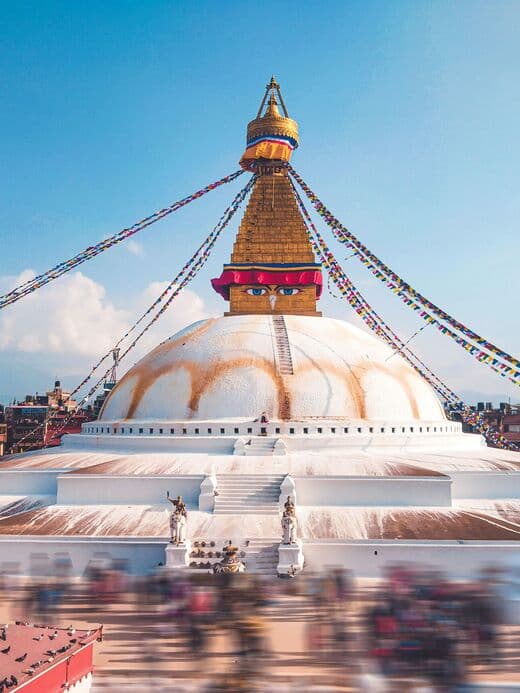
The Kathmandu Valley alone contains seven UNESCO World Heritage Sites -- Kathmandu Durbar Square, Patan Durbar Square, Bhaktapur Durbar Square, Swayambhunath (the Monkey Temple), Boudhanath Stupa, Pashupatinath Temple, and Changu Narayan. Each of these is a living site, not a museum. People worship at Pashupatinath every day; the cremation ghats on the Bagmati River operate continuously. Boudhanath is the center of Tibetan exile culture, surrounded by monasteries where you can hear monks debating philosophy in the courtyards. These are not tourist attractions that happen to have religious significance -- they are religious sites that happen to attract tourists. The distinction matters, and if you approach them with appropriate respect, the experiences are profoundly different from visiting a museum.
The Trekking
Nepal invented modern trekking tourism. When Edmund Hillary and Tenzing Norgay summited Everest in 1953, they opened not just a mountain but an industry. Over the following decades, Nepal developed the most sophisticated trekking infrastructure in the world: networks of tea houses (basic lodges) along major routes, a system of permits and checkpoints, trained guides and porters, and rescue capabilities (though these come with significant caveats -- see the safety section). Today you can trek for three weeks through the Annapurna Circuit without carrying a tent, sleeping in lodges every night, eating hot meals prepared by local families, and walking through ecosystems that range from subtropical jungle to arctic desert.
The variety is what makes Nepal special. The Everest Base Camp trek is the most famous, but it is one of dozens of established routes. The Annapurna Circuit takes you through the deepest gorge on Earth. The Langtang Valley trek brings you close to the Tibetan border with far fewer crowds. The Manaslu Circuit is increasingly popular as a less-trafficked alternative to Annapurna. And the opening of new trekking peaks in Nepal's western provinces -- regions like Dolpa and Humla that have historically seen very few tourists -- means that experienced trekkers can still find genuine remoteness.
The People
This risks sounding saccharine, but I will say it anyway because it is true: Nepali hospitality is extraordinary. Not in the polished, professional way you experience in, say, Japan or Singapore. In a warmer, more improvised way. Your tea house host will insist you sit by the fire. The family running a dal bhat restaurant will pile your plate higher than you can possibly finish. The porter carrying twice your body weight up a mountain will smile and ask if you are okay. Strangers will go out of their way to help you find an address, sometimes literally walking you there. This is not a transaction; it is a cultural value. The Nepali phrase "Atithi Devo Bhava" -- the guest is god -- is taken seriously, and you will feel it.
Does this mean every interaction is wonderful? No. You will encounter touts in Thamel, aggressive taxi drivers at the airport, and the occasional shopkeeper who sees you as a walking ATM. Tourism creates its own distortions. But the baseline level of genuine warmth and helpfulness is high, and it makes navigating a challenging country considerably easier.
The Value
Nepal remains one of the most affordable travel destinations in Asia. A decent room in Kathmandu or Pokhara runs $15-40 per night. A full dal bhat meal -- rice, lentils, vegetables, pickles, sometimes meat -- costs $2-4 in a local restaurant. A cup of tea on a trek costs $0.50-1.50. A 12-day guided trek including permits, accommodation, meals, guide, and porter can be arranged for $800-1,500 depending on the route and the quality of the agency. For Americans, Brits, Australians, and Canadians accustomed to paying $15 for a mediocre lunch at home, Nepal's prices feel almost unreal.
This does not mean you cannot spend money. Luxury lodges in the Annapurna region charge $200-400 per night. Helicopter tours to Everest Base Camp cost $1,000-2,000. Fine dining in Kathmandu can approach Western prices. But the floor is low, and a comfortable (not spartan) trip can be done for $40-60 per day including accommodation, food, transport, and activities. Try doing that in Western Europe.
The Timing
Nepal is having a moment. The Visit Nepal 2026 campaign has accelerated infrastructure development. New roads (bumpy as they are) have opened previously inaccessible regions. Satellite internet -- via Starlink terminals that some enterprising lodge owners have installed -- is reaching places that were completely off-grid five years ago. Solar-powered tea houses are becoming more common along trekking routes, meaning you can charge your devices without relying on expensive generators. The country is changing fast, and the window in which you can experience both the traditional culture and the modern improvements is right now. In ten years, Nepal will be different. Not worse, necessarily, but different. If you have been thinking about going, the next couple of years are an excellent time.
2. Regions of Nepal
Nepal is roughly the shape of a rectangle, about 885 kilometers long and 200 kilometers wide, squeezed between China (Tibet) to the north and India to the south, east, and west. Despite its small size -- it is slightly larger than Arkansas -- it contains the most extreme topographic variation on Earth, from the flat Terai plains at 60 meters above sea level to the summit of Everest at 8,849 meters. This compression of altitude means that in a single day's drive, you can pass through subtropical jungle, temperate forest, alpine meadow, and rocky moonscape. Each zone has its own climate, culture, cuisine, and reasons to visit.
Kathmandu Valley
The Kathmandu Valley is where most trips begin and end, and it deserves more than the day or two that many trekkers give it. The valley contains three historically distinct cities -- Kathmandu, Patan (Lalitpur), and Bhaktapur -- each with its own Durbar Square, its own palace complex, and its own character. Together they represent one of the densest concentrations of historic architecture in Asia.
Kathmandu itself is chaotic, dusty, noisy, and fascinating. The tourist district of Thamel is a compressed maze of guesthouses, trekking gear shops (many selling convincing counterfeits), restaurants serving everything from momos to pizza, and bars that stay open late. It is tourist infrastructure at its most concentrated, and opinions vary on whether that is a good thing. I find Thamel useful as a base -- you can arrange anything here, from permits to guides to onward transport -- but I would not spend all my time there.
The real treasures of Kathmandu are outside Thamel. Boudhanath Stupa, the largest stupa in Nepal and one of the largest in the world, is the heart of the city's Tibetan community. Walking the kora (circumambulation path) at dusk, with hundreds of others spinning prayer wheels and murmuring mantras while butter lamps flicker in the gathering dark, is one of the most atmospheric experiences in South Asia. Pashupatinath Temple, on the banks of the Bagmati River, is Nepal's holiest Hindu site. Non-Hindus cannot enter the main temple, but you can observe from across the river, including the cremation ghats where funeral pyres burn throughout the day. It is confronting and beautiful and deeply human. Swayambhunath -- the Monkey Temple -- sits on a hilltop west of the city and offers panoramic views of the valley, assuming the smog cooperates. The 365 stone steps to the top are steep, and the resident monkeys are bold. Watch your water bottles.
Patan, across the Bagmati River from Kathmandu, is older and in many ways more refined. Patan Durbar Square is arguably the most beautiful of the three, with the Krishna Temple's stone carvings being particular highlights. The Patan Museum, housed in the old royal palace, is one of the best-curated museums in South Asia. Patan also has a thriving arts scene -- metalwork, thangka painting, and woodcarving -- and you can visit workshops where these traditions continue.
Bhaktapur is the most preserved of the three cities, partly because it charges an entry fee (about $15 for foreigners) that funds conservation. The result is a medieval city that feels remarkably intact. Bhaktapur Durbar Square, the 55-Window Palace, Nyatapola Temple (the tallest temple in the valley), and the surrounding lanes of brick houses and pottery squares make this the most photogenic of the three cities. Come early in the morning before the tour buses arrive, and you can have the squares nearly to yourself. Bhaktapur is also the place to try juju dhau -- king curd -- a sweet, creamy yogurt that is the city's signature food. It is outstanding.
Other valley destinations worth your time include Changu Narayan, the oldest temple in the valley (dating to the 4th century); Kirtipur, a hilltop Newar town with great views and fewer tourists; and the Kopan Monastery, which offers meditation courses for beginners. Budget at least three full days for the valley -- more if you are interested in temples, art, or Tibetan Buddhism.
Pokhara
Pokhara is Nepal's second city and the de facto adventure capital. Sitting at the shore of Phewa Lake with the Annapurna range as a backdrop, it is visually stunning on clear days -- emphasis on clear, because clouds often roll in by late morning. The lakeside tourist strip is more relaxed than Thamel, with restaurants, cafes, and shops strung along Lakeside Road (officially Baidam). It is the launching point for the Annapurna Circuit, Annapurna Base Camp trek, Poon Hill trek, and numerous shorter hikes.
Beyond trekking, Pokhara offers paragliding (tandem flights from Sarangkot, around $80-100 for a 30-minute flight), boating on Phewa Lake, zip-lining, bungee jumping, and ultralight aircraft flights. The International Mountain Museum is worth a couple of hours for its exhibits on Himalayan climbing history. The Devi's Falls (Davis Falls) and Gupteshwor Mahadev Cave are mildly interesting natural attractions but not essential.
Pokhara's best asset, though, is simply its atmosphere. After the intensity of Kathmandu, the relatively clean air, the lake, and the slower pace make it an excellent place to decompress. Many travelers spend more time here than planned, which is either a testament to its charm or a symptom of travel fatigue, depending on your perspective. The food scene has improved significantly, with excellent coffee shops, bakeries, and restaurants serving everything from Nepali to Korean to Italian cuisine. For American travelers, you will find decent pizza and surprisingly good steaks at several lakeside restaurants -- a welcome change after weeks of dal bhat.
One practical note: the road from Kathmandu to Pokhara via the Prithvi Highway is currently under major renovation, expected to continue through 2026. This means the journey, normally 6-7 hours, now takes 8-10 hours by tourist bus and potentially longer by local bus. Flights between Kathmandu and Pokhara (about 25 minutes) are available for $80-130 one way and are worth considering if your time is limited. The views from the right side of the aircraft -- the entire Himalayan range laid out below you -- are spectacular.
Annapurna Region
The Annapurna Conservation Area is Nepal's most popular trekking region, and for good reason. It offers an extraordinary variety of landscapes, cultures, and difficulty levels within a relatively compact area. The region is anchored by the Annapurna massif (Annapurna I at 8,091 meters is the tenth highest mountain in the world) and includes several distinct trekking routes.
The Annapurna Circuit is the classic long trek, traditionally taking 15-21 days to complete the full loop from Besisahar through Manang, over the Thorong La Pass (5,416 meters), and down to Jomsom and Pokhara. The circuit passes through dense rhododendron forests, across high alpine plateaus, through traditional Gurung and Thakali villages, and over one of the highest trekking passes in the world. The Kali Gandaki gorge section, between the Annapurna and Dhaulagiri ranges, is the deepest gorge on Earth -- a fact that is impossible to truly appreciate until you are standing at the bottom looking up at mountains that rise nearly seven vertical kilometers above you.
Road construction has changed the circuit significantly. Jeep roads now extend along parts of the route that were trail-only a decade ago, and some trekkers choose to skip sections by vehicle. Purists lament this; pragmatists note that it makes the trek more accessible. The most dramatic sections -- from Manang over the Thorong La to Muktinath -- remain trail-only and are as magnificent as ever.
The Annapurna Base Camp (ABC) trek is shorter (7-12 days) and reaches the spectacular amphitheater of Annapurna Base Camp at 4,130 meters, surrounded by a 360-degree wall of peaks. It is physically demanding but does not require the altitude acclimatization that the Thorong La demands, making it a good choice for trekkers with limited time.
The Poon Hill trek (also called the Ghorepani Poon Hill trek) is the Annapurna region's shortest and most accessible option, taking 4-5 days. The sunrise from Poon Hill (3,210 meters) is one of Nepal's iconic views: a panorama of Dhaulagiri, Annapurna South, Annapurna I, Machapuchare, and several other major peaks, all glowing gold and pink in the morning light. If you have limited time and moderate fitness, this is the trek to do.
The Annapurna region also offers the Mardi Himal trek (5-7 days, rising in popularity as a less-crowded alternative), the Khopra Ridge trek (community-based, excellent views), and connections into the Upper Mustang region.
Everest (Khumbu) Region
The Khumbu region in northeastern Nepal is Everest country, and trekking here means walking in the footsteps of mountaineering history. The Everest Base Camp (EBC) trek is Nepal's most iconic trekking route, and despite the crowds (particularly in October and November), it delivers an experience that lives up to its reputation.
The trek begins with a flight to Lukla (Tenzing-Hillary Airport, 2,860 meters), which is an experience in itself -- the runway is short, steeply inclined, and ends at a cliff edge. Cancellations due to weather are common, so build buffer days into your schedule. From Lukla, the standard EBC route takes 12-14 days round trip, passing through Sherpa villages like Namche Bazaar (the "Gateway to Everest," a bustling trading town at 3,440 meters), Tengboche (home to a famous Buddhist monastery), Dingboche, Lobuche, and Gorak Shep before reaching Base Camp at 5,364 meters.
Base Camp itself can be anticlimactic if you are expecting a dramatic view of Everest's summit -- you are too close and too low to see it properly from there. The better viewpoint is Kala Patthar (5,645 meters), a rocky peak above Gorak Shep that offers the classic Everest panorama. Most trekkers climb Kala Patthar at dawn on their last day, which means a 4 AM start in bitter cold, followed by one of the most rewarding sunrises you will ever see.
The Khumbu region also offers the Gokyo Lakes trek (an alternative or extension to EBC that visits turquoise glacial lakes and climbs Gokyo Ri for equally stunning views), the Three Passes trek (the most challenging standard route in the Khumbu, crossing three passes above 5,000 meters over 18-20 days), and various climbing peaks for those with mountaineering ambitions. Island Peak (6,189 meters) is the most popular trekking peak, requiring basic mountaineering skills and about 18-20 days total including the approach trek.
Be aware that the Khumbu region is more expensive than the Annapurna region. Tea house prices increase significantly with altitude, and you will pay $5-8 for a basic meal at higher elevations (compared to $2-3 in the Annapurna lowlands). Budget accordingly.
Chitwan
Chitwan National Park, in the southern Terai lowlands, is Nepal's most famous wildlife destination and a UNESCO World Heritage Site. It is a completely different Nepal from the mountains -- flat, subtropical, hot (especially in summer), and home to one-horned rhinoceroses, Bengal tigers, gharial crocodiles, sloth bears, wild elephants, and over 550 species of birds.
Most visitors base themselves in Sauraha, the tourist village on the park's northern edge. Safari options include jeep safaris (the most common, typically 3-4 hours), walking safaris (with armed guides -- the wildlife is genuinely wild), canoe trips on the Rapti River (excellent for birdwatching and crocodile spotting), and elephant-back safaris (increasingly controversial -- do your own research on the ethics and make your own decision).
Tiger sightings are rare but not impossible; rhino sightings are nearly guaranteed on a multi-day visit. The park is best visited from October to March, when the weather is cool and dry and the grass has been cut, making wildlife easier to spot. April and May are extremely hot (40+ degrees Celsius), and the monsoon season (June-September) makes many areas inaccessible.
Budget two to three nights in Chitwan. Most lodges offer package deals that include accommodation, meals, and safari activities for $30-80 per person per day, depending on the quality of the lodge. Luxury lodges inside the park (like Tiger Tops and Barahi Jungle Lodge) charge $200-500 per night but offer a distinctly different experience from the budget operations in Sauraha.
Lumbini
Lumbini, in the western Terai, is the birthplace of Siddhartha Gautama -- the Buddha -- and a UNESCO World Heritage Site. For Buddhists, it is one of the four holiest pilgrimage sites in the world. For non-Buddhists, it is a fascinating and peaceful complex of temples, monasteries, and gardens that offers insight into Buddhism's global reach.
The Lumbini Development Zone covers about 6.5 square kilometers and includes the Maya Devi Temple (marking the exact birthplace), the Ashoka Pillar (erected by the Mauryan emperor in 249 BCE), the Sacred Garden, and two monastery zones -- one for Theravada Buddhist countries and one for Mahayana. Each country has built its own monastery in its national architectural style, creating a striking architectural museum: the Japanese temple, the Chinese temple, the Thai temple, the German Lumbini monastery, and many others line the central canal.
Lumbini is flat, hot, and best explored by bicycle (available for rent at most hotels). Plan for at least one full day. The nearest airports are in Bhairahawa (about 25 km away, with flights to Kathmandu) and across the Indian border in Gorakhpur. Many travelers combine Lumbini with Chitwan in a southern Nepal loop.
Upper Mustang
Upper Mustang is one of Nepal's last truly isolated regions. Once the independent Kingdom of Lo, it was closed to foreigners until 1992 and still requires a special restricted area permit ($500 for 10 days). The landscape is unlike anything else in Nepal -- barren, wind-eroded desert terrain that looks more like Tibet or the American Southwest than the green hills most people associate with the Himalayas. This is rain shadow country, sitting behind the Annapurna and Dhaulagiri ranges, and it receives virtually no monsoon precipitation.
The trek to Lo Manthang, the walled capital, takes about 8-10 days from Jomsom. Along the way you pass through cave dwellings that are thousands of years old, red and ochre cliffs with sky caves (some containing ancient human remains), and villages where traditional Tibetan Buddhist culture persists largely unchanged. Lo Manthang itself is a compact medieval town with a palace, several monasteries, and whitewashed houses inside crumbling walls.
Upper Mustang is expensive (the permit alone is $500, and you must be accompanied by a registered guide and use a licensed agency) but genuinely otherworldly. If you have the budget and the time, it is one of the most unique trekking experiences in Nepal -- or anywhere. The dry climate means it is also one of the few regions that remains accessible during the monsoon season, making it an excellent choice for summer travel.
Langtang Region
The Langtang Valley, north of Kathmandu, is the closest major trekking region to the capital and one of the most underrated. The Langtang Valley trek takes 7-10 days and passes through beautiful forests of rhododendron and bamboo, past waterfalls and yak pastures, to the high glacial valley of Langtang itself. The region was devastated by a massive landslide triggered by the 2015 earthquake, which buried the village of Langtang and killed over 350 people. The rebuilt village is a testament to the community's resilience, and trekking here provides direct economic support to families who lost everything.
The Langtang region also offers the Gosaikunda Lakes trek (sacred Hindu pilgrimage lakes at 4,380 meters) and the Helambu trek (lower altitude, accessible year-round, good for those with limited time). These can be combined into a longer circuit. The relative proximity to Kathmandu -- the trailhead at Syabrubesi is 7-8 hours by bus -- means you can be trekking within a day of arriving in Nepal, making Langtang an efficient choice for travelers with tight schedules.
Bandipur
Bandipur is a small hilltop town on the old trade route between Kathmandu and Pokhara, and it is one of Nepal's best-kept secrets. Perched on a ridge at about 1,030 meters, it offers panoramic views of the Himalayan range, beautifully preserved Newar architecture, and a pace of life that feels decades removed from the chaos of Kathmandu. There are no cars on the main street -- it is a pedestrian zone of old brick buildings, shops, and small hotels. The sunsets from Bandipur are legendary, with the Annapurna range turning gold and then pink as the light fades.
Bandipur makes an excellent overnight stop between Kathmandu and Pokhara. The turnoff from the Prithvi Highway is at Dumre, from where it is about a 30-minute drive up the hill. Day hikes to the Siddha Cave (one of the largest caves in Nepal), Thani Mai temple, and surrounding villages offer plenty to do. Accommodation ranges from basic guesthouses ($10-15) to a couple of boutique hotels ($50-80). If you want to experience small-town Nepal without the tourist infrastructure, Bandipur is the answer.
Manaslu Region
The Manaslu Circuit is increasingly popular as an alternative to the Annapurna Circuit, and with good reason. It offers similar variety -- subtropical valleys to high passes -- with significantly fewer trekkers. The circuit takes 14-18 days and circles Mount Manaslu (8,163 meters, the eighth highest mountain in the world), crossing the Larkya La pass at 5,160 meters.
Like Upper Mustang, Manaslu requires a restricted area permit ($70 for the first week, $10 per day thereafter as of recent pricing -- check current rates), and you must trek with a registered agency and at least two people. The tea house infrastructure is less developed than in the Annapurna region, meaning accommodation can be basic at higher elevations, but this is part of the appeal -- the Manaslu Circuit feels more remote and adventurous than the well-trodden Annapurna paths.
The cultural highlights include Tibetan Buddhist villages in the upper valley, particularly around Samagaon and Samdo, where you are close to the Tibetan border and the cultural influence is strong. The Larkya La crossing is physically demanding but not technical, and the views of Manaslu's north face from the approach are extraordinary.
Terai
The Terai is Nepal's southern lowland strip, bordering India. It is flat, hot, fertile, and home to about half of Nepal's population. Most tourists pass through quickly on their way to Chitwan or Lumbini, but the Terai has its own appeal. The cities -- Biratnagar, Birgunj, Janakpur, Nepalganj, Butwal -- are chaotic, commercial, and deeply Indian in character. They are not pretty, but they are authentic. Janakpur, in particular, is worth a visit for its Janaki Mandir (a stunning marble temple dedicated to Sita) and its vibrant Maithili culture.
The Terai is also home to several other national parks and wildlife reserves beyond Chitwan: Bardia National Park (more remote and less visited than Chitwan, with better tiger-sighting odds), Koshi Tappu Wildlife Reserve (outstanding birdwatching, especially during migration season), and Parsa National Park (recently expanded and contiguous with Chitwan). For wildlife enthusiasts willing to go off the beaten path, Bardia in particular offers a more intimate and less commercialized safari experience than Chitwan.
Ilam and Eastern Nepal
Eastern Nepal is the least-visited region by international tourists, and that is a shame. The hills of Ilam are Nepal's tea country -- lush green plantations that produce excellent orthodox tea, with misty hills and a climate reminiscent of Darjeeling (which is just across the border in India). You can visit tea estates, stay in homestays, and hike through some of the most beautiful hill country in Nepal without seeing another tourist.
The Kanchenjunga region in the far northeast offers some of the most challenging and remote trekking in Nepal, approaching the base of the world's third-highest mountain (8,586 meters). This is expedition-grade trekking that requires camping equipment and full self-sufficiency, as there are no tea houses along much of the route. It is for experienced trekkers only, but those who have done it consistently rank it among their greatest trekking experiences.
The eastern Terai town of Janakpur, mentioned above, is the cultural capital of the Maithili-speaking community and a major Hindu pilgrimage site. The region sees few Western tourists, meaning you get a glimpse of Nepali life untouched by the tourism economy. Getting here requires some effort -- flights to Biratnagar from Kathmandu, followed by ground transport -- but the effort is rewarded with authenticity that the major tourist trails cannot match.
3. Trekking in Nepal
Trekking is what puts Nepal on the map for most adventure travelers, and the experience here is fundamentally different from hiking in the United States, Europe, or other developed nations. Understanding how trekking works in Nepal -- the permits, the regulations, the logistics, the culture -- is essential for having a safe and enjoyable experience.
The Mandatory Guide Rule
This is the single most important regulatory change in recent years. Since 2023, solo trekking is banned in Nepal. All foreign trekkers must hire a guide registered with the Trekking Agencies' Association of Nepal (TAAN) or the Nepal Mountaineering Association (NMA). This applies to all national park and conservation area treks, which covers essentially every trekking route in the country. You can no longer simply show up at a trailhead and start walking alone.
Opinions on this rule are divided. Nepal says it is about safety -- and it is true that solo trekkers are more vulnerable to altitude sickness, injury, and getting lost. Critics point out that it is also about economics -- funneling trekking spending through registered agencies and their employees. Whatever your view, it is the law, and enforcement at checkpoints is real. Budget $25-40 per day for a guide on a standard trek (this covers their salary, meals, and accommodation -- you pay directly for your own). Many agencies offer package deals that include guide, permits, accommodation, and meals for a fixed price.
The quality of guides varies enormously. The best guides are genuinely knowledgeable about the mountains, the culture, the flora and fauna, and altitude management. They will monitor your acclimatization, adjust the pace, and intervene early if they see signs of trouble. The worst are essentially permit-checking escorts who walk behind you looking at their phones. Ask your agency about your guide's experience, training, and language skills before committing. A good guide transforms a trek; a bad one is an expensive annoyance.
Permits and Paperwork
Trekking permits are the bureaucratic reality of Nepal, and getting them right is non-negotiable. The system can be confusing, but here is the basic framework:
TIMS Card (Trekkers' Information Management System): Required for ALL treks in Nepal. Costs $20 for organized trekkers (those booking through an agency) or $10 if you are trekking independently with your own guide. Your agency will typically handle this, but you need two passport photos. The TIMS card serves as a tracking system -- your details are recorded at checkpoints along the trail, which helps locate trekkers in emergencies.
National Park / Conservation Area Permits: Required for entry into specific areas. Prices vary:
- Annapurna Conservation Area Permit (ACAP): $30
- Sagarmatha (Everest) National Park: $30
- Langtang National Park: $30
- Makalu Barun National Park: $30
Restricted Area Permits: Required for sensitive border regions. Upper Mustang ($500 for 10 days), Upper Dolpo ($500 for 10 days), Manaslu ($70-100 for the first week), and several others. These must be arranged through a registered agency -- you cannot get them independently.
Pro tip for Americans, Brits, and Australians: bring extra passport photos from home. You will need them for permits, visa extensions, and SIM card registration. Passport photos in Kathmandu are cheap and readily available, but having them ready saves time.
Tea House Trekking vs. Camping
The vast majority of treks in Nepal use the tea house (lodge) system. Tea houses are basic lodges along trekking routes, typically family-run, offering rooms with twin beds, a common dining room with a wood or yak-dung stove, and shared bathroom facilities (at lower elevations, some have attached bathrooms). The deal is simple: rooms are cheap ($3-10 per night) or sometimes free, but you are expected to eat meals at the tea house. The food is standard trekking fare -- dal bhat (rice with lentil soup, vegetables, and pickles), fried rice, noodle soup, pancakes, porridge, and various egg preparations. It is not gourmet, but it is hot, filling, and reasonably safe if you follow basic hygiene rules (eat cooked food, drink treated water, avoid salads at altitude).
The tea house system makes Nepal uniquely accessible for trekkers. You do not need to carry a tent, sleeping mat, stove, or cooking equipment. A good sleeping bag (rated to -10C for high-altitude treks), warm layers, rain gear, and a daypack are sufficient. This reduces pack weight dramatically and makes multiweek treks feasible for people who could not carry a fully loaded camping backpack.
Camping treks are required in remote areas without tea house infrastructure (parts of the Kanchenjunga region, Dolpo, some new western trekking routes) and are offered as luxury options on popular routes (staffed camps with dining tents, hot showers, and better food). Camping treks are more expensive because you need to bring everything and hire additional porters to carry it.
Altitude Sickness
Acute Mountain Sickness (AMS) is the single biggest health risk on Nepal's high-altitude treks. It can affect anyone, regardless of age or fitness level, and it can kill. The basic rule is simple: above 3,000 meters, gain no more than 300-500 meters of sleeping altitude per day, and take a rest day every 1,000 meters of altitude gain. Most well-designed itineraries build these acclimatization days into the schedule.
Symptoms of mild AMS include headache, nausea, loss of appetite, difficulty sleeping, and fatigue. These are common and usually manageable -- stay hydrated, take it easy, and consider acetazolamide (Diamox) as a preventive measure (discuss with your doctor before the trip). Symptoms of severe AMS, including confusion, ataxia (loss of coordination), persistent vomiting, and breathlessness at rest, are medical emergencies. The only treatment is immediate descent. Do not push through these symptoms. People die from AMS in Nepal every year, and almost all of these deaths are preventable.
Your guide should be trained in altitude sickness recognition and management. If they are not, you have the wrong guide. Pulse oximeters are increasingly common at tea houses and with guides -- a blood oxygen reading below 80% at altitude is a warning sign, below 70% is dangerous.
The Helicopter Rescue Scam
This is an ugly reality of trekking in Nepal, and you need to know about it. Over the past several years, a massive helicopter rescue fraud scheme was exposed, involving collusion between trekking agencies, guides, clinics, and helicopter companies. The scam worked like this: guides would encourage trekkers with minor symptoms to call for helicopter evacuation, claiming their condition was serious. The trekker would be flown to Kathmandu, taken to a private clinic for unnecessary treatment, and the combined bills -- helicopter, clinic, overnight stay -- would be submitted to the trekker's travel insurance. The amounts were staggering: a 2025-2026 investigation revealed approximately $19.65 million in fraudulent claims.
Insurance companies responded by tightening reimbursement policies, blacklisting clinics, and in some cases refusing to cover helicopter rescues in Nepal at all. This has had real consequences for legitimate emergencies: some trekkers with genuine AMS or injuries have faced delays or been unable to get timely evacuation because helicopter companies now require upfront payment or guaranteed insurance coverage.
How to protect yourself:
- Choose your trekking agency carefully -- research reviews, ask for references, and avoid suspiciously cheap deals (the cost savings may come from kickbacks on fraudulent rescues)
- Get travel insurance that specifically covers high-altitude trekking and helicopter evacuation (standard travel insurance often does not) -- companies like Global Rescue, World Nomads, and Covermore offer Nepal-specific policies
- Understand your insurance policy's terms -- does it require pre-authorization? Does it cover above a certain altitude? Does it have a Nepal exclusion?
- If your guide suggests evacuation, assess your own symptoms honestly -- mild headache and nausea at 4,000 meters are normal; confusion and inability to walk are not
- Know that you can always descend on foot (or by yak or porter-carry if necessary) -- helicopter evacuation should be a last resort, not a first response
- Keep records of any medical treatment you receive in Nepal, including the names of the clinic and treating doctors
What to Bring
A detailed packing list could fill its own article, but here are the essentials that people most commonly get wrong:
- Sleeping bag: Tea houses provide blankets, but they are often thin and may not be clean. A good sleeping bag (comfort rating -10C for high treks, 0C for lower ones) is worth its weight in gold. You can rent them in Kathmandu or Pokhara for $1-2 per day
- Water treatment: SteriPEN or water purification tablets. Do not buy plastic water bottles on the trek -- they create massive waste and cost $2-5 each at altitude. Many tea houses offer boiled or filtered water for $0.50-1
- Trekking poles: Highly recommended for descents, which are harder on the knees than ascents. Available for rent in Thamel for $1-2 per day
- Layers: Temperature varies enormously, from T-shirt weather at lower elevations to below-freezing at night above 4,000 meters. A good layering system (base layer, insulating layer, shell) is more versatile than a single heavy jacket
- Headlamp: Essential. Power cuts happen, and you will need it for early-morning starts and nighttime bathroom trips
- First aid kit: Including Diamox (acetazolamide), ibuprofen, oral rehydration salts, antidiarrheal medication, blister treatment, and any personal medications
- Cash: ATMs do not exist above the major towns. Carry enough Nepali rupees for the entire trek, plus a reserve. Tea houses on popular routes sometimes accept card payment, but do not count on it
Porters
Hiring a porter is standard practice in Nepal and is one of the most direct ways to support the local economy. Porters typically carry 20-30 kg (your bag plus supplies) and cost $15-25 per day including their meals and accommodation. Some trekkers feel uncomfortable having someone carry their stuff, and that is a valid sentiment -- but consider that for many Nepalis from mountain communities, portering is a well-established and respected profession, and the income is significant in a country where the average monthly wage is around $200.
If you hire a porter, ensure they are properly equipped -- warm clothing, good footwear, and sunglasses at altitude. Tragically, porters sometimes work in inadequate gear because agencies cut costs. If your porter looks cold or underdressed, say something to your agency. And tip generously -- 10-15% of their total wages at the end of the trek is standard.
4. When to Visit Nepal
Nepal has distinct seasons, and choosing the right time to visit is one of the most consequential decisions in trip planning. Get it right and you will have clear skies, comfortable temperatures, and dry trails. Get it wrong and you will spend your trip staring at clouds, dodging leeches, and dealing with flight cancellations.
Peak Season: October to November
This is Nepal's best season and the busiest. The monsoon has just ended, washing the air clean and leaving the mountains in sharp relief against deep blue skies. Temperatures are comfortable at most elevations, trails are dry (mostly), and the rhododendrons and other vegetation are lush from the rain. October-November is prime time for trekking, with visibility at its best and conditions most favorable for crossing high passes. The major treks -- Annapurna Circuit, Everest Base Camp -- are at their most crowded during these months, with tea houses filling up by early afternoon and the trails busy with groups.
Festivals also cluster in this period. Dashain (the biggest Hindu festival, a 15-day celebration in October) and Tihar (the festival of lights, in October or November) are spectacular cultural experiences, but be aware that many businesses close during Dashain and domestic transport is packed with people traveling to family homes.
Second Season: March to May
Spring is the second-best season for trekking and offers some advantages over autumn. The rhododendrons bloom at altitude (March-April), creating forests of red, pink, and white that are genuinely stunning. Temperatures are warming, and the trails are less crowded than in October. However, visibility is often hazier due to pre-monsoon atmospheric conditions, and by May the heat at lower elevations can be intense. Afternoon clouds and thunderstorms become more frequent as the monsoon approaches.
March-April is good for lower-altitude treks (Poon Hill, Langtang, Helambu) and for Chitwan (the grass has been cut and wildlife is more visible). May is generally too hot for lowland activities but still workable for high-altitude treks.
Monsoon: June to September
The monsoon brings heavy rain, leeches, landslides, flight cancellations, and soggy everything. Most trekkers avoid Nepal during this period, and for good reason -- trails become muddy and dangerous, views are obscured by clouds, and the risk of landslides is real (several deaths occur each monsoon season from trail collapses). However, there are exceptions: Upper Mustang and Dolpo, in the rain shadow of the Himalayan range, receive very little monsoon precipitation and are actually best visited during this period. The rice paddies of the Terai and middle hills are vividly green, and the cultural scene in Kathmandu continues -- this is when many festivals occur. Budget travelers will find lower prices and fewer crowds.
Winter: December to February
Winter in Nepal is cold at altitude (below freezing above 3,000 meters at night) and some high passes may be closed by snow. However, it is an excellent time to visit the Kathmandu Valley, Pokhara, Chitwan, and Lumbini, where temperatures are cool but pleasant. Low-altitude treks like Poon Hill and Helambu are feasible if you have warm gear, and the lack of crowds is a significant advantage. Clear winter days offer superb mountain views from Kathmandu and Pokhara -- some of the best visibility of the year. January and February can produce especially crisp, clear conditions. The main drawback is shorter days and cold nights.
5. How to Get There
Tribhuvan International Airport (KTM) in Kathmandu is Nepal's only international airport, and virtually all international visitors arrive here. The airport is small, frequently chaotic, and occasionally closed due to weather or political events -- welcome to Nepal.
From the United States
There are no direct flights from the US to Nepal. The most common routing options are:
- Via Doha (Qatar Airways): The most popular option for American travelers. Qatar flies from multiple US cities (JFK, IAD, ORD, LAX, SFO, DFW, and others) to Doha, with connections to Kathmandu. Total travel time: 18-24 hours depending on connection. Qatar's hub in Doha is excellent for long layovers.
- Via Dubai (Emirates/flydubai): Similar routing via Dubai. Emirates serves many US cities, and flydubai operates the Dubai-Kathmandu leg.
- Via Istanbul (Turkish Airlines): Good option from East Coast cities. Turkish Airlines offers competitive fares and has direct Istanbul-Kathmandu service.
- Via Delhi (various airlines): Fly to Delhi on a US carrier or partner (United, American, Air India) and connect on a short flight to Kathmandu. This works well if you want to combine Nepal with India.
Round-trip fares from the US typically range from $800 to $1,500 depending on season, advance purchase, and routing. Sign up for fare alerts on Google Flights or Scott's Cheap Flights -- deals to Kathmandu appear periodically.
From the United Kingdom
UK travelers have similar options, with slightly shorter travel times:
- Via Doha (Qatar Airways): London Heathrow to Doha to Kathmandu. Total about 14-16 hours.
- Via Dubai (Emirates): London to Dubai to Kathmandu. Similar total time.
- Via Istanbul (Turkish Airlines): London to Istanbul to Kathmandu.
- Via Delhi (various): Direct London-Delhi flights are plentiful, then a short hop to Kathmandu.
Fares from London start around 500-800 GBP return in economy.
From Australia
Australian travelers typically route through Southeast Asian or Middle Eastern hubs:
- Via Singapore or Bangkok: Fly to either city, then connect to Kathmandu on Nepal Airlines, Thai Airways (via Bangkok), or a regional carrier.
- Via Kuala Lumpur (Malaysia Airlines/AirAsia): Budget option.
- Via Doha or Dubai: Good from Perth, Sydney, or Melbourne.
From Canada
Canadian travelers use similar routings as Americans. Air Canada serves Delhi directly from Toronto and Vancouver, making the Delhi-Kathmandu connection a natural choice. Middle Eastern carriers via their hubs are the other common option.
Overland from India
Several border crossings between India and Nepal are open to foreigners. The most popular are:
- Sunauli/Bhairahawa: The most common crossing, near Lumbini. Buses from Varanasi and Gorakhpur on the Indian side.
- Birgunj/Raxaul: Near Patna on the Indian side. Convenient for reaching Chitwan.
- Kakarbhitta/Panitanki: In the far east, near Darjeeling and Siliguri. Useful if combining with the Indian northeast.
- Nepalgunj/Rupaidiha: Western crossing, useful for accessing Bardia National Park.
Overland crossings are straightforward but time-consuming. Nepal visas on arrival are available at major land borders. Expect chaos, pushy touts, and a complete absence of organization at the border itself -- it gets better once you are through.
Visa Information for US/UK/AU/CA Citizens
Nepal offers visa on arrival for citizens of most countries, including the US, UK, Australia, and Canada. The process is straightforward:
- 15 days: $30
- 30 days: $50
- 90 days: $125
You can pay in USD (cash) or by credit card (Visa/Mastercard, though the card machine sometimes does not work -- bring cash as backup). You will need one passport photo and a passport valid for at least six months. There are now electronic kiosks at Tribhuvan Airport where you fill in your arrival form before joining the visa queue -- use them, they save time. You can also fill out the form online before arrival at the Department of Immigration website.
Visa extensions are available in Kathmandu and Pokhara at immigration offices, up to a total of 150 days per calendar year. Extensions cost $3 per day. Late fines for overstaying are steep -- do not overstay your visa.
6. Transportation Within Nepal
Getting around Nepal is an adventure in itself -- and I use "adventure" in the sense of "experience that builds character through discomfort." Nepal has no railways, no subway systems, and limited domestic air service. Ground transport is dominated by buses and jeeps on roads that range from adequate to genuinely terrifying. Understanding your options will help you make informed choices about how to allocate your time and money.
Domestic Flights
Nepal has several domestic airlines serving routes between Kathmandu, Pokhara, Lukla, Bhairahawa (Lumbini), Bharatpur (Chitwan), Biratnagar, Nepalgunj, and various smaller airstrips. Yeti Airlines and its subsidiary Tara Air are the most established; Buddha Air is another major carrier. Flights are short (Kathmandu to Pokhara is 25 minutes, Kathmandu to Lukla is 30 minutes) and relatively affordable ($80-200 depending on route and season).
However -- and this is important -- flights in Nepal are frequently delayed or canceled due to weather. The mountain airports (Lukla, Jomsom, Simikot) are VFR-only (visual flight rules), meaning pilots must be able to see the runway. Cloud cover, wind, or reduced visibility can ground flights for hours or days. During peak season, a backlog of canceled flights can create a cascade effect, with passengers waiting in airports for days. Always build buffer days into your schedule around any mountain flight, especially Lukla. Flying out of Lukla on your last available day before an international connection is a recipe for disaster -- I have seen it go wrong too many times.
The alternative to the Kathmandu-Lukla flight is a helicopter charter (about $2,000-3,000 per group of up to 5 passengers), which can fly in conditions that fixed-wing aircraft cannot. Some trekkers use the helicopter as a backup plan for the return from Lukla.
Tourist Buses
Tourist buses are the standard mode of long-distance transport for visitors. They are more comfortable, safer, and more expensive than local buses, though "comfortable" and "safe" are relative terms by Western standards. The main tourist bus routes are:
- Kathmandu to Pokhara: 8-10 hours (previously 6-7, extended due to Prithvi Highway renovation through 2026). Departures from the tourist bus park near Thamel at around 7 AM. Cost: $8-15 depending on the bus company. Greenline is the most upscale option, with reclining seats, air conditioning (when it works), and a lunch stop at Riverside Spring Resort
- Kathmandu/Pokhara to Chitwan (Sauraha): 5-7 hours from either city. Similar pricing
- Pokhara to Lumbini: About 7 hours
- Kathmandu to various trekking trailheads: Varies widely, from 7 hours (Syabrubesi for Langtang) to 10+ hours (Besisahar for Annapurna Circuit)
Tourist buses typically include a lunch stop and arrive in the afternoon. Book through your hotel or any travel agency in Thamel or Lakeside -- prices are fairly standardized.
Local Buses
Local buses are cheap ($2-5 for most routes), run frequently, and are experiences unto themselves. They are also crowded, slow, uncomfortable, and driven by people who either have nerves of steel or no survival instinct -- possibly both. Buses navigate mountain roads with sheer drops, passing oncoming traffic on blind corners, with passengers, livestock, and cargo packed to capacity and beyond. Roof seating is common on rural routes.
I recommend local buses for short routes (under 3 hours) if you want an authentic experience and are not prone to motion sickness. For longer distances, tourist buses or flights are worth the extra cost. Microbus services (smaller vans that run fixed routes) operate on many corridors and are a step up from full-sized buses in terms of comfort, though they tend to wait until full before departing.
Jeeps and 4WDs
Private jeeps are available for hire in all tourist areas and are the primary transport option for reaching remote trailheads, navigating unpaved mountain roads, and traveling in small groups. Prices are negotiable and depend on distance, road conditions, and season. A private jeep from Kathmandu to Syabrubesi (Langtang trailhead) costs about $100-150; from Pokhara to Nayapul (Annapurna trailhead) about $30-50. Shared jeeps on popular routes cost $5-15 per person.
On mountain roads, jeeps are often the only option. The ride can be spectacular and terrifying in equal measure -- narrow dirt tracks carved into cliffsides, with hundreds of meters of empty air on one side and a wall of rock on the other. If this sounds unappealing, you are not wrong. But it is also exhilarating, and the roads access some of the most beautiful landscapes in the world.
Taxis and Ride-Hailing
In Kathmandu and Pokhara, taxis are plentiful. Metered taxis exist in theory but in practice most drivers refuse to use the meter, especially with tourists. Always negotiate the fare before getting in. As a rough guide, a taxi from Thamel to Boudhanath should cost 400-600 NPR ($3-5); from Thamel to the airport is 500-800 NPR ($4-6). Prepaid taxi counters at the airport eliminate the negotiation -- use them.
Ride-hailing apps have transformed urban transport in Kathmandu. Pathao is the dominant app, functioning like Uber with both car and motorcycle options. InDrive (where you set your price), Tootle (motorcycle taxis), and Yango are also available. These are generally cheaper than negotiating with street taxis and eliminate the haggling. You will need a local SIM card with data to use them -- see the connectivity section.
Motorcycles and Scooters
Motorcycle rental is available in Kathmandu and Pokhara for experienced riders. Rates are $10-20 per day for a basic scooter or small motorcycle. An international driving permit is technically required but enforcement is lax. Be warned: Kathmandu traffic is among the most chaotic in Asia, and road conditions outside the valley are unpredictable. Motorcycle accidents are a leading cause of tourist injuries in Nepal. If you ride, wear a helmet (required by law), drive defensively, and do not attempt mountain roads unless you are an experienced off-road rider.
7. Cultural Code
Nepal is a culturally rich and conservative society. While Nepalis are extraordinarily tolerant of tourists' mistakes, understanding and respecting local customs will deepen your experience and earn genuine appreciation. Here is what you need to know.
Religion and Sacred Sites
Nepal is roughly 80% Hindu and 10% Buddhist, with the two traditions deeply intertwined. Many sites are sacred to both religions. When visiting temples and stupas:
- Remove your shoes before entering temple grounds (follow what locals do -- sometimes the boundary is obvious, sometimes it is not)
- Walk clockwise around Buddhist stupas and monuments (counterclockwise is considered disrespectful)
- Do not touch religious objects, statues, or offerings unless invited to do so
- Some Hindu temples are closed to non-Hindus (Pashupatinath's main temple, for example). Respect these restrictions without complaint
- Dress modestly at religious sites -- cover shoulders and knees. This applies to both men and women
- Ask before photographing religious ceremonies, sadhus (holy men), and devotees. Some sadhus at Pashupatinath pose for photos in exchange for tips -- this is a well-established transaction, and 100-200 NPR is appropriate
Daily Interactions
The traditional Nepali greeting is "Namaste" (or "Namaskar" for added formality), spoken with hands pressed together in a prayer position. Using it will make people smile. English is widely understood in tourist areas but limited elsewhere -- learning a few Nepali phrases (dhanyabad = thank you, mitho = delicious, kati ho = how much) goes a long way.
Physical contact norms differ from Western countries:
- The left hand is considered unclean. Use your right hand for eating, giving, and receiving
- Feet are considered the lowest and dirtiest part of the body. Do not point your feet at people or religious objects, do not step over people who are sitting on the ground, and remove your shoes when entering homes
- The head is considered sacred. Do not touch people's heads, including children's (however cute they are)
- Public displays of affection between romantic partners are frowned upon. Holding hands is generally acceptable; kissing in public is not
- Conversely, same-sex friends often hold hands or walk arm-in-arm. This is a sign of friendship, not romance
Food Etiquette
Nepalis traditionally eat with their right hand (the left hand is not used for eating). In tourist restaurants you will be given cutlery, but in local establishments you may be expected to eat with your hand -- watch what others do. Once you have touched food with your hand or lips, it is considered "jutho" (polluted/used) and should not be offered to or shared with others. This includes drinking from a water bottle -- if someone offers you water, pour it into your mouth without touching the bottle to your lips.
Dal bhat is the staple meal, typically eaten twice a day. In traditional settings, your plate will be refilled until you indicate you have had enough by covering the plate with your hand. Saying "pugyo" (enough) also works.
Photography
Always ask permission before photographing people, especially in rural areas and on treks. Most Nepalis are happy to be photographed -- many will actively pose -- but some are not, and their wishes should be respected. Do not photograph cremation ceremonies at Pashupatinath without asking, and do not photograph military installations, police checkpoints, or airport security areas. Photographing children without parental consent is increasingly (and rightly) considered inappropriate.
Tipping
Tipping is not traditionally part of Nepali culture but has become established in the tourism sector. General guidelines:
- Restaurants: 5-10% if a service charge is not included
- Trekking guides: $5-10 per day (given at the end of the trek)
- Porters: $3-5 per day (given at the end)
- Taxi drivers: not expected, but rounding up is appreciated
- Hotel staff: 100-200 NPR for porters and housekeeping
Environmental Responsibility
Nepal's trekking routes face a serious litter problem, particularly plastic waste. Carry your trash out, use refillable water bottles with purification, and avoid single-use plastics wherever possible. Some tea houses charge for garbage disposal at altitude, which is reasonable -- it costs money and effort to transport waste down from the mountains. The "take only photographs, leave only footprints" principle is especially important in Nepal, where waste management infrastructure outside major cities is minimal.
8. Safety
Nepal is generally a safe country for tourists. Violent crime against foreigners is rare, and most Nepalis go out of their way to help visitors. However, there are specific risks that every traveler should be aware of.
Natural Hazards
Nepal sits on a seismically active zone, and earthquakes are a real risk. The devastating 2015 earthquake (7.8 magnitude) killed nearly 9,000 people and caused widespread destruction, particularly in the Kathmandu Valley, Langtang, and Gorkha districts. Aftershocks continued for months, and some buildings damaged in 2015 have not been rebuilt. Understanding basic earthquake safety -- drop, cover, hold on -- is advisable. Your hotel should have an evacuation plan; if it does not, consider switching hotels.
Landslides are common during and after the monsoon season, particularly on mountain roads and trekking trails. These can block roads for hours or days and have killed both trekkers and local residents. Travel on mountain roads during the monsoon is riskier, and trails may be impassable.
River flooding occurs in the Terai during monsoon season and can affect road transport and low-lying accommodation.
Road Safety
This is probably the biggest safety risk in Nepal, statistically speaking. Road accidents are common, and Nepal has one of the highest traffic fatality rates in Asia. Factors include poor road conditions, aggressive driving, overloaded vehicles, lack of safety standards, and limited emergency response capability. Long-distance night buses are particularly risky -- avoid them if possible. If you are uncomfortable with your driver's behavior, say something. Tourist bus drivers are generally more careful than local bus drivers, but standards vary.
Political Stability
Nepal's politics are dynamic, to put it diplomatically. The country has gone through a civil war (1996-2006), a royal massacre (2001), the abolition of the monarchy (2008), and multiple changes of government since. Protests and strikes (bandas) can occur with little warning and may affect transport. September 2025 saw significant protests in Kathmandu and other cities, and elections were held in March 2026. While political instability rarely affects tourists directly, bandas can shut down roads and businesses for a day or more. Check the current situation before travel and have flexibility in your schedule.
Scams and Petty Crime
Petty theft (pickpocketing, bag-snatching) occurs in crowded areas of Kathmandu, particularly around Thamel and bus stations. Use common sense -- do not flash expensive electronics, keep valuables in a money belt or hotel safe, and be aware of your surroundings in crowds. More common than theft are scams -- overcharging by taxis, gem scams (someone claims to be a student and tries to sell you "genuine" stones at inflated prices), and the helicopter rescue scam discussed earlier. Be politely skeptical of unsolicited offers of help, friendship, or business opportunities from strangers in tourist areas.
Women Travelers
Nepal is generally safe for women travelers, though not without challenges. Unwanted attention, staring, and occasional verbal harassment occur, particularly in more conservative areas. Practical advice: dress modestly (covering shoulders and knees), avoid walking alone at night in poorly lit areas, trust your instincts about uncomfortable situations, and consider joining group treks rather than trekking alone with a male guide you do not know. The mandatory guide rule means you will be with someone on the trek -- request a female guide if you prefer (they exist, though are less common than male guides).
Travel Insurance
This cannot be emphasized enough: do not come to Nepal without comprehensive travel insurance that specifically covers:
- Medical treatment and hospitalization
- Emergency evacuation, including helicopter rescue at high altitude
- Trip cancellation and interruption
- Personal liability
For American travelers, standard domestic health insurance (even with the best US plans) does not cover medical treatment abroad. You need a separate travel insurance policy. For UK travelers, your EHIC/GHIC card does not cover Nepal. Australian and Canadian travelers similarly need separate policies.
Ensure your policy covers trekking at the altitude you plan to reach -- many standard policies cap at 3,000 or 4,000 meters, which is below EBC, Thorong La, and most other high passes. Global Rescue, World Nomads, and IMG (International Medical Group) are commonly recommended by experienced Nepal travelers. Read the fine print, especially regarding helicopter evacuation pre-authorization requirements.
9. Health
Health risks in Nepal are manageable with preparation but real enough to take seriously. The most common issues travelers face are gastrointestinal problems, altitude sickness (covered in the trekking section), and respiratory issues from air pollution in Kathmandu.
Vaccinations and Medications
Consult a travel medicine specialist 6-8 weeks before your trip. Commonly recommended vaccinations include:
- Routine vaccinations (make sure they are up to date)
- Hepatitis A (strongly recommended)
- Typhoid (strongly recommended)
- Hepatitis B (recommended for longer stays)
- Japanese Encephalitis (recommended if visiting the Terai during monsoon)
- Rabies (recommended if you will be in rural areas far from medical care -- dog bites are common)
Malaria risk exists in the Terai lowlands but is minimal in Kathmandu and the mountains. Whether to take antimalarials depends on your itinerary -- discuss with your doctor. Dengue fever (transmitted by mosquitoes) is present in Kathmandu and the Terai; use insect repellent.
Bring a basic medical kit including: broad-spectrum antibiotics (prescribed by your doctor for traveler's diarrhea -- azithromycin or ciprofloxacin are common choices), oral rehydration salts, anti-diarrheal medication (loperamide), acetazolamide (Diamox for altitude), painkillers, antihistamines, sunscreen (you will burn quickly at altitude), and any personal medications in their original packaging with prescriptions.
Water and Food Safety
Do not drink tap water anywhere in Nepal. Use filtered, boiled, or chemically treated water, or buy sealed bottled water (check the seal -- refilled bottles are not unheard of). On treks, water purification tablets or a SteriPEN are better than buying plastic bottles. Many tea houses and restaurants in Kathmandu offer filtered water -- Safe Water Stations are increasingly common on trekking routes.
The most common tourist ailment is "Delhi belly" -- gastrointestinal distress from unfamiliar bacteria. Minimize risk by eating freshly cooked, thoroughly heated food. Avoid raw vegetables, salads, unpeeled fruit, and buffets that have been sitting out. Street food in Kathmandu is delicious but risky for sensitive stomachs. Momos (dumplings) from a busy stall with high turnover are generally safe; that plate of raw salad from a quiet restaurant is not.
Medical Facilities
Medical care in Kathmandu is adequate for most common conditions. CIWEC Hospital and Nepal International Clinic are the most trusted facilities for expatriates and tourists -- they are staffed by international-standard doctors and are expensive by local standards (consultations start at $50-80). Outside Kathmandu, medical facilities are limited, and on remote treks, they are essentially nonexistent. This is why travel insurance with evacuation coverage is non-negotiable.
Air Quality
Kathmandu's air quality is poor, particularly during winter (December-February) when temperature inversions trap pollution in the valley. If you have asthma or respiratory sensitivities, bring appropriate medication and consider wearing an N95 mask during heavy pollution days. The air improves dramatically once you leave the valley.
10. Money and Budget
Nepal's currency is the Nepali Rupee (NPR). As of early 2026, the exchange rate is approximately 133-135 NPR to 1 USD. The rupee is pegged to the Indian rupee at a fixed rate of 1.6 INR = 1 NPR, and Indian rupees are widely accepted in Nepal (though not vice versa).
Cash and Cards
Nepal is predominantly a cash economy outside major hotels and upscale restaurants. ATMs are widely available in Kathmandu, Pokhara, and other cities. Most ATMs accept international Visa and Mastercard and dispense a maximum of 35,000-50,000 NPR ($260-370) per transaction, with a fee of 400-500 NPR ($3-4) per withdrawal. Nabil Bank and Himalayan Bank ATMs are generally the most reliable for international cards.
Credit cards are accepted at upscale hotels, restaurants, trekking agencies, and some shops in Thamel, usually with a 3-4% surcharge. Do not rely on cards as your primary payment method -- carry enough cash for your immediate needs and replenish at ATMs when you can.
On treks, cash is the only option. There are no ATMs above the major gateway towns (Namche Bazaar on the EBC route has one, but it is unreliable). Calculate your trekking expenses in advance and carry the full amount in Nepali rupees, plus a reserve. US dollars are useful as emergency backup and are accepted by some trekking lodges and agencies.
Budget Breakdown
Nepal offers a wide range of spending levels. Here are realistic daily budgets for different travel styles:
Budget ($20-35/day): Dormitory or basic guesthouse ($5-10), dal bhat meals at local restaurants ($2-4 per meal), local bus transport, free or cheap temple visits. This is tight but feasible for experienced budget travelers.
Mid-range ($40-80/day): Decent hotel with private bathroom ($15-35), restaurant meals including occasional Western food ($5-10 per meal), tourist bus transport, guided activities. This is comfortable and is what most travelers spend.
Comfortable ($80-150/day): Good hotel ($40-80), diverse restaurant dining ($10-20 per meal), domestic flights, quality guided tours and activities. You will live well at this level.
Luxury ($150+/day): Boutique hotels and luxury lodges ($100-300+), fine dining, private transport and guides, helicopter tours. Nepal's luxury market is growing, particularly in the Annapurna region where high-end trekking lodges offer a very different experience from standard tea houses.
Trekking costs (per day, in addition to above): Guide ($25-40), porter ($15-25), tea house accommodation ($3-10), meals ($10-20), and miscellaneous charges (hot showers $2-3, device charging $2-3, Wi-Fi $2-3 at altitude). Total: $55-100 per day on a standard guided tea house trek, depending on the route and altitude.
Tipping and Bargaining
Bargaining is expected in markets, with street vendors, and for taxi rides. It is not expected in restaurants, at fixed-price shops, or for services with established rates. Start at about 40-50% of the initial asking price and work toward a middle ground. Keep it friendly -- aggressive bargaining over small amounts (the difference between $1 and $2) is not a good look.
For US travelers accustomed to tipping culture: Nepal's tipping norms are more modest than at home. See the tipping guide in the Cultural Code section above.
TSA Considerations for Americans
If you are flying back to the US, be aware of TSA rules regarding items you might purchase in Nepal. Khukuri knives (the iconic curved Nepali blade) must go in checked luggage. Singing bowls are fine in carry-on but may require additional screening. Incense, tea, and spices are allowed but may attract attention from agricultural inspectors. Declare any food items on your customs form.
11. Itineraries
Here are four suggested itineraries for different trip lengths. These are frameworks, not rigid schedules -- Nepal has a way of disrupting plans, and flexibility is essential. Build in buffer days for weather delays, illness, or simply wanting to stay somewhere longer than expected. All itineraries assume arrival and departure from Kathmandu.
7 Days: Kathmandu Valley and Pokhara
This is a tight but rewarding itinerary that hits the major highlights without trekking. It works well as a stand-alone trip or as a foundation for a longer visit.
Day 1: Arrive in Kathmandu
Arrive at Tribhuvan International Airport. Clear immigration (visa on arrival for US/UK/AU/CA passport holders -- have $50 USD cash ready for a 30-day visa and one passport photo). Get a prepaid taxi from the counter inside the terminal to Thamel (about 700 NPR). Check into your hotel and rest -- you have probably been traveling for 20+ hours. If you arrive early and feel energetic, walk to Thamel's fringes to get oriented. Have dinner at a rooftop restaurant in Thamel with views over the city. Go to bed early -- jet lag is real, and tomorrow starts early.
Day 2: Kathmandu -- Boudhanath and Pashupatinath
Start the morning at Boudhanath Stupa. Arrive by 7-8 AM to see the morning ritual: Tibetan Buddhists circumambulating the stupa, spinning prayer wheels, prostrating on the stone pavement. Walk the kora yourself -- join the flow of people moving clockwise around the enormous dome. Have breakfast at one of the rooftop restaurants surrounding the stupa. After breakfast, explore the surrounding monasteries -- several welcome visitors and you can observe monks at their studies or in debate.
In the afternoon, take a taxi or Pathao to Pashupatinath Temple. Spend at least two hours here. Cross the river to the eastern bank for views of the cremation ghats, where Hindu funeral rites take place continuously. The Arya Ghat, used for prominent individuals, and the other burning ghats are a profoundly moving sight -- fire, incense, grief, and ritual blending in a way that most Western visitors have never witnessed. Walk up the hill on the eastern side to the smaller temples and the deer park. As evening approaches, walk back down to the riverbank and watch the aarti ceremony if one is taking place.
Return to Thamel for dinner. Try a Nepali set meal (thali) at a local restaurant -- Bhojan Griha in an old Newar building is an atmospheric choice if you want to splurge ($15-20 for a multi-course meal with cultural performance).
Day 3: Patan and Bhaktapur
Take a morning taxi to Patan Durbar Square (about 30 minutes from Thamel). Spend the morning exploring the square, the Patan Museum, and the surrounding lanes. The metalwork and thangka painting shops in the surrounding streets are some of the best in the valley. Have lunch in Patan -- the Third Eye restaurant near the square is decent.
After lunch, continue to Bhaktapur (another 30-40 minutes by taxi). Pay the entry fee ($15) and spend the afternoon walking through the medieval streets. Bhaktapur Durbar Square, Taumadhi Square (with the towering Nyatapola Temple), and the Pottery Square are the highlights. Do not miss the juju dhau (king curd) -- buy a clay pot of it from any of the stalls and eat it sitting in one of the squares. As the afternoon tour groups leave, the squares empty out and the light turns golden. This is when Bhaktapur is at its best. Return to Kathmandu by taxi in the evening.
Day 4: Travel to Pokhara
You have two options: take the tourist bus (departing around 7 AM from the tourist bus park, arriving 3-5 PM, about $10-15) or fly (25 minutes, about $100-130 one way, morning departures). Given the Prithvi Highway renovation, I recommend flying if your budget allows -- the time savings are significant and the mountain views from the flight are a highlight in themselves. If you take the bus, bring snacks, water, entertainment, and patience. The road is scenic but rough.
Arrive in Pokhara and check into your hotel on Lakeside. Spend the late afternoon walking along the lakeshore, renting a rowboat for an hour on Phewa Lake, and exploring the Lakeside strip. Watch the sunset from a lakeside restaurant -- the Annapurna range (if visible) turns pink and then purple as the sun drops. Have dinner at one of the many international restaurants -- Busy Bee Cafe for Nepali food, Godfather's for pizza, Mike's Restaurant for a more upscale experience.
Day 5: Pokhara -- Sarangkot and Activities
Wake before dawn and take a taxi to Sarangkot (about 30 minutes, 1,500-2,000 NPR). The sunrise view from the Sarangkot viewpoint is one of Nepal's classic panoramas: the entire Annapurna range, Machapuchare (Fish Tail), and Dhaulagiri spread across the northern horizon. On a clear day -- and autumn mornings are usually clear -- the light on the peaks is extraordinary. There is a small fee (about 100 NPR) for the viewpoint, and tea and snacks are available.
Return to Pokhara for breakfast. Spend the mid-morning on an activity of your choice: paragliding from Sarangkot ($80-100 for a tandem flight -- this is spectacular and highly recommended if you are not afraid of heights), boating on Phewa Lake, visiting the International Mountain Museum, or simply relaxing by the lake with a book and a coffee. In the afternoon, visit the World Peace Pagoda (either by boat across the lake followed by a steep 30-minute hike, or by taxi to the back entrance). The pagoda itself is modest, but the views of Pokhara, Phewa Lake, and the mountains from the hilltop are superb. Return to Lakeside for dinner.
Day 6: Return to Kathmandu, Swayambhunath
Take the morning flight or tourist bus back to Kathmandu. If you fly, you will arrive by late morning with time for more sightseeing. Visit Swayambhunath (the Monkey Temple) in the afternoon -- climb the 365 steps to the hilltop stupa for panoramic views of the Kathmandu Valley. The monkeys are aggressive about food -- keep water bottles inside your bag. The golden spire and the painted eyes of the Buddha gazing out in four directions are iconic, and the surrounding smaller shrines and temples reward exploration. Walk back down and explore the surrounding neighborhood, which is less touristy than Thamel.
Spend the evening shopping in Thamel if you have not already. Pashmina shawls, thangka paintings, singing bowls, khukuri knives, Nepali tea, and spices are popular purchases. Bargain firmly but fairly. Have a farewell dinner at a nice restaurant -- Krishnarpan at Dwarika's Hotel offers a multi-course Nepali feast that is probably the finest dining experience in the country ($50-60 per person, reservation required).
Day 7: Departure
Depending on your flight time, you may have a few morning hours for last-minute shopping or sightseeing. The Garden of Dreams, a neoclassical garden in the heart of Thamel, is a peaceful place to spend a final hour. Allow 2-3 hours before your flight to get to the airport, clear security, and deal with the inevitable crowds. International departure tax is included in your ticket price. The duty-free shop at the airport has a reasonable selection of Nepali goods if you forgot to buy something.
10 Days: Kathmandu, Poon Hill Trek, and Pokhara
This itinerary adds Nepal's most accessible trek to the cultural highlights, giving you a taste of the trekking experience without requiring extreme fitness or high-altitude acclimatization.
Day 1: Arrive in Kathmandu
Same as the 7-day itinerary. Arrive, settle in, rest. If you have not already arranged your trek, visit a few trekking agencies in Thamel to compare prices and assess professionalism. You need a guide (mandatory), and most agencies will also include a porter. A 4-5 day Poon Hill trek package typically costs $250-400 including guide, porter, accommodation, meals, TIMS card, and ACAP permit. Confirm all inclusions in writing.
Day 2: Kathmandu Sightseeing
Full day exploring the valley: Boudhanath and Pashupatinath in the morning and early afternoon, Kathmandu Durbar Square in the late afternoon. The Durbar Square was heavily damaged in the 2015 earthquake and reconstruction is ongoing, but the surviving temples and the atmosphere of the old city around it remain compelling. The Kumari Ghar (House of the Living Goddess) is here -- if you are lucky, the Kumari (a young girl selected as the incarnation of the goddess Taleju) may appear briefly at the window. Walk through the narrow lanes south of the square into the old Newar neighborhood around Asan and Indra Chowk, where traditional life continues largely unchanged by tourism.
Day 3: Travel to Pokhara
Morning flight or tourist bus to Pokhara. Arrive and prepare for the trek: check gear, buy any supplies you need (trekking poles, water purification, snacks), confirm arrangements with your guide. Explore Lakeside in the afternoon, have dinner, and get to bed early -- the trek starts tomorrow.
Day 4: Pokhara to Tikhedhunga (Trek Day 1)
Drive from Pokhara to Nayapul (about 1.5 hours by car or jeep). Begin trekking from Nayapul along the Modi Khola river valley to Tikhedhunga. The trail passes through rice terraces and subtropical vegetation, crossing suspension bridges and passing through small villages. The walking is moderate -- about 4-5 hours, mostly flat or gently uphill. Your first tea house experience: a simple room with twin beds, a common dining area, and basic facilities. Have dal bhat for dinner (get used to it -- you will eat a lot of dal bhat this week). The sound of the river and the stars overhead are your introduction to trekking life.
Day 5: Tikhedhunga to Ghorepani (Trek Day 2)
This is the toughest day of the trek. From Tikhedhunga, the trail climbs steeply up approximately 3,300 stone steps to the village of Ulleri, then continues through oak and rhododendron forest to Ghorepani at 2,860 meters. The total ascent is about 1,700 meters over 6-7 hours of walking. It is physically demanding, and you will feel the altitude increasing. Take it slow, stay hydrated, and enjoy the changing vegetation as you climb from subtropical lowlands into temperate forest. If you are trekking in March-April, the rhododendrons will be in bloom -- forests of red, pink, and white flowers along the trail. Arrive in Ghorepani in the afternoon, check into your tea house, and rest. You will need to be up very early tomorrow.
Day 6: Poon Hill Sunrise, Ghorepani to Tadapani (Trek Day 3)
Wake at 4:30 AM and hike up to Poon Hill (3,210 meters) in the dark -- about 45 minutes of steep climbing by headlamp. Arrive before dawn and wait. As the sky lightens, the Himalayan panorama reveals itself: Dhaulagiri (8,167 m) to the west, Annapurna South (7,219 m), Annapurna I (8,091 m), and Machapuchare (6,993 m) to the north, with dozens of other peaks stretching across the horizon. When the first light of sunrise hits the peaks, turning them from gray to gold to blazing white, you will understand why people trek in Nepal. This is one of those moments that photographs cannot adequately capture -- the scale, the silence, the cold air, the gathering light. Stay as long as you want.
Return to Ghorepani for breakfast, then trek to Tadapani through dense rhododendron forest. This is about 4-5 hours of walking, mostly downhill with some sections of ascent. Tadapani sits at about 2,630 meters and offers views of Machapuchare (Fish Tail mountain) and the Annapurna range. Afternoon free for resting, exploring, or simply sitting on the tea house terrace and staring at the mountains.
Day 7: Tadapani to Ghandruk to Nayapul, Return to Pokhara (Trek Day 4)
Final day of trekking. Descend from Tadapani through forest and terraced farmland to the large Gurung village of Ghandruk, one of the most picturesque villages in the Annapurna region. Stone houses with slate roofs cascade down the hillside, and the Annapurna range provides an absurdly photogenic backdrop. Spend time exploring the village and visiting the Gurung Museum, which showcases the culture of this important mountain community. From Ghandruk, continue descending to Nayapul (or the nearby road head at Kimche, from where you can take a jeep). Total walking time: 5-6 hours, mostly downhill (be kind to your knees -- use trekking poles). From Nayapul, drive back to Pokhara. You have earned a hot shower, a cold beer, and whatever food you have been craving.
Day 8: Pokhara Rest Day
Rest and recovery day. Sleep in. Have a Western breakfast at one of the lakeside cafes. Get a massage ($10-20 for a full hour). Rent a boat on Phewa Lake. Go paragliding if the weather is good and your legs can handle the walk to the launch point. Browse the shops for souvenirs. Eat everything you were craving on the trek -- pizza, pasta, steak, cake. You have walked roughly 50 kilometers over four days; your body deserves this.
Day 9: Return to Kathmandu
Morning flight or bus back to Kathmandu. Visit Swayambhunath or explore any parts of the valley you missed on Day 2. Afternoon shopping in Thamel. Farewell dinner.
Day 10: Departure
Morning departure from Tribhuvan Airport. If your flight is in the afternoon, consider a morning visit to the Garden of Dreams or a final walk through the old city neighborhoods.
14 Days: Kathmandu, Everest Base Camp Trek, and Pokhara
This is the classic Nepal itinerary for trekkers: the Everest Base Camp trek bookended by cultural time in Kathmandu and relaxation in Pokhara. It is ambitious but doable, with minimal buffer for weather delays -- ideally, add 2-3 extra days if you can.
Day 1: Arrive in Kathmandu
Arrive, clear immigration, transfer to Thamel. Rest and acclimatize to the time zone. If time allows, do a short orientation walk around Thamel. Confirm your trekking arrangements -- your agency should have your TIMS card, Sagarmatha National Park permit, guide, and porter ready to go. Check your gear: sleeping bag (rated to at least -15C for EBC), down jacket, warm layers, trekking boots (broken in!), headlamp, water purification, first aid kit with Diamox.
Day 2: Kathmandu Sightseeing
Full day in the valley: Boudhanath, Pashupatinath, and either Patan or Bhaktapur. Soak in the culture before heading to the mountains. This is your last day of easy access to Western food, hot showers, and reliable Wi-Fi -- enjoy them. Pick up any last-minute trekking supplies. Have an early dinner and get to bed -- you have an early flight tomorrow.
Day 3: Fly to Lukla, Trek to Phakding
Wake at 4:30 AM and transfer to the domestic terminal at Tribhuvan Airport. The Kathmandu-Lukla flight departs early to avoid afternoon weather -- expect a 6-7 AM departure time. The flight is 30 minutes of stunning mountain views followed by the most dramatic landing you will ever experience: the runway at Lukla is 460 meters long, angled uphill at 12%, and ends at a stone wall. Pilots land uphill and take off downhill. It is safe (mostly) but will get your heart rate up.
From Lukla (2,860 m), begin trekking along the Dudh Kosi river valley to Phakding (2,610 m). This is an easy 3-4 hour walk, mostly downhill and flat, through pine forest and past tea houses and small settlements. The trail is well-maintained and well-marked. First night on the trek: modest tea house, simple food, early to bed. You will hear the river all night.
Day 4: Phakding to Namche Bazaar
A challenging day: 6-7 hours of walking with significant uphill, gaining about 830 meters in altitude. The trail follows the river valley, crossing several suspension bridges (including the famous Hillary Suspension Bridge, which is long, high, and swings noticeably). The final two hours are a steep, relentless climb to Namche Bazaar (3,440 m), the "Gateway to Everest." On a clear day, you will get your first glimpse of Everest during the ascent, peeking over the Lhotse-Nuptse ridge. Namche itself is a bustling, colorful town carved into a horseshoe-shaped hillside, with lodges, shops, bakeries, and even a few bars. It is the last major town on the route and your base for acclimatization.
Day 5: Acclimatization Day in Namche Bazaar
Critical rest day. The golden rule of altitude acclimatization is "climb high, sleep low" -- so today you will hike up to the Everest View Hotel (3,880 m) or the Syangboche airstrip for panoramic views of Everest, Lhotse, Ama Dablam, and the surrounding peaks, then descend back to Namche to sleep. The hike takes 3-4 hours round trip and is moderate. In Namche, visit the Sherpa Culture Museum and the Saturday market (if your timing aligns). Many trekkers get their first symptoms of altitude here -- mild headache, loss of appetite, difficulty sleeping. Stay hydrated (3-4 liters of water per day), avoid alcohol, eat well, and take it easy.
Day 6: Namche Bazaar to Tengboche
Trek from Namche to Tengboche (3,860 m), about 5-6 hours. The trail undulates through rhododendron forest with incredible views of Ama Dablam, one of the most beautiful mountains in the Himalayas. Tengboche is home to the famous Tengboche Monastery, the largest monastery in the Khumbu region. If you arrive in time (mornings and late afternoons), attend the monks' prayer ceremony -- the sound of horns, drums, and chanting in the incense-filled hall, with Ama Dablam visible through the windows, is unforgettable.
Day 7: Tengboche to Dingboche
Trek from Tengboche to Dingboche (4,410 m), about 5-6 hours. The trail drops steeply from Tengboche (which always feels wrong when you are trying to gain altitude), crosses the Imja Khola river, then climbs steadily through increasingly sparse vegetation. You are above the treeline now, and the landscape becomes starker -- rock, scrub, yak pastures, and enormous mountains on all sides. Dingboche sits in a wide valley with views of Island Peak, Lhotse, and Ama Dablam. The air is noticeably thinner here. Mild altitude symptoms are common. Drink water, rest, and go to bed early.
Day 8: Acclimatization Day in Dingboche
Second rest day. Hike up to Nagarjun Hill (5,100 m) for views of Makalu, Lhotse, and Ama Dablam, then return to Dingboche. Or explore the valley and the yak pastures around the village. Do not push hard -- the purpose of today is to let your body adjust to 4,400 meters. Some trekkers feel great; others feel terrible. Both are normal. If you have persistent headache, nausea, or dizziness that does not improve with rest and hydration, discuss with your guide about potentially spending an extra night.
Day 9: Dingboche to Lobuche
Trek from Dingboche to Lobuche (4,940 m), about 5 hours. The trail passes the Thukla Pass memorial area, where stone cairns and plaques commemorate climbers who died on Everest and other nearby peaks. It is a sobering place, with names like Scott Fischer and other mountaineering legends among the memorials. Beyond the pass, the landscape is barren and lunar -- moraine fields, glacial debris, and towering walls of ice and rock. Lobuche is a small collection of tea houses at the edge of the Khumbu Glacier. Nights here are cold -- below -10C is common -- and sleep is often disturbed by altitude. You are very high now, and your body knows it.
Day 10: Lobuche to Gorak Shep, Visit Everest Base Camp
Trek from Lobuche to Gorak Shep (5,164 m), about 3 hours across rocky, difficult terrain. Drop your bags at the tea house in Gorak Shep and continue to Everest Base Camp (5,364 m), about 2-3 hours each way. The trail crosses the Khumbu Glacier, navigating between ice towers (seracs) and rubble. Base Camp itself, during climbing season, is a tent city of expedition teams preparing for summit attempts. Outside climbing season, it is a rocky, windswept plateau marked by prayer flags. You are standing at the foot of the tallest mountain on Earth. The Khumbu Icefall, which climbers must navigate to reach the higher camps, is visible above you -- a chaotic cascade of ice blocks that shift and collapse unpredictably. Return to Gorak Shep exhausted but elated.
Day 11: Kala Patthar Sunrise, Descend to Pheriche
Wake at 3:30-4:00 AM and climb Kala Patthar (5,645 m) for the classic Everest sunrise panorama. This is the highest point of the trek and possibly the hardest -- the altitude makes every step feel like ten, and the predawn cold is brutal (-15 to -20C with wind chill). The climb takes about 1.5-2 hours. At the top, watch the sun rise over Everest's pyramid summit, with the Khumbu Glacier stretching below and a sea of peaks in every direction. This is the moment. This is why you are here. Descend to Gorak Shep for breakfast, then continue descending to Pheriche (4,371 m) or Pangboche (3,930 m). The descent is fast -- your body is grateful for the lower altitude, and you will feel the difference within hours.
Day 12: Descend to Namche Bazaar
Long descent day from Pheriche back to Namche Bazaar. Most trekkers cover this in 6-7 hours, passing back through Tengboche, through the forests, and up the final climb into Namche. The return journey feels different -- you are fitter, more acclimatized, and moving faster. The views you barely noticed on the way up now demand attention. Celebrate in Namche with a hot shower (if available), a meal at one of the better restaurants, and perhaps a beer -- you have earned it.
Day 13: Namche to Lukla
Descend from Namche to Lukla, about 6-7 hours. This covers two days of uphill in one day of downhill, so be prepared for tired legs and knees. Arrive in Lukla by mid-afternoon. Confirm your flight for tomorrow (ask your guide to check with the airline). Have dinner in Lukla and reflect on the trek. If weather looks problematic, your guide may suggest alternative plans -- helicopter charter, walking to the road at Salleri, etc. Be flexible.
Day 14: Fly Lukla to Kathmandu, Departure or Continue
Early morning flight from Lukla back to Kathmandu (weather permitting -- this is where your buffer days would be used if the flight is canceled). Arrive in Kathmandu by late morning. If this is your last day, you can catch an evening international flight. If you have more time, add one or two days for Kathmandu sightseeing and shopping, or continue to Pokhara for rest and recovery. Most travelers who have just done EBC need at least a day of pure rest before flying home -- you will be physically tired, possibly altitude-hungover, and emotionally full.
21 Days: The Grand Nepal Tour
Three weeks allows you to combine the cultural highlights, a major trek, a wildlife experience, and time to simply exist in Nepal without rushing. This is the itinerary for those who want to see the full spectrum of what the country offers.
Day 1: Arrive in Kathmandu
Arrive at Tribhuvan International Airport. Process your visa on arrival ($50 for 30 days). Transfer to your hotel in Thamel. Take the afternoon to rest and recover from the long journey. Walk around the immediate neighborhood to get your bearings. Exchange some money or find an ATM. Have your first Nepali meal -- try momos (steamed dumplings) at a local place. Go to bed early with the sound of Thamel's evening buzz filtering through your window.
Day 2: Kathmandu -- Durbar Square and Old City
Start at Kathmandu Durbar Square. Despite earthquake damage, the square remains a fascinating mix of temples, palaces, and daily life. See the Kumari Ghar (hoping for a glimpse of the living goddess), the Kasthamandap (the wooden pavilion that gave the city its name, now reconstructed), and the Taleju Temple. Walk through the narrow lanes of the old city toward Asan and Indra Chowk -- these are the real markets where Kathmandu residents shop for spices, textiles, metalwork, and ritual supplies. The sensory overload is total: incense, temple bells, motorcycle horns, fruit vendors, and the constant flow of humanity through streets barely wide enough for two people abreast. After lunch, visit the Garden of Dreams, a restored neoclassical garden that provides a welcome oasis of quiet in the urban chaos.
Day 3: Boudhanath, Pashupatinath, and Trek Preparation
Morning at Boudhanath Stupa -- arrive early for the morning kora. Explore the surrounding monasteries and have breakfast at a rooftop cafe. Head to Pashupatinath in the early afternoon. Spend time on both sides of the river, observing cremation rituals, sadhu life, and the temple complex. Late afternoon: finalize your trekking arrangements. Confirm your guide, porter, permits, equipment, and itinerary with your agency. Buy any supplies you still need -- Thamel has everything, though quality varies (genuine brand-name gear is available but more expensive than counterfeits).
Day 4: Patan and Bhaktapur
Full day visiting the two other Durbar Square cities. Morning in Patan: the Durbar Square, Patan Museum, Golden Temple, and the surrounding Newar neighborhood with its artisan workshops. Lunch in Patan (try Cafe Swotha for upscale Nepali food in a beautifully restored Newar building). Afternoon in Bhaktapur: Durbar Square, Nyatapola Temple, Pottery Square, Taumadhi Square. Buy juju dhau. Watch the sunset light on the old brick buildings. Return to Kathmandu in the evening.
Day 5: Fly to Pokhara
Morning flight to Pokhara (25 minutes, window seat on the right side for mountain views). Check into a Lakeside hotel. Afternoon free: explore Lakeside, rent a boat on Phewa Lake, visit the Old Bazaar area away from the tourist strip. The Old Bazaar is where Pokhara residents actually shop and live -- it has character that Lakeside sometimes lacks. Evening: good dinner and early bed before the trek.
Day 6: Trek Day 1 -- Pokhara to Nayapul to Tikhedhunga
Drive to Nayapul and begin the Poon Hill / Annapurna region trek. Walk through rice paddies and along the Modi Khola to Tikhedhunga. About 4-5 hours of gentle walking. Your guide will set the pace -- slower than you think necessary, which is exactly right. First tea house night. Dal bhat for dinner. Stars like you have never seen them.
Day 7: Trek Day 2 -- Tikhedhunga to Ghorepani
The big climb day. 3,300 stone steps from Tikhedhunga to Ulleri, then forest trail to Ghorepani (2,860 m). Six to seven hours of hard walking, mostly uphill. The rhododendron forest in the upper sections is magical, especially in spring. Arrive at Ghorepani tired but accomplished. Set your alarm for 4:30 AM -- tomorrow is the highlight.
Day 8: Trek Day 3 -- Poon Hill, Ghorepani to Tadapani
Predawn climb to Poon Hill (3,210 m) for the Himalayan sunrise panorama. Return to Ghorepani for breakfast. Trek through rhododendron and oak forest to Tadapani (2,630 m). Five hours of walking, mix of up and down. Afternoon rest at the tea house with views of Machapuchare.
Day 9: Trek Day 4 -- Tadapani to Ghandruk to Nayapul, Return to Pokhara
Descend through forest and farmland to Ghandruk village. Explore this beautiful Gurung settlement, visit the Gurung Museum. Continue down to Nayapul and drive back to Pokhara. Hot shower, cold beer, celebration dinner at Lakeside. Your legs will thank you for the rest.
Day 10: Pokhara Rest Day
Full rest day. Sleep in, have brunch, get a massage, go paragliding if the weather cooperates, browse the shops, read a book by the lake. If you are feeling energetic, the day hike to the World Peace Pagoda is a good option -- either by boat across the lake plus a 30-minute climb, or by road. Evening: splurge on dinner at the Lakeside restaurant of your choice.
Day 11: Pokhara to Bandipur
Take a tourist bus or private car east toward Kathmandu, stopping at Dumre on the Prithvi Highway. From Dumre, a 30-minute drive up a winding road brings you to Bandipur, the hilltop gem. Check into a guesthouse on the main street. Spend the afternoon exploring the car-free old town, visiting the Tundikhel (open ground with panoramic mountain views), and the Bindhabasini Temple. Watch the sunset from the main street -- the entire Himalayan range glows in the evening light. Dinner at one of the small restaurants. Bandipur is quiet, beautiful, and feels a world away from tourist Nepal.
Day 12: Bandipur to Chitwan
Morning exploration of Bandipur -- hike to Siddha Cave (about 1.5 hours round trip, Nepal's largest cave) if time allows. Then continue by road to Chitwan (Sauraha), about 4-5 hours by car or bus from Dumre. Arrive in the afternoon and settle into your lodge. An evening nature walk along the river or a visit to the Tharu cultural program (traditional dance of the local Tharu people) is a good way to orient yourself.
Day 13: Chitwan Safari Day 1
Full day in Chitwan National Park. Morning jeep safari (4 hours) into the park core area. Look for one-horned rhinoceros (very likely to see), deer (spotted, sambar, hog), wild boar, monkeys, and if you are exceptionally lucky, Bengal tiger (genuinely rare but not impossible). The bird life is spectacular -- over 550 species recorded, including several stork and egret species, kingfishers, and hornbills. Afternoon canoe trip on the Rapti River: float silently downstream watching mugger crocodiles bask on sandbanks and gharials (long-snouted fish-eating crocodiles) slip into the water. Birdwatching opportunities are excellent from the canoe.
Day 14: Chitwan Safari Day 2
Morning walking safari with an armed guide (required by park regulations) through the forest and grasslands. This is a more intimate experience than the jeep -- you move quietly, tracking wildlife on foot, and the possibility of encountering a rhino or wild elephant at close range is thrilling and slightly terrifying. Afternoon visit to the Elephant Breeding Center (if open) or the Gharial Conservation Breeding Center, where you can see young gharials being raised for release into the wild. Or simply relax at your lodge -- the jungle sounds (cicadas, birds, distant animal calls) are the soundtrack of lazy Chitwan afternoons.
Day 15: Chitwan to Lumbini
Travel from Chitwan to Lumbini (about 4-5 hours by car). Arrive in the afternoon and check into your hotel. Visit the Maya Devi Temple and the Sacred Garden in the late afternoon -- the light is beautiful at this time, and the crowds thin out. The Ashoka Pillar, erected in 249 BCE to mark the Buddha's birthplace, stands in the garden -- one of the most important archaeological artifacts in Buddhist history. Walk the grounds quietly. Even if you are not Buddhist, the peace of this place is palpable.
Day 16: Lumbini Full Day
Rent a bicycle (available from most hotels, 200-300 NPR per day) and explore the full Lumbini Development Zone. Start with the Monastery Zone -- each country has built a monastery in its own architectural style, and the variety is remarkable. The Japanese temple, the Vietnamese pagoda, the German monastery, the Thai temple, the Chinese monastery with its enormous compound, the Cambodian monastery, the Myanmar pagoda -- each reflects its home country's Buddhist tradition. The central canal connecting the zones is lined with trees and makes for pleasant cycling. Visit the Lumbini Museum and the World Peace Flame. Return to the Sacred Garden for sunset, when the temple and garden are bathed in golden light and the day-trippers have left.
Day 17: Lumbini to Kathmandu
Fly from Bhairahawa airport (about 25 km from Lumbini) to Kathmandu (about 40 minutes). Alternatively, the road journey takes 8-10 hours by tourist bus. Arrive in Kathmandu and check into your hotel. This is your decompression day -- laundry, repacking, processing photographs, visiting any sites you missed earlier. Or simply wander the streets with no agenda, which is one of the best things to do in Kathmandu. Visit Swayambhunath in the late afternoon for sunset views over the valley.
Day 18: Kathmandu -- Kirtipur and Changu Narayan
Visit two less-touristed but rewarding sites near Kathmandu. Morning: Kirtipur, a hilltop Newar town about 5 km southwest of the city center. Kirtipur has a proud history (it was the last town to fall to the Gorkha conquest in the 18th century), beautiful old temples, and panoramic views of the valley. Walk through the narrow streets, visit the Bagh Bhairav Temple and the Chilancho Vihar stupa. Have lunch at a local restaurant -- Kirtipur is known for its Newari cuisine, including choyla (grilled buffalo meat with spices), chataamari (Newari pizza), and local rice beer.
Afternoon: Changu Narayan Temple, the oldest temple in the Kathmandu Valley (dating to the 4th century CE), perched on a hilltop about 12 km east of Kathmandu. The temple is dedicated to Vishnu and features some of the finest stone carvings in Nepal. The hilltop setting, surrounded by forest, is peaceful, and on clear days the views of the valley and mountains are excellent. Return to Kathmandu in the evening.
Day 19: Shopping and Last Explorations
Dedicated shopping day in Kathmandu. If you have been restraining yourself, now is the time. Thamel for mainstream souvenirs; Patan for quality metalwork and thangkas; Boudhanath for Tibetan goods; Asan for spices and incense. Some specific recommendations: Mahaguthi Fair Trade (handmade paper, textiles, crafts -- proceeds support artisans), Sana Hastakala (fair trade crafts), and the fixed-price shops run by the Women's Foundation for quality goods at honest prices. For high-quality pashmina, seek out certified shops and be prepared to pay $50-100 for genuine cashmere -- the $5 pashminas in Thamel are acrylic.
If shopping is not your thing, use today for something you missed: a cooking class (several operators in Thamel offer half-day classes where you learn to make momos, dal bhat, and other Nepali dishes, $20-30 per person), a mountain bike ride in the valley, or a day trip to Namo Buddha (a Buddhist pilgrimage site about 40 km from Kathmandu with a beautiful monastery and views).
Day 20: Final Day in Kathmandu
Last full day. Visit anything you missed, revisit your favorite sites, or simply sit in a rooftop cafe in Thamel and watch the world go by. The rhythms of Kathmandu -- the temple bells in the morning, the traffic chaos at midday, the vendors calling out their goods, the dogs sleeping in the sun, the prayer flags fluttering on every rooftop -- will be familiar now. Return to the Garden of Dreams for a peaceful final hour. Pack carefully (khukuri knives in checked luggage, remember). Farewell dinner -- make it a good one. Write some notes about the trip while the memories are fresh.
Day 21: Departure
Transfer to the airport. Allow plenty of time -- Kathmandu airport can be chaotic, especially during peak season. Clear security, browse the duty-free shop for any last purchases. Board your flight home. Watch the Himalayas recede through the window and start planning your return trip, because you will want to come back. Everyone does.
12. Connectivity
Staying connected in Nepal has improved dramatically in recent years, but expectations need to be calibrated. In Kathmandu and Pokhara, you will have reliable 4G data, widespread Wi-Fi, and can work remotely if needed. On treks, connectivity drops sharply and becomes a luxury rather than a given.
SIM Cards
Get a Nepali SIM card at the airport or in Thamel. Ncell and Nepal Telecom (NTC) are the two main providers. Ncell has better 4G coverage in urban areas; NTC has slightly better coverage in rural and mountain areas. A tourist SIM costs about $5-10 and gives you a local number plus a data package. Bring your passport -- you will need to show ID to register the SIM. Most modern phones are unlocked and will work with Nepali SIMs; if your phone is locked to a US carrier, you may need to request an unlock before you travel.
Data packages are cheap: 10 GB for about $5, 30 GB for $10-15. In Kathmandu and Pokhara, 4G speeds are reasonable (10-20 Mbps). Outside major cities, coverage drops to 3G or disappears entirely. On major trekking routes, you will get intermittent cell signal at lower elevations (up to about 3,500 meters) but nothing reliable above that. Some tea houses have Wi-Fi, typically charging $2-5 per device per session. The Wi-Fi is usually satellite-based and slow -- good enough for messaging and basic email but not for video calls or large uploads.
Satellite Internet
A notable development: some lodge owners in popular trekking areas have installed Starlink terminals, bringing genuine high-speed internet to places that were completely offline a few years ago. This is not yet widespread, but it is growing, and you may find surprisingly good connectivity at unexpected tea houses. This is changing the trekking experience in subtle ways -- trekkers can now share real-time updates, guides can check weather forecasts on the trail, and emergency communication is more reliable. Whether this is a good thing depends on your perspective: some trekkers come to the mountains precisely to disconnect, and the availability of Instagram at 4,000 meters threatens that.
Charging Devices
In cities, electrical outlets are standard (Type C/D/M -- bring a universal adapter). Power cuts have become less frequent in recent years but still occur. On treks, charging is a significant issue above major towns. Many tea houses offer charging for $2-5 per device (from generators or, increasingly, solar panels). Solar-powered tea houses are becoming more common, particularly along popular routes. Bring a portable power bank (at least 10,000 mAh, preferably 20,000 mAh) for days when charging is not available. Battery life decreases significantly in cold temperatures -- sleep with your phone and power bank inside your sleeping bag to keep them warm.
Apps and Services
Download maps (Google Maps offline, Maps.me) and any trekking apps before you leave major cities -- you will not be able to download them on the trail. WhatsApp is the most common messaging platform in Nepal and works well over limited data connections. Google Translate with the Nepali language pack downloaded offline is helpful for communication outside tourist areas.
13. Food and Drink
Nepali cuisine is underrated. Most travelers eat dal bhat twice a day for weeks on a trek and conclude that Nepali food is monotonous. But dal bhat -- while indeed the foundation -- is just the beginning. Nepal's food culture is shaped by its geography (everything from tropical fruits to highland yak cheese), its ethnic diversity (Newari, Thakali, Tibetan, Terai/Indian influences), and its position between India and Tibet.
The Essentials
Dal Bhat: The national dish, eaten twice daily by most Nepalis. Rice (bhat) with lentil soup (dal), vegetable curry (tarkari), pickles (achaar), and sometimes meat (chicken, mutton, or fish). The phrase "dal bhat power, 24 hour" is a Nepali cliche that trekking guides love -- and it is not entirely wrong. The combination of complex carbohydrates, protein, and vegetables is excellent trekking fuel, and the unlimited refills policy means you can eat as much as your stomach will hold. Quality varies from inspired home cooking to bland institutional preparation. The best dal bhat is usually in family-run tea houses and local restaurants rather than tourist establishments. At its best, the achaar (pickle/chutney) alone can be extraordinary -- tomato-based, chili-based, or made with sesame and timur (Sichuan pepper).
Momos: Nepal's beloved dumplings, originally Tibetan but now thoroughly Nepali. Steamed, fried, or served in soup, filled with buffalo meat, chicken, vegetables, or cheese. The ubiquitous snack food, available everywhere from street carts to high-end restaurants. Street momos in Kathmandu cost about 100-200 NPR ($0.75-1.50) for a plate of 8-10 and range from transcendent to questionable. Restaurant momos are safer but less exciting. The best momos have thin, delicate wrappers, generous filling, and are served with a spicy tomato-sesame dipping sauce. C-momos (chili momos, tossed in spicy sauce after frying) are a popular variant that will test your spice tolerance.
Sel Roti: A traditional Nepali sweet bread, ring-shaped, made from rice flour and deep-fried. Common during festivals and celebrations but available at bakeries year-round. Crispy on the outside, soft inside, slightly sweet. Excellent with tea for breakfast.
Chataamari: Often called "Newari pizza" -- a rice-flour crepe topped with minced meat, egg, vegetables, and spices. A Newar specialty found in Kathmandu Valley restaurants, particularly in Patan and Bhaktapur. It is nothing like pizza, but it is delicious.
Choyla: Grilled and spiced buffalo meat (or sometimes chicken), marinated in mustard oil, timur, and chili. A Newari specialty, often served as a snack with beaten rice (chiura). Rich, spicy, and complex in flavor. One of the best meat dishes in Nepal.
Thukpa: Tibetan noodle soup, widely available in trekking regions and in Kathmandu's Boudhanath area. Hearty, warming, and perfect for cold evenings at altitude. Contains noodles, vegetables, and sometimes meat in a clear or slightly spiced broth. The mountain equivalent of chicken soup -- comforting and restorative.
Sukuti: Dried meat (usually buffalo or yak), often served as a snack or appetizer. Chewy, intensely flavored, and pairs well with local beer. Found at bars and restaurants throughout the country.
Regional Specialties
Newari Cuisine (Kathmandu Valley): The most sophisticated of Nepal's food traditions, with dozens of distinct dishes traditionally served in elaborate feast sequences (bhoj/bhojan). Beyond chataamari and choyla, look for yomari (steamed rice-flour dumplings filled with chaku/molasses and sesame), kwati (mixed bean soup, traditionally eaten during Janai Purnima festival), and bara (lentil pancakes, often topped with egg or meat). For the full Newari feast experience, book dinner at Bhojan Griha or Krishnarpan in Kathmandu.
Thakali Cuisine (Annapurna/Mustang region): The Thakali people are renowned as Nepal's best cooks, and Thakali restaurants are found throughout the country. A Thakali set meal is an elevated version of dal bhat, with more side dishes, higher quality ingredients, and distinctive flavors including buckwheat, black dal, and jimbu (Himalayan herb with an onion-like flavor). Eating at a Thakali lodge on the Annapurna Circuit is a culinary highlight of the trek.
Tibetan-influenced food (mountain regions): In higher elevations and near the Tibetan border (Manang, Mustang, Khumbu), you will find Tibetan bread (fried dough, served for breakfast), tsampa (roasted barley flour, mixed with butter tea or water), yak cheese (hard, sharp, sometimes available aged), and butter tea (po cha -- an acquired taste, salty and buttery, brewed with yak butter). Butter tea is not something most Westerners enjoy immediately, but it grows on you, and at high altitude its calories and warmth are genuinely useful.
Terai cuisine: The southern lowlands share much with northern Indian cuisine: flatbreads (roti, paratha), curries, biryani, samosas, and sweets. Spicing tends to be hotter than in the hills. Janakpur and the eastern Terai have distinct Maithili food traditions.
Drinks
Tea (chiya): Nepal runs on tea. Standard Nepali chiya is milk tea -- black tea brewed with milk, sugar, and sometimes spices (masala chiya, similar to Indian chai). It costs 30-50 NPR ($0.25-0.40) at local tea stalls and is offered constantly as a gesture of hospitality. On treks, tea is the social lubricant of the tea house -- everyone gathers around the stove with cups of tea after a day's walking. Nepali tea from the eastern hills (Ilam) is excellent if you prefer it without milk -- ask for kalo chiya (black tea).
Coffee: Nepal grows its own coffee in the middle hills, and the specialty coffee scene in Kathmandu and Pokhara has exploded in recent years. Himalayan Java is the established chain, but independent cafes with properly trained baristas and single-origin Nepali beans are increasingly common. Expect to pay $2-4 for a good espresso drink, which is expensive by local standards but cheap for Americans and Europeans. Coffee on treks is instant Nescafe unless your tea house has upgraded -- manage expectations.
Beer: Nepal has several domestic brands: Gorkha (the most popular), Everest, Nepal Ice, and Sherpa. They are standard lagers -- nothing exceptional, but cold and refreshing after a day's trekking. Expect to pay 300-500 NPR ($2.25-3.75) in a restaurant and more at altitude (up to 800-1,000 NPR at high tea houses). A growing craft beer scene in Kathmandu includes breweries like Sherpa Brewery and several microbreweries producing IPAs, wheat beers, and stouts.
Raksi: Nepali moonshine, distilled from rice or millet. Ranges from smooth and pleasant to paint-stripper-grade, depending on the producer. Commonly offered in homes and at local gatherings. Approach with caution -- the alcohol content is unpredictable, and a hangover at altitude is a special kind of misery. Tongba, fermented millet beer served in a wooden container with hot water poured over the grains and sipped through a bamboo straw, is a gentler option popular in the eastern hills and on some treks.
Lassi: Yogurt-based drink, sweet or salty, widely available. Refreshing in the heat of the Terai but risky if made with unfiltered water or unpasteurized yogurt -- stick to established restaurants.
Food Safety on Treks
The higher you go, the more conservative you should be with food choices. Above 3,500 meters, stick to cooked food: dal bhat, fried rice, noodle soup, boiled potatoes. Avoid meat at high altitude -- it takes longer to cook thoroughly in the thin air, and refrigeration is limited. The "rule of the trail" is: if you can see it being cooked fresh, it is probably safe. Buffets, salads, and pre-prepared cold foods are riskier. Dal bhat is always the safest option because the rice is boiled and the dal is cooked fresh each meal.
Garlic soup is a popular trekking remedy -- many trekkers swear it helps with altitude acclimatization, and at the very least it is warming, tasty, and supposedly helps ward off vampires (an underappreciated concern above 4,000 meters).
14. Shopping
Nepal offers excellent shopping for distinctive handicrafts, textiles, and art. The challenge is separating genuine quality from tourist-grade fakes -- and in Nepal, that distinction can be harder to make than you think.
What to Buy
Pashmina: Genuine pashmina (cashmere) shawls and scarves are Nepal's premium textile export. Real pashmina is soft, warm, lightweight, and expensive ($50-200+ for a quality shawl). The $5-10 "pashminas" sold in Thamel are acrylic or silk-acrylic blends -- they look similar but feel and perform differently. For genuine cashmere, buy from certified shops or fair trade organizations. A simple test: hold a lighter briefly near the edge -- real pashmina smells like burning hair; acrylic melts.
Thangka Paintings: Traditional Tibetan Buddhist scroll paintings, created by skilled artists in Kathmandu and Patan. Quality ranges from mass-produced tourist pieces ($20-50) to museum-quality works that take months to complete ($500-5,000+). If you are serious about thangka, visit workshops in Patan or Boudhanath where you can watch artists at work and discuss the symbolism and technique. A good thangka is both a work of art and a spiritual object -- understanding what you are buying matters.
Singing Bowls: Metal bowls that produce resonant tones when struck or rubbed. Used in meditation and sound healing, they are one of Nepal's most popular souvenirs. Handmade bowls from seven metals (gold, silver, copper, tin, iron, lead, mercury) are the traditional standard, though many modern bowls are machine-made from fewer metals. Genuine antique bowls are rare and expensive. A good new handmade bowl costs $30-100 depending on size and quality. Test before buying -- the sound should be clear and sustained.
Khukuri Knives: The curved blade carried by Gurkha soldiers, now a national symbol. Quality ranges from cheap tourist souvenirs ($10-20) to professional-grade blades from the Gurkha workshops ($50-150). A good khukuri is a functional tool with a solid tang, balanced weight, and sharp edge. Remember: these must go in checked luggage when flying.
Handmade Paper: Nepali lokta paper, made from the bark of the Daphne shrub, is beautiful and distinctive. Available as notebooks, cards, lampshades, and decorative items. Lightweight and easy to pack. Mahaguthi and other fair trade shops have good selections.
Spices and Tea: Nepali spices (especially timur/Sichuan pepper, which has a unique numbing-citrus flavor) and Ilam tea make excellent lightweight gifts. Available at Asan market in Kathmandu for the best prices and selection. Declare food items on your customs form when returning home.
Trekking Gear: Thamel is famous for its trekking gear shops, many selling convincing counterfeits of major brands (North Face, Mammut, Arc'teryx) at a fraction of the genuine price. The quality of counterfeits varies -- some are surprisingly good, others fall apart quickly. If you need budget gear for a single trek, Thamel fakes can serve. If you want gear that lasts, buy genuine (available at a few authorized retailers) or bring it from home. Rental is also an option for items like sleeping bags and down jackets ($1-3 per day).
Where to Shop
Thamel (Kathmandu): The tourist shopping epicenter. Everything is available here, prices are negotiable, and quality varies wildly. Good for trekking gear (real or fake), souvenirs, books, and casual browsing. Prices are tourist prices -- start bargaining at 40-50% of the asking price.
Patan: Better for high-quality metalwork, thangka paintings, and traditional crafts. Less aggressive selling than Thamel. The Patan Industrial Estate area has several quality workshops.
Boudhanath: Best for Tibetan goods -- prayer flags, malas (prayer beads), thangkas, incense, Tibetan clothing, and Buddhist artifacts. The shops surrounding the stupa cater to both pilgrims and tourists.
Asan and Indra Chowk (Kathmandu old city): The real markets where locals shop. Best for spices, textiles, metalwork, and ritual supplies. Prices are lower than Thamel, but less English is spoken and bargaining requires more effort.
Lakeside (Pokhara): Similar to Thamel but more relaxed. Good for post-trek shopping when you know what you want. Prices are comparable to Kathmandu.
Bargaining Tips
Bargaining is expected in markets and small shops. It is not expected in restaurants, supermarkets, or shops with fixed prices. Start at about 40-50% of the asking price and work toward a middle ground. Keep it friendly -- aggressive or angry bargaining is counterproductive and culturally inappropriate. If you cannot agree on a price, walking away often results in the seller calling you back. Do not bargain for items you do not intend to buy -- it wastes everyone's time.
15. Useful Apps
Download these before you leave home -- several require map data that should be downloaded over Wi-Fi before you reach areas without reliable data.
- Pathao: Nepal's main ride-hailing app. Car and motorcycle taxis in Kathmandu and Pokhara. Essential for avoiding taxi-fare negotiations
- InDrive: Alternative ride-hailing where you set your price. Good for comparing rates with Pathao
- Tootle: Motorcycle taxi app. Cheaper than car-based services, faster in Kathmandu traffic
- Yango: Another ride-hailing option gaining traction in Kathmandu
- BusSewa: Bus ticket booking app. Useful for booking tourist bus seats to Pokhara, Chitwan, and other destinations
- Foodmandu: Food delivery app for Kathmandu. Useful if you are jet-lagged and do not want to leave your hotel
- Maps.me: Offline maps with trekking trails. Download the Nepal map before you leave. Trails are generally accurate and the offline functionality is essential in areas without data coverage
- Google Maps: Download offline map of Nepal. Good for urban navigation, less detailed than Maps.me for trekking trails
- Google Translate: Download the Nepali language pack for offline use. The camera function (point at text for instant translation) works with Devanagari script
- WhatsApp: The standard messaging app in Nepal. Your guide, hotel, and agency will communicate via WhatsApp
- XE Currency: Real-time exchange rate converter. Useful when bargaining or checking if you are getting a fair deal
16. Conclusion
Nepal will test you. The altitude will make you breathless. The roads will make you nervous. The bureaucracy will make you patient (or crazy, depending on your temperament). The food -- if you are not careful -- will send you running for the nearest bathroom. The dust and pollution of Kathmandu will coat your lungs. The early mornings, the cold nights, the physical demands of trekking, the constant negotiation of cultural differences -- none of it is easy.
And none of it matters, in the end, compared to what Nepal gives you.
It gives you the Himalayas -- not as a screensaver or a National Geographic spread, but as a physical reality that dwarfs everything you thought was big. It gives you sunrises that stop thought. It gives you the warm clasp of a stranger's hands around a cup of tea at 4,000 meters. It gives you cremation fires and prayer wheels, ancient gods and living goddesses, rhododendron forests and glacier valleys. It gives you dal bhat until you cannot eat another bite, and then it gives you more. It gives you the sound of monastery horns at dawn and the silence of snow falling on rock. It gives you honest fatigue, the kind that comes from walking for days through the greatest mountains on Earth, and the equally honest satisfaction of having done it.
Nepal is not a destination you visit once and check off. It is a place that works its way under your skin. The veteran trekkers I know -- the ones who have been to fifty countries and climbed on six continents -- keep coming back to Nepal. Not because it is the most comfortable place or the most convenient or the most Instagram-worthy (though it is undeniably photogenic). They come back because Nepal, more than almost anywhere else, makes them feel alive. The difficulty is part of it. The beauty is part of it. The people are the biggest part of it.
A few practical reminders for your planning: get your travel insurance sorted before you book anything else. Download your offline maps and apps while you have reliable Wi-Fi. Bring more cash than you think you need. Build buffer days into any schedule that involves flights to mountain airports. Read the fine print on your trekking permits. Choose your trekking agency carefully, and do not be afraid to ask hard questions about their practices, their guides' qualifications, and their policies on emergencies. Carry a water bottle and purification method. Pack layers. Break in your boots before you arrive.
Nepal is actively investing in its future as a tourism destination. The Visit Nepal 2026 campaign has brought infrastructure improvements, new routes, better connectivity, and increased international attention (that TIME magazine recognition was well deserved). But the fundamental appeal of Nepal has not changed: it is still a place where a medieval city exists alongside a modern one, where the world's highest mountains are a day's walk from subtropical jungle, where a $3 meal can be the best thing you eat all year, and where the person sitting next to you on the bus will go out of their way to make sure you are okay.
Go. Be respectful, be prepared, be flexible, and be ready to have your assumptions about what travel can be completely recalibrated. Nepal is extraordinary, and it is waiting for you.
Namaste.