Stonehenge
Stonehenge is a mystery frozen in stone. Five thousand years ago, Neolithic people dragged 80-ton blocks hundreds of kilometers and arranged them in a circle with precision difficult to explain without modern tools. Why? How? Standing before these stones, you realize—we still don't know the answers. And in that unknowing lies part of the place's magic.
What You See
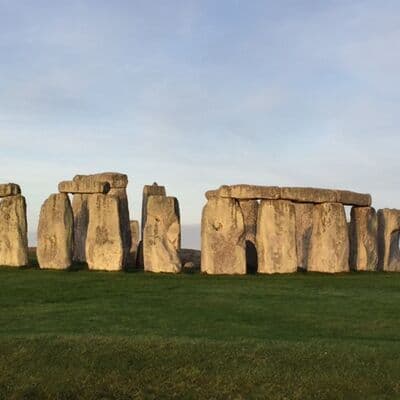
The main circle comprises sarsen stones—local sandstone brought from Marlborough Downs, 30 kilometers away. The largest weigh up to 25 tons. Vertical stones with horizontal lintels—trilithons—once formed a continuous ring. About half the original structure stands today.
The inner circle consists of bluestones, named for their color when wet. They're smaller—up to 4 tons—but their origin is more remarkable: the Preseli Mountains in Wales, 240 kilometers as the crow flies. How Stone Age people moved them—on foot, by boat, on rollers—remains debated.
The Heel Stone stands outside the circle, on the axis of the summer solstice sunrise. When the sun rises directly above it—that's the moment for which, perhaps, everything was built.
The Altar Stone lies at the center, half-buried. Its function is unclear—Victorian romantics gave it the name, not archaeologists.
Construction History
Stonehenge was built in three main phases over 1,500 years.
Phase 1 (circa 3000 BC)
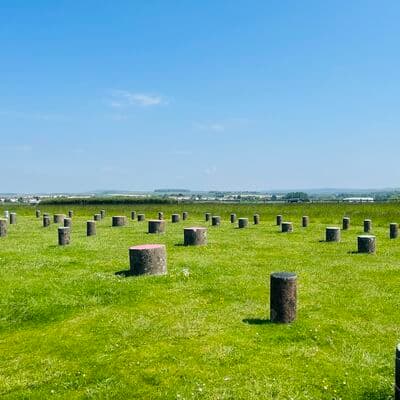
The original monument—a circular ditch and bank (henge) about 100 meters in diameter. Inside—a ring of 56 pits (Aubrey Holes), named after a 17th-century antiquarian. Cremated remains were found in the pits—this was a burial site even before the stones appeared.
Phase 2 (circa 2600 BC)
Bluestones arrived from Wales and the first stone structure was erected—possibly a double semicircle. Later they were rearranged several times.
Phase 3 (circa 2500-1600 BC)
The sarsen stones appeared—the main circle and five trilithons inside. This is what defines Stonehenge's silhouette today. Stones were shaped with remarkable precision: mortise-and-tenon joints on the lintels—woodworking technology transferred to stone.
Bluestones were rearranged into their final configuration—an inner oval and outer circle. Work continued for another 500 years, with final changes around 1600 BC.
Why Was It Built
Short answer: we don't know. Long answer: many hypotheses, none definitively proven.
Astronomical Observatory
Orientation to solstices is obvious and intentional. On summer solstice, the sun rises directly over the Heel Stone, the beam passing through the main axis. At winter solstice, sunset is visible through the central trilithon. But an observatory for what? Agricultural calendar? Religious rituals?
Place of Healing
Welsh bluestones were associated with healing power—sacred springs exist there. Many remains around Stonehenge belong to people with injuries and illnesses. Perhaps this was a Neolithic Lourdes—a pilgrimage site for the sick?
Unifying Monument
Construction required coordinating thousands of people across generations. Perhaps the process itself was the goal—uniting scattered tribes through a common project. Stones from different regions—a symbol of territorial union?
Place of Ancestors
Cremated remains of more than 60 people were found in the Aubrey Holes and surroundings. Was this an elite cemetery? Temple of the dead? Connection with ancestors was central to Neolithic religions.
Stonehenge Landscape
The circle itself is just the center of a vast ritual landscape. Within several kilometers—hundreds of barrows, avenues, henges.
The Avenue
A ceremonial road from Stonehenge to the River Avon—3 kilometers. Perhaps bluestones were carried along it after river travel. Or processions walked to the circle during rituals.
The Cursus
A long ditch 3 kilometers north—500 years older than Stonehenge itself. Purpose unknown, but clearly connected to the complex.
Durrington Walls
A huge settlement 3 kilometers away—where Stonehenge's builders lived. Remains of feasts were found: pig bones slaughtered at specific times of year. Construction was accompanied by mass celebrations.
Barrows
Hundreds of Bronze Age burial mounds surround Stonehenge. People continued burying their dead near the ancient monument for a thousand years after construction ended.
Visiting Stonehenge
Regular Visit
Most visitors come during daytime with tickets including the visitor center and shuttle to the stones. A circular path runs 10-15 meters from the stones. You can't get closer—monument protection. This disappoints many: you see the stones but can't touch them.
The visitor center is an excellent museum: replicas of Neolithic houses, discovered artifacts, interactive exhibits about construction. Worth spending an hour before or after the stones.
Inner Circle Access
Special tours (Stone Circle Access) allow entry inside the circle—before public opening or after closing. Groups up to 30 people, one hour inside the enclosure. Book months ahead—huge demand, few spots.
This is a completely different experience: standing between stones, seeing their texture up close, understanding the scale. Especially at sunrise or sunset, when light is soft and crowds absent.
Solstices
On summer and winter solstice, access to the stones is free and open—thousands gather to greet sunrise (summer) or sunset (winter). Druids, neo-pagans, curious tourists, photographers—a diverse and noisy crowd. Not for quiet contemplation, but a unique atmosphere.
Practical Information
Getting There
From London: 2 hours by car, or train to Salisbury (1.5 hours) plus Stonehenge Tour bus (30 minutes). The bus runs a circular route via Old Sarum—can be included in your visit.
From Bath: 1 hour by car. Many combine Stonehenge with Roman baths.
Organized tours from London—convenient if carless, but less flexibility.
Tickets
About £22 for adults, book ahead with a time slot. On peak days, no entry without booking. English Heritage or National Trust membership—free entry (Stonehenge is managed by English Heritage).
Stone Circle Access—about £50, book 2-3 months ahead on the English Heritage website.
When to Go
Early morning or evening—fewer people, better light. Shoulder season (March-April, October-November)—fewer crowds than summer. Winter—short days, but special atmosphere, especially if you're lucky with fog or frost.
Time Needed
Minimum 2 hours: visitor center plus stones. To walk the landscape, see barrows, reach the Cursus—half a day. Combined with Salisbury and its cathedral—a full day.
What Else to See Nearby
Salisbury Cathedral
English Gothic masterpiece 15 kilometers away. Britain's tallest spire (123 m), one of four surviving copies of Magna Carta. Combine with Stonehenge—contrast Neolithic and Medieval.
Avebury
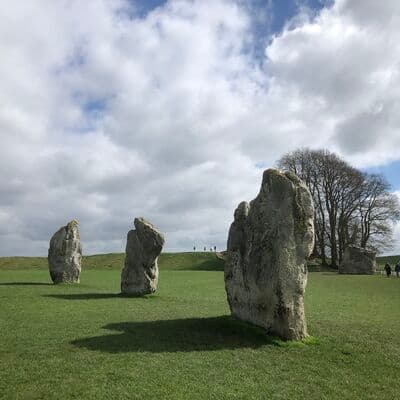
Another megalithic complex 40 kilometers away—less famous but in some ways more impressive. The stone circle is much larger than Stonehenge, with a village literally inside it. You can touch the stones and walk among them without barriers.
Old Sarum
Ruins of an Iron Age hillfort, Roman fort, and Norman castle on a hill between Salisbury and Stonehenge. History in layers: 5,000 years of human presence in one place.
Myths and Misconceptions
Druids didn't build Stonehenge—it's 2,000 years older than Celtic culture. Modern druids perform rituals here, but this is a 19th-century reconstruction, not ancient tradition.
Merlin didn't transport the stones by magic—that's legend from Geoffrey of Monmouth (12th century).
Atmosphere
Stonehenge is a place where time loses meaning. Five thousand years ago, people stood here looking at the same stones, watching the same sun rise. We don't know their names, their language, their beliefs—but we share this view with them.
The mystery is part of the experience. If we knew exactly why Stonehenge was built, it would become just another archaeological site. The unknowing keeps it alive—a question mark on the English plain, reminding us that the past holds secrets we may never solve.