Sagrada Familia
Sagrada Familia is a building that has been under construction for 140 years and still isn't finished. When you walk inside and see columns branching like trees toward the ceiling, light playing through stained glass in every color, you understand—Antoni Gaudí wasn't creating a temple, but a stone forest reaching toward the sky.
Gaudí's Vision
Gaudí took over the project in 1883 from another architect and completely reimagined it. He devoted the next 43 years of his life to this temple, the final 12 exclusively to it, sleeping in his workshop on the construction site.
His concept: every element of the building must carry symbolic meaning. 18 towers—12 apostles, 4 evangelists, the Virgin Mary, and Jesus Christ (the central, tallest one—172.5 meters). Three façades—Nativity, Passion, and Glory—tell Christ's story from birth to resurrection.
Nature's Architecture
Gaudí studied nature and transferred its laws into stone. The columns inside aren't cylinders but spirals resembling tree trunks. They branch toward the ceiling at angles calculated for optimal weight distribution—like tree branches.
Hyperbolic paraboloids, helicoids, conoids—Gaudí found these mathematical surfaces in nature: in shells, bones, plants. He didn't use traditional buttresses—weight is distributed through inclined columns, as in a forest.
Nativity Façade
The only façade built during Gaudí's lifetime faces east, toward the rising sun. It's covered in sculptures telling the story of Christ's birth: the Annunciation, Adoration of the Magi, Flight into Egypt. Natural forms appear everywhere—turtles at the column bases, birds, plants, snow on the peaks.
Gaudí made plaster casts from living people, animals, even stillborn infants—for maximum realism in the figures. The four towers of this façade are dedicated to the apostles Matthew, Barnabas, Jude, and Simon.
Passion Façade
The western façade, built from 1954 following sculptor Josep Subirachs' design, is the complete opposite. Angular figures, sharp edges, absence of ornamentation. Scenes of Christ's Passion—from the Last Supper to the Burial—read bottom to top, left to right.
The magic square on the façade—numbers from 1 to 16, with each row summing to 33, Christ's age at crucifixion. Subirachs deliberately repeated some numbers and omitted others, creating asymmetry.
Interior
Inside lies the main revelation. 36 columns of different stone types (porphyry, basalt, granite, sandstone) rise up to 70 meters. Light enters through stained glass windows—warm red-orange from the west, cool blue-green from the east. The interior transforms throughout the day.
The ceiling resembles a forest canopy—light passes through the "foliage" of hyperboloids, creating shadow play. Gaudí said that inside his temple, even an atheist would feel God's presence.
The Towers
Ascend one of the towers (elevator up, walking down—400 steps of spiral staircase). From here you'll see details invisible from below: ceramic mosaic, Venetian glass, inscriptions reading "Sanctus" and "Hosanna." And all of Barcelona—from mountains to sea.
By 2026, the centenary of Gaudí's death, they plan to complete the main Tower of Jesus Christ. It will become the tallest church tower in the world—172.5 meters. Remaining work will continue for several more years.
Construction History
When Gaudí was killed by a tram in 1926, only a quarter of the building was complete. The 1936 Civil War destroyed his workshop with drawings and models. Construction resumed in the 1950s using surviving fragments and photographs.
Modern technology—3D modeling, CNC stone-cutting machines—has accelerated the work. What Gaudí planned for 300 years might be completed in 150. Funding comes exclusively from donations and ticket sales—about 4.5 million visitors annually.
Practical Information
Tickets are online only—book 2-3 weeks ahead, especially for weekends and summer months. Basic admission is €26, tower access €36, audio guide an additional €8. Hours: 9:00 AM-8:00 PM (summer), 9:00 AM-6:00 PM (winter).
The best time inside is morning (light through eastern windows) or evening (sunset light through western ones). Dress code: covered shoulders and knees. The audio guide is worth getting—without context, much will remain unclear.
Around the Temple
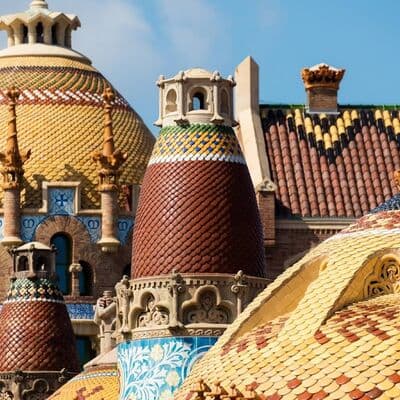
From the square in front of the Nativity façade, you'll get the best photo angle—the reflection in the pond. The park across the street (Plaça de Gaudí) is perfect for a picnic with a temple view. Hospital de Sant Pau, 10 minutes' walk away, is another Catalan modernism masterpiece.
Come twice: daytime for inside, nighttime to see the illuminated façades. Sagrada Familia lit up is one of Barcelona's most iconic images.
Legacy
UNESCO included the Nativity façade and crypt in its World Heritage list. But Gaudí's main legacy is proof that architecture can be organic, that a building can grow like a living organism, that beauty and function are inseparable. Sagrada Familia isn't a frozen monument—it's an ongoing creation, a temple that builds itself.