Petra
When you first see Petra, you realize no photographs can convey the scale of this wonder. The Rose City, carved directly into cliffs over two thousand years ago, seems an impossible creation of human hands. Here, in the heart of the Jordanian desert, the ancient Nabataeans created a capital that controlled trade routes between Arabia, Egypt, and the Mediterranean.
Path Through the Siq
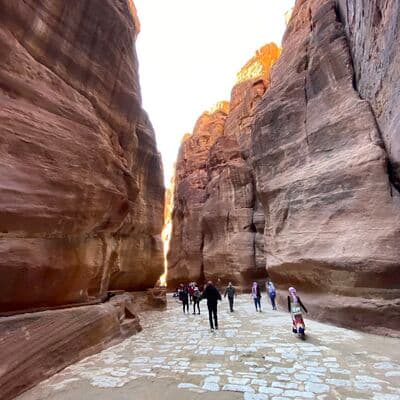
Your journey into Petra begins with passage through the Siq—a narrow gorge over a kilometer long, where cliffs rise 80 meters on either side. You walk along an ancient paved road, see remnants of water channels carved into stone, and understand the Nabataeans' engineering genius. They knew how to collect every drop of water in this waterless land.
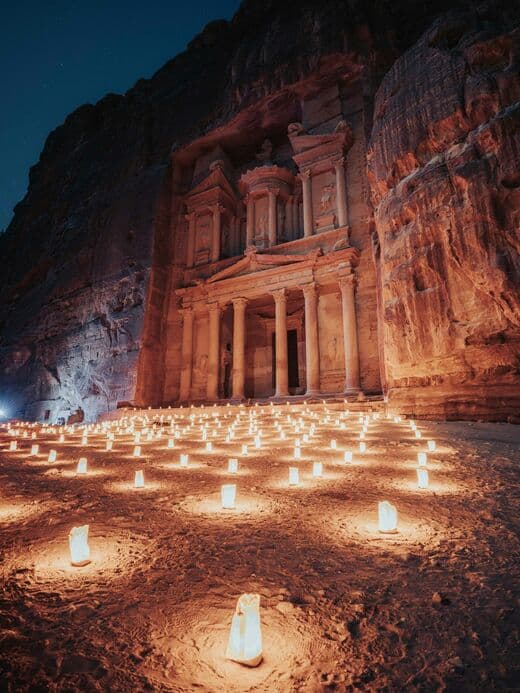
With each step the walls narrow, light grows dim, and suddenly—through the gap between cliffs—the façade of Al-Khazneh appears. This moment is unforgettable. Pink stone, lit by sun, literally glows in the gorge's darkness.
The Treasury — Al-Khazneh
The Treasury's façade, 40 meters high, is Petra's most photographed monument. Built in the 1st century BCE for Nabataean King Aretas IV, it combines Greek, Egyptian, and Mesopotamian architectural elements. The name "Treasury" came later—Bedouins believed the urn at the top held pharaoh's gold.
Standing at its base, you examine every detail: Corinthian columns, figures of Amazons and discophori, reliefs of eagles and lions. Inside—a simple square room, but the Nabataeans created beauty on façades facing sun and visitors.
Street of Façades and Theater
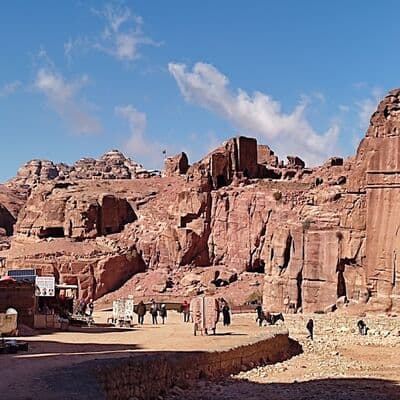
After Al-Khazneh, a wide valley opens with dozens of tombs carved into cliffs on both sides. This is the Street of Façades—necropolis of Nabataean nobility. Each tomb is unique: stepped portals, columns of different orders, mysterious symbols.
The Roman theater seating 3,000 is carved directly into the hillside. Imagine: spectators sat in stone seats while ancient tomb façades rose behind the stage. Even for Romans, who knew their theaters, this place was special.
City Center
The Colonnaded Street—ancient Petra's main artery—stretches through the valley center. Here stood markets, temples, public buildings. The Great Temple with its massive columns, Temple of the Winged Lions, Byzantine Church with stunning mosaics—all traces of different prosperity eras.
On Al-Khubtha hill rises Qasr al-Bint—Petra's only freestanding building. This 1st-century BCE temple was dedicated to the chief Nabataean deity Dushara. Massive sandstone walls have withstood two millennia and earthquakes.
The Monastery — Ad-Deir
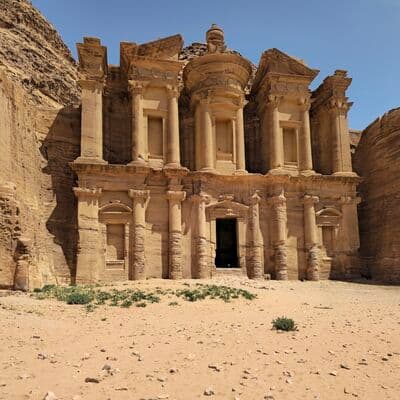
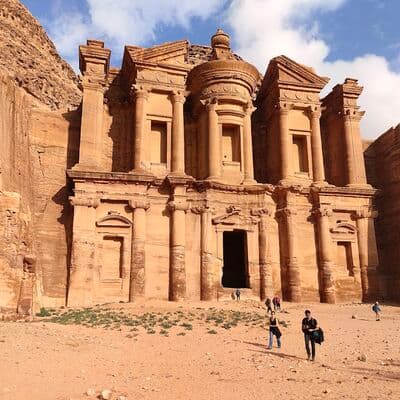
850 steps lead to Petra's most grandiose monument. The climb takes about an hour, but every step is worth the effort. The Monastery is even larger than the Treasury—a façade 47 meters wide and 48 meters tall carved into sheer cliff at the mountain's summit.
Built in the 1st century CE, it served as a Nabataean temple, then a Christian monastery in Byzantine times. From here, a panorama opens across Wadi Araba valley and Negev mountains. Sit in the shade, drink tea at the Bedouin café opposite—this is a place for contemplation.
High Place of Sacrifice
Another climb—up Jabal al-Madhbah—leads to the altar where Nabataeans sacrificed to their gods. Along the way: Lion Fountain, Garden Tomb, obelisks. At the summit—a flat platform with carved altar and channels for blood drainage.
Descent through Wadi Farasa reveals completely different Petra: vividly colored rock, Lion Triclinium with unique frescoes, Soldier's Tomb. This route is less known to tourists but incredibly beautiful.
Practical Information
Petra is open daily 6:00 AM to 6:00 PM summer, until 4:00 PM winter. One-day entry costs about 50 Jordanian dinars (roughly $70), two days—55, three—60. Jordan Pass includes visa and entry to all country attractions.
Arrive at opening—in the first hours the Treasury is sunlit and tourists are few. Three days let you see everything unhurried: main route, Monastery, minor trails. Bring comfortable shoes, hat, water, and sunscreen.
Petra by Night
Three times weekly (Monday, Wednesday, Thursday), Petra by Night runs. The path through the Siq is lit by thousands of candles, Bedouin music plays at the Treasury, stories of the ancient city are told. A completely different, mystical and unforgettable experience.
Where to Stay
Wadi Musa—the town at Petra's entrance—offers hotels for any budget. Best mountain views at Mövenpick and Petra Guest House, located right at the entrance. Budget hostels cluster in town center, 10-15 minutes walk or free shuttle to the entrance.
History and Significance
The Nabataeans—a nomadic Arab people—settled in these mountains by the 4th century BCE. Controlling caravan routes, they grew rich trading incense and spices. Petra became their capital—a city of 30,000 with water systems, gardens, and temples.
After Roman conquest in 106 CE, the city prospered for several more centuries, but shifting trade routes led to decline. The 363 earthquake destroyed many buildings. By the 7th century, Petra was abandoned, known only to local Bedouins.
Swiss traveler Johann Burckhardt "discovered" Petra for Europe in 1812. Since then, it remains one of the world's most desired destinations—and in 2007 was named one of the New Seven Wonders of the World.