Pavlovsk Palace
If Peterhof represents the empire's ceremonial might, Pavlovsk is its intimate side. The palace and park created for Paul I and Maria Feodorovna became an embodiment of taste and harmony. No giant fountains or gilded baroque here—just classicism, an English landscape park, and the atmosphere of a country residence where you want to stay.
History
Catherine II gave the Pavlovsk lands to her son Paul and his wife Maria Feodorovna in 1777. Charles Cameron began palace construction, Vincenzo Brenna continued. Maria Feodorovna, a woman of refined taste, personally supervised the decor—hence the exquisite interiors.
After Paul I's assassination in 1801, the widow continued living at Pavlovsk, making it a center of art and charity. In the 19th century, the residence passed through inheritance, remaining a Romanov favorite.
During the war, the palace was occupied and destroyed during the German retreat. Restoration was a triumph of Soviet specialists: interiors were recreated from prewar photographs and inventories.
The Palace
Architecture
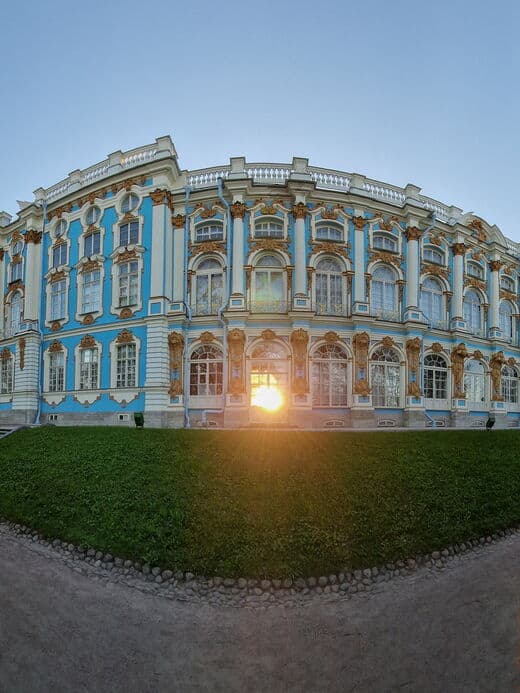
Central building with dome, semicircular galleries, side wings—strict late 18th-century classicism. Yellow facade, white columns, no baroque excess. The palace doesn't overwhelm—it invites.
Interiors
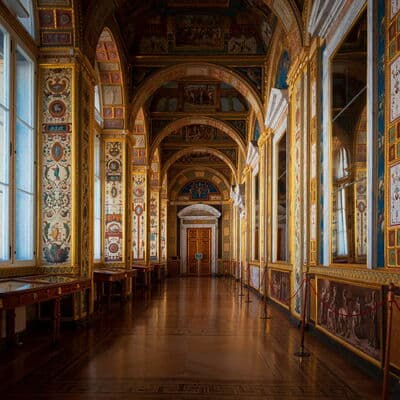
Pavlovsk's main treasure is interiors preserving the era's spirit. Italian Hall with antique sculptures. Greek Hall with artificial marble columns. Paul I's Formal Library. Maria Feodorovna's chambers with porcelain collection. Every room is a considered ensemble: furniture, fabrics, paintings, sculpture.
The decorative arts collection is among Russia's finest: French bronze, Russian porcelain, antique casts, clocks, vases.
The Park
Landscape Style
Pavlovsk Park is Europe's largest landscape park (600 hectares). No formal alleys—hills, valleys, groves, the Slavyanka River. The layout imitates natural terrain, though every tree was planted according to plan.
Park Districts
The park divides into areas with different moods. Palace grounds—formal, with flower beds. Slavyanka River valley—pastoral views, bridges, pavilions. White Birch—birch grove, romance. New Sylvia and Old Sylvia—forest masses with radiating alleys.
Pavilions
Temple of Friendship—a rotunda on Slavyanka's bank, dedicated to Catherine II. Apollo Colonnade—a romantic faux ruin. Pil Tower—tower by the dam. Rose Pavilion—summer cottage in the park. Each pavilion is a waypoint on the walking route.
Practical Information
Getting There
Train from Vitebsky Station to Pavlovsk station—30 minutes. Park entrance is from the station. Also buses from Moskovskaya and Kupchino metro.
Tickets
Park entry—about 150 rubles (free in winter). Palace—separate ticket (from 600 rubles). Buy online in season.
Hours
Park open 6:00 AM to 9:00 PM (longer in summer). Palace—10:00 AM to 6:00 PM, closed Fridays and first Monday of month.
Time Needed
For the palace—2 hours. For the park—2 hours to a full day (600 hectares!). Ideally—arrive in the morning and spend the whole day.
Pavlovsk vs Peterhof
Common question: which to visit? Peterhof—fountains, baroque, crowds. Pavlovsk—classicism, nature, tranquility. Peterhof is about imperial power, Pavlovsk about taste and harmony. If time allows—both. If not—depends on your mood.
Atmosphere
Pavlovsk is a place where breathing comes easy. The palace doesn't overwhelm with luxury, the park doesn't tire with formality. You can walk for hours, getting lost in alleys, emerging at pavilions and bridges, listening to silence. This isn't a fortress-museum—it's a country house where people of good taste once lived. And that taste is still felt.