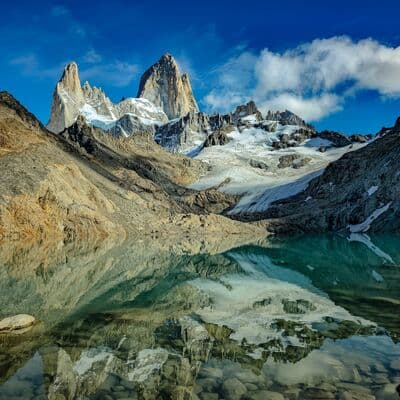
Mount Fitz Roy
Some mountains inspire awe. Others instill fear. And then there's Fitz Roy — a mountain that seems impossible. Its silhouette of sharp granite spires rises above the Patagonian steppe like a vision from another world. The local Tehuelche people called it Chaltén — "smoking mountain" — because of the clouds that almost always shroud its summit. And when those clouds part, you're treated to a sight that stays with you forever.
A Mountain That Hides
Fitz Roy is one of the most technically challenging mountains for climbing in the world. Its height — 3,405 meters — isn't impressive compared to the Himalayas, but the vertical granite walls and unpredictable weather make ascent extremely dangerous. Only a handful climb Fitz Roy each year — this isn't Everest with its queues.
But for ordinary trekkers, the mountain is accessible for contemplation. A series of day hikes from the village of El Chaltén lead to viewpoints overlooking Fitz Roy and surrounding peaks. These are among the best day hikes in the world.
Treks to Fitz Roy
Laguna de los Tres
The main route is 25 km round trip, taking 8-10 hours. The trail starts right from the village and leads through forest, along rivers of turquoise water, past Laguna Capri. The final ascent — a steep hour up moraine — and you emerge at the lake at Fitz Roy's base. If weather cooperates, the view is incredible: granite needles reflected in glacial water.
Sunrise at Laguna de los Tres is a cult experience. The first rays paint the peaks red and orange (alpenglow) as shadows slowly retreat across the rocks. For this, you'll need to set out at 3-4 AM with a headlamp or camp overnight at Poincenot campground.
Laguna Torre
An alternative route — 18 km, 6-8 hours. It leads to the other side of the massif with views of Cerro Torre — even sharper and more technically challenging than Fitz Roy. The trail follows the river through lenga (southern beech) forest. The lake at Cerro Torre's base is often covered with floating icebergs.
Combined Route
Both treks can be joined into a two-day hike with a campground overnight. This allows you to see both sides of the massif without rushing.
El Chaltén: Trekking Capital
The village of El Chaltén is Argentina's youngest town (founded 1985) and self-proclaimed "national trekking capital." A few streets with hostels, restaurants, and gear shops. The vibe is like base camp: everyone here is for the mountains.
The treks are free — there's no entrance fee to the national park. Campgrounds along the trails are also free (except private ones). It's surprisingly accessible for such beauty.
Practical Tips
When to Go
Season runs November through March. December-February has the best weather and longest days, but also more people. Patagonian weather is unpredictable: sun can give way to storm within an hour. Plan several days — if the first is cloudy, you'll have another chance.
Getting There
Bus from El Calafate (3 hours), which has flights from Buenos Aires. Many combine this with Perito Moreno Glacier and Torres del Paine in Chile.
What to Bring
Patagonian wind is serious force. A windproof jacket is essential. Layers for any weather. Trekking boots — trails are rocky. Food and water — there are no shops on the trails. And a camera with a charged battery — the views are worth it.
Atmosphere and Character
Fitz Roy is a diva mountain. It hides behind clouds most of the time. Locals joke: "If you can't see Fitz Roy — it will rain. If you can see it — it's already raining." But when it reveals itself, you understand why people return here again and again.
The silhouette of Fitz Roy is the Patagonia brand logo. Company founder Yvon Chouinard saw this mountain in 1968 and was so impressed he made it the symbol of his outdoor clothing empire. Seeing the mountain in person, you understand: there's no better symbol of wild nature.
This is a place where you feel small — and that's a good thing. The granite spires against the endless sky remind you that nature has created things humanity can never replicate.