Cruiser Aurora
At permanent berth on the Petrogradskaya embankment stands a cruiser from which—according to official history—a new world began. The Aurora is a ship of legend, a ship of symbol, a ship whose blank shot in October 1917 signaled the storming of the Winter Palace. Today it's a museum, but the aura of history hasn't faded.
Ship History
Birth
The Aurora was built in 1900 at the New Admiralty shipyard in St. Petersburg. A protected cruiser of the first rank—medium class by the era's standards. Named after a frigate that defended Petropavlovsk-Kamchatsky in 1854.
Combat History
The cruiser served in the Russo-Japanese War. At the Battle of Tsushima in 1905—the catastrophic defeat of the Russian fleet—the Aurora was damaged but reached Manila (where it was interned). Returned to Russia in 1906.
October 1917
On October 25 (November 7 new style), 1917, the Aurora was moored on the Neva near Nikolaevsky Bridge. At 9:45 PM, the ship fired a blank shot—signaling the storming of the Winter Palace. Thus began the revolution that changed the world. The shot was blank, but its symbolic charge was immense.
After the Revolution
In the 1920s-30s, the cruiser served as a training ship. During World War II, Aurora's guns were removed for Leningrad's defense; the ship sank from bombing, later raised. Since 1948—permanent berth as a monument-museum.
Museum
Exhibition
Inside the cruiser is a museum of ship and naval history. Six halls: from construction to present day. Shipboard life of the early 20th century, Tsushima, revolution, World War II. Original artifacts, documents, models, reconstructions.
Deck and Guns
The upper deck is open for viewing. Guns, masts, bridge, anchors—you can touch them and take photos. View of the Neva and Winter Palace—the very one they fired at in 1917.
Engine Room
After the 2014-2016 restoration, the engine room is open—steam boilers, mechanisms that powered the ship. Impressive century-old engineering.
Practical Information
Tickets
Adult—about 400 rubles. Children, students—discounts. Purchase at the ticket office or online. Queues occur in season.
Hours
Wednesday-Sunday 11:00 AM to 6:00 PM. Monday, Tuesday—closed. Last Wednesday of the month—maintenance day.
Getting There
Gorkovskaya metro—10 minutes walking through Alexander Park. Reachable from the Peter and Paul Fortress or Troitsky Bridge. Address: Petrogradskaya Embankment, 2.
Time Needed
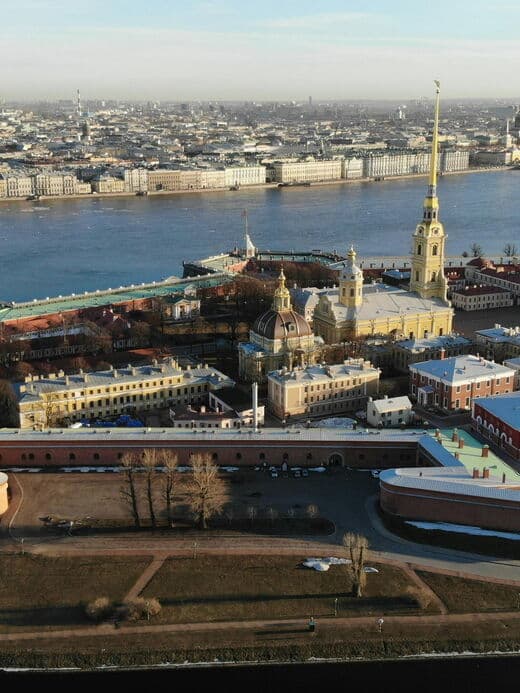
For the museum—1-1.5 hours. Can combine with the Peter and Paul Fortress—nearby.
Context
The Aurora is the main monument to the October Revolution. Attitudes toward this event have changed: from sacred symbol of the Soviet era to "coup" in post-Soviet years. But the cruiser remains—as a historical artifact, as a monument to an era, as simply a beautiful old ship.
Atmosphere
Standing on the Aurora's deck looking at the Neva is a strange feeling. From here they fired at the Winter Palace. From here began what defined the 20th century. Whether you like it or not—history happened here. The ship is its witness and participant. And it's simply a beautiful silhouette visible from the embankments: three funnels, masts, flag. St. Petersburg classic.