Bronze Horseman
"On the shore of desolate waves he stood, full of great thoughts"—every Russian knows these lines from Pushkin. The Bronze Horseman—a monument to Peter I—has become a symbol of St. Petersburg and Russia itself. A granite rock, a rearing horse, the tsar's outstretched hand—an image that has defined the city's visual identity for three centuries.
Creation History
Catherine's Commission
Catherine II commissioned the monument in 1766. The pedestal inscription—"To Peter the First from Catherine the Second"—was a political gesture: the empress positioned herself as a continuer of Peter's reforms. The unveiling took place in 1782, marking the centennial of Peter's reign.
Falconet
The creator was French sculptor Étienne Maurice Falconet. He worked on the monument for 12 years, rejecting his patrons' advice. Instead of a traditional triumphant figure, he created an image of a transformer: Peter wears simple clothing, not armor; the horse is wild, not ceremonial, trampling a serpent (symbol of obstacles).
Thunder Stone
The pedestal is a granite boulder weighing about 1,500 tons. It was found in a forest near St. Petersburg, called the Thunder Stone (legend says lightning struck it). Transportation took two years: in winter, across ice on special platforms. The operation was considered an engineering marvel of its age.
The Head
Peter's head was sculpted by Falconet's student—Marie-Anne Collot. Falconet couldn't achieve the right expression, but the young sculptress created a masterpiece on her first attempt. The resolute face, the gaze fixed on the distance—that's her work.
Pushkin's Poem
The monument became "The Bronze Horseman" thanks to Pushkin's 1833 poem. The story of mad Yevgeny, pursued by the animated statue during a flood, transformed the monument into a literary symbol. "Bronze" is poetic license—the statue is cast in bronze, not copper ("medny" in Russian means copper).
The poem added a metaphysical dimension: Peter is not merely a tsar but a force of nature—transforming and destroying. This duality remains in how the city perceives itself.
Visiting
The Square
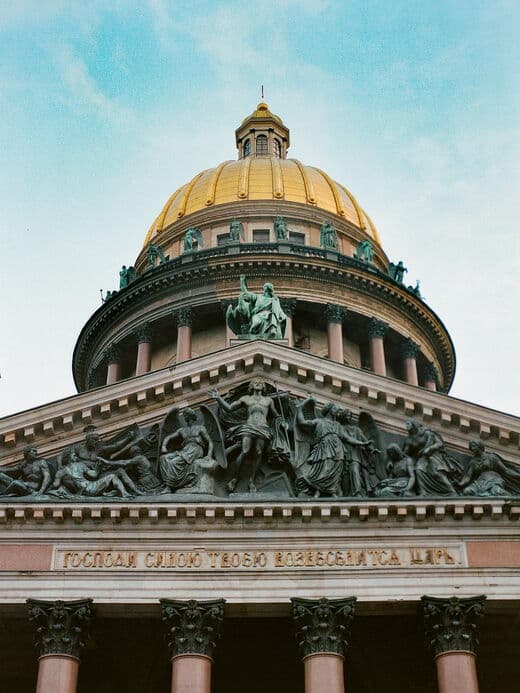
The monument stands on Senate Square (formerly Decembrists' Square—site of the 1825 uprising). The spacious square allows you to view the monument from all sides. Behind it—the Senate and Synod buildings (now the Constitutional Court); to the left—St. Isaac's Cathedral.
Angles
The classic view is head-on, with the Neva behind. But walk around: from the side, the composition's dynamism reveals itself; from behind, the rock's power. Evening brings illumination.
Details
The serpent under the hooves is both symbol and structural element: a third support point (the horse stands on its hind legs). A laurel wreath on Peter's head is the only decoration. The cape billows in the wind—creating an illusion of movement.
Practical Information
Access
Free, open 24 hours. The monument stands in an open square.
Getting There
Admiralteyskaya metro—5 minutes through Alexander Garden. Nevsky Prospekt metro—15 minutes.
Nearby
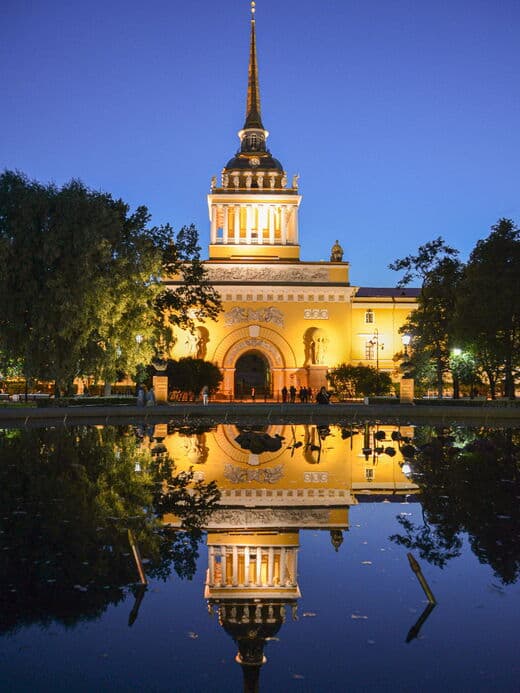
St. Isaac's Cathedral—100 meters away. The Admiralty—across the garden. Palace Square—10 minutes.
Atmosphere
The Bronze Horseman is more than a monument. It's the starting point of St. Petersburg's mythology: Peter, frozen on the edge of the abyss, having reared Russia onto its hind legs. Pushkin heard tragedy in this image; tourists see grandeur; locals see everyday scenery. But standing at the rock's base, gazing at the hand outstretched over the Neva, you feel the scale of the vision—the tsar's, the sculptor's, and the poet's.