Acropolis
The Acropolis rises above Athens as a reminder of a time when this city was the center of civilization. Climbing the ancient steps, you walk the same path that Socrates, Pericles, and Sophocles walked. Here, on this sacred rock 156 meters high, ancient Greeks created temples that defined the concept of beauty for millennia to come.
The Parthenon — Perfection in Stone
The Parthenon isn't just a temple—it's a mathematical equation embodied in marble. Built between 447 and 432 BCE under Phidias's direction, it was dedicated to the goddess Athena. The 46 Doric columns appear perfectly straight, but each tilts slightly inward, and the base curves gently upward—these optical corrections create the sensation of absolute harmony.
The entire temple was built without mortar—blocks of Pentelic marble fitted with precision unmatched by many modern construction projects. In antiquity, a 12-meter statue of Athena by Phidias stood inside—a wooden frame covered with ivory and over a ton of gold.
The Parthenon's history is one of metamorphosis: a Christian church in the 6th century, a mosque after Ottoman conquest, a powder magazine exploded by a Venetian cannonball in 1687. Lord Elgin removed half the sculptures to London, where they remain in the British Museum to this day.
The Erechtheion and Caryatids
On the north side of the Acropolis stands the Erechtheion—the most unusual temple in the complex. Built on different levels, it united the cults of Athena, Poseidon, and the legendary King Erechtheus. Here they showed visitors the mark of Poseidon's trident and Athena's sacred olive tree.
Six caryatids—columns shaped like maidens—support the southern portico. Five originals are in the New Acropolis Museum, the sixth in the British Museum. Copies stand on the temple, but even they impress with their elegance: each figure is unique, the folds of their garments concealing their load-bearing function.
The Propylaea and Temple of Nike
The Propylaea—the ceremonial entrance to the Acropolis—was built simultaneously with the Parthenon. Five gates between Doric columns, side wings, a ceiling of marble beams—even the entrance here is a work of art. Architect Mnesicles never finished the project due to the outbreak of the Peloponnesian War.
To the right of the entrance, on a rocky outcrop, stands the miniature Temple of Athena Nike—goddess of victory. From here, legend says, King Aegeus threw himself into the sea upon seeing the black sail of Theseus's ship, believing his son had perished. In fact, Theseus had defeated the Minotaur but forgot to change the sails.
What You See Today
Restoration of the Acropolis has continued since 1975 and will probably never end. Cranes, scaffolding, and numbered marble blocks are everywhere. This is a living archaeological process—scholars literally assembling a puzzle, returning stones to their places.
Beneath your feet—marble polished by millions of footsteps. It's slippery, especially after rain—wear shoes with good grip. Crowds concentrate around the Parthenon, but walk to the eastern edge and you'll find yourself almost alone with a view of the city.
New Acropolis Museum
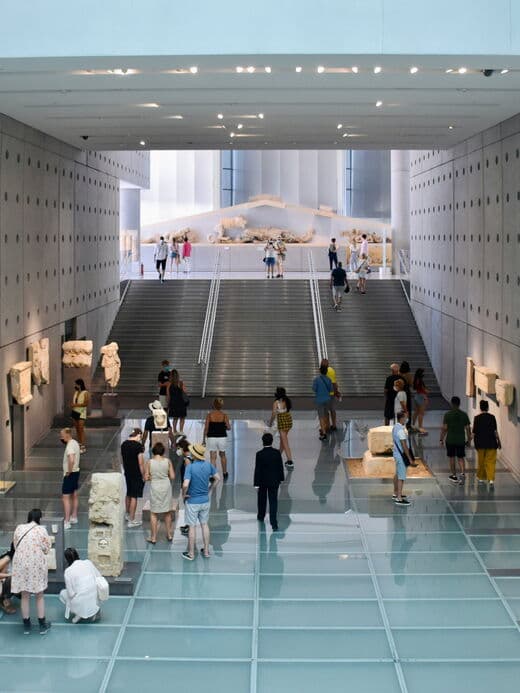
At the foot of the rock, one of the world's finest museums opened in 2009. The glass floor on the first level lets you see excavations beneath the building. Original caryatids, Parthenon frieze fragments, archaic statues with enigmatic smiles—everything presented in light close to natural.
The top floor mirrors the Parthenon's orientation and displays metopes and frieze. Empty spaces between originals are filled with plaster copies of what's in London—a silent reminder of the unresolved dispute over the sculptures' return.
Practical Information
The Acropolis is open daily from 8:00 AM to 8:00 PM in summer (April-October) and 8:00 AM to 5:00 PM in winter. Admission is €20; a combined ticket for all Athens archaeological sites is €30 (valid 5 days). The first Sunday of each month from November to March is free.
Arrive at opening or two hours before closing—midday brings heat and crowds. Spring and autumn are ideal for visiting. Bring water—there's none on the hill. The New Acropolis Museum stays open late on Fridays—combine it with an evening stroll through Plaka.
Surroundings
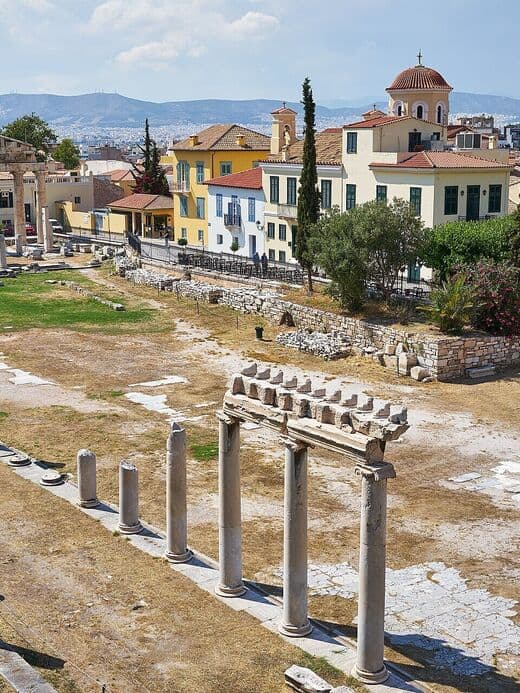
The Acropolis's southern slope features the Theatre of Dionysus, where Aeschylus's tragedies and Aristophanes's comedies premiered. Nearby stands the Odeon of Herodes Atticus, a 2nd-century Roman theater still hosting open-air concerts.
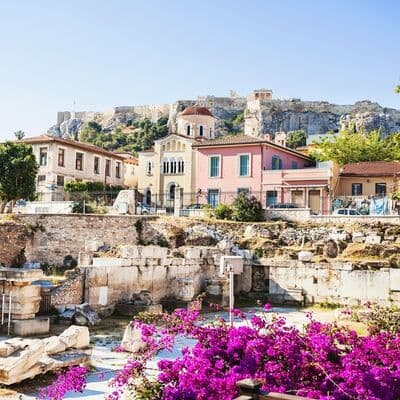
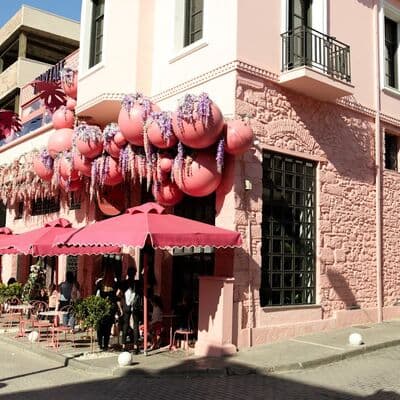
The Plaka district at the foot is a labyrinth of narrow streets with tavernas, souvenirs, and neoclassical houses. Anafiotika is a tiny quarter of whitewashed houses built in the 19th century by settlers from Anafi island. Climb Philopappou Hill at sunset for the best view of the illuminated Acropolis.
Significance
The Acropolis isn't just ruins. It's the starting point of European civilization: democracy, philosophy, theater, architecture. Here, in a small city-state during a few decades of the 5th century BCE, the foundations of what we call Western culture were created. Standing on these stones, you realize—you're part of this tradition.